
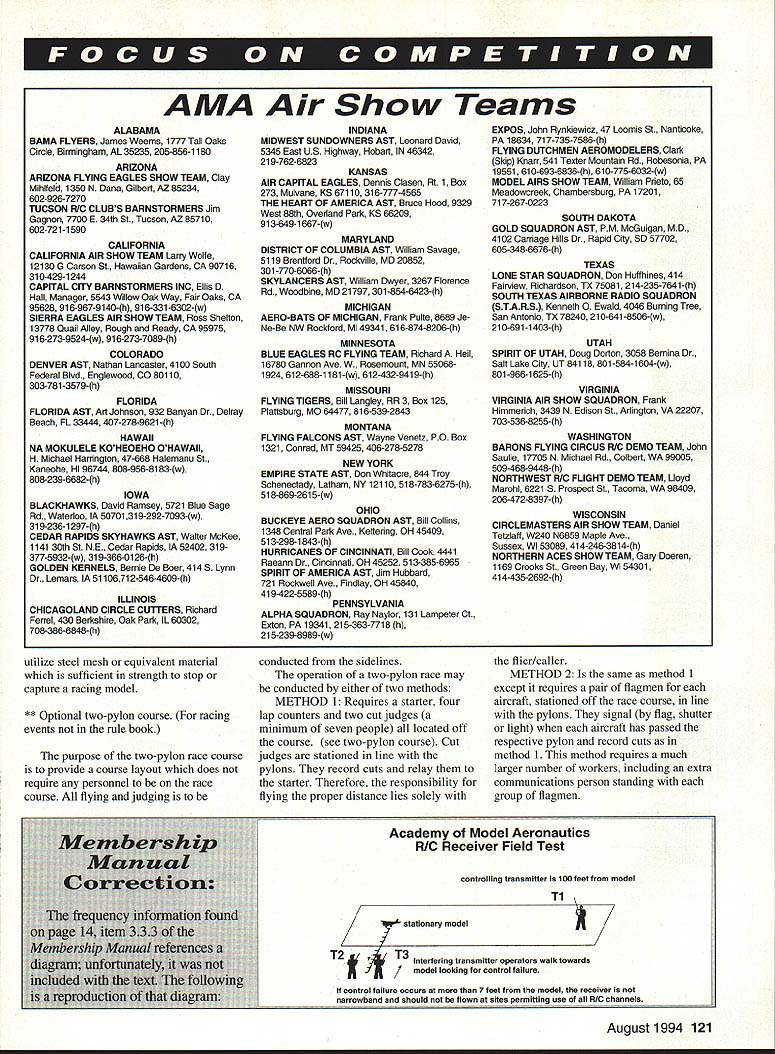
Focus On Competition
Technical Director — Bob Underwood
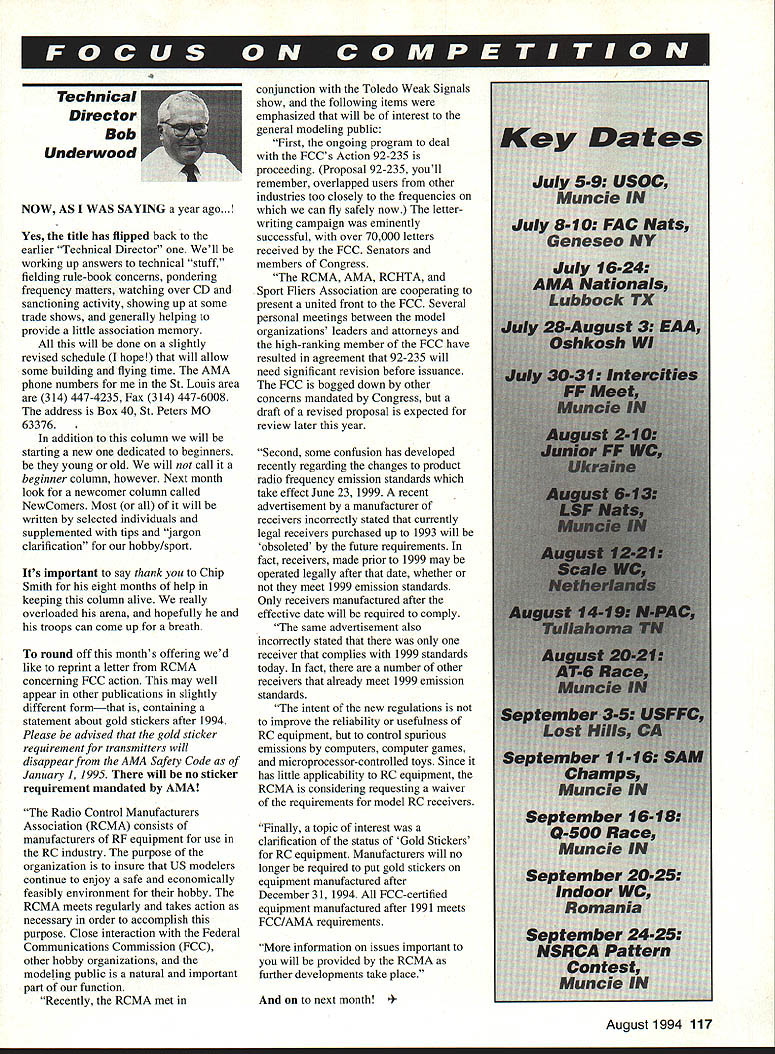
Now, as I was saying a year ago... Yes, the title has reverted to "Technical Director." My responsibilities will include answering technical questions, fielding rule-book concerns, pondering frequency matters, watching over contest director (CD) sanctioning activity, showing up at some trade shows, and generally helping to provide a little association memory. I plan to work on a slightly revised schedule that will allow some building and flying time.
Contact (St. Louis area):
- Phone: (314) 447-4235
- Fax: (314) 447-6008
- Address: P.O. Box 40, St. Peters, MO 63376
We will be starting a new column dedicated to newcomers, young and old. We will call it NewComers. Most of the material will be written by selected individuals and supplemented with tips and jargon clarification for our hobby/sport.
Special thanks to Chip Smith for eight months of help in keeping this column alive. We really overloaded his arena, and hopefully he and his volunteers can come up for a breath.
To round off this month's offering, we reprint a statement from the Radio Control Manufacturers Association (RCMA) concerning FCC action and related issues.
RCMA statement on FCC actions and product standards
The Radio Control Manufacturers Association (RCMA) is composed of manufacturers of RF equipment for the RC industry. The organization's purpose is to ensure that U.S. modelers continue to enjoy a safe and economically feasible environment for their hobby. The RCMA meets regularly and takes actions necessary to accomplish this purpose. Close interaction with the Federal Communications Commission (FCC), other hobby organizations, and the modeling public is an important part of this function.
At the recent RCMA meeting (held in conjunction with the Toledo Weak Signals show) the following items were emphasized:
- FCC Action 92-235 (Proposal 92-235)
- The ongoing program to address Proposal 92-235 is proceeding. That proposal overlapped users from other industries too closely to frequencies used safely by modelers.
- A letter-writing campaign was very successful, with over 70,000 letters received by the FCC, U.S. Senators, and members of Congress.
- The RCMA, AMA, RCHTA, and the Sport Fliers Association are cooperating to present a united front to the FCC. Personal meetings between organization leaders, attorneys, and a high-ranking FCC official resulted in agreement that Proposal 92-235 will need significant revision before issuance. The FCC is currently occupied with other matters, but a draft revised proposal is expected for review later this year.
- Changes to product radio-frequency emission standards (effective June 23, 1999)
- Some confusion has arisen from a manufacturer's advertisement incorrectly stating that currently legal receivers purchased up to 1993 would be rendered obsolete by the future requirements. In fact, receivers manufactured prior to June 23, 1999, may be operated legally after that date whether or not they meet the 1999 emission standards. Only receivers manufactured after the effective date will be required to comply.
- The advertisement also incorrectly stated that only one receiver meets the 1999 standards today. In fact, a number of receivers already meet those standards.
- The intent of the new regulations is to control spurious emissions by computers, computer games, and microprocessor-controlled toys; they are not primarily aimed at improving RC equipment. Because the regulations have little applicability to RC equipment, the RCMA is considering requesting a waiver of the requirements for model RC receivers.
- Status of "gold stickers"
- Manufacturers will no longer be required to apply gold stickers to equipment manufactured after December 31, 1994.
- All FCC-certified equipment manufactured after 1991 meets FCC/AMA requirements.
- Please note: the gold-sticker requirement for transmitters will disappear from the AMA Safety Code as of January 1, 1995. There will be no sticker requirement mandated by the AMA after that date.
More information on issues important to modelers will be provided by the RCMA as developments occur.
And on to next month! — Bob Underwood, Technical Director
---
Servos and Safety Requirements
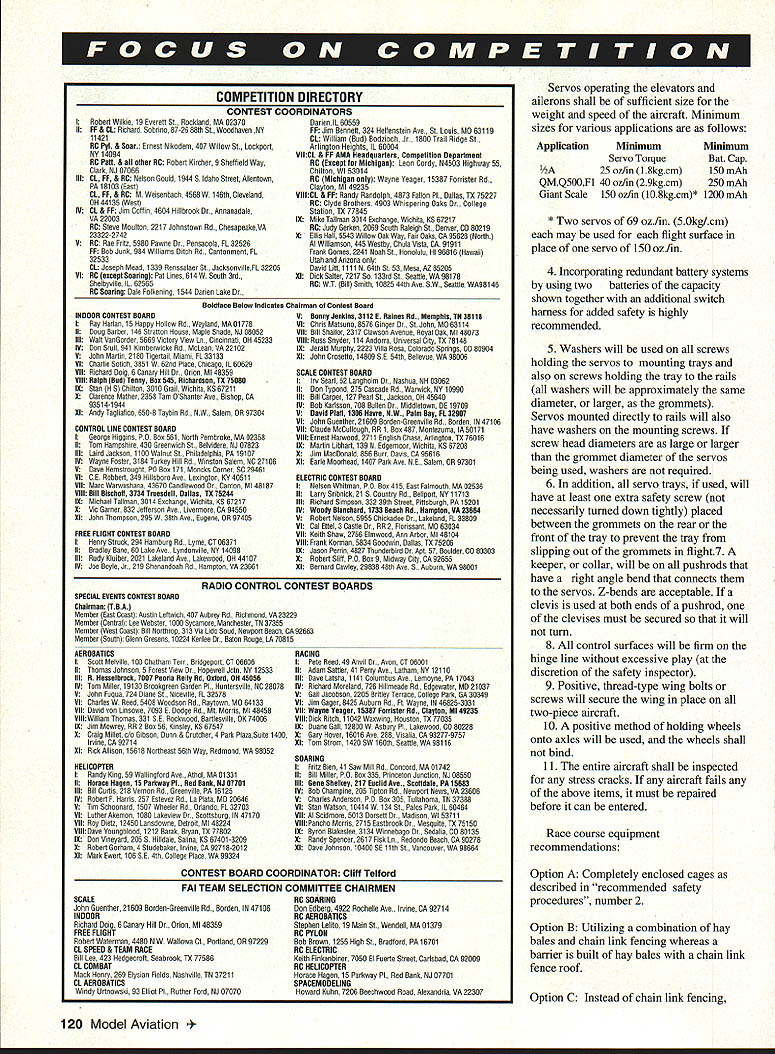
- Servos operating the elevators and ailerons shall be of sufficient size for the weight and speed of the aircraft. Minimum sizes for various applications are as follows:
- 1/2 A: 25 oz./in. (1.8 kg·cm) torque; Battery capacity 150 mAh
- .40 size: 40 oz./in. (2.9 kg·cm) torque; Battery capacity 250 mAh
- Giant scale: 150 oz./in. (10.8 kg·cm) torque; Battery capacity 1200 mAh
- Two servos of 69 oz./in. (5.0 kg·cm) each may be used for each flight surface in place of one servo of 150 oz./in.
- Incorporating redundant battery systems by using two batteries of the indicated capacities together with an additional switch harness for added safety is highly recommended.
- Washers will be used on all screws holding the servos to mounting trays and on screws holding the tray to the rails (washers should be approximately the same diameter, or larger, than the grommets). Servos mounted directly to rails will also have washers on the mounting screws. If screw head diameters are as large or larger than the grommet diameter of the servos being used, washers are not required.
- All servo trays, if used, will have at least one extra safety screw (not necessarily tightened fully) placed between the grommets on the rear or front of the tray to prevent the tray from slipping out of the grommets in flight.
- A keeper, or collar, shall be on all pushrods that have a right-angle bend that connects them to the servos. Z-bends are acceptable. If a clevis is used at both ends of a pushrod, one clevis must be secured so that it will not turn.
- All control surfaces shall be firm on the hinge line without excessive play (at the discretion of the safety inspector).
- Positive, thread-type wing bolts or screws shall secure the wing in place on all two-piece aircraft.
- A positive method of holding wheels onto axles shall be used, and the wheels shall not bind.
- The entire aircraft shall be inspected for stress cracks. Any aircraft failing the above items must be repaired before it can be entered.
Race Course Equipment Recommendations
- Option A: Completely enclosed cages as described in "recommended safety procedures".
- Option B: A barrier built of hay bales with a chain link fence roof.
- Option C: Use steel mesh or equivalent material sufficient in strength to stop or capture a racing model (in place of chain link fencing).
Optional two-pylon course (for racing events not in the rule book)
- Purpose: Provide a course layout that does not require personnel on the race course. All flying and judging is conducted from the sidelines.
- Method 1:
- Requires a starter or lap counters and two cut judges (minimum of seven people), all located off the course.
- Cut judges are stationed in line with the pylons. They record cuts and relay them to the starter. The flier/caller is responsible for flying the proper distance.
- Method 2:
- Same as Method 1, but requires a pair of flagmen for each aircraft (stationed off the race course, in line with the pylons). They signal (by flag, shutter, or light) when each aircraft has passed the respective pylon and record cuts as in Method 1.
- This method requires a larger number of workers, including an extra communications person standing with each group of flagmen.
---
Lost Hills FFMAA Address Change
The Lost Hills Free Flight Model Airfield Association has changed its address. Use of the field requires membership in the Association for insurance purposes, so there is substantial correspondence. To spread the word, the Association is notifying major model publications.
For general information and reservations:
- Mr. C. J. Jordan
- Lost Hills Free Flight Model Airfield Association
- 18122 Theodora Drive
- Tustin, CA 92680
- Tel.: (714) 832-3138
For membership information or applications:
- Lost Hills Association Membership
- 4737 Boyar Avenue
- Long Beach, CA 90807-1238
Thanks for your consideration. — Abe Gallas, Secretary
---
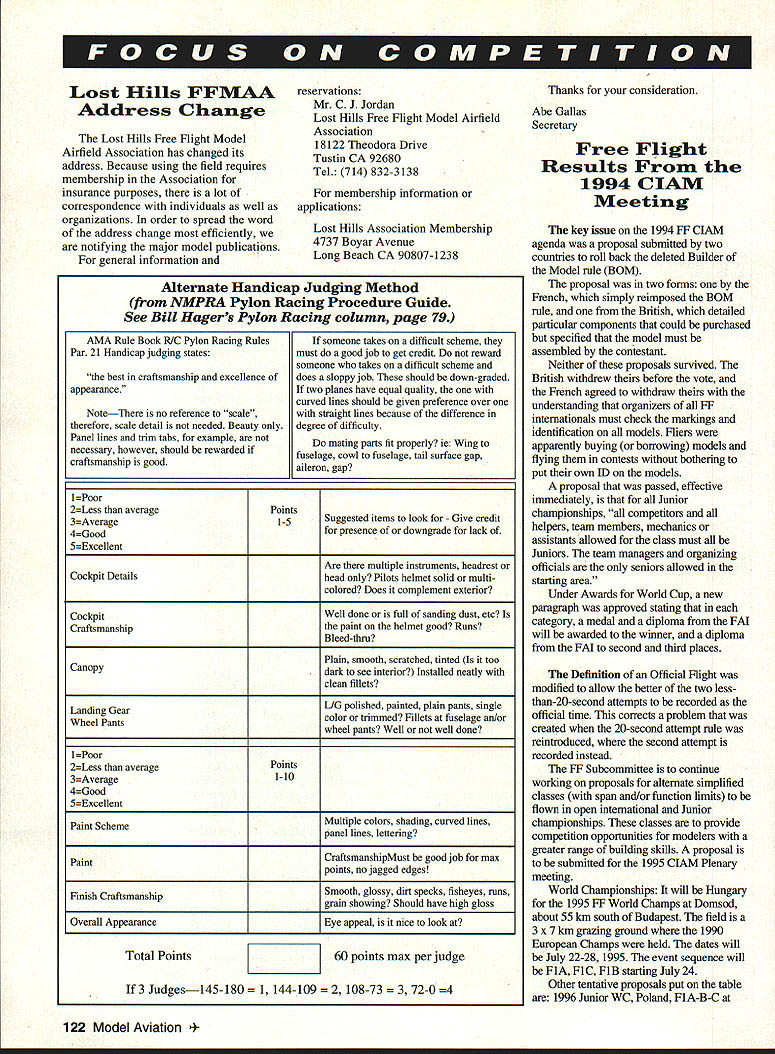
Alternate Handicap Judging Method
(from NMPRA Pylon Racing Procedure Guide. See Bill Hager's Pylon Racing column, page 79.)
AMA Rule Book R/C Pylon Racing Rules, Paragraph 21 (Handicap judging) states: "the best in craftsmanship and excellence of appearance."
Note: There is no reference to "scale"; therefore scale detail is not required. The focus is on beauty and craftsmanship. Panel lines and trim tabs are not necessary, but should be rewarded if craftsmanship is good.
Guidelines for judging:
- If someone attempts a difficult scheme, it must be well executed to receive credit. Do not reward a difficult but sloppy job.
- If two planes have equal quality, the one with curved lines should be given preference over one with straight lines because of the increased difficulty.
- Check fit of mating parts (wing to fuselage, cowl to fuselage, tail surface gaps, aileron gaps).
Scoring (per item): 1 = Poor 2 = Less than average 3 = Average 4 = Good 5 = Excellent
Suggested items to look for (give credit for presence or downgrade for lack of):
- Cockpit Details
- Multiple instruments? Headrest or head only? Pilot's helmet solid or multi-colored? Does it complement the exterior?
- Cockpit Craftsmanship
- Well done or full of sanding dust, etc.? Is paint on the helmet good? Runs? Bleed-thru?
- Canopy
- Plain, smooth, scratched, tinted (is it too dark to see interior?) Installed neatly with clean fillets?
- Landing Gear / Wheel Pants
- Polished or painted? Plain parts, single color or trimmed? Fillets at fuselage and/or wheel pants? Well done or not?
Additional scoring (1–10 scale suggestions):
- Paint Scheme: multiple colors, shading, curved lines, panel lines, lettering?
- Paint Craftsmanship: quality of application—no jagged edges for max points.
- Finish Craftsmanship: smoothness, gloss, absence of specks, fisheyes, runs, grain showing.
- Overall Appearance: general eye appeal.
Total points: 60 points maximum per judge.
If 3 judges, handicap mapping (total points to handicap):
- 145–180 = 1
- 109–144 = 2
- 73–108 = 3
- 0–72 = 4
---
Free Flight Results From the 1994 CIAM Meeting
The key issue on the 1994 Free Flight (FF) CIAM agenda was a proposal by two countries to reimpose the deleted Builder of the Model (BOM) rule.
- Two proposals were presented:
- The French proposal reimposed the BOM rule.
- The British proposal specified particular components that could be purchased but required the model to be assembled by the contestant.
- Neither proposal survived. The British withdrew theirs before the vote, and the French agreed to withdraw theirs on the understanding that organizers of all FF internationals must check the markings and identification on all models. Fliers had been buying or borrowing models and flying them in contests without placing their own ID on the models.
Other decisions and proposals:
- Juniors: A new rule, effective immediately, requires that for all Junior Championships all competitors and all helpers, team members, mechanics, or assistants allowed for the class must all be juniors. Team managers and organizing officials are the only seniors allowed in the starting area.
- Awards for World Cup: In each category a medal and a diploma from the FAI will be awarded to the winner; a diploma from the FAI will be awarded to second and third places.
- Definition of an Official Flight: Modified to allow the better of the two less-than-20-second attempts to be recorded as the official time. This corrects a problem created when the 20-second attempt rule was reintroduced.
- Alternate simplified classes: The FF Subcommittee will continue to work on proposals for alternate simplified classes (with span and/or function limits) to be flown in open international and Junior championships. These classes aim to provide competition opportunities for modelers with a greater range of building skills. A proposal will be submitted for the 1995 CIAM Plenary meeting.
World Championships:
- 1995 FF World Championships: Hungary — at Domsod (about 55 km south of Budapest). The field is a 3 x 7 km grazing ground where the 1990 European Championships were held. Dates: July 22–28, 1995. Event sequence: F1A, F1C, F1B starting July 24.
- Tentative proposals mentioned: 1996 Junior WC (Poland, Leszno); 1996 Indoor WC (Czech Republic, F1D at Brno); 1997 FF WC (Czech Republic, F1A-B-C at Sazena); 1998 Junior WC (Romania, F1A-B-C).
— George Xenakis
---
1994 CIAM Soaring Report
The CIAM Soaring Subcommittee conducts business for five FAI RC soaring classes. Two classes are official events (F3B and F3J) and three are provisional (F3F, F3H, and F3K). The 1994 CIAM meeting had rules proposals on the agenda for both official classes; none were proposed for the provisional classes.
F3B:
- A Belgian proposal permitting a competitor to use three models instead of two was approved but will not be effective until 1997 because it is a change in model specifications. When effective, the third model must be processed at the same time as the first two.
- A Belgian proposal to prohibit charging winch batteries in the launch area (prompted by observed practice at the 1993 World Championships) was approved as an immediate clarification: charging winch batteries is banned in any of the safety areas.
- A Belgian proposal to require at least three timekeepers and at least two officials at both Base A and Base B in the speed task did not obtain final approval. It received a majority in the technical meeting but was defeated in the plenary due to unclear wording about base official functions. It may be reintroduced with revised wording in the future.
- Romania bid for and was accepted to host the 1995 F3B World Championships; details were to be submitted by the Romanian delegate.
F3J:
- A subcommittee proposal to prohibit the use of mechanical aids (pulleys) in hand towing was referred back to the subcommittee for further study. This is important because pulleys and multiple towpersons can create very high tow tensions—possibly greater than a winch—and allow heavy models to be easily towed in no-wind conditions.
- Safety concerns include the practice of staking one end of the towline and pulling away; if the stake comes out, it can be thrown toward the towperson—an injury has already occurred.
- There is debate between maintaining F3J as a simple, low-cost thermal-duration class versus evolving toward high-power launches and F3B-type models.
- F3J was expected to obtain World Championship status at the plenary, but the item was not added to the agenda and therefore was not considered. There is resistance within CIAM to proliferation of World Championship classes, especially similar ones.
Comments and input on these items are invited. — Terry Edmonds, Subcommittee Member
---
CIAM Scale Subcommittee Report 1994
The Scale Subcommittee meeting was attended by representatives of 14 nations.
World Championship offers:
- 1996 Scale World Championships: Offers from France and South Africa. France was accepted; the meet will be held at Perigueux Airport in July 1996 for radio control, control line, and will include an international competition for Large Scale models. Perigueux is in southern France, 70 miles east of Bordeaux and 300 miles south of Paris.
- 1998 Scale World Championships: Offers from South Africa, Canada, and Finland. The firm offer from Finland would include control line, radio control, and an international competition for Large Scale models.
Rule changes (effective 1997 unless otherwise noted):
- Rule 6.1.3: Static judging will precede flying regardless of the number of entries (previously static judging was first except when entries exceeded 30).
- Rule 6.1.4: Flight judges must be of different nationalities (changed from "preferably" to "mandatory"). The rule that flying was to commence when half of the models had been static-judged is deleted.
- Rule 6.1.5: Half marks may be used to determine fidelity-to-scale and craftsmanship scores, and also for flight scores, rather than fractions of a point.
- Rule 6.2.9 (Control Line Scale): Each maneuver may be awarded marks between 0 and 10 in increments of a half mark.
- Rule 6.3.1 (RC Scale): The previous wing loading limit of 100 g/dm2 is increased to 250 g/dm2 to accommodate modern jet types with small wing area.
- Rule 6.3.3.c (RC Scale): An official flight is terminated when the model lands and stops, except during the touch-and-go maneuver.
- Rule 6.3.4 (RC Scale): Flight times increased by two minutes—to 14 minutes for aerobatic and 17 minutes for non-aerobatic prototypes (the prior 1992 reduction was found ineffective).
- Rule 6.3.7 (RC Scale): The maneuver "Overshoot" is to be used only by non-aerobatic prototype models.
- Rule 6.3.7.v (RC Scale): A new optional maneuver "Wingover" with a K factor of 4 is added. Description: From straight flight the model makes a near-vertical climb, then performs a 180-degree turn left or right, and recovers straight and level at the same altitude on a heading opposite to entry.
- Rule 6.3.8 (RC Scale): Each maneuver may be awarded marks between 0 and 10 using increments of half a mark (previously full marks only).
- Rule 6.3.6 (RC Scale): The maneuver "360-degree descending circle" is to be terminated at a maximum altitude of 6 meters (effective 1994).
Large Scale RC:
- The supplement to the FAI Sporting Code (provisional rules for Large Scale RC) is amended to stipulate minimum model weights (without fuel) to differentiate Large Scale from F4C:
- Single-engine models: minimum 7 kg
- Twin-engine models: minimum 8 kg
- Models with more than two engines: minimum 9 kg
Peanut Scale Free Flight:
- Under static judging the rule "No measurements will be taken" is changed to "No scale measurements will be taken."
- A proposal to permit a scale propeller during static judging was defeated.
New class proposal:
- A new class, F4J Scale Jet, with a complete set of rules has been proposed as separate from F4C RC Scale. Since scale ducted-fan models have already won recent F4C World Championships, the Scale Subcommittee decided no change to F4C rules is necessary at this time.
— Bob Wischer
Transcribed from original scans by AI. Minor OCR errors may remain.

