
Focus on Competition
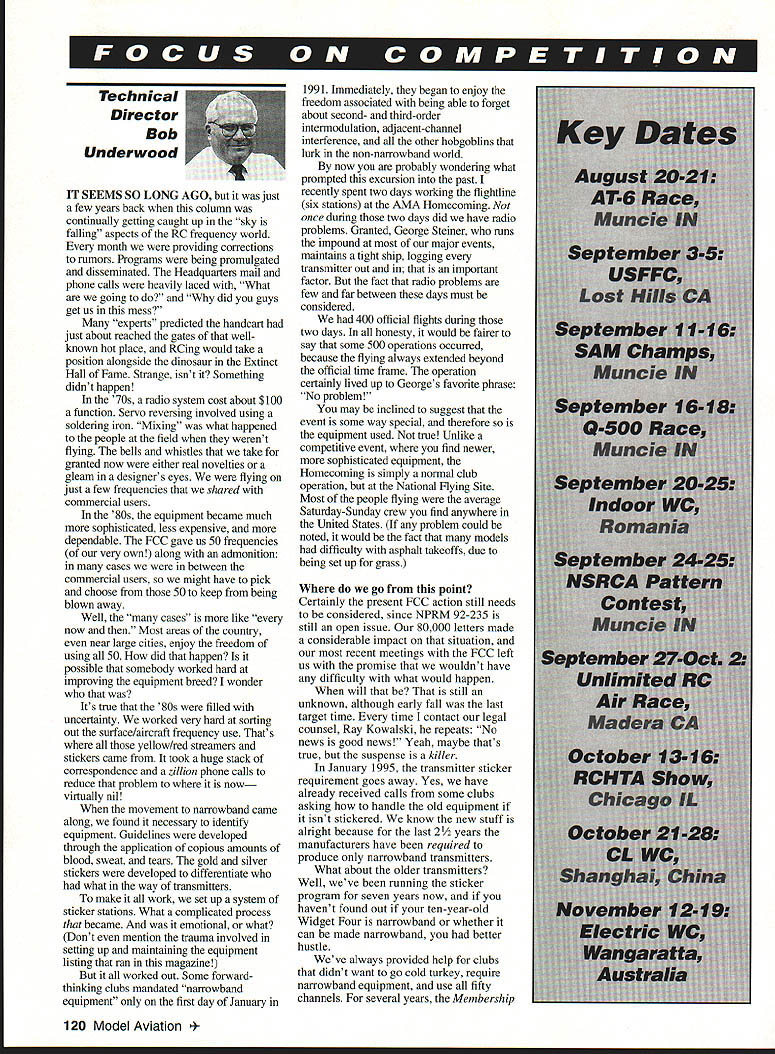
Technical Director — Bob Underwood
It seems so long ago, but it was just a few years back when this column was continually getting caught up in the "sky is falling" aspects of the RC frequency world. Every month we were providing corrections to rumors. Programs were being promulgated and disseminated. The Headquarters mail and phone calls were heavily laced with, "What are we going to do?" and "Why did you guys get us in this mess?"
Many "experts" predicted the handcart had just about reached the gates of that well-known hot place, and RCing would take a position alongside the dinosaur in the Extinct Hall of Fame. Strange, isn't it? Something didn't happen!
In the '70s, a radio system cost about $100 a function. Servo reversing involved using a soldering iron. "Mixing" was what happened to the people at the field when they weren't flying. The bells and whistles that we take for granted now were either real novelties or a gleam in a designer's eyes. We were flying on just a few frequencies that we shared with commercial users.
In the '80s, the equipment became much more sophisticated, less expensive, and more dependable. The FCC gave us 50 frequencies (of our very own!) along with an admonition: in many cases we were in between the commercial users, so we might have to pick and choose from those 50 to keep from being blown away.
Well, the "many cases" is more like "every now and then." Most areas of the country, even near large cities, enjoy the freedom of using all 50. How did that happen? Is it possible that somebody worked hard at improving the equipment breed? I wonder who that was?
It's true that the '80s were filled with uncertainty. We worked very hard at sorting out the surface/aircraft frequency use. That's where all those yellow/red streamers and stickers came from. It took a huge stack of correspondence and a zillion phone calls to reduce that problem to where it is now—virtually nil.
When the movement to narrowband came along, we found it necessary to identify equipment. Guidelines were developed through the application of copious amounts of blood, sweat, and tears. The gold and silver stickers were developed to differentiate who had what in the way of transmitters.
To make it all work, we set up a system of sticker stations. What a complicated process that became. And was it emotional, or what? Don't even mention the trauma involved in setting up and maintaining the equipment listing that ran in this magazine!
But it all worked out. Some forward-thinking clubs mandated "narrowband equipment" only on the first day of January in 1991. Immediately, they began to enjoy the freedom associated with being able to forget about second- and third-order intermodulation, adjacent-channel interference, and all the other hobgoblins that lurk in the non-narrowband world.
By now you are probably wondering what prompted this excursion into the past. I recently spent two days working the flightline (six stations) at the AMA Homecoming. Not once during those two days did we have radio problems. Granted, George Steiner, who runs the impound at most of our major events, maintains a tight ship, logging every transmitter out and in; that is an important factor. But the fact that radio problems are few and far between these days must be considered.
We had 400 official flights during those two days. In all honesty, it would be fairer to say that some 500 operations occurred, because the flying always extended beyond the official time frame. The operation certainly lived up to George's favorite phrase: "No problem!"
You may be inclined to suggest that the event is in some way special, and therefore so is the equipment used. Not true! Unlike a competitive event, where you find newer, more sophisticated equipment, the Homecoming is simply a normal club operation, but at the National Flying Site. Most of the people flying were the average Saturday-Sunday crew you find anywhere in the United States. (If any problem could be noted, it would be the fact that many models had difficulty with asphalt takeoffs, due to being set up for grass.)
Where do we go from this point? Certainly the present FCC action still needs to be considered, since NPRM 92-235 is still an open issue. Our 80,000 letters made a considerable impact on that situation, and our most recent meetings with the FCC left us with the promise that we wouldn't have any difficulty with what would happen.
When will that be? That is still an unknown, although early fall was the last target time. Every time I contact our legal counsel, Ray Kowalski, he repeats: "No news is good news!" Yeah, maybe that's true, but the suspense is a killer.
In January 1995, the transmitter sticker requirement goes away. Yes, I have already received calls from some clubs asking how to handle the old equipment if it isn't stickered. We know the new stuff is all right because for the last 2-1/2 years the manufacturers have been required to produce only narrowband transmitters.
What about the older transmitters? Well, we've been running the sticker program for seven years now, and if you haven't found out if your ten-year-old or older Widget Four is narrowband or whether it can be made narrowband, you had better hustle.
We've always provided help for clubs that didn't want to go cold turkey, require narrowband equipment, and use all fifty channels. For several years, the Membership Manual contained a variety of frequency management plans. By employing them, clubs could continue using older equipment and maintain some level of safe operation. They are gone now, and in their place are simple tests that can be performed to determine whether a transmitter is narrowband.
Please understand that these are not lab-type operations, but they will give the club something to work with. Of course, if the club continues to fly old stuff they'll have to employ careful frequency-use discipline. If they are not narrowbanded, the old wide-band transmitters become illegal by FCC regulation in 1998. As far as receivers are concerned, they will probably be able to legally live forever! After all, the FCC generally doesn't care what you take out of the air—only what you put into it.
An often-expressed concern centers around the safety of using the older stuff. That's a tough one to address. Many people are still using the old gear and are not having problems. In fact, we still get reports of 27 MHz use without problems! But the "no problems" are generally directly related to the amount of isolation of the flying site.
If you fly a zillion miles from anywhere, you probably won't have a problem if you handle the model-to-model interference procedures. But if you are near a metropolitan area, look out! Remember: even the smaller cities have at least one pager now. Beyond that, there are many other commercial applications on those frequencies we list, and some of those uses could run along the edge of your flying site in the middle of nowhere.
It's hard to know that it's there, so even if you control the RC frequencies at your club site, you may not be able to determine all the other sources of interference. Of course, you can always borrow the Academy's tools, in the form of scanners or channel analyzers.
Would I continue to fly old wideband equipment? Ain't no way! I saw first-hand several years ago what happened when someone tried to operate an older single-conversion receiver on channel 48 (23 channels away from someone on channel 25). Since the competition had advertised "narrowband equipment only," there shouldn't have been a problem—but there was.
When the channel 48 party was asked why he wasn't using a narrowband receiver, he replied that five people had told him that it was! The CD suggested that five people were wrong and grounded the equipment. (Incidentally, I was on channel 25.)
Fortunately, I was in the air first or the other guy would have been.
Yes, I understand that many people are on limited budgets and just can't afford to upgrade old equipment or buy new stuff. That's the main reason the Academy worked out a bunch of ways to prolong its use. But remember that the airwaves are only going to become more and more saturated with RF. That's a lead-pipe cinch! You're going to have to decide at what point a crashed model and the upgrade cost cross one another in your budget.
In closing this month, I can't help but reflect on the conversation I had with a member several years ago during IMS in California. He was quite agitated about the thought of having to deep-six his older equipment. He felt a little better when I passed along the information that it wasn't an FCC requirement at that point. I added a bunch of thoughts about how we might do some upgrading in stages. Since he flew in the Los Angeles area, we both recognized that he'd have to work out some means. Finally, I felt I had convinced him that cost (time and money) and safety issues made it worthwhile. But I wasn't prepared for his closing cry: "But I have over 100 radio systems!"
Yep, I guess he really did (or does) have a problem. I never have been able to figure out how in the heck he'd ever keep track of changing 100 transmitters and receivers—let alone what you'd do with that many anyway! To each his own.
Transcribed from original scans by AI. Minor OCR errors may remain.

