
Focus On Competition
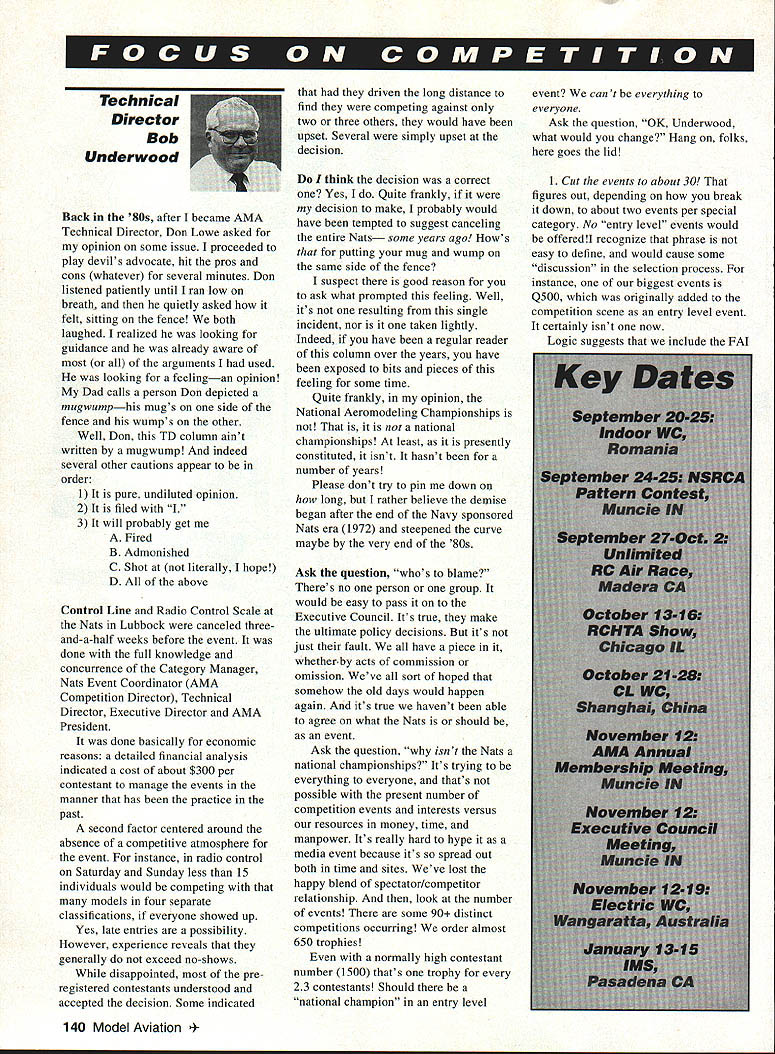
Technical Director Bob Underwood
Back in the ’80s, after I became AMA Technical Director, Don Lowe asked for my opinion on some issue. I proceeded to play devil’s advocate, hit the pros and cons for several minutes. Don listened patiently until I ran low on breath, and then he quietly asked how it felt, sitting on the fence! We both laughed. I realized he was looking for guidance and he was already aware of most (or all) of the arguments I had used. He was looking for a feeling—an opinion! My Dad calls a person Don depicted a mugwump—his mug’s on one side of the fence and his wump’s on the other.
Well, Don, this TD column ain’t written by a mugwump! And indeed several other cautions appear to be in order:
- It is pure, undiluted opinion.
- It is filed with “L”.
- It will probably get me
- A. Fired
- B. Admonished
- C. Shot (not literally, I hope!)
- D. All of the above
Control Line and Radio Control Scale Nats in Lubbock were canceled three-and-a-half weeks before the event. It was done with the full knowledge and concurrence of the Category Manager, Nats Event Coordinator (AMA Competition Director), Technical Director, Executive Director and AMA President.
It was done basically for economic reasons: a detailed financial analysis indicated a cost of about $300 per contestant to manage the events in the manner that has been the practice in the past.
A second factor centered around the absence of a competitive atmosphere for the event. For instance, in radio control on Saturday and Sunday less than 15 individuals would be competing with that many models in four separate classifications, if everyone showed up. Yes, late entries are a possibility. However, experience reveals that they generally do not exceed no-shows.
While disappointed, most of the pre-registered contestants understood and accepted the decision. Some indicated that had they driven the long distance to find they were competing against only two or three others, they would have been upset. Several were simply upset at the decision.
Do I think the decision was a correct one? Yes, I do. Quite frankly, if it were my decision to make, I probably would have been tempted to suggest canceling the entire Nats—some years ago! How’s that for putting your mug and wump on the same side of the fence?
I suspect there is good reason for you to ask what prompted this feeling. Well, it’s not one resulting from this single incident, nor is it one taken lightly. Indeed, if you have been a regular reader of this column over the years, you have been exposed to bits and pieces of this feeling for some time.
Quite frankly, in my opinion, the National Aeromodeling Championships is not a national championships! At least, as it is presently constituted, it isn’t. It hasn’t been for a number of years.
Please don’t try to pin me down on how long, but I rather believe the demise began after the end of the Navy-sponsored Nats era (1972) and steepened the curve maybe by the very end of the ’80s.
Ask the question, “who’s to blame?” There’s no one person or one group. It would be easy to pass it on to the Executive Council. It’s true, they make the ultimate policy decisions. But it’s not just their fault. We all have a piece in it, whether by acts of commission or omission. We’ve all sort of hoped that somehow the old days would happen again. And it’s true we haven’t been able to agree on what the Nats is or should be, as an event.
Ask the question, “why isn’t the Nats a national championships?” It’s trying to be everything to everyone, and that’s not possible with the present number of competition events and interests versus our resources in money, time, and manpower. It’s really hard to hype it as a media event because it’s so spread out both in time and sites. We’ve lost the happy blend of spectator/competitor relationship. And then, look at the number of events! There are some 90+ distinct competitions occurring! We order almost 650 trophies!
Even with a normally high contestant number (1500) that’s one trophy for every 2.3 contestants! Should there be a “national champion” in an entry level event? We can’t be everything to everyone.
Ask the question, “OK, Underwood, what would you change?” Hang on, folks, here goes the lid!
- Cut the events to about 30. That figures out, depending on how you break it down, to about two events per special category. No “entry level” events would be offered—I recognize the phrase is not easy to define and would cause some discussion. For instance, one of our biggest events is Q500, which was originally added to the competition scene as an entry level event. It certainly isn’t one now.
Logic suggests that we include the FAI events for which we field international teams. That would also be very controversial, in light of the present very low level of competition activity in a few of those categories.
A few other thoughts on events would be to suggest that the selection would be guided by input from any AMA specialist-interest groups that might exist representing the discipline. Some separate events, such as A, B, C, D Free Flight Gas or Control Line Speed classes might actually fly together against the standing record (percentage of record for the class) as one event.
- Find a national sponsor. For years, we have avoided this approach, partly for fear of becoming encumbered or "controlled." But we cannot properly fund the Nats with only contestant entry fees!
Several years ago, a good friend of the Academy, who was attached to a large corporation, was working with us in creating a $50,000 sponsorship. Unfortunately, before the deal was culminated, he was moved to another division of the company and lost control of the funds. A pity! There is money out there, and one reason for the recent survey was to generate information we can use to seek it. We've got the information, so—
- Cut the number of trophies. Yes, I know their cost is not a big-ticket item. What's really at stake is their value as a trophy!
I have several Nats trophies packed away at home that I'll never display. One is a second place, and two are thirds. They really have little meaning to me. While they say second or third, they might as well say last, since I was competing against only one or two other contestants. Can a 15th place in Pylon really mean much?
I suggest that a maximum of five places be awarded trophies, and then only if a number of individuals actually compete. From 10 to 20 contestants, three awards. Below 10 pre-registered contestants, the event would be canceled! An award should be won or honor earned — not recognition for entry!
- Volunteers should be just that! (This is a really touchy one!)
In 1970, I attended my first Nats. Dad and I worked the Delta Dart program. Through the many years we were able to stay in a free room at the BOQ. A month after the meet, they each received a check for $50. It was a pleasant surprise, but certainly not expected.
Over the years, we have developed a hefty budget for Nats workers. Certainly, it is nice to be able to defray some of the expense incurred by those who give very generously of their time, talent, and money to work long, hard, often unpaid hours.
But we need to carefully study our present policy. I came to that conclusion the first year I attended the EAA convention at Oshkosh and learned that the only "compensation" the some 5,000 volunteers received was the ability to be part of the event and a discount card for the museum store!
I realize you're sitting there saying that there's no way you can compare the Nats to the EAA Fly-In! Absolutely true! That's the point! Volunteers make the event—but the event, if it is meaningful, creates the volunteers.
If I were a betting man, I'd bet that events like Top Gun and the Greater Des Moines Aviation Expo, and World Championships have little difficulty attracting workers for little more than the honor of being part of the event. The event creates the volunteer—if it's truly meaningful and not just a chore!
Well, I've worked hard at upsetting just about everybody with this piece. Please understand that I care very much for the Academy and for the Nats concept. It's not my nature to create controversy for controversy's sake. But we must regroup in this area.
Is the Nats to be truly a national competition? Then maybe it needs to spring from a system such as that used by Scale Masters, where regional events qualify the individual to attend the finals. Maybe we need to finally make the commitment to chop the Nats into manageable pieces so it can be a first-rate competition for each of the venues. Maybe we can finally determine whether we want it to be only a media showcase event or only a national competition.
It's time to come to grips with the issue, rather than to continually compromise and create dissention. Frankly, it's time for it to at least not cost AMA money!
One little detour in thought, that is indirectly a part of the Nats problem, includes another plea from the Technical Director dealing with the rule book. Some time ago, I indicated a concern about the ever-increasing number of events. Such concern was dismissed by many on the basis that the rules are only ink on paper. The philosophy became, "Let the events flow." Sorta like, "Create the event and they will come!" But they haven't!
In spite of an ever-increasing number of events (160 now) the number of competitors in the Academy remains about the same or has decreased percentage-wise when compared to overall membership. In dealing with the highly diverse special event interest within a special interest, we dilute the attention we can focus upon any of them individually.
Try a little exercise: Go back to the last three Navy sponsored Nats and look at the number of events. You'll find there was about 1/3 the number we have now! We could handle them at a single site, within a reasonable time frame. We really can't do that with our offering now.
Interestingly, if you consider the competition events attracting the most attention at this time, they are not AMA rule book events. The Reno-style racing, TOC, and warbirds all command healthy numbers. Consider Top Gun, which, while the rules bear some similarity to AMA's, are a separate, distinct set.
Now ask yourself the question: did the rules make those events, or are they almost incidental due to the success of the event? Surely, their success should tell us something.
Even within what some folks are wont to call "rule book events" we find so many deviations it is often difficult to identify them as "rule book". In racing, Q500 contains a host of events that started as standardized rule book, but contain changes so dramatic, it seems ludicrous to identify them as "rule book". We often find these "events with deviations" creeping into the Nats as unofficial activities.
In closing, I guess what I am suggesting is that we have a problem. A big problem! Do I have all the answers to how we can correct them? Heck, no! I don't even have all the questions! But I've posed some:
- Is the Nats, in your view, a national championships? A showcase? A media event?
- Can we support a major event of the magnitude we want with funds from contestant entries?
- Should we focus on the high-profile, high-interest events?
- Can we put prestige back into the event and give the trophy real meaning?
- Can we decide what the Nats is supposed to be in the first place?
- Can it live in a permanent home rather than being nomadic?
- Should it be broken into pieces in an effort to devote adequate time to focus on creating a first-rate competition for each venue?
- Where they exist, can we count on special-interest groups to make it happen?
Your comments are invited, whether you are a Nats competitor or not.
Talk to you next month—if I'm still here!
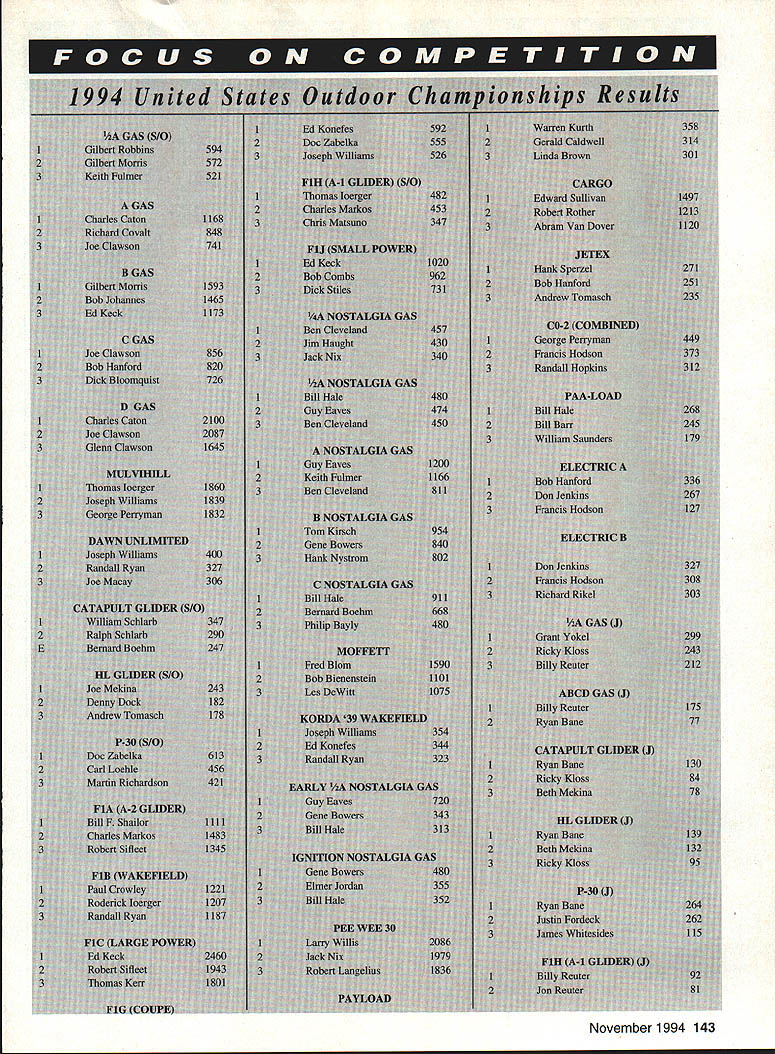
1994 United States Outdoor Championships Results
- 1/2A GAS (S/O)
- Gilbert Robbins — 594
- Gilbert Morris — 572
- Keith Fulmer — 521
- A GAS
- Charles Caton — 1168
- Richard Covalt — 848
- Joe Clawson — 741
- B GAS
- Gilbert Morris — 1593
- Bob Johannes — 1465
- Ed Keck — 1173
- C GAS
- Joe Clawson — 856
- Bob Hanford — 820
- Dick Bloomquist — 726
- D GAS
- Charles Caton — 2100
- Joe Clawson — 2087
- Glenn Clawson — 1645
- MULTIHILL
- Thomas Joerger — 1860
- Joseph Williams — 1839
- George Perryman — 1832
- DAWN UNLIMITED
- Joseph Williams — 400
- Randall Ryan — 327
- Joe Macay — 306
- CATAPULT GLIDER (S/O)
- William Schlarb — 347
- Ralph Schlarb — 290
- Bernard Boehm — 247
- HL GLIDER (S/O)
- Joe Mekina — 243
- Denny Dock — 182
- Andrew Tomasch — 178
- P-30 (S/O)
- Doc Zabelka — 613
- Carl Loehle — 456
- Martin Richardson — 421
- F1A (A-2 GLIDER)
- Bill F. Shailor — 1111
- Charles Markos — 1483
- Robert Sifleet — 1345
- F1B (WAKEFIELD)
- Paul Crowley — 1221
- Roderick Joerger — 1207
- Randall Ryan — 1187
- F1C (LARGE POWER)
- Ed Keck — 2460
- Robert Sifleet — 1943
- Thomas Kerr — 1801
- F1H (A-1 GLIDER) (S/O)
- Thomas Joerger — 482
- Charles Markos — 453
- Chris Matsuno — 347
- F1J (SMALL POWER)
- Ed Keck — 1020
- Bob Combs — 962
- Dick Stiles — 731
- 1/4A NOSTALGIA GAS
- Ben Cleveland — 457
- Jim Haught — 430
- Jack Nix — 340
- 1/2A NOSTALGIA GAS
- Bill Hale — 480
- Guy Eaves — 474
- Ben Cleveland — 450
- A NOSTALGIA GAS
- Guy Eaves — 1200
- Keith Fulmer — 1166
- Ben Cleveland — 811
- B NOSTALGIA GAS
- Tom Kirsch — 954
- Gene Bowers — 840
- Hank Nystrom — 802
- C NOSTALGIA GAS
- Bill Hale — 911
- Bernard Boehm — 668
- Philip Bayly — 480
- MOFFETT
- Fred Blom — 1590
- Bob Bienenstein — 1101
- Les DeWitt — 1075
- KORDA '39 WAKEFIELD
- Joseph Williams — 354
- Ed Konefes — 344
- Randall Ryan — 323
- EARLY 1/2A NOSTALGIA GAS
- Guy Eaves — 720
- Gene Bowers — 343
- Bill Hale — 313
- IGNITION NOSTALGIA GAS
- Gene Bowers — 480
- Elmer Jordan — 355
- Bill Hale — 352
- PEE WEE 30
- Larry Willis — 2086
- Jack Nix — 1979
- Robert Langelius — 1836
- PAYLOAD
- Ed Konefes — 592
- Doc Zabelka — 555
- Joseph Williams — 526
- F1H (A-1 GLIDER) (O)
- Thomas Joerger — 482
- Charles Markos — 453
- Chris Matsuno — 347
- FIJ (SMALL POWER)
- Ed Keck — 1020
- Bob Combs — 962
- Dick Stiles — 731
- CARGO
- Edward Sullivan — 1497
- Robert Rother — 1213
- Abram Van Dover — 1120
- JETEX
- Hank Sperzel — 271
- Bob Hanford — 251
- Andrew Tomasch — 235
- CO-2 (COMBINED)
- George Perryman — 449
- Francis Hodson — 373
- Randall Hopkins — 312
- PAA-LOAD
- Bill Hale — 268
- Bill Barr — 245
- William Saunders — 179
- ELECTRIC A
- Bob Hanford — 336
- Don Jenkins — 267
- Francis Hodson — 127
- ELECTRIC B
- Don Jenkins — 327
- Francis Hodson — 308
- Richard Rikel — 303
- 1/4A GAS (J)
- Grant Yokel — 299
- Ricky Kloss — 243
- Billy Reuter — 212
- ABCD GAS (J)
- Billy Reuter — 175
- Ryan Bane — 77
- CATAPULT GLIDER (J)
- Ryan Bane — 130
- Ricky Kloss — 84
- Beth Mekina — 78
- HL GLIDER (J)
- Ryan Bane — 139
- Beth Mekina — 132
- Ricky Kloss — 95
- P-30 (J)
- Ryan Bane — 264
- Justin Fordeck — 262
- James Whitesides — 115
- F1H (A-1 GLIDER) (J)
- Billy Reuter — 92
- Jon Reuter — 81
- Additional reported scores
- Warren Kurth — 358
- Gerald Caldwell — 314
- Linda Brown — 301
Transcribed from original scans by AI. Minor OCR errors may remain.

