
Focus on Competition
Technical Director — Bob Underwood
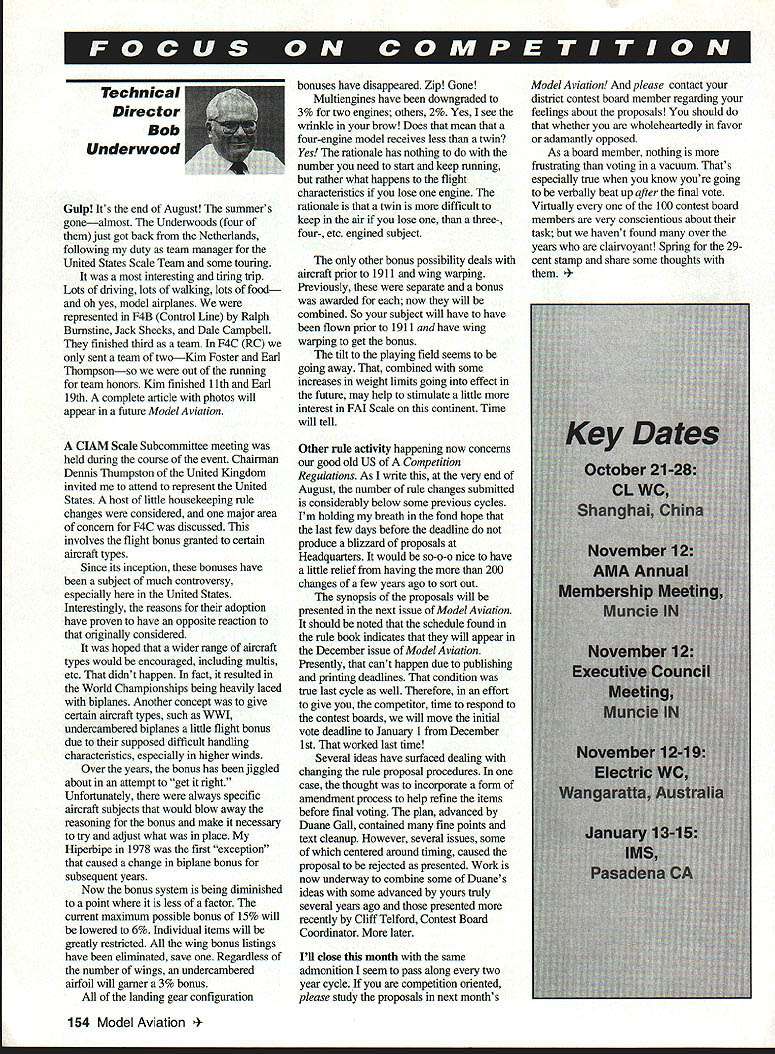
Gulp! It's the end of August! The summer's gone—almost. The Underwoods (four of them) just got back from the Netherlands, following my duty as team manager for the United States Scale Team and some touring. It was a most interesting and tiring trip: lots of driving, lots of walking, lots of food—and oh yes, model airplanes. We were represented in F4B (control line) by Ralph Burnstine, Jack Sheeks, and Dale Campbell. They finished third as a team. In F4C (RC) we only sent a team of two—Kim Foster and Earl Thompson—so we were out of the running for team honors. Kim finished 11th and Earl 19th. A complete article with photos will appear in a future Model Aviation.
A CIAM Scale Subcommittee meeting was held during the event. Chairman Dennis Thumpston of the United Kingdom invited me to attend to represent the United States. A host of housekeeping rule changes were considered, and one major area of concern for F4C was discussed: the flight bonuses granted to certain aircraft types.
Since their inception, these bonuses have been a subject of much controversy, especially here in the United States. Interestingly, the reasons for their adoption have produced the opposite effect to that originally intended. It was hoped a wider range of aircraft types (including multis) would be encouraged; instead, the World Championships became heavily laced with biplanes. Another concept was to give certain aircraft types, such as WWI undercambered biplanes, a small flight bonus due to supposedly difficult handling characteristics, especially in higher winds.
Over the years the bonus system has been adjusted repeatedly to try to "get it right." Unfortunately, specific aircraft exceptions often undermined the reasoning and forced further changes. My Hiperbipe in 1978 was the first "exception" that caused a change in the biplane bonus for subsequent years.
The bonus system is now being reduced so it will be less of a factor. Key changes include:
- Maximum possible bonus reduced from 15% to 6%.
- Individual bonus items will be greatly restricted.
- All wing-count bonus listings eliminated except one: any undercambered airfoil (regardless of number of wings) will receive a 3% bonus.
- All landing-gear configuration bonuses have been removed.
- Multiengine bonuses revised: two engines (twin) = 3%; three or more engines = 2%. Yes, that means a four-engine model receives less than a twin. The rationale is not about how many engines you must start and keep running, but what happens to flight characteristics if you lose one engine: a twin is more difficult to keep flying if it loses one engine than a three- or four-engined subject.
- The only other bonus possibility concerns aircraft flown prior to 1911 and wing warping. Previously these were separate bonuses; now they will be combined. Your subject must have been flown prior to 1911 and have wing warping to qualify.
The tilt to the playing field seems to be going away. That, combined with some increases in weight limits coming into effect, may help stimulate more interest in FAI Scale on this continent. Time will tell.
US Competition Regulations
Other rule activity concerns our US Competition Regulations. As I write this at the end of August, the number of rule changes submitted is considerably below some previous cycles. I'm holding my breath in the fond hope that the last few days before the deadline do not produce a blizzard of proposals. Headquarters, it would be so-o-o nice to have a little relief from having to sort out more than 200 changes as in past cycles.
The synopsis of the proposals will be presented in the next issue of Model Aviation. Note that the schedule found in the rule book indicates they will appear in the December issue; presently that can't happen due to publishing and printing deadlines (that was true last cycle as well). To give competitors time to respond to contest boards, we will move the initial vote deadline to January 1 from December 1. That worked last time.
Several ideas have surfaced to change the rule-proposal procedures. One plan, advanced by Duane Gall, contained many fine points and text cleanup and proposed an amendment process to refine items before final voting. However, timing and other issues caused that proposal to be rejected as presented. Work is now underway to combine some of Duane's ideas with ones I advanced several years ago and those more recently presented by Cliff Telford, Contest Board Coordinator. More later.
Final note to competitors
If you are competition-oriented, please study the proposals in next month's Model Aviation and contact your district contest board member with your thoughts—whether you are wholeheartedly in favor or adamantly opposed. As a board member, nothing is more frustrating than voting in a vacuum. Virtually every one of the 100 contest board members is conscientious about their task, but we haven't found many who are clairvoyant! Spring for the 29-cent stamp and share some thoughts with Model Aviation.
Transcribed from original scans by AI. Minor OCR errors may remain.

