
Focus on Competition
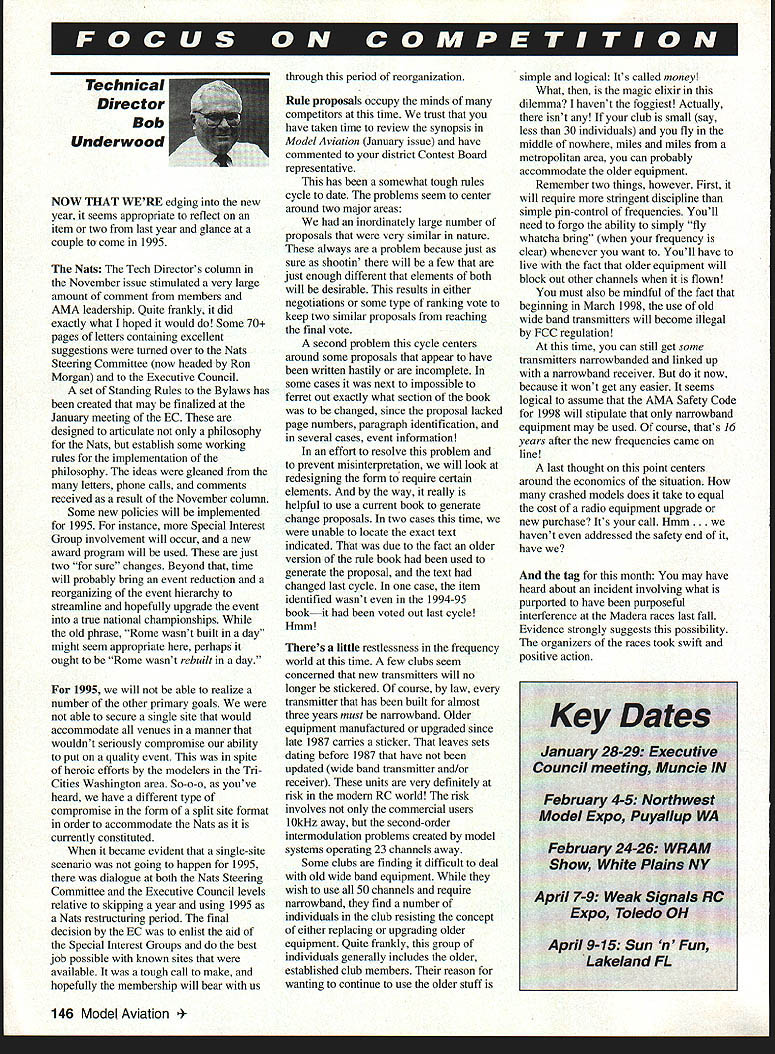
Technical Director Bob Underwood
Now that we're edging into the new year, it seems appropriate to reflect on an item or two from last year and glance at a couple to come in 1995.
The Nats: The Tech Director's column in the November issue stimulated a very large amount of comment from members and AMA leadership. Quite frankly, it did exactly what I hoped it would do. Some 70+ pages of letters containing excellent suggestions were turned over to the Nats Steering Committee (now headed by Ron Morgan) and to the Executive Council.
A set of Standing Rules to the Bylaws has been created that may be finalized at the January meeting of the EC. These are designed not only to articulate a philosophy for the Nats, but to establish some working rules for the implementation of that philosophy. The ideas were gleaned from many letters, phone calls, and comments received as a result of the November column.
Some new policies will be implemented for 1995. For instance:
- More Special Interest Group involvement will occur.
- A new award program will be used.
These are just two "for sure" changes. Beyond that, time will probably bring an event reduction and a reorganization of the event hierarchy to streamline and hopefully upgrade the event into a true national championship. While the old phrase "Rome wasn't built in a day" might seem appropriate here, perhaps it ought to be "Rome wasn't rebuilt in a day."
For 1995, we will not be able to realize a number of the other primary goals. We were not able to secure a single site that would accommodate all venues in a manner that wouldn't seriously compromise our ability to put on a quality event. This was in spite of heroic efforts by the modelers in the Tri-Cities, Washington area. So, as you've heard, we have a different type of compromise in the form of a split-site format in order to accommodate the Nats as it is currently constituted.
When it became evident that a single-site scenario was not going to happen for 1995, there was dialogue at both the Nats Steering Committee and the Executive Council levels about skipping a year and using 1995 as a Nats restructuring period. The final decision by the EC was to enlist the aid of the Special Interest Groups and do the best job possible with the known sites that were available. It was a tough call to make, and hopefully the membership will bear with us through this period of reorganization.
Rule proposals occupy the minds of many competitors at this time. We trust that you have taken time to review the synopsis in Model Aviation (January issue) and have commented to your district Contest Board representative.
This has been a somewhat tough rules cycle to date. The problems seem to center around two major areas:
- We had an inordinately large number of proposals that were very similar in nature. These always are a problem because just as sure as shootin' there will be a few that are just enough different that elements of both will be desirable. This results in either negotiations or some type of ranking vote to keep two similar proposals from reaching the final vote.
- Some proposals appear to have been written hastily or are incomplete. In some cases it was next to impossible to ferret out exactly what section of the book was to be changed, since the proposal lacked page numbers, paragraph identification, and in several cases, event information.
In an effort to resolve this problem and to prevent misinterpretation, we will look at redesigning the form to require certain elements. And by the way, it really is helpful to use a current book to generate change proposals. In two cases this time, we were unable to locate the exact text indicated because an older version of the rule book had been used to generate the proposal and the text had changed last cycle. In one case, the item identified wasn't even in the 1994-95 book—it had been voted out last cycle.
There's a little restlessness in the frequency world at this time. A few clubs seem concerned that new transmitters will no longer be stickered. By law, every transmitter that has been built for almost three years must be narrowband. Older equipment manufactured or upgraded since late 1987 carries a sticker. That leaves sets dating before 1987 that have not been updated (wide-band transmitter and/or receiver). These units are very definitely at risk in the modern RC world. The risk involves not only commercial users 10 kHz away, but second-order intermodulation problems created by model systems operating 23 channels away.
Some clubs are finding it difficult to deal with old wide-band equipment. While they wish to use all 50 channels and require narrowband, they find a number of individuals in the club resisting the concept of either replacing or upgrading older equipment. Quite frankly, this group of individuals generally includes the older, established club members. Their reason for wanting to continue to use the older stuff is simple and logical: it's called money.
What, then, is the magic elixir in this dilemma? I haven't the foggiest. Actually, there isn't any. If your club is small (say, less than 30 individuals) and you fly in the middle of nowhere, miles and miles from a metropolitan area, you can probably accommodate the older equipment.
Remember two things, however:
- First, it will require more stringent discipline than simple pin-control of frequencies. You'll need to forgo the ability to simply "fly what you bring" (when your frequency is clear) whenever you want to. You'll have to live with the fact that older equipment will block out other channels when it is flown.
- Second, beginning in March 1998 the use of old, wide-band transmitters will become illegal by FCC regulation.
At this time, you can still get some transmitters narrowbanded and linked up with a narrow-band receiver. But do it now, because it won't get any easier. It seems logical to assume that the AMA Safety Code for 1998 will stipulate that only narrow-band equipment may be used.
My last thought on this point centers around the economics of the situation. How many crashed models does it take to equal the cost of a radio equipment upgrade or new purchase? It's your call. We haven't even addressed the safety end of it, have we?
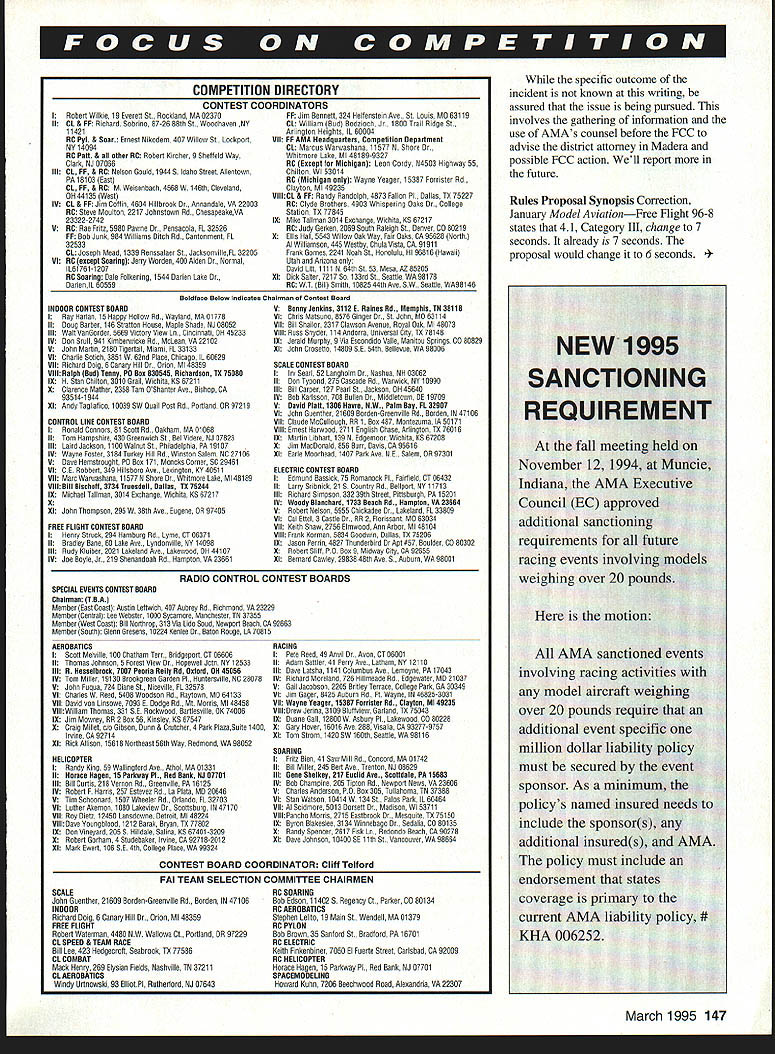
Tag: You may have heard about an incident involving what is purported to have been purposeful interference at the Madera races last fall. Evidence strongly suggests this possibility. The organizers of the races took swift and positive action. While the specific outcome of the incident is not known at this writing, the matter is being pursued. This involves the gathering of information and the use of AMA's counsel before the FCC to advise the district attorney in Madera and the possible FCC action. We'll report more in the future.
Rules Proposal Synopsis Correction: January Model Aviation — Free Flight 96-8 states that 4.1, Category III, changes to 7 seconds. It already is 7 seconds. The proposal would change it to 6 seconds.
---
FOCUS ON COMPETITION
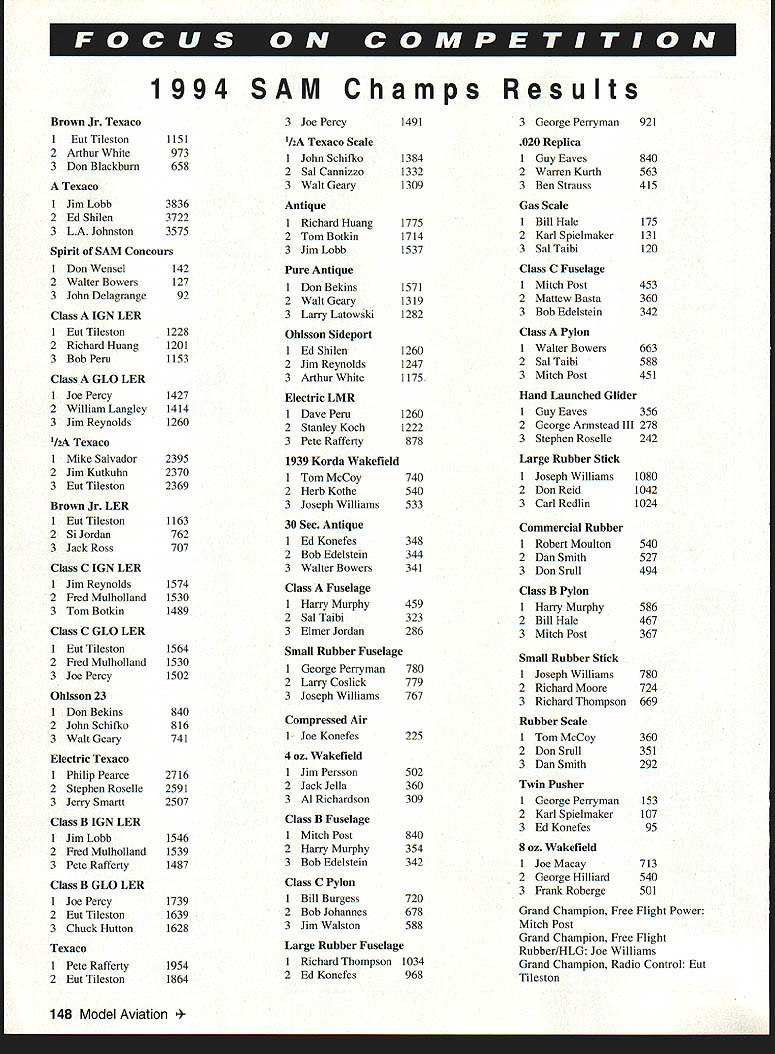
1994 SAM Champs Results
Brown Jr. Texaco
- 1. Eut Tileston — 1151
- 2. Arthur White — 973
- 3. Don Blackburn — 658
A Texaco
- 1. Jim Lobb — 3836
- 2. Ed Shilen — 3722
- 3. L.A. Johnston — 3575
Spirit of SAM Concours
- 1. Don Wensel — 142
- 2. Walter Bowers — 127
- 3. John Delagrange — 92
Class A IGN LER
- 1. Eut Tileston — 1228
- 2. Richard Huang — 1201
- 3. Bob Peru — 1153
Class A GLO LER
- 1. Joe Percy — 1427
- 2. William Langley — 1414
- 3. Jim Reynolds — 1260
1/2A Texaco
- 1. Mike Salvador — 2395
- 2. Jim Kutkuhn — 2370
- 3. Eut Tileston — 2369
Brown Jr. LER
- 1. Eut Tileston — 1163
- 2. Si Jordan — 762
- 3. Jack Ross — 707
Class C IGN LER
- 1. Jim Reynolds — 1574
- 2. Fred Mulholland — 1530
- 3. Tom Botkin — 1489
Class C GLO LER
- 1. Eut Tileston — 1564
- 2. Fred Mulholland — 1530
- 3. Joe Percy — 1502
Ohlsson 23
- 1. Don Bekins — 840
- 2. John Schifko — 816
- 3. Walt Geary — 741
Electric Texaco
- 1. Philip Pearce — 2716
- 2. Stephen Roselle — 2591
- 3. Jerry Smartt — 2507
Class B IGN LER
- 1. Jim Lobb — 1546
- 2. Fred Mulholland — 1539
- 3. Pete Rafferty — 1487
Class B GLO LER
- 1. Joe Percy — 1739
- 2. Eut Tileston — 1639
- 3. Chuck Hutton — 1628
Texaco
- 1. Pete Rafferty — 1954
- 2. Eut Tileston — 1864
- 3. Joe Percy — 1491
1/2A Texaco Scale
- 1. John Schifko — 1384
- 2. Sal Cannizzo — 1332
- 3. Walt Geary — 1309
Antique
- 1. Richard Huang — 1775
- 2. Tom Botkin — 1714
- 3. Jim Lobb — 1537
Pure Antique
- 1. Don Bekins — 1571
- 2. Walt Geary — 1319
- 3. Larry Latowski — 1282
Ohlsson Sideport
- 1. Ed Shilen — 1260
- 2. Jim Reynolds — 1247
- 3. Arthur White — 1175
Electric LMR
- 1. Dave Peru — 1260
- 2. Stanley Koch — 1222
- 3. Pete Rafferty — 878
1939 Korda Wakefield
- 1. Tom McCoy — 740
- 2. Herb Kothe — 540
- 3. Joseph Williams — 533
30 Sec. Antique
- 1. Ed Konefes — 348
- 2. Bob Edelstein — 344
- 3. Walter Bowers — 341
Class A Fuselage
- 1. Harry Murphy — 459
- 2. Sal Taibi — 323
- 3. Elmer Jordan — 286
Small Rubber Fuselage
- 1. George Perryman — 780
- 2. Larry Coslick — 779
- 3. Joseph Williams — 767
Compressed Air
- 1. Joe Konefes — 225
4 oz. Wakefield
- 1. Jim Persson — 502
- 2. Jack Jella — 360
- 3. Al Richardson — 309
Class B Fuselage
- 1. Mitch Post — 840
- 2. Harry Murphy — 354
- 3. Bob Edelstein — 342
Class C Pylon
- 1. Bill Burgess — 720
- 2. Bob Johannes — 678
- 3. Jim Walston — 588
Large Rubber Fuselage
- 1. Richard Thompson — 1034
- 2. Ed Konefes — 968
.020 Replica
- 1. Guy Eaves — 840
- 2. Warren Kurth — 563
- 3. Ben Strauss — 415
Gas Scale
- 1. Bill Hale — 175
- 2. Karl Spielmaker — 131
- 3. Sal Taibi — 120
Class C Fuselage
- 1. Mitch Post — 453
- 2. Matthew Basta — 360
- 3. Bob Edelstein — 342
Class A Pylon
- 1. Walter Bowers — 663
- 2. Sal Taibi — 588
- 3. Mitch Post — 451
Hand Launched Glider
- 1. Guy Eaves — 356
- 2. George Armstead III — 278
- 3. Stephen Roselle — 242
Large Rubber Stick
- 1. Joseph Williams — 1080
- 2. Don Reid — 1042
- 3. Carl Redlin — 1024
Commercial Rubber
- 1. Robert Moulton — 540
- 2. Dan Smith — 527
- 3. Don Srull — 494
Class B Pylon
- 1. Harry Murphy — 586
- 2. Bill Hale — 467
- 3. Mitch Post — 367
Small Rubber Stick
- 1. Joseph Williams — 780
- 2. Richard Moore — 724
- 3. Richard Thompson — 669
Rubber Scale
- 1. Tom McCoy — 360
- 2. Don Srull — 351
- 3. Dan Smith — 292
Twin Pusher
- 1. George Perryman — 153
- 2. Karl Spielmaker — 107
- 3. Ed Konefes — 95
8 oz. Wakefield
- 1. Joe Macey — 713
- 2. George Hilliard — 540
- 3. Frank Roberge — 501
Grand Champions
- Free Flight Power: Mitch Post
- Free Flight Rubber/HLG: Joe Williams
- Radio Control: Eut Tileston
---
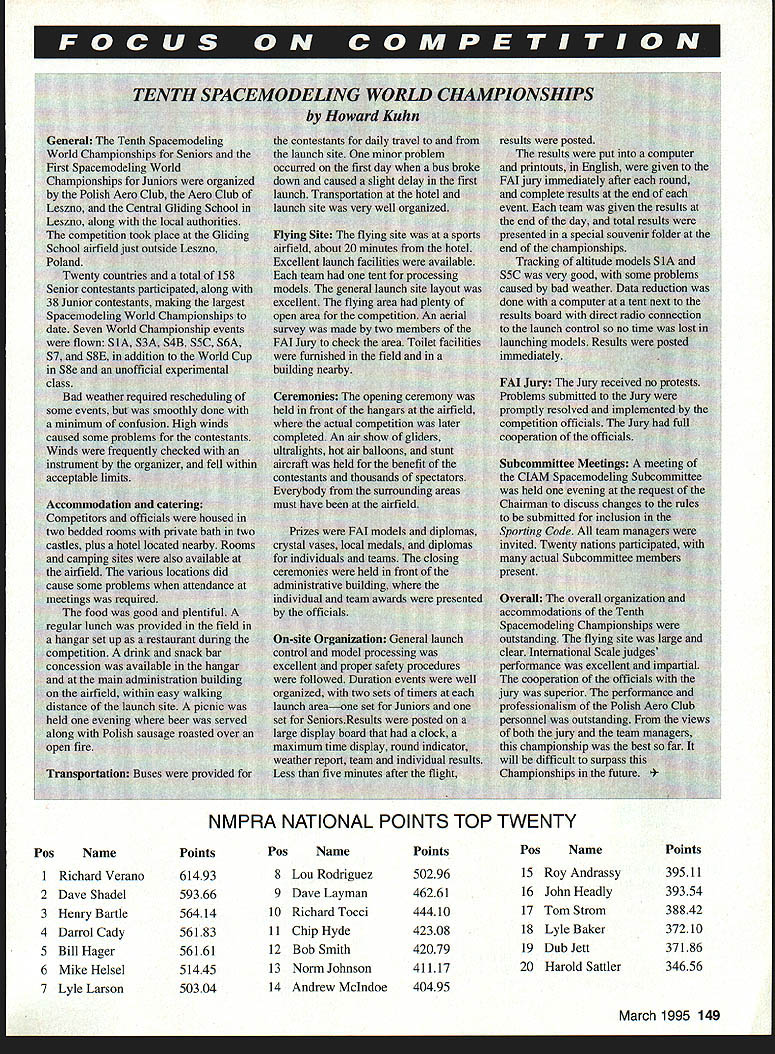
TENTH SPACEMODELING WORLD CHAMPIONSHIPS
by Howard Kuhn
General: The Tenth Spacemodeling World Championships for Seniors and the First Spacemodeling World Championships for Juniors were organized by the Polish Aero Club, the Aero Club of Leszno, and the Central Gliding School in Leszno, along with the local authorities. The competition took place at the Gliding School airfield just outside Leszno, Poland.
Twenty countries and a total of 158 Senior contestants participated, along with 38 Junior contestants, making the largest Spacemodeling World Championships to date. Seven World Championship events were flown: S1A, S3A, S4B, S5C, S6A, S7, and S8E, in addition to the World Cup in S8E and an unofficial experimental class.
Bad weather required rescheduling of some events, but this was smoothly done with a minimum of confusion. High winds caused some problems for the contestants; winds were frequently checked with an instrument by the organizer and fell within acceptable limits.
Accommodation and catering: Competitors and officials were housed in two-bedded rooms with private bath in two castles, plus a nearby hotel. Rooms and camping sites were also available at the airfield. The various locations did cause some problems when attendance at meetings was required.
The food was good and plentiful. A regular lunch was provided in the field in a hangar set up as a restaurant during the competition. A drink and snack bar concession was available in the hangar and at the main administration building on the airfield, within easy walking distance of the launch site. A picnic was held one evening where beer and Polish sausage roasted over an open fire were served.
Transportation: Buses were provided for the contestants for daily travel to and from the launch site. One minor problem occurred on the first day when a bus broke down and caused a slight delay in the first launch. Otherwise, transportation at the hotel and launch site was very well organized.
Flying Site: The flying site was at a sports airfield, about 20 minutes from the hotel. Excellent launch facilities were available. Each team had one tent for processing models. The general launch site layout was excellent and the flying area had plenty of open area for the competition. An aerial survey was made by two members of the FAI Jury to check the area. Toilet facilities were furnished in the field and in a nearby building.
Ceremonies: The opening ceremony was held in front of the hangars at the airfield, where the actual competition was later completed. An air show of gliders, ultralights, hot air balloons, and stunt aircraft was held for the benefit of the contestants and thousands of spectators. Prizes were FAI models and diplomas, crystal vases, local medals, and diplomas for individuals and teams. The closing ceremonies were held in front of the administrative building, where the individual and team awards were presented by the officials.
On-site Organization: General launch control and model processing were excellent and proper safety procedures were followed. Duration events were well organized, with two sets of timers at each launch area — one set for Juniors and one set for Seniors. Results were posted on a large display board that had a clock, a maximum time display, round indicator, weather report, team and individual results. Less than five minutes after the flight, results were posted.
The results were entered into a computer and printouts, in English, were given to the FAI jury immediately after each round, and complete results at the end of each event. Each team was given the results at the end of the day, and total results were presented in a special souvenir folder at the end of the championships.
FAI Jury: The Jury received no protests. Problems submitted to the Jury were promptly resolved and implemented by the competition officials. The Jury had full cooperation of the officials.
Subcommittee Meetings: A meeting of the CIAM Spacemodeling Subcommittee was held one evening at the request of the Chairman to discuss changes to the rules to be submitted for inclusion in the Sporting Code. All team managers were invited. Twenty nations participated, with many Subcommittee members present.
Overall: The overall organization and accommodations of the Tenth Spacemodeling Championships were outstanding. The flying site was large and clear. International Scale judges' performance was excellent and impartial. The cooperation of the officials with the jury was superior. The performance and professionalism of the Polish Aero Club personnel was outstanding. From the views of both the jury and the team managers, this championship was the best so far.
---
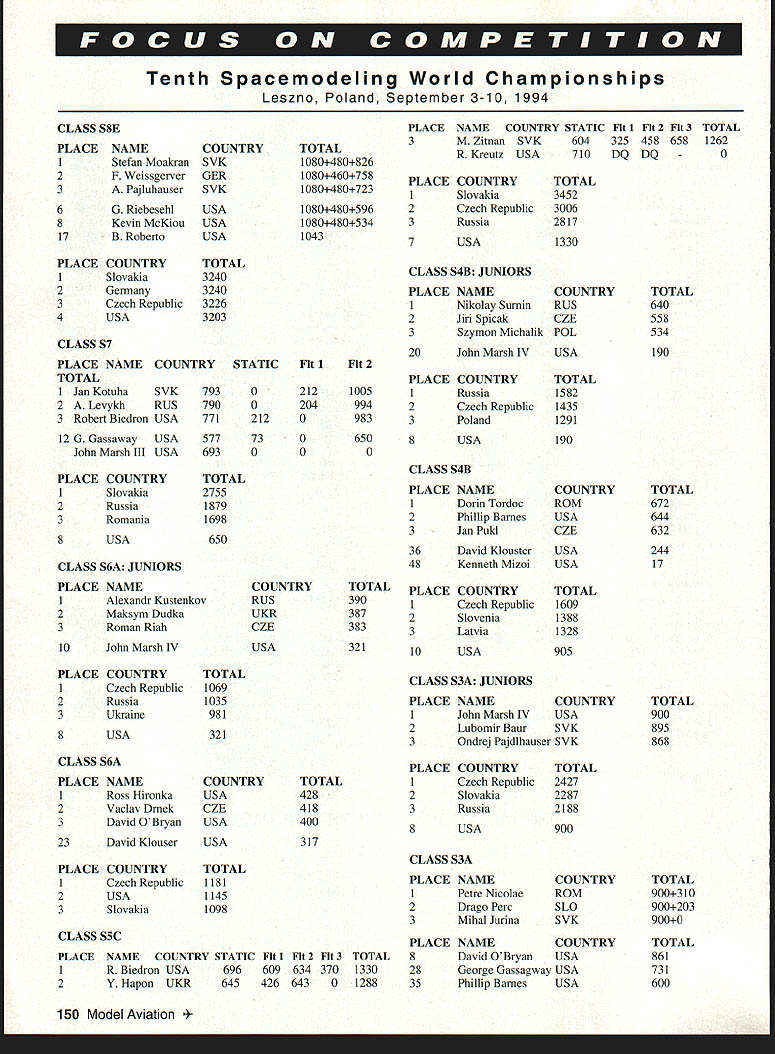
Focus on Competition
Tenth Spacemodeling World Championships
Leszno, Poland, September 3–10, 1994
CLASS S8E — Individual
- 1. Stefan Mokran (SVK) — 1080 + 480 + 826
- 2. F. Weissgerber (GER) — 1080 + 460 + 758
- 3. A. Paluhauser (SVK) — 1080 + 480 + 723
- 6. G. Riebesehl (USA) — 1080 + 480 + 596
- 8. Kevin McKiou (USA) — 1080 + 480 + 534
- 17. B. Roberto (USA) — 1043
CLASS S8E — Teams
- 1. Slovakia — 3240
- 2. Germany — 3240
- 3. Czech Republic — 3226
- 4. USA — 3203
CLASS S7 — Individual
- 1. Jan Kotuha (SVK) — Static 793, Flt1 0, Flt2 212, Total 1005
- 2. A. Levykh (RUS) — Static 793, Flt1 0, Flt2 204, Total 994
- 3. Robert Biedron (USA) — Static 771, Flt1 212, Flt2 0, Total 983
- 12. G. Gassaway (USA) — 577 + 73 + 0 = 650
- John Marsh III (USA) — Static 693, Flt1 0, Flt2 0, Total 0
CLASS S7 — Teams
- 1. Slovakia — 2755
- 2. Russia — 1879
- 3. Romania — 1698
- 8. USA — 650
CLASS S6A — Juniors — Individual
- 1. Alexandr Kustenkov (RUS) — 390
- 2. Maksym Dudka (UKR) — 387
- 3. Roman Riah (CZE) — 383
- 10. John Marsh IV (USA) — 321
CLASS S6A — Juniors — Teams
- 1. Czech Republic — 1069
- 2. Russia — 1035
- 3. Ukraine — 981
- 8. USA — 321
CLASS S6A — Individual
- 1. Ross Hironka (USA) — 428
- 2. Vaclav Drnek (CZE) — 418
- 3. David O'Bryan (USA) — 400
- 23. David Klouser (USA) — 317
CLASS S6A — Teams
- 1. Czech Republic — 1181
- 2. USA — 1145
- 3. Slovakia — 1098
CLASS S5C — Individual
- 1. R. Biedron (USA) — Static 696, Flt1 609, Flt2 634, Flt3 370, Total 1330
- 2. V. Hapon (UKR) — Static 645, Flt1 426, Flt2 643, Flt3 0, Total 1288
- 3. M. Zitnan (SVK) — Static 604, Flt1 325, Flt2 458, Flt3 658, Total 1262
- R. Kreutz (USA) — Static 710, DQ, DQ, 0, Total 0
CLASS S5C — Teams
- 1. Slovakia — 3452
- 2. Czech Republic — 3006
- 3. Russia — 2817
- 7. USA — 1330
CLASS S4B — Juniors
- 1. Nikolay Surnin (RUS) — 640
- 2. Jiri Spiciak (CZE) — 558
- 3. Szymon Michalik (POL) — 534
- 20. John Marsh IV (USA) — 190
CLASS S4B — Juniors — Teams
- 1. Russia — 1582
- 2. Czech Republic — 1435
- 3. Poland — 1291
- 8. USA — 190
CLASS S4B — Individual
- 1. Dorin Tordoc (ROM) — 672
- 2. Phillip Barnes (USA) — 644
- 3. Jan Pukl (CZE) — 632
- 36. David Klouster (USA) — 244
- 48. Kenneth Mizoi (USA) — 17
CLASS S4B — Teams
- 1. Czech Republic — 1609
- 2. Slovenia — 1388
- 3. Latvia — 1328
- 10. USA — 905
CLASS S3A — Juniors
- 1. John Marsh IV (USA) — 900
- 2. Lubomir Baur (SVK) — 895
- 3. Ondrej Pajdihauser (SVK) — 868
CLASS S3A — Juniors — Teams
- 1. Czech Republic — 2427
- 2. Slovakia — 2287
- 3. Russia — 2188
- 8. USA — 900
CLASS S3A — Individual
- 1. Petre Nicolae (ROM) — 900 + 310
- 2. Drago Perc (SLO) — 900 + 203
- 3. Mihai Jurina (SVK) — 900 + 0
CLASS S3A — Additional Placings
- 8. David O'Bryan (USA) — 861
- 28. George Gassaway (USA) — 731
- 35. Phillip Barnes (USA) — 600
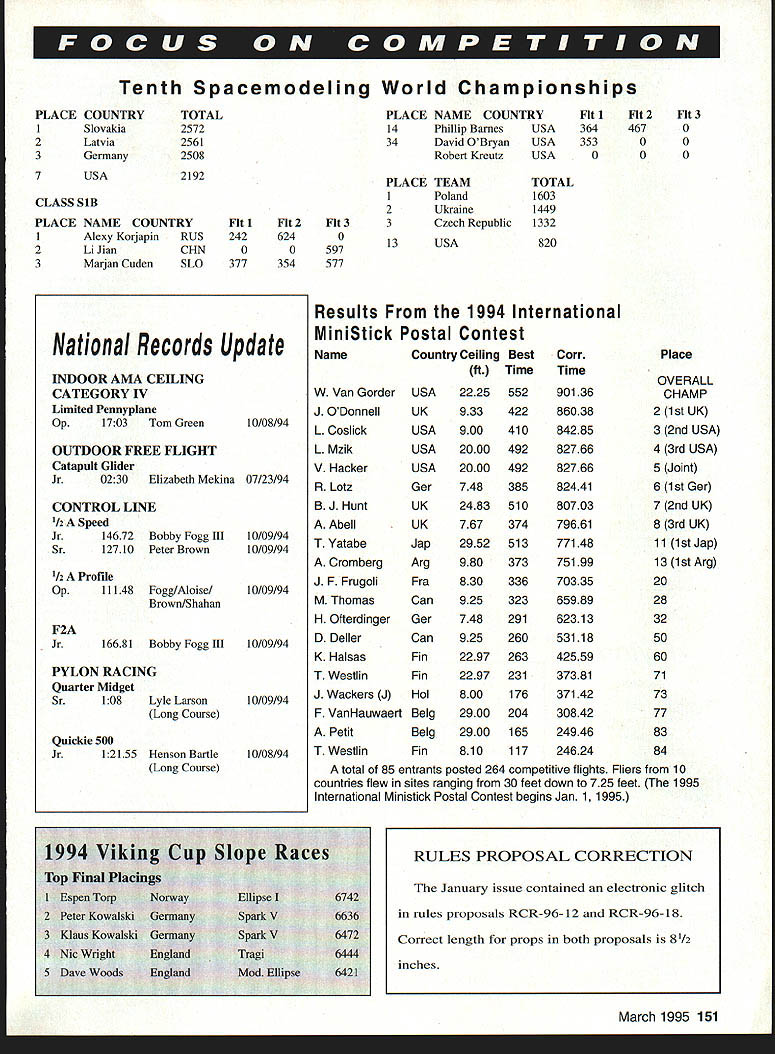
Overall Team Placings (additional summary)
- 1. Slovakia — 2572
- 2. Latvia — 2561
- 3. Germany — 2508
- 7. USA — 2192
CLASS S1B — Individual
- 1. Alexey Korjapin (RUS) — Flt1 242, Flt2 624, Flt3 0
- 2. Li Jian (CHN) — Flt1 0, Flt2 0, Flt3 597
- 3. Marjan Cuden (SLO) — Flt1 377, Flt2 354, Flt3 577
CLASS S1B — Additional Placings
- 14. Phillip Barnes (USA) — 364, 467, 0
- 34. David O'Bryan (USA) — 353, 0, 0
- 35. Robert Kreutz (USA) — 0, 0, 0
CLASS S1B — Teams
- 1. Poland — 1603
- 2. Ukraine — 1449
- 3. Czech Republic — 1332
- 13. USA — 820
---
National Records Update
INDOOR AMA CEILING
- CATEGORY IV — Limited Pennyplane
- Op. 17:03 Tom Green — 10/08/94
OUTDOOR FREE FLIGHT
- Catapult Glider Jr. — 02:30 Elizabeth Mekina — 07/23/94
CONTROL LINE
- 1/2 A Speed
- Jr. 146.72 Bobby Fogg III — 10/09/94
- Sr. 127.10 Peter Brown — 10/09/94
- 1/2 A Profile
- Op. 111.48 Fogg/Aloise/Brown/Shahan — 10/09/94
- F2A
- Jr. 166.81 Bobby Fogg III — 10/09/94
PYLON RACING
- Quarter Midget Sr. (Long Course) — 1:08 Lyle Larson — 10/09/94
- Quickie 500 Jr. (Long Course) — 1:21.55 Henson Bartle — 10/08/94
---
Results From the 1994 International MiniStick Postal Contest
A total of 85 entrants posted 264 competitive flights. Fliers from 10 countries flew in sites ranging from 30 feet down to 7.25 feet. (The 1995 International Ministick Postal Contest begins Jan. 1, 1995.)
Top placings:
- W. Van Gorder (USA) — Ceiling 22.25 ft, Best Time 552, Corr. Time 901.36 — OVERALL CHAMP
- J. O'Donnell (UK) — Ceiling 9.32 ft, Best Time 422, Corr. Time 860.38 — 2 (1st UK)
- L. Coslick (USA) — Ceiling 9.00 ft, Best Time 410, Corr. Time 842.85 — 3 (2nd USA)
- L. Mzik (USA) — Ceiling 20.00 ft, Best Time 492, Corr. Time 827.66 — 4 (3rd USA)
- V. Hacker (USA) — Ceiling 20.00 ft, Best Time 492, Corr. Time 827.66 — 5 (joint)
- R. Lotz (GER) — Ceiling 7.48 ft, Best Time 385, Corr. Time 824.41 — 6 (1st GER)
- B. J. Hunt (UK) — Ceiling 24.83 ft, Best Time 510, Corr. Time 807.03 — 7 (2nd UK)
- A. Abell (UK) — Ceiling 7.67 ft, Best Time 374, Corr. Time 796.61 — 8 (3rd UK)
- T. Yatabe (JPN) — Ceiling 29.52 ft, Best Time 513, Corr. Time 771.48 — 11 (1st JPN)
- A. Cromberg (ARG) — Ceiling 9.80 ft, Best Time 373, Corr. Time 751.99 — 13 (1st ARG)
Other finishers included J. F. Frugoli (FRA), M. Thomas (CAN), H. Ofterdinger (GER), D. Deller (CAN), K. Halssas (FIN), T. Westlin (FIN), J. Wackers (HOL), F. VanHauwaert (BELG), A. Petit (BELG), among others.
---
1994 Viking Cup Slope Races
Top Final Placings
- 1. Espen Torp (Norway) — Ellipse I — 6742
- 2. Peter Kowalski (Germany) — Spark V — 6636
- 3. Klaus Kowalski (Germany) — Spark V — 6472
- 4. Nic Wright (England) — Tragi — 6444
- 5. Dave Woods (England) — Mod. Ellipse — 6421
---
RULES PROPOSAL CORRECTION
The January issue contained an electronic glitch in rules proposals RCR-96-12 and RCR-96-18. Correct length for props in both proposals is 8-1/2 inches.
Transcribed from original scans by AI. Minor OCR errors may remain.

