
Focus on Competition
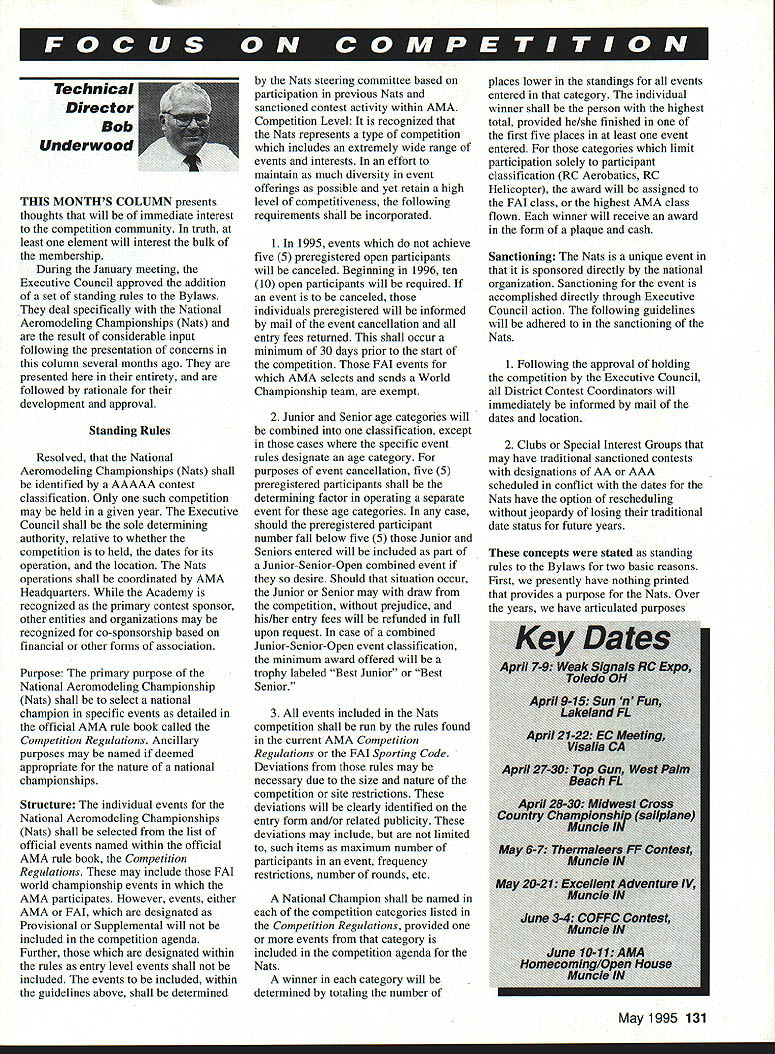
Technical Director Bob Underwood
This month's column presents thoughts of immediate interest to the competition community and, in truth, elements that will interest the bulk of the membership. During the January meeting, the Executive Council approved the addition of a set of standing rules to the Bylaws dealing specifically with the National Aeromodeling Championships (Nats). These rules are the result of considerable input following concerns presented in this column several months ago. They are presented here in their entirety, followed by the rationale for their development and approval.
Standing Rules
Resolved, that the National Aeromodeling Championships (Nats) shall be identified as an AAAAA contest classification. Only one such competition may be held in a given year. The Executive Council shall be the sole determining authority relative to whether the competition is to be held, the dates for its operation, and the location. Nats operations shall be coordinated by AMA Headquarters. While the Academy shall be recognized as the primary contest sponsor, other entities and organizations may be recognized for co-sponsorship based on financial or other forms of association.
Purpose
The primary purpose of the National Aeromodeling Championships (Nats) shall be to select a national champion in specific events as detailed in the official AMA rule book called the Competition Regulations. Ancillary purposes may be named if deemed appropriate for the nature of a national championship.
Structure
The individual events for the National Aeromodeling Championships (Nats) shall be selected from the list of official events named within the official AMA rule book, the Competition Regulations. These may include those FAI world championship events in which the AMA participates. However, events, either AMA or FAI, which are designated as Provisional or Supplemental will not be included in the competition agenda. Further, those designated within the rules as entry-level events shall not be included. The events to be included, within the guidelines above, shall be determined by the Nats Steering Committee based on participation in previous Nats and sanctioned contest activity within AMA.
Competition Level: The Nats represents a type of competition that includes an extremely wide range of events and interests. In an effort to maintain as much diversity in event offerings as possible, and yet retain a high level of competitiveness, the following requirements shall be incorporated.
- In 1995, events that do not achieve five (5) preregistered open participants will be canceled. Beginning in 1996, ten (10) open participants will be required. If an event is to be canceled, those individuals preregistered will be informed by mail of the event cancellation and all entry fees returned. This shall occur a minimum of 30 days prior to the start of the competition. FAI events for which AMA selects and sends a World Championship team are exempt.
- Junior and Senior age categories will be combined into one classification, except in those cases where the specific event rules designate an age category. For purposes of event cancellation, five (5) preregistered participants shall be the determining factor in operating a separate event for these age categories. Should the preregistered participant number fall below five (5), those Juniors and Seniors entered will be included as part of a Junior-Senior-Open combined event if they so desire. In that case, the Junior or Senior may withdraw from the competition without prejudice, and his/her entry fees will be refunded in full upon request. In the case of a combined Junior-Senior-Open event classification, the minimum award offered will be a trophy labeled "Best Junior" or "Best Senior."
- All events included in the Nats competition shall be run by the rules found in the current AMA Competition Regulations or the FAI Sporting Code. Deviations from those rules may be necessary due to the size and nature of the competition or site restrictions. These deviations will be clearly identified on the entry form and/or related publicity. Deviations may include, but are not limited to, such items as maximum number of participants in an event, frequency restrictions, number of rounds, etc.
A National Champion shall be named in each of the competition categories listed in the Competition Regulations, provided one or more competitors from that category is included in the competition agenda for the Nats.
A winner in each category will be determined by totaling the number of places lower in the standings for all events entered in that category. The individual winner shall be the person with the highest total, provided he or she finished in one of the first five places in at least one event entered. For those categories which limit participation solely to participant classification (RC Aerobatics, RC Helicopter), the award will be assigned to the FAI class, or the highest AMA class flown. Each winner will receive an award in the form of a plaque and cash.
Sanctioning
The Nats is a unique event in that it is sponsored directly by the national organization. Sanctioning for the event is accomplished directly through Executive Council action. The following guidelines will be adhered to in the sanctioning of the Nats.
- Following the approval of holding the competition by the Executive Council, all District Contest Coordinators will immediately be informed by mail of the dates and location.
- Clubs or Special Interest Groups that may have traditional sanctioned contests with designations of AA or AAA scheduled in conflict with the dates for the Nats have the option of rescheduling without jeopardy of losing their traditional date status for future years.
These standing rules were added for two basic reasons. First, there is presently nothing printed that provides a formal purpose for the Nats. Over the years we have articulated purposes in various places, but these standing rules provide a formal, permanent statement. Second, questions and requests for Nats-like activities under AA or AAA designations have increased. The standing rules clearly define what a Nats is, why it exists, and how it will be managed, providing a basis for future action.
During Executive Council meetings we have sometimes wandered in purpose, depending upon the needs and individual interpretations at the time of discussion. The concepts presented here were gleaned from more than 80 pages of text in letters received by your Technical Director, phone calls, dialogue with the Nats Committee, letters to Model Aviation, and newsletters. I emphatically state that in no way do I claim this to be the definitive set of rules. They were, in fact, modified upon counsel after their first reading at the November 1994 meeting. By placing these relatively general guidelines within the standing rules, they may be easily refined; long periods of intricate activity are not necessary to effect a change. They can receive direct input and modification at any regular Executive Council meeting.
Most elements are self-explanatory and fit our present standard practices; two points may prompt questions: event cancellation and category champions. While the category champion concept is straightforward, it will require careful bookwork — and this year in particular, some delay in naming the individual due to the time frame for holding some events.
The event cancellation section will, of course, evoke comment. When CL and RC Scale events were canceled in 1994, a significant number of individuals expressed displeasure. Interestingly, many who voiced concern did so not because they disagreed with the concept, but because they interpreted the words on page 2 of the Competition Regulations as stating that cancellation could not be done under any circumstances.
It will not serve any constructive purpose to reopen that debate here. However, the rationale for including a cancellation concept in the standing rules should be addressed.
First, there is the issue of competition level. Respondents over the last few months have virtually all agreed that a national championship should feature only meaningful levels of competition and that small numbers "do not a championship make." Second, there is an element of economics involved. It has been argued that the inclusion of lesser-populated events may encourage attendees to fly many multiple events rather than just one or two, possibly increasing revenue. That premise remains to be proven, as does whether any additional expenses are offset.
How do we resolve the event cancellation conflict? The following has been introduced as an Urgent Rule Proposal:
Urgent Rule Proposal — Cancellation Due to Low Entry
Replace present text with the following:
"Cancellation of an advertised event on the day of the contest, because of low entry, may not be done. A participant who has shown intent to fly in an advertised event must be permitted to enter an event which includes that class of model originally advertised. In instances where pre-entry is required, cancellation of an event due to low entry may occur only if 45 days exist between the pre-entry deadline and the contest. Upon cancellation of an event or events, the contest management shall be required to inform those pre-entered individuals of the cancellation by mail."
Note there are safety valves inserted in the proposal. You will also note a discrepancy in the cutoff between the standing rules (30 days) and the cancellation proposal (45 days). That facilitates postmark deadlines and actually getting letters in the mail. While we are generally addressing large events that require pre-entry, we have not placed the competitor in jeopardy of showing up and having the event canceled that day due to low entry.
For those not conversant with the Contest Board Rule Proposal process, an Urgent Proposal is treated as follows:
- "An Urgent Proposal is one which is neither an interpretation nor is it necessarily related to safety. It constitutes an actual change in the rules and therefore the justification for this type of proposal must be very closely scrutinized to prevent abuse."
- The proposal is forwarded to the Contest Board Coordinator after a screening process. It is then submitted to Model Aviation for publication and a copy sent to the Contest Boards, along with opinions available. The boards then vote for a choice of:
- A. Immediate Action, or
- B. Denial of Immediate Action.
If 60% favor Immediate Action, a vote is taken four to six weeks after publication to ratify or reject the proposal. If ratified, it is forwarded for inclusion in the next rulebook. If not, it is returned to the person who submitted it for possible action in the next rule cycle.
One additional clarification: certain parts of the rulebook fall within the jurisdiction of the Contest Boards, others are the responsibility of the Executive Council, and still others are assigned to EC/CB. Past reviews of these jurisdictional arrangements by attorneys clearly indicate that the Executive Council must retain "residual plenary power." In layman's terms, the Executive Council possesses overriding, final authority in matters. During my tenure as Technical Director, we have worked diligently to prevent any such overriding vote, and it is noteworthy that negotiations have always prevented such activity.
In conclusion, we are trying to work with all parties to facilitate a change in how we look at the Nats. Nobody seems to deny that change is necessary; the degree and nature are a matter of discussion. The standing rules are a stepping-stone for debate and change. Pride of authorship is not the issue; the important concept is that there must be something to work with, and its very presence commands further action.
One last item: elements of conjecture regarding the 1996 Nats were clarified by further Executive Council action at the January meeting. A plan was proposed and approved that would result in the necessary development of the National Flying Site, making it possible to run all of the events (sans Indoor) at the Muncie site. Granted, it will necessitate a longer time frame than usual, but now we can get busy planning the schedule, working with Special Interest Groups, and all that good stuff.
Nats — Muncie '96. Will you be there?
Technical Director Bob Underwood
World Championships Report
The pilots accelerated quickly entering the course, which allowed the Americans to fly a low-climb (6–8 second motor run) four-lap cycle. The models were more visible and the turns could be called more accurately.
After six rounds (with the throwaway dropped), Freudenthaler was leading Bridgeman by 6 points out of 3,600, and the championships would be determined by the seventh and final round. The wind was more than 30 mph and rain squalls were moving through the area.
Bridgeman was called to fly first and flew a flawless round with 602 points using the low-climb technique. Freudenthaler elected to fly the high-climb six-lap cycle and lost concentration or visibility, cutting a pylon and losing valuable time. His final score was 561 points and Bridgeman was the new world champion of F5B. The US team won the silver medal, with Austria winning the gold and Germany winning the bronze.
This was the first world championships for F5D Electric Pylon Racing, as the FAI had just approved the event at this year's Paris meeting. The US team was a volunteer team, as time did not permit a team selection program. Steve Condon, Larry Jolly, and Darryl Perkins were not considered novices to pylon racing.
The German team of Bartels, Merz, and Schambeck had to be seen to be believed. Their models were immaculate, and in typical German fashion, their model box weighed 220 lb and carried everything: 15 complete models, 45 propellers, four complete charging stations with internal cooling, and all necessary tools and repair items.
Eleven rounds were flown, with two throwaway rounds. The German team won the individual gold, silver, and bronze medals and the team gold medal. The US team won the silver and the Australians won the bronze.
Considering that this was the Americans' first chance to see what international competition is all about, they learned a lot and will be very competitive the next time in Czechoslovakia. Congratulations to all the members of both teams for a job well done and for the professional way in which both teams performed.
Championships Results
F5B World Championships — Individual
- 1) J. Bridgeman (USA) 3,631
- 2) R. Freudenthaler (AUT) 3,620
- 3) W. Schaffer (GER) 3,617
- 6) S. Neu (USA) 3,556
- 14) R. Sliff (USA) 3,462
F5B World Championships — Team
- 1) Austria 10,689
- 2) United States 10,649
- 3) Germany 10,571
F5D World Championships — Individual
- 1) F. Schambeck (GER) 901.6
- 2) S. Merz (GER) 913.9
- 3) J. Bartels (GER) 933.5
- 5) L. Jolly (USA) 1,004.2
- 8) S. Condon (USA) 1,059.9
- 9) D. Perkins (USA) 1,068.0
F5D World Championships — Team
- 1) Germany 2,749.0
- 2) United States 3,132.1
- 3) Austria 3,705.3
Transcribed from original scans by AI. Minor OCR errors may remain.

