
Focus on Competition
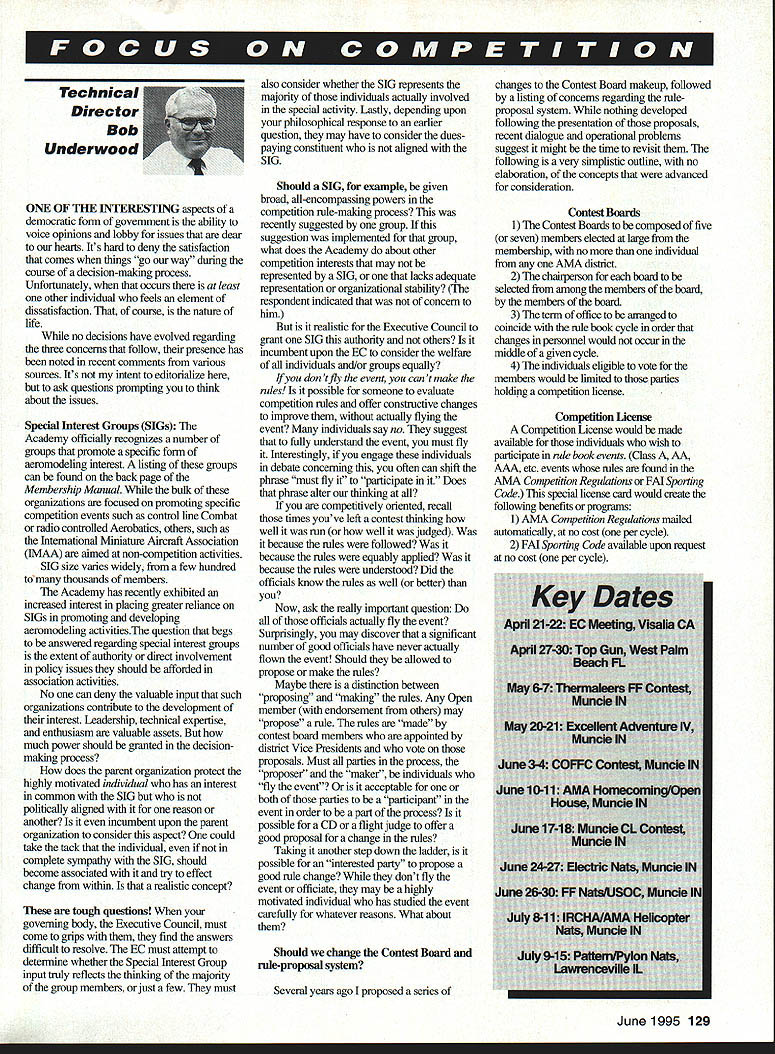
Technical Director Bob Underwood
One of the interesting aspects of a democratic form of government is the ability to voice opinions and lobby for issues that are dear to our hearts. It's hard to deny the satisfaction that comes when things "go our way" during a decision-making process. Unfortunately, when that occurs at least one other individual often feels an element of dissatisfaction. That, of course, is the nature of life.
While no decisions have evolved regarding the concerns that follow, they have been noted in recent comments from various sources. It is not my intent to editorialize here, but to ask questions that prompt you to think about these issues.
Special Interest Groups (SIGs)
The Academy officially recognizes a number of groups that promote specific forms of aeromodeling interest. A listing of these groups can be found on the back page of the Membership Manual. Many of these organizations focus on promoting specific competition events (for example, control-line Combat or radio-controlled Aerobatics); others, such as the International Miniature Aircraft Association (IMAA), are aimed at non-competition activities. SIG size varies widely, from a few hundred to many thousands of members.
The Academy has recently shown an increased interest in placing greater reliance on SIGs to promote and develop aeromodeling activities. The question that begs to be answered is: to what extent should authority or direct involvement in policy issues be afforded to SIGs within association activities?
No one can deny the valuable input these organizations contribute: leadership, technical expertise, and enthusiasm are valuable assets. But how much power should be granted in the decision-making process? How does the parent organization protect the highly motivated individual who shares the SIG's interest but is not politically aligned with it? Is it incumbent upon the parent organization to consider this aspect, or should the individual join the SIG and attempt change from within? Is that realistic?
These are tough questions. When your governing body, the Executive Council (EC), must confront them, the answers are difficult to resolve. The EC must attempt to determine whether SIG input truly reflects the thinking of the majority of the group's members or only a few. They must also consider whether the SIG represents the majority of those actually involved in the special activity. Lastly, depending on your philosophical response to the earlier question, they may have to consider the dues-paying constituent who is not aligned with the SIG.
Should a SIG, for example, be given broad, all-encompassing powers in the competition rule-making process? This was recently suggested by one group. If implemented for that group, what does the Academy do about other competition interests that are not represented by a SIG or are represented by a SIG that lacks adequate representation or organizational stability? Is it realistic for the Executive Council to grant one SIG this authority and not others? Is it incumbent upon the EC to consider the welfare of all individuals and groups equally?
Must you fly the event to make the rules?
A common refrain is: "If you don't fly the event, you can't make the rules." Is it possible for someone to evaluate competition rules and offer constructive changes to improve them without actually flying the event? Many individuals say no; they suggest that to fully understand an event you must fly it. Interestingly, in debate the phrase "must fly" is often shifted to "must participate." Does that change our thinking?
If you are competitively oriented, recall times you left a contest thinking it was well run or well judged. Was that because the rules were followed, equably applied, and understood? Did the officials know the rules as well as or better than you? Now ask the important question: do all those officials actually fly the event? You may find that a significant number of good officials have never flown the event. Should they be allowed to propose or make rules?
Maybe there is a distinction between "proposing" and "making" the rules. Any Open member (with endorsement from others) may propose a rule. The rules are "made" by contest board members who are appointed by district Vice Presidents and who vote on those proposals. Must all parties in the process — the "proposer" and the "maker" — be individuals who fly the event? Or is it acceptable for one or both parties to be participants rather than flyers? Is it possible for a contest director (CD) or a flight judge to offer a good proposal for change? What about an interested party who neither flies the event nor officiates but has studied the event carefully and is highly motivated?
Should we change the Contest Board and rule-proposal system to address these questions?
Contest Boards (proposed outline)
Several years ago I proposed a series of changes to the Contest Board makeup, followed by a listing of concerns regarding the rule-proposal system. While nothing developed following that presentation, recent dialogue and operational problems suggest it might be time to revisit them. The following is a simple outline of the concepts that were advanced for consideration:
- The Contest Boards should be composed of five (or seven) members elected at large from the membership, with no more than one individual from any one AMA district.
- The chairperson for each board should be selected from among the board members by the board.
- Terms of office should be arranged to coincide with the rule book cycle so that changes in personnel do not occur in the middle of a cycle.
- The individuals eligible to vote for the members should be limited to those holding a competition license.
Competition License (proposed)
A Competition License would be made available for individuals who wish to participate in rule-book events (Class A, AA, AAA, etc., whose rules are found in the AMA Competition Regulations or the FAI Sporting Code). This special license card would create the following benefits or protections:
- AMA Competition Regulations mailed automatically at no cost (one per cycle).
- FAI Sporting Code available upon request at no cost (one per cycle).
- Twice-a-year newsletter containing AMA and FAI updates (changes, clarifications, etc.).
- Allowing for a face-to-face contest board meeting, if necessary, each cycle.
- Improved readability of the AMA Competition Regulations.
- Recording of contest classifications at Activity Headquarters (Pattern, Helicopter, Scale, etc.).
- Input of contest results data to determine accurate competition information.
Rules Proposal Procedures
The current Rules Proposal System has been the subject of considerable concern in recent years. Beyond the fact that the current schedule is not workable due to publication timelines, a host of other concerns are evident, including:
- Lack of definitive procedures for changing rules.
- Lack of clarity regarding authority levels for chairpersons.
- Unclear authority lines and subgroups of the boards, as well as their relationship to the Executive Council and Special Interest Groups.
This last group of concerns raises many questions. Should we seriously consider a comprehensive overhaul of both the Contest Boards and the Rules Proposal Procedures? Are some of the earlier suggestions viable options to consider? Nearly twelve years have passed since a combined Executive Council/Contest Board Chairperson meeting was convened to review the Procedures. Is it time to hold another?
Would a face-to-face meeting of the Contest Boards help us break through the serious communication problem we currently have? Would it be helpful to have detailed competition information available? There are budgetary concerns related to several suggestions. Are items such as rule books, face-to-face meetings, computer inputting, etc., worth a small fee—say $5—for a special Competition License? What other benefits or services might be made available? What other procedural changes to programs or documents would be helpful?
We have entered an era of significant change within the Academy. In years of rapid association growth the task was often to manage the mundane and keep our heads above water. With the emergence of a new mission statement and vision, we must develop a common approach to our problems and goals.
Due to time restraints, it is not easy to manage a large organization with volunteer leadership, especially when interests are varied. It’s imperative that we carefully study where we are, where we are going, and form a firm alliance based on our common bond: the enjoyment of building and flying model aircraft.
Transcribed from original scans by AI. Minor OCR errors may remain.

