
Focus on Competition
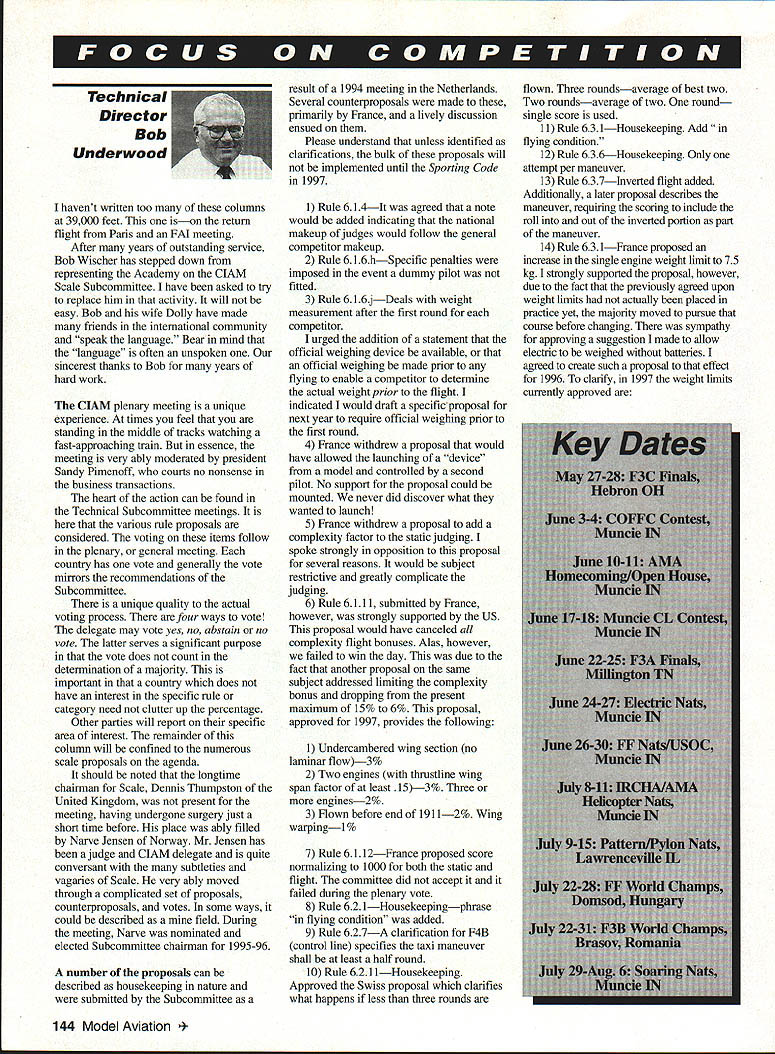
Technical Director
Bob Underwood
I haven't written too many of these columns at 39,000 feet. This one is — on the return flight from Paris and an FAI meeting.
After many years of outstanding service, Bob Wischer has stepped down from representing the Academy on the CIAM Scale Subcommittee. I have been asked to try to replace him in that activity. It will not be easy. Bob and his wife Dolly have made many friends in the international community and "speak the language." Bear in mind that the "language" is often an unspoken one. Our sincerest thanks to Bob for many years of hard work.
The CIAM plenary meeting is a unique experience. At times you feel that you are standing in the middle of tracks watching a fast-approaching train. In essence, the meeting is very ably moderated by president Sandy Pimenoff, who courts no nonsense in the business transactions.
The heart of the action can be found in the Technical Subcommittee meetings. It is here that the various rule proposals are considered. The voting on these items follows in the plenary (general meeting). Each country has one vote and generally the vote mirrors the recommendations of the Subcommittee.
There is a unique quality to the actual voting process. There are four ways to vote: yes, no, abstain, or no vote. The latter serves a significant purpose in that the vote does not count in determination of a majority. This is important: a country that does not have an interest in a specific rule or category need not clutter up the percentage. Other parties will report on their specific area of interest. The remainder of this column is confined to the numerous Scale proposals on the agenda.
It should be noted that the longtime chairman for Scale, Dennis Thumpston of the United Kingdom, was not present for the meeting, having undergone surgery just a short time before. His place was ably filled by Narve Jensen of Norway. Mr. Jensen has been a judge and CIAM delegate and is quite conversant with the many subtleties and vagaries of Scale. He very ably moved through a complicated set of proposals, counterproposals and votes. In some ways, it could be described as a mine field. During the meeting, Narve was nominated and elected Subcommittee chairman for 1995–96.
A number of the proposals can be described as housekeeping in nature and were submitted by the Subcommittee as a result of a 1994 meeting in the Netherlands. Several counterproposals were made to these, primarily by France, and a lively discussion ensued.
Please understand that unless identified as clarifications, the bulk of these proposals will not be implemented until the Sporting Code in 1997.
- Rule 6.1.4 — It was agreed that a note would be added indicating that the national makeup of judges would follow the general competitor makeup.
- Rule 6.1.6.h — Specific penalties were imposed in the event a dummy pilot was not fitted.
- Rule 6.1.6.j — Deals with weight measurement after the first round for each competitor. I urged the addition of a statement that official weighing be available, or that an official weighing be made prior to any flying to enable a competitor to determine the actual weight prior to the flight. I indicated I would draft a specific proposal next year to require official weighing prior to the first round.
- France withdrew a proposal that would have allowed the launching of a "device" from a model and controlled by a second pilot. No support for the proposal could be mounted. We never did discover what they wanted to launch.
- France withdrew a proposal to add a complexity factor to the static judging. I spoke strongly in opposition to this proposal for several reasons: it would be subjective, restrictive and would greatly complicate the judging.
- Rule 6.1.11 — Submitted by France, however strongly supported by the US, this proposal would have canceled all complexity flight bonuses. We failed to win the day because another proposal on the same subject addressed limiting the complexity bonus, dropping the present maximum of 15% to 6%. This proposal, approved for 1997, provides the following:
- Undercambered wing section (no laminar flow) — 3%
- Two engines (with thrustline wing span factor of at least .15) — 3%; three or more engines — 2%
- Flown before end of 1911 — 2%
- Wing warping — 1%
- Rule 6.1.12 — France proposed score normalizing to 1000 for both the static and flight. The committee did not accept it and it failed during the plenary vote.
- Rule 6.2.1 — Housekeeping: phrase "in flying condition" was added.
- Rule 6.2.7 — A clarification for F4B (control line) specifies the taxi maneuver shall be at least a half round.
- Rule 6.2.11 — Housekeeping. Approved the Swiss proposal which clarifies what happens if less than three rounds are flown:
- Three rounds — average of best two
- Two rounds — average of two
- One round — single score is used
- Rule 6.3.1 — Housekeeping. Add "in flying condition."
- Rule 6.3.6 — Housekeeping. Only one attempt per maneuver.
- Rule 6.3.7 — Inverted flight added. Additionally, a later proposal describes that the maneuver requiring scoring include the roll into and out of the inverted portion as part of the maneuver.
- Rule 6.3.1 — France proposed an increase in the single-engine weight limit to 7.5 kg. I strongly supported the proposal; however, because the previously agreed-upon weight limits had not actually been placed into practice yet, the majority moved to pursue that course before changing. There was sympathy for approving a suggestion I made to allow electric models to be weighed without batteries. I agreed to create such a proposal for 1996. To clarify, the weight limits currently approved for 1997 are:
- Single engine: 7 kg
- Electric: 7.5 kg
- Twin-engine: 8 kg
- More than two engines: 9 kg
- Judges' guide — Scale Subcommittee states that 20 minutes "should" be available for static judging (we debated "should" or "must" for 20 minutes!).
- Judges' guide — France proposed a statement that static judges will "discuss each item as a team and attempt to arrive at a unanimously agreed score for each item, although each will retain the right to differ." I still feel you can't serve both masters, but the rule is there.
- Organizer's Guide — For F4B a safety area was added around the flight circle.
- A host of housekeeping items:
a. Rule 6.2.7.9 (F4B) — Taxi demo must occur after flight. b. Wind direction removed from F4C manoeuvres. c. 6.3.7.p — Simple maneuvers such as procedure turn, climbing turn, descending turn are not acceptable for aerobatic-type aircraft. d. Rule 6.3.6.1 — If the model flies with retractable gear down, the total flight score shall be reduced by 10%.
- In the supplement to the Sporting Code, changes were made to the specifications for large RC Flying Scale. The dummy pilot is included in the overall weight and references to minimum weight were deleted.
- A completely rewritten set of Peanut Scale rules were adopted and an overly complicated set of outdoor rubber scale rules were rejected.
All in all, a few significant advances were made in opening up the rules. However, it must be remembered that the Sporting Code operates on a four-year cycle. The next book is 1997. Next year will be the last opportunity to modify the 1997 book.
I intend to write up several proposals for next year and will distribute them to the Scale community. Input from the field would be most helpful. I also have a copy of the preliminary bulletin for the World Championships in France next year. If you would like a copy, contact me at Box 40, St. Peters, MO 63376; Tel: (314) 447-4235 or contact Teresa McKee at AMA Headquarters.
Lambert International is about an hour away. The movie Stargate interjected itself into the writing of this column. However, we were able to drag the document back through the time warp with us. Let's hope we will be able to share some time this August when we select the F4B and F4C teams for the 1996 World Championships in France.
Building a Scale model to the rigid FAI specifications is a real challenge. However, there is great satisfaction in creating an FAI model. Participation on an international level results in many rewards — especially the friendships with kindred souls all over the world.
Transcribed from original scans by AI. Minor OCR errors may remain.

