
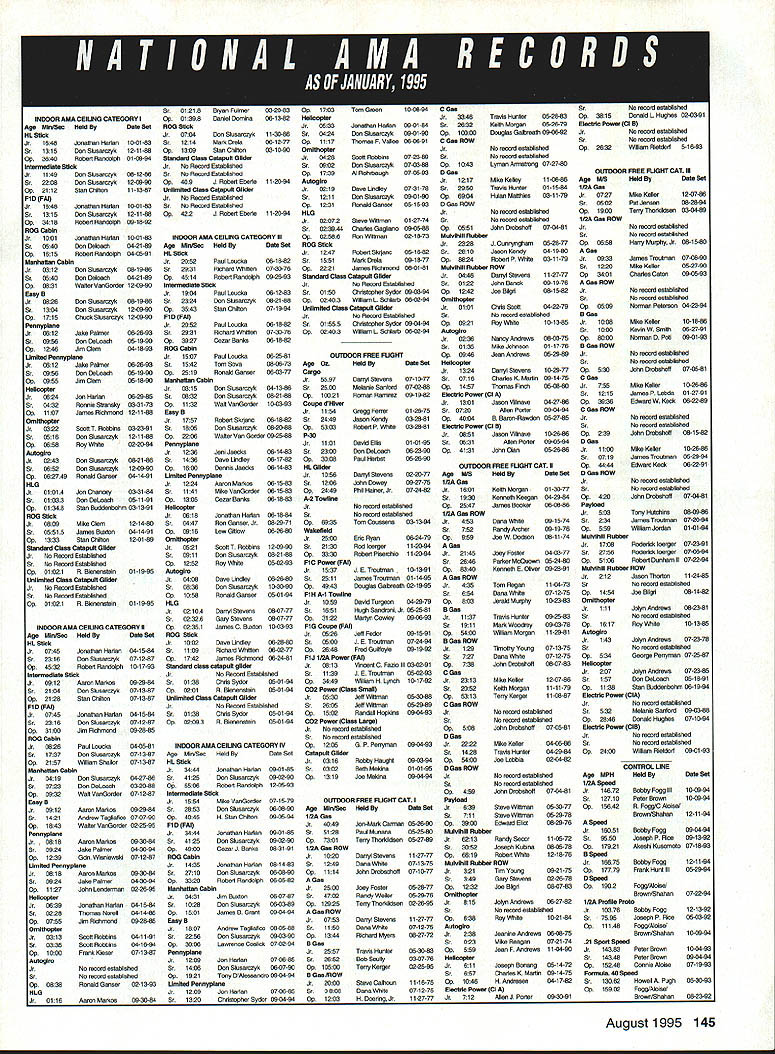
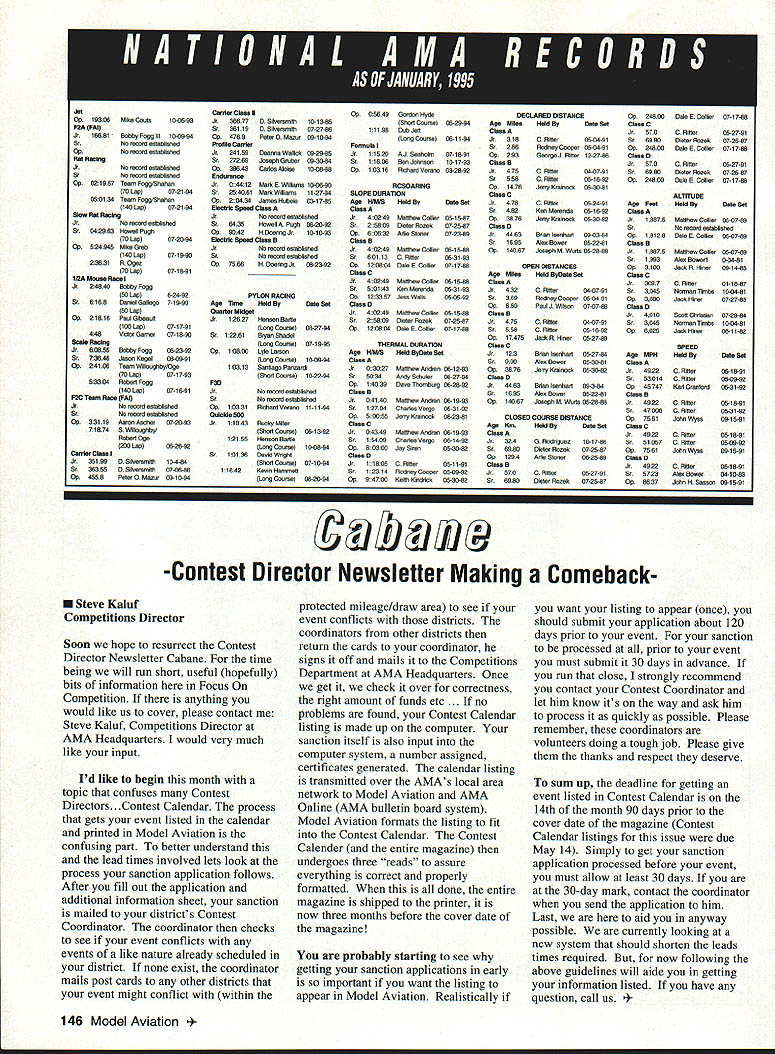
Focus on Competition
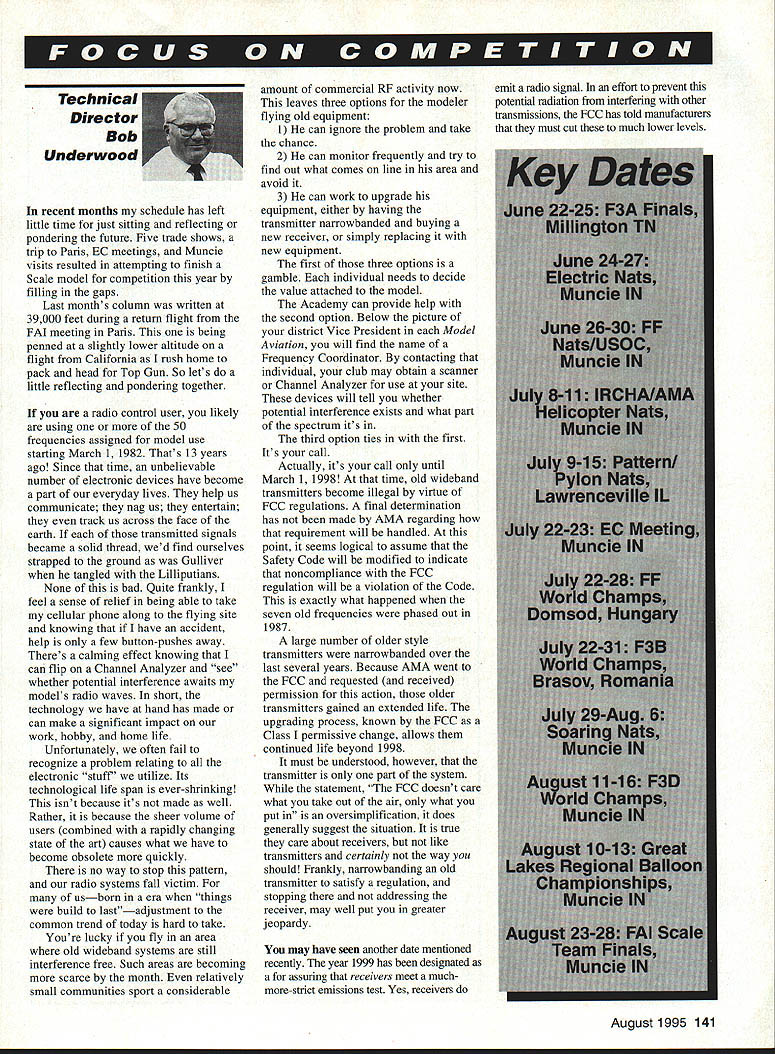
Technical Director — Bob Underwood
In recent months my schedule has left little time for just sitting, reflecting, or pondering the future. Five trade shows, a trip to Paris for EC meetings, Muncie visits, and attempts to finish a scale model for competition this year have filled the gaps. Last month's column was written at 39,000 feet during a return flight from the FAI meeting in Paris; this one is being penned at a slightly lower altitude on a flight from California as I rush home to pack and head for Top Gun. So let's do a little reflecting and pondering together.
If you are a radio-control user, you likely are using one or more of the 50 frequencies assigned for model use starting March 1, 1982. Since that time an unbelievable number of electronic devices have become part of our everyday lives: they help us communicate, nag us, entertain us, and even track us across the face of the earth. Transmitted signals have become a solid thread; without them we'd find ourselves strapped to the ground as was Gulliver when he tangled with the Lilliputians.
None of this is bad. Quite frankly, I feel a sense of relief taking my cellular phone along to the flying site and knowing that if I have an accident help is only a few button-pushes away. There's also a calming effect in being able to flip on a channel analyzer and "see" whether potential interference awaits my model's radio waves. In short, available technology has made — and can make — a significant impact on our work, hobby, and home life.
Unfortunately, we often fail to recognize a problem related to all the electronic "stuff" we utilize: its technological life span is ever‑shrinking. This isn't because it's not made well, but because the sheer volume of users combined with a rapidly changing state of the art causes equipment to become obsolete more quickly. There is no way to stop this pattern, and our radio systems fall victim. For many of us—born in an era when "things were built to last"—adjusting to today's trend is hard to take.
You're lucky if you fly in an area where old wideband systems are still interference-free. Such areas are becoming more scarce month by month. Even relatively small communities now have considerable commercial RF activity. This leaves three options for the modeler flying old equipment:
- Ignore the problem and take the chance.
- Monitor frequently and try to find out what comes on line in the area and avoid it.
- Upgrade equipment — have the transmitter narrowbanded and buy a new receiver, or simply replace it with new equipment.
The first option is a gamble; each individual must decide the value attached to the model. The Academy can help with the second option. Below the picture of your district vice president in each Model Aviation you will find the name of a Frequency Coordinator. By contacting that individual, your club may obtain a scanner or channel analyzer for use at your site. These devices will tell you whether potential interference exists and what part of the spectrum it's in.
The third option ties into the first — it's your call. Actually, it's your call only until March 1, 1998. On that date old wideband transmitters become illegal under FCC regulations. A final determination has not yet been made by AMA regarding how this requirement will be handled, but it seems logical to assume the Safety Code will be modified to indicate that noncompliance with the FCC regulation will be a violation of the Code. This is exactly what happened when seven old frequencies were phased out in 1987.
A large number of older-style transmitters were narrowbanded over the last several years. Because AMA went to the FCC and requested (and received) permission for this action, those older transmitters gained an extended life. The upgrading process, known by the FCC as a Class I permissive change, allows continued use beyond 1998.
It must be understood, however, that the transmitter is only one part of the system. While the oversimplified statement "The FCC doesn't care what you take out of the air, only what you put in" is not strictly accurate, it does generally suggest the situation. The FCC does care about receivers, but not in the same way as transmitters — and certainly not the way you should. Narrowbanding an old transmitter to satisfy regulation and stopping there without addressing the receiver may well put you in greater jeopardy.
You may have seen another date mentioned recently. The year 1999 has been designated as the time for assuring receivers meet a much more‑strict emissions test. Yes, receivers do emit a radio signal. In an effort to prevent this potential radiation from interfering with other transmissions, the FCC has told manufacturers that emissions must be reduced to much lower levels.
Before you become concerned and say "Oh no — another equipment change," please understand the regulation does not affect equipment now in place or equipment you purchase and use until the date it is grandfathered. Manufacturers may have slightly upgraded receivers to meet the new requirement, and a significant number of receivers on the market already appear to meet it. The potential problem is very low-cost receivers produced for cars and boats.
AMA has been vigilant and proactive in protecting our frequency turf and will continue to maintain that attitude. Each RC modeler must exercise care in approaching frequency use and understand the rapidly escalating RF world. We must be willing to move smartly into a new world and a new century.
AMA Air Show Teams
ALABAMA
- Bama Flyers — James Weems, 1777 Tall Oaks Circle, Birmingham, AL 35235; 205-856-1180 (h)
ARIZONA
- Arizona Flying Eagles Show Team — Ronald Young, 1301 S. Date, Mesa, AZ 85202; 602-964-5513 (h)
- Tucson R/C Club's Barnstormers — Chuck Brooks, Secretary, 6738 E. Scarlett, Tucson, AZ 85710; 602-298-9439 (h), 602-750-5311 (w); Jim Gagnon, Manager, 602-721-1590 (h)
CALIFORNIA
- California Air Show Team — Larry Wolfe, 12130 G. Carson St., Hawaiian Gardens, CA 90716; 310-429-1244
- Capital City Barnstormers, Inc. — Ellis D. Hall, Manager, 5854 Willow Oak Way, Fair Oaks, CA 95628; 916-983-3803 (h), 916-631-6302 (w)
- Sierra Eagles Air Show Team — Ross Shelton, 17778 Quail Alley, Pinedale, CA 95975; 916-273-9524 (w), 916-273-7098 (h)
FLORIDA
- Florida AST — Art Johnson, 932 Banyan Dr., Delray Beach, FL 33444; 407-278-9621 (h)
HAWAII
- Na Mokulele Kohehohe O Hawaii — H. Michael Harrington, 47-685 Haleiwaunu Street, Kaneohe, HI 96744; 808-956-8183 (w), 808-239-6682
IOWA
- Blackhawks — David Ramsey, 5721 Blue Sage Rd., Waterloo, IA 50701; 319-292-7093 (h), 319-236-1297 (w)
- Cedar Rapids Skyhawks AST — Walter McKee, 1141 30th St. N.E., Cedar Rapids, IA 52402; 319-377-5932 (w), 319-396-0806 (h)
- Golden Kernels — Bernie De Boer, 414 S. Lynn Dr., Le Mars, IA 51016; 712-546-4609 (h)
ILLINOIS
- Chicagoland Circle Cutters — Dennis Slater, 5153 W. Melrose, Chicago, IL 60641; 312-777-1167 (h)
INDIANA
- Midwest Sundowners AST — Leonard David, 5345 East U.S. Highway, Hobart, IN 46342; 219-762-6823
KANSAS
- Air Capital Eagles — Dennis Clesen, Rt. 1, Box 273, Mulvane, KS 67110; 316-777-4565
- The Heart of America AST — Bruce Hood, 2329 West 68th, Overland Park, KS 66209; 913-649-1667 (h)
MARYLAND / DISTRICT OF COLUMBIA
- District of Columbia AST — William Savage, 5119 Brentford Dr., Rockville, MD 20852; 301-770-6086 (h)
- Skylaneers AST — William Dwyer, 3267 Florence Rd., Woodbine, MD 21797; 301-854-6423 (h)
MICHIGAN
- Aero-Bats of Michigan — Frank Pulte, 8689 Je-Ne-Be N.W., Rockford, MI 49341; 616-874-8206
MINNESOTA
- Blue Eagles R/C Flying Team — Richard A. Heil, 16780 Gannon Ave. W., Rosemount, MN 55068-1924; 612-868-7249 (w), 612-432-9419 (h)
MISSOURI
- Flying Tigers — Bill Langley, R.R. 3, Box 125, Plattsburg, MO 64477; 816-539-2843
NEW YORK
- Empire State AST — Don Whitacre, 844 Troy-Schenectady Rd., Latham, NY 12110; 518-783-6275 (h), 518-869-2615 (w)
OHIO
- Buckeye Aero Squadron AST — James A. Martin, 5783 Harshmanville Rd., Huber Heights, OH 45424; 513-235-1648 (h)
- Hurricanes of Cincinnati — Bill Cook, 4441 Rauen Dr., Cincinnati, OH 45252; 513-385-6965 (h)
- Spirit of America AST — Jim Hubbard, 721 Rockwell Ave., Findlay, OH 45840; 419-422-5589 (h)
PENNSYLVANIA
- Alpha Squadron — Ray Naylor, 131 Lampert Ct., Exton, PA 19341; 215-363-7718 (h), 215-239-8989 (w)
- Expos — John Rynkiewicz, 47 Loomis St., Nanticoke, PA 18634; 717-735-7586 (h)
- The Flying Dutchmen Aeromodelers — Clark (Skip) Knarr, 341 Foxor Mountain Rd., Robesonia, PA 19551; 610-693-6832 (h), 610-775-6032 (w)
- Model Airs Show Team — William Prieto, 65 Meadowcreek, Chambersburg, PA 17201; 717-267-0223
SOUTH DAKOTA
- Gold Squadron AST — P.M. McGulgan, M.D., 4102 Carriage Hills Dr., Rapid City, SD 57702; 605-348-6676 (h)
TEXAS
- Lone Star Squadron — Don Huthlines, 414 Fairview, Richardson, TX 75081; 214-235-7641 (h)
- S.T.A.R.S. Show Team — Kenneth O. Ewald, 650 Dove Tree, Spring Branch, TX 78070; 210-641-8506 (w), 210-980-3666 (h)
UTAH
- Spirit of Utah — Doug Dorton, 3058 Bennina Dr., Salt Lake City, UT 84118; 801-977-0091 (w), 801-966-1625 (h)
VIRGINIA
- Virginia Air Show Squadron — Frank Himmeler, 3439 N. Beech St., Arlington, VA 22207; 703-536-8255 (h)
WASHINGTON
- Barons Flying Circus R/C Demo Team — John Saulle, 17705 N. Michael Rd., Colbert, WA 99005; 509-468-9448 (h)
- Northwest R/C Flight Demo Team — Michael Walker, 8317 Custer Rd. S.W., Tacoma, WA 98499; 206-582-0665 (h)
WISCONSIN
- Critters Air Show Team — Daniel Tostleff, 4240 Neb. Ave., Sussex, WI 53089; 414-246-3814 (h)
- Northern Aces Show Team — Gary Doren, 1169 Crooks St., Green Bay, WI 54301; 414-435-2692 (h)
Focus on Competition — F3C Report
Horace Hagen
We addressed the aeromodeling fund set up by CIAM. It spelled out items covering income and expenses of the fund and the F3C subcommittee recommended the proposal unanimously.
The last item on the agenda was the F3C proposal from France recommending a change to section 5.4.1.1.b, Performance of the schedule. The proposal stated: "For the manoeuvres described in Paragraphs 5.4.12.4 through 5.4.12.9 (including the landing), the pilot has to stay between the model flight area and the judges' line; that is, the helicopter must never be between the judges and the pilot."
The reason given was safety. A large influx of new F3C pilots in recent years has resulted in some dangerous situations where a model came too close to the judges and created an unsafe situation. It was pointed out that the model must fly between the pilot and the judges in the "Horizontal Eight" manoeuvre. The counterpoint was that the pilot's depth perception is more limited during the "Top Hat" and "Autorotation" manoeuvres while looking skyward. After a lengthy discussion, the F3C technical meeting recommended the French proposal: 5 for, 2 against. I will write a paragraph containing the new text and distribute it to all Aero Clubs.
The Plenary meeting reconvened for nominations of 1995 officers at 16:00 hours and ended at 16:30 hours. The F3C subcommittee worked until 19:00 hours on the 1997 F3C program and made significant progress.
Prior to the meeting I assembled a summary of the 12 proposals submitted to date and made them available to members present. I also summarized the newly proposed manoeuvres and separated them into three categories:
- Hovering manoeuvres — 21
- Aerobatic manoeuvres — 39
- Landing manoeuvres — 7
The most important decisions made at this meeting were as follows:
- Starting time reduced from 5 to 3 minutes maximum.
- Flight time reduced from 10 minutes to 8 minutes.
- Schedules to consist of 3 hovering, 6 acrobatic, and 1 landing manoeuvre.
- Engine allowed to run during autorotation manoeuvre.
- Two- or three-manoeuvre schedules permitted.
- A different schedule flown each round.
- No Turnaround sequence.
- No 3D manoeuvres (3D = sustained inverted hover longer than 2 seconds).
- Four preliminary rounds + three flyoff rounds.
- Preliminary rounds to count for a maximum of 25% of final individual score.
- Pilot must stand between judges 2 and 3 or between judges 3 and 4 for all manoeuvres.
I recommended a time schedule for the subcommittee work between now and the November 1995 submission deadline:
- By July 1: I will mail out a straw-man proposal containing all changes submitted to date and my own tentative manoeuvre schedules A, B, and C.
- By August 15: S/C members must send their suggested schedules A, B, and C and other changes.
- By September 15: I will distribute a proposal incorporating those suggestions.
- By October 15: Each S/C member will have the opportunity for last-minute changes; I will then have two weeks to incorporate them into a final document.
If you have suggestions for the 1997 F3C program, please mail them to: Horace Hagen, 15 Parkway Place, Red Bank, NJ 07701, or call (908) 741-3097.
CIAM Soaring Report
Following last year's plenary meeting, Tomas Bartovsky, Soaring Sub-Committee Chairman, reorganized delegation of responsibilities within the subcommittee. Vice-chairmen were assigned as follows:
- P3B — Terry Edmonds, USA
- F3F — Preben Norholm, Denmark
- F3H — (not assigned)
- F3I — (not assigned)
- F3J — Jack Sille, United Kingdom
The main charge of the subcommittee during the last year was to generate an F3B Organizer's Guide. As newly appointed F3B Vice-Chairman, I was given the task of writing the document. The guide has been completed but not yet received final approval from CIAM. Many thanks to subcommittee members and others who contributed. Acceptance of the guide is expected at next year's CIAM meeting and it will then be printed in the "Supplemental to the FAI Sporting Code." In the meantime, if anyone wants a copy, contact me and I will send it.
Rules proposals were presented for three soaring classes: F3B, F3J, and provisional class F3I.
F3B: A proposal from the Czech Republic to change how infractions of safety areas are handled was approved with immediate implementation. The new rule removes subjective judgment by officials concerning flying below 3 meters in the safety area. The safety areas have been expanded to include the entire winch lane and pit areas. Replace existing wording in section 5.3.1.9 with the following:
"The organizer must clearly mark the boundary between the landing area and the area assigned for other business (safety area) except in the circumstances described in paragraph 5.3.1.5a) lines 1, 2, 3, and 5, and after release of the model from the hand of the pilot or helper, the contact of the model with any object (earth, car, stick, plant, line, etc.) or person within the safety area will be penalized. The number of contacts during one flight does not matter (maximum one penalty for one flight). The penalty will be a deduction of 100 points from the competitor's final score and shall be listed on the score."
Contest Director Notes
Steve Kaluf, Competitions Director
Soon we hope to resurrect the Contest Director Newsletter column. For the time being we will run short, useful bits of information here in Focus on Competition. If there is anything you would like us to cover, please contact me at AMA Headquarters — I would very much like your input.
This month I'd like to cover a topic that confuses many contest directors: the Contest Calendar. The process that gets your event listed in the calendar and printed in Model Aviation involves several steps and lead times.
Process overview:
- After you fill out the sanction application and additional information sheet, your sanction is mailed to your district's Contest Coordinator.
- The coordinator checks for conflicts with like events already scheduled in the district.
- If none exist, the coordinator mails postcards to other districts within the protected mileage/draw area to check for conflicts.
- Coordinators from other districts return the cards; your coordinator signs off and mails the sanction to the Competitions Department at AMA Headquarters.
- At Headquarters we check correctness and fees. The calendar listing is made up on the computer, the sanction itself is input and numbered, and certificates are generated.
- The calendar listing is transmitted over AMA's local area network to Model Aviation and AMA Online. Model Aviation formats the listing to fit the Contest Calendar.
- The magazine undergoes three reads for correctness and formatting and then is shipped to the printer — about three months before the cover date.
Guidelines:
- To have your event listed in Model Aviation (once), submit your application about 120 days prior to the event.
- To have your sanction processed prior to your event, submit at least 30 days in advance.
- If you submit at the 30-day mark, contact your Contest Coordinator to expedite processing.
- Contest Calendar listings for an issue are due on the 14th of the month 90 days prior to the magazine cover date.
These coordinators are volunteers doing a tough job. Please show them thanks and respect. We're also looking at a new system that should shorten mail times, but for now following the above guidelines will help get your information listed. If you have questions, call us.
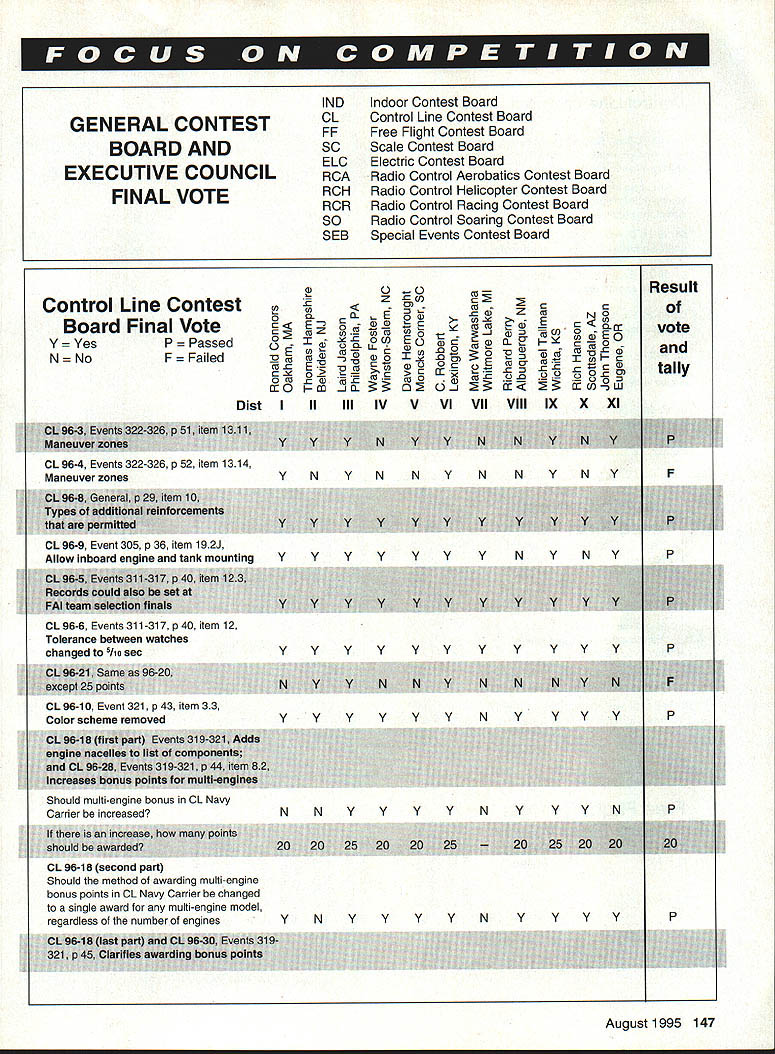
General Contest Board and Executive Council Final Vote
Abbreviations
- IND — Indoor Contest Board
- CL — Control Line Contest Board
- FF — Free Flight Contest Board
- SC — Scale Contest Board
- ELC — Electric Contest Board
- RCA — Radio Control Aerobatics Contest Board
- RCH — Radio Control Helicopter Contest Board
- RCR — Radio Control Racing Contest Board
- SO — Radio Control Soaring Contest Board
- SEB — Special Events Contest Board
Voting keys: Y = Yes, N = No, P = Passed, F = Failed
Control Line Contest Board — Final Vote
- CL 96-3 (Events 322-326, item 13.11, Maneuver zones) — Result: Passed
- CL 96-4 (Events 322-326, item 13.14, Maneuver zones) — Result: Failed
- CL 96-8 (General, item 10, Types of additional reinforcements permitted) — Result: Passed
- CL 96-9 (Event 305, item 19.2, Allow inboard engine and tank mounting) — Result: Passed
- CL 96-5 (Events 311-317, item 12.3, Records could also be set at FAI team selection finals) — Result: Passed
- CL 96-6 (Events 311-317, item 12, Tolerance between watches changed to 5/10 sec) — Result: Passed
- CL 96-21 (Same as 96-20, except 25 points) — Result: Failed
- CL 96-10 (Event 321, item 3.3, Color scheme removed) — Result: Passed
- CL 96-18 (first part) & CL 96-28 (Events 319-321, adds engine nacelles; increases multi-engine bonus) — Result: Passed
- CL 96-18 (second part, change method of awarding multi-engine bonus points) — Result: Passed
- CL 96-18 (last part) & CL 96-30 (Events 319-321, clarifies awarding bonus points) — Result: Passed
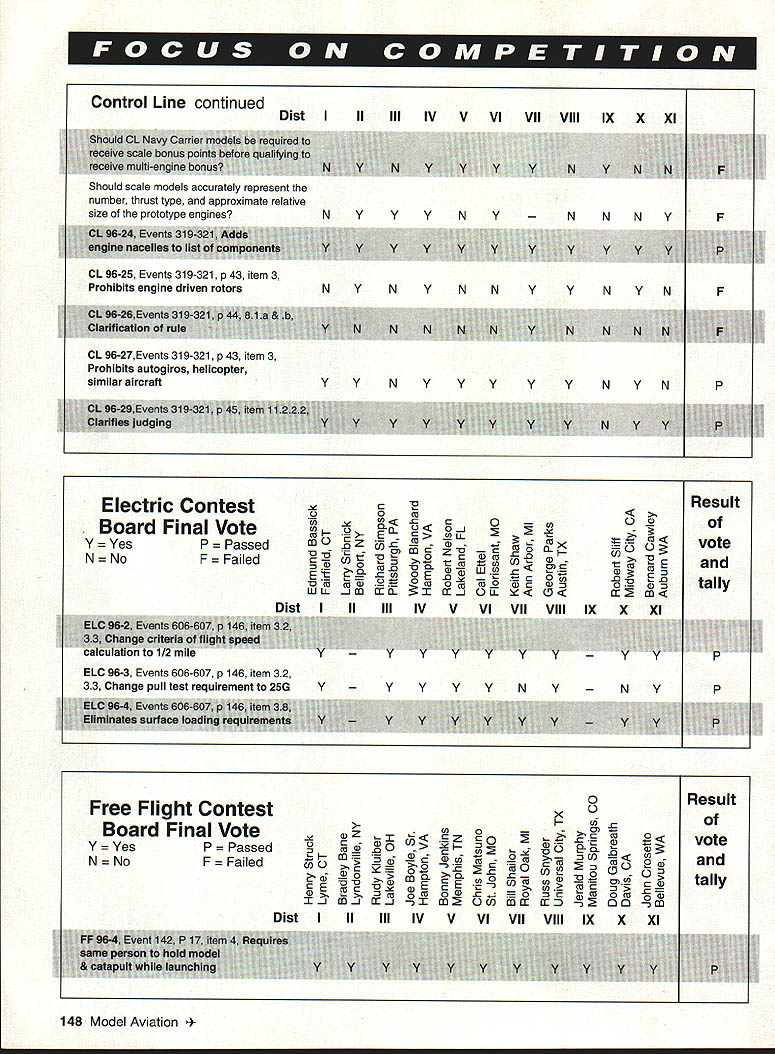
- Other CL items debated included requiring scale bonus points before multi-engine bonus, representation of number and type of prototype engines, and various clarifications (mixed results, several failed)
Electric Contest Board — Final Vote
- ELC 96-2 (Events 606-607, change criteria of flight speed calculation to 1/2 mile) — Result: Passed
- ELC 96-3 (Events 606-607, change pull test requirement to 25G) — Result: Passed
- ELC 96-4 (Events 606-607, eliminate surface loading requirements) — Result: Passed
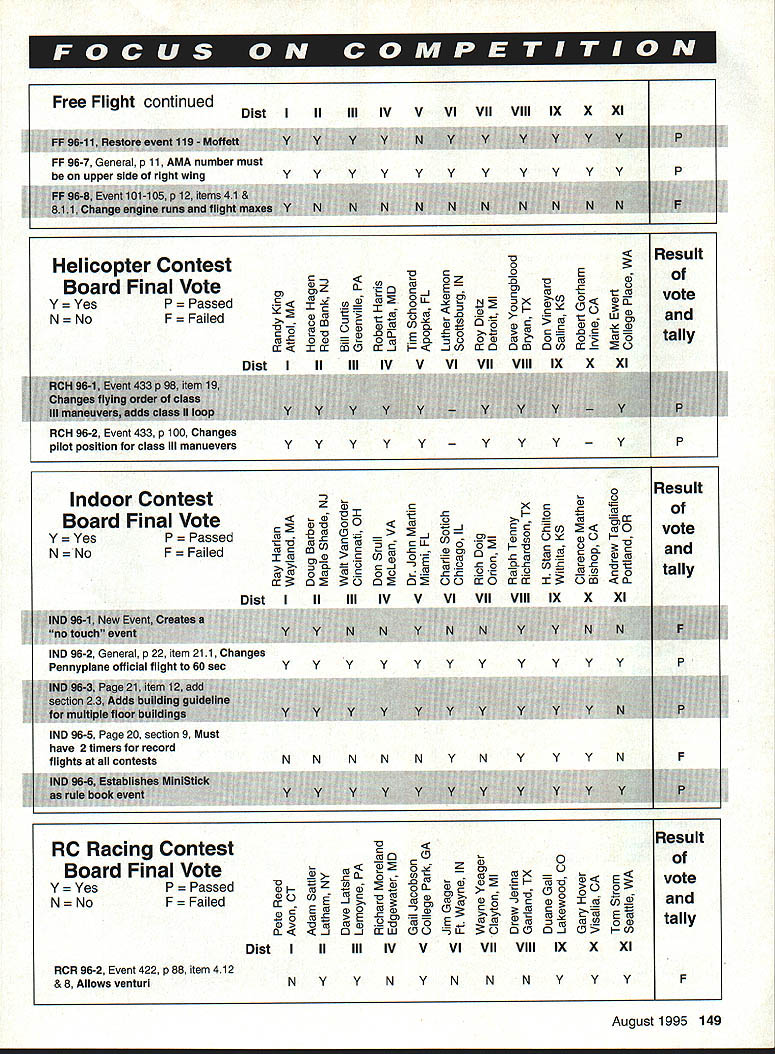
Free Flight Contest Board — Final Vote
- FF 96-4 (Event 142, requires same person to hold model & catapult while launching) — Result: Passed
- FF 96-11 (Restore event 119 - Moffett) — Result: Passed
- FF 96-7 (General, display AMA number on upper side of right wing) — Result: Passed
- FF 96-8 (Event 101-105, change engine runs and flight maxes) — Result: Failed
Helicopter Contest Board — Final Vote
- RCH 96-1 (Event 433, changes flying order of class III maneuvers, adds class II loop) — Result: Passed
- RCH 96-2 (Event 433, changes pilot position for class III maneuvers) — Result: Passed
Indoor Contest Board — Final Vote
- IND 96-1 (New event, creates a "no touch" event) — Result: Failed
- IND 96-2 (Change Pennylane official flight to 60 sec) — Result: Passed
- IND 96-3 (Add building guideline for multiple floor buildings) — Result: Passed
- IND 96-5 (Must have 2 timers for record flights at all contests) — Result: Failed
- IND 96-6 (Establishes MiniStick as rule book event) — Result: Passed
RC Racing Contest Board — Final Vote (selected items)
- RCR 96-2 (Event 422, allow venturi) — Result: Failed
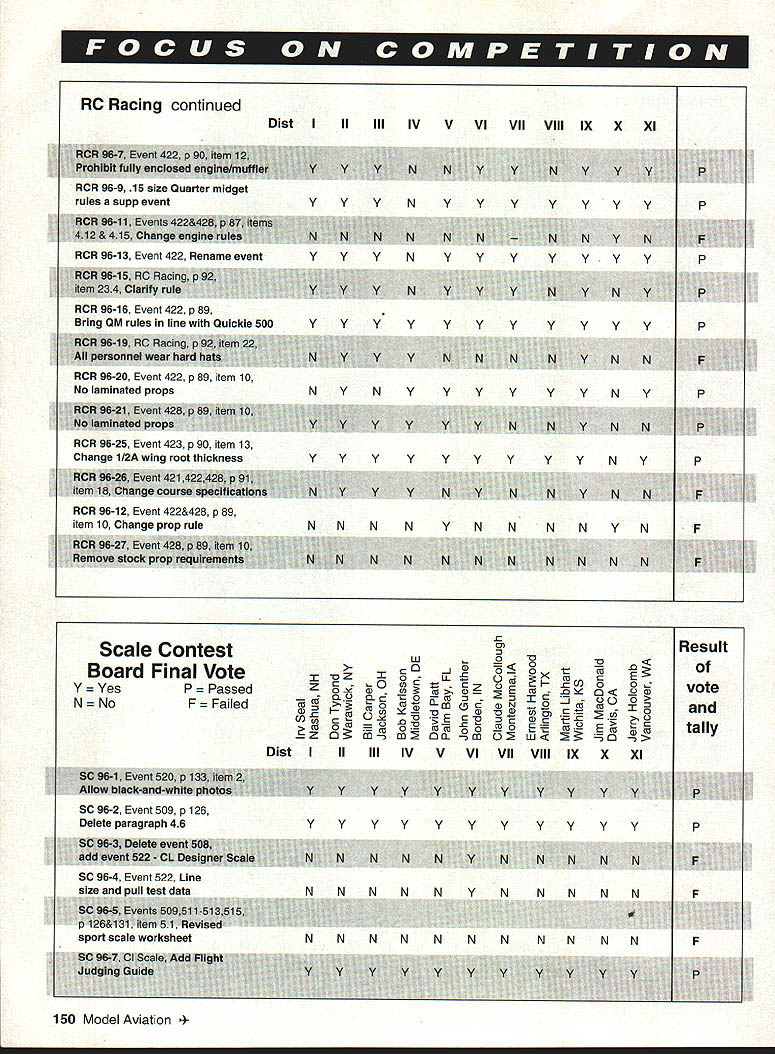
- RCR 96-7 (Event 422, prohibit fully enclosed engine/muffler) — under consideration (details listed)
- RCR 96-9 (.15 size Quarter midget rules a supp event) — under consideration
- RCR 96-11 (Events 422 & 428, change engine rules) — under consideration
- RCR 96-13 (Event 422, rename event) — under consideration
- RCR 96-15 (Clarify rule) — under consideration
- RCR 96-16 (Bring QM rules in line with Quickie 500) — under consideration
- RCR 96-19 (All personnel wear hard hats) — under consideration
- RCR 96-20 / 96-21 (No laminated props) — under consideration
- RCR 96-25 (Change 1/2A wing root thickness) — under consideration
- RCR 96-26 (Change course specifications) — under consideration
- RCR 96-12 / 96-27 (Change/remove prop requirements) — under consideration
Scale Contest Board — Final Vote (selected items)
- SC 96-1 (Event 520, allow black-and-white photos) — under consideration
- SC 96-2 (Event 509, delete paragraph 4.6) — under consideration
- SC 96-3 (Delete event 508, add event 522 - CL Designer Scale) — under consideration
- SC 96-4 (Event 522, line size and pull test data) — under consideration
- SC 96-5 (Revised sport scale worksheet) — under consideration
- SC 96-7 (Add Flight Judging Guide) — under consideration
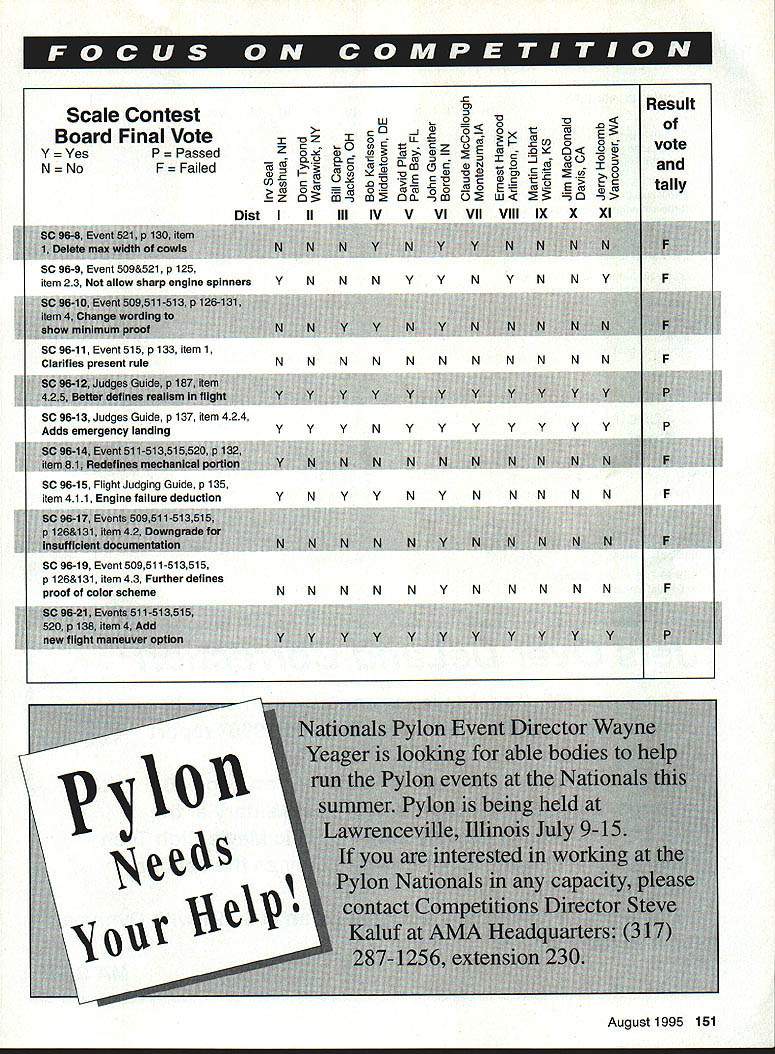
- SC 96-8 — Delete max width of cowls — Result: Failed
- SC 96-9 — Not allow sharp engine spinners — Result: Failed
- SC 96-10 through SC 96-19 — Various clarifications and rule changes (majority failed)
- SC 96-12 (Judges Guide, better defines realism in flight) — Result: Passed
- SC 96-13 (Judges Guide, adds emergency landing) — Result: Passed
- SC 96-21 (Add new flight maneuver option) — Result: Passed
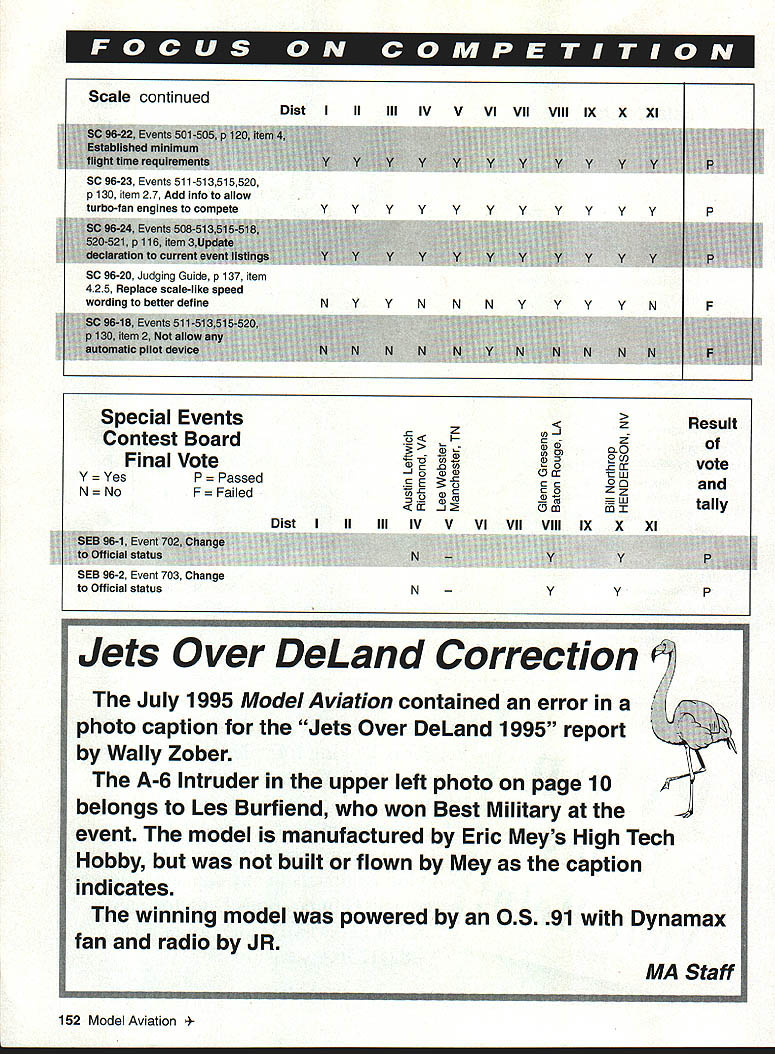
- SC 96-22 (Established minimum flight time requirements) — Result: Passed
- SC 96-23 (Allow turbo-fan engines to compete) — Result: Passed
- SC 96-24 (Update declaration to current event listings) — Result: Passed
Special Events Contest Board — Final Vote
- SEB 96-1 (Event 702, change to official status) — Result: Passed
- SEB 96-2 (Event 703, change to official status) — Result: Passed
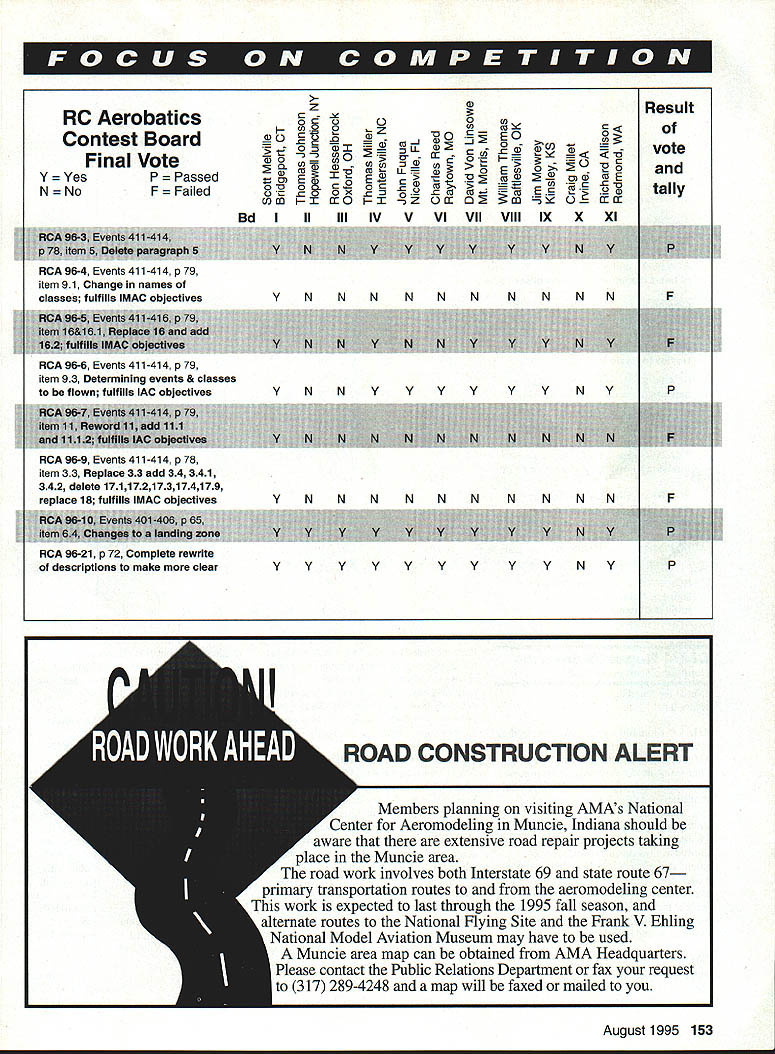
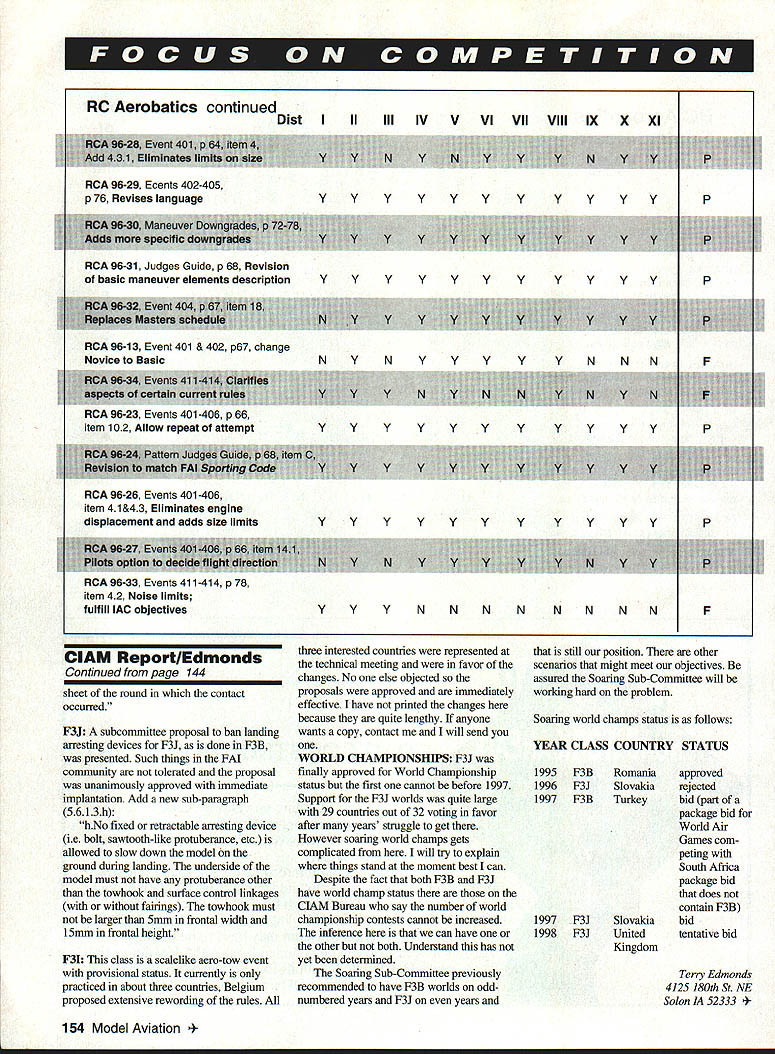
RC Aerobatics Contest Board — Final Vote (selected items)
- RCA 96-3 (Events 411-414, delete paragraph 5) — Result: Passed
- RCA 96-4 (Change in names of classes; IMAC objectives) — Result: Failed
- RCA 96-5 (Replace and add sections to fulfill IMAC objectives) — Result: Failed
- RCA 96-6 (Determining events & classes to be flown; fulfills IAC objectives) — Result: Passed
- RCA 96-7 (Rewording and additions; IAC objectives) — Result: Failed
- RCA 96-9 (Comprehensive replacements and additions; IMAC objectives) — Result: Failed
- RCA 96-10 (Events 401-406, changes to a landing zone) — Result: Passed
- RCA 96-21 (Complete rewrite of descriptions to make them clearer) — Result: Passed
(End of contest board summaries.)
Transcribed from original scans by AI. Minor OCR errors may remain.

