
Focus on Competition
Technical Director — Steve Kaluf
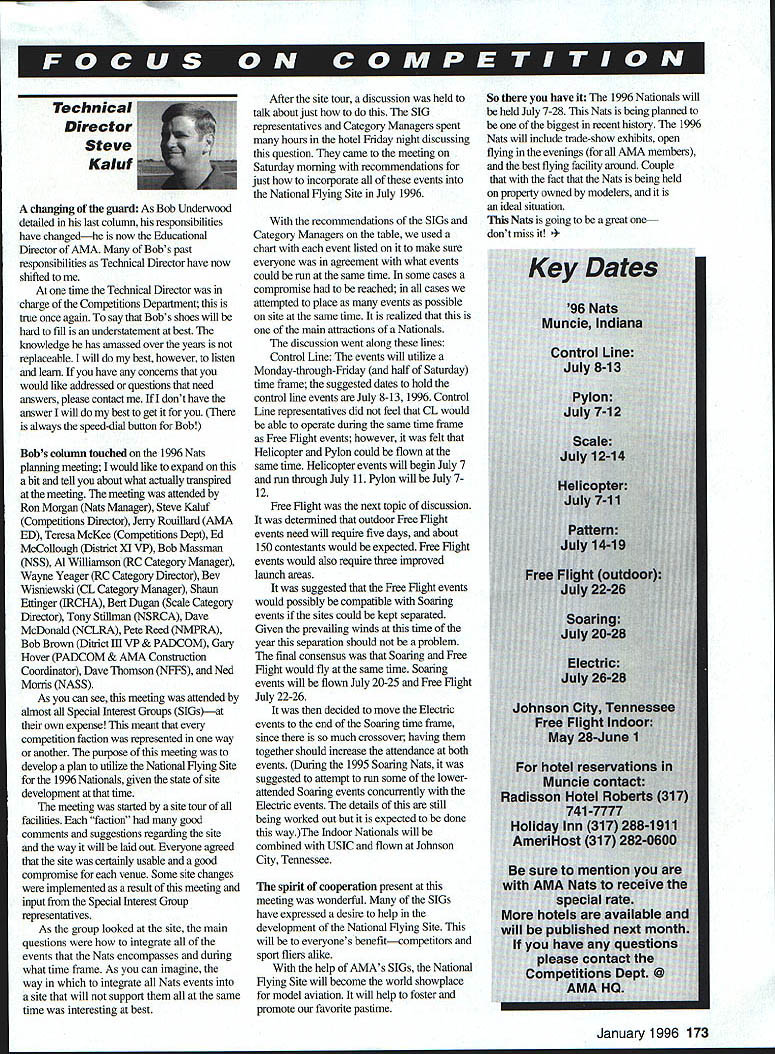
A changing of the guard: Bob Underwood is now the Educational Director of AMA, and many of his past responsibilities as Technical Director have shifted to me. The Technical Director is once again in charge of the Competitions Department. Bob's shoes will be hard to fill — the knowledge he has amassed over the years is irreplaceable. I will do my best to listen and learn. If you have concerns or questions you would like addressed, please contact me. If I don't have the answer I will do my best to get it for you.
Bob's column touched on the 1996 Nats planning meeting; I would like to expand on what actually transpired. The meeting was attended by almost all Special Interest Groups (SIGs) — at their own expense — so every competition faction was represented in one way or another. Attendees included:
- Ron Morgan (Nats Manager)
- Steve Kaluf (Competitions Director)
- Jerry Rouillard (AMA Executive Director)
- Teresa McKee (Competitions Department)
- Ed McCollough (District XI VP)
- Bob Massman (NSS)
- Al Williamson (RC Category Manager)
- Wayne Yeager (RC Category Director)
- Bev Wisniewski (CL Category Manager)
- Shaun Ettinger (IRCHA)
- Bert Dugan (Scale Category Director)
- Tony Stillman (NSRCA)
- Dave McDonald (NCLRA)
- Pete Reed (NMPRA)
- Bob Brown (District III VP & PADCOM)
- Gary Hoover (PADCOM & AMA Construction Coordinator)
- Dave Thomson (NFFS)
- Ned Morris (NASS)
The meeting began with a site tour of the National Flying Site. Each faction had many good comments and suggestions regarding the site and how it should be laid out. Everyone agreed the site was usable and a reasonable compromise for each venue. Some site changes were implemented as a result of input from the SIG representatives.
The main question as the group examined the site was how to integrate all of the Nats events into a site that could not support them all running simultaneously, and over what time frame to schedule each discipline. SIG representatives and Category Managers spent many hours discussing this, then reconvened with recommendations for incorporating all events at the National Flying Site in July 1996.
With SIG and Category Manager recommendations on the table, we used a chart listing each event to ensure agreement about what events could be run concurrently. In some cases compromises were required; in all cases we attempted to place as many events as possible on site at the same time, recognizing that simultaneous events are a main attraction of a Nationals. The schedule and decisions are summarized below.
- Control Line
- Events will utilize Monday through Friday and half of Saturday.
- Suggested dates: July 8–13, 1996.
- Control Line representatives did not feel CL could operate during the same time frame as Free Flight events; however, Helicopter and Pylon could be flown at the same time as Control Line.
- Helicopter
- Dates: July 7–11, 1996.
- Pylon
- Dates: July 7–12, 1996.
- Free Flight
- Outdoor Free Flight events will require five days and approximately 150 contestants.
- Free Flight will require three improved launch areas.
- It was suggested Free Flight might be compatible with Soaring if sites could be kept separated; given prevailing winds at that time of year, separation should not be a problem.
- Dates: July 22–26, 1996.
- Soaring
- Soaring and Free Flight will fly at the same time, with sites separated.
- Dates: July 20–25, 1996.
- Electric
- Electric events were moved to the end of the Soaring time frame to take advantage of crossover between competitors; scheduling them together should increase attendance for both.
- During the 1995 Soaring Nats it was suggested to run some lower-attended Soaring events concurrently with Electric events; details are still being worked out but the expectation is to proceed that way.
- Indoor Nationals / USIC
- The Indoor Nationals will be combined with USIC and flown in Johnson City, Tennessee.
The spirit of cooperation at the meeting was excellent. Many SIGs have expressed a desire to help develop the National Flying Site. With their help the site will become a world showplace for model aviation, fostering and promoting our pastime to the benefit of competitors and sport fliers alike.
Summary: The 1996 Nationals will be held July 7–28, 1996. This Nats is planned to be one of the biggest in recent history and will include trade-show exhibits, open flying in the evenings for all AMA members, and outstanding flying facilities — all on property owned by modelers. This should make for an exceptional event. Don't miss it!
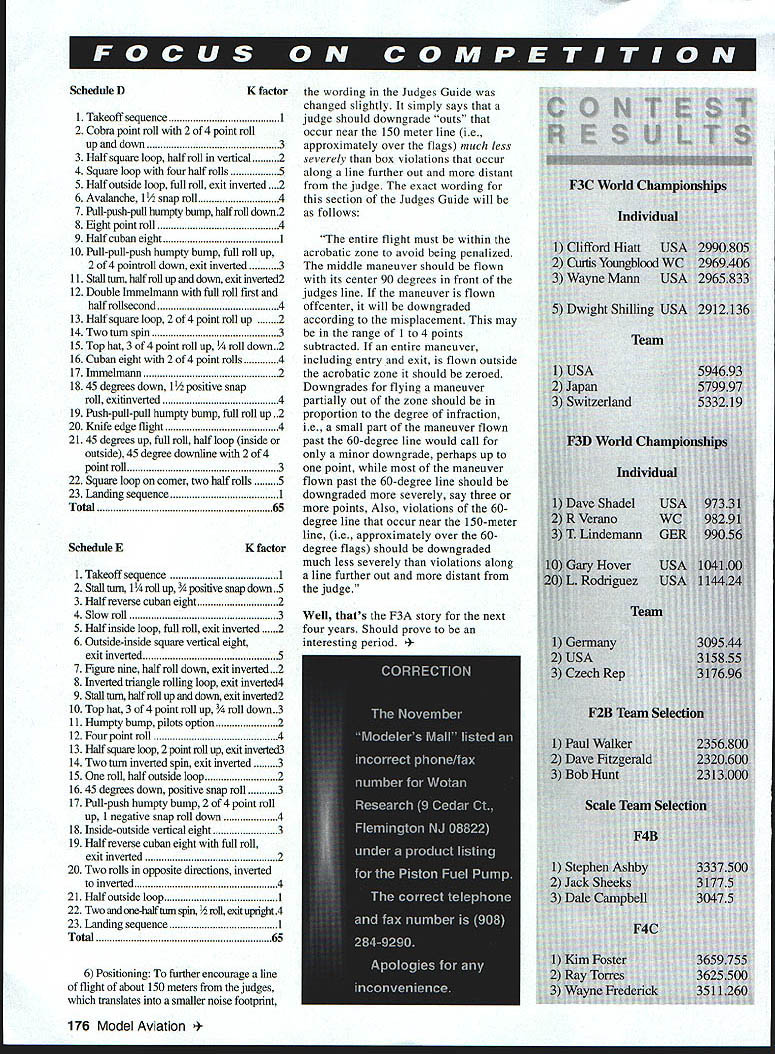
F3A Judges Guide — Positioning
To further encourage a line of flight of about 150 meters from the judges (which translates into a smaller noise footprint), the wording in the Judges Guide was changed slightly. It now advises that a judge should downgrade "outs" that occur near the 150-meter line (approximately over the flags) much less severely than violations that occur farther out and more distant from the judge. The exact wording for this section of the Judges Guide is as follows:
"The entire flight must be within the acrobatic zone to avoid being penalized. The middle maneuver should be flown with its center 90 degrees in front of the judges' line. If the maneuver is flown off center, it will be downgraded according to the misplacement. This may be in the range of 1 to 4 points subtracted. If an entire maneuver, including entry and exit, is flown outside the acrobatic zone it should be zeroed. Downgrades for flying a maneuver partially out of the zone should be in proportion to the degree of infraction, i.e., a small part of the maneuver flown past the 60-degree line would call for only a minor downgrade, perhaps up to one point, while most of the maneuver flown past the 60-degree line should be downgraded more severely, say three or more points. Also, violations of the 60-degree line that occur near the 150-meter line (i.e., approximately over the 60-degree flags) should be downgraded much less severely than violations that occur a long way further out and more distant from the judge."
Well, that's the F3A story for the next four years. It should prove to be an interesting period.
Transcribed from original scans by AI. Minor OCR errors may remain.

