
Focus on Competition
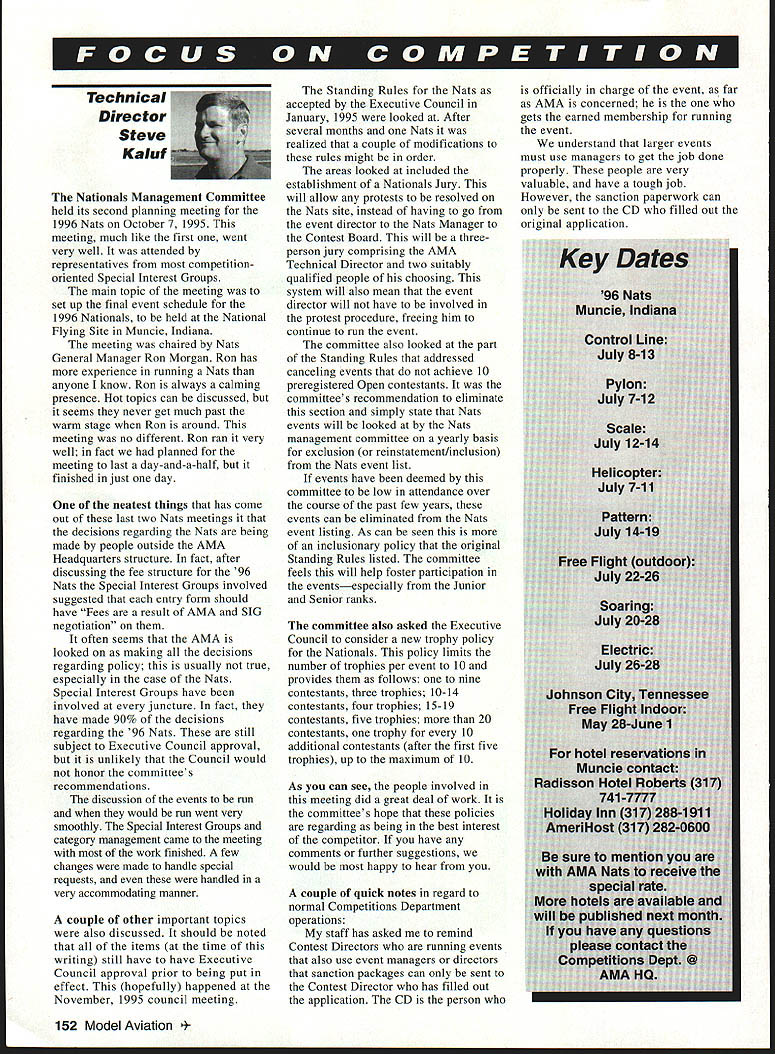
Technical Director Steve Kaluf
The Nationals Management Committee held its second planning meeting for the 1996 Nats on October 7, 1995. The meeting, much like the first, went very well and was attended by representatives from most competition-oriented Special Interest Groups. The main topic was to finalize the event schedule for the 1996 Nationals to be held at the National Flying Site in Muncie, Indiana.
The meeting was chaired by Nats General Manager Ron Morgan. Ron has more experience running a Nats than anyone I know; he is always a calming presence. Hot topics can be discussed, but they rarely get much past the warm stage when Ron is around. He ran this meeting very well — it had been planned for a day-and-a-half but finished in one day.
One notable outcome of the last two Nats meetings is that many decisions are being made by people outside the AMA Headquarters structure. After discussing the fee structure for the ’96 Nats, the Special Interest Groups suggested that each entry form include the statement: “Fees are a result of AMA and SIG negotiation.”
Special Interest Groups have been involved at every juncture and have made roughly 90% of the decisions regarding the 1996 Nats. These decisions are still subject to Executive Council approval, but it is unlikely the Council will not honor the committee’s recommendations. Discussion of events and scheduling went smoothly — SIGs and category management arrived with most of the work done, and only a few accommodating changes were made for special requests.
Standing Rules review and proposed changes
- The Standing Rules for the Nats (accepted by the Executive Council in January 1995) were reviewed. After running one Nats under those rules, a couple of modifications were suggested.
- Nationals Jury: The committee recommended establishing a three-person Nationals Jury to resolve protests on-site instead of routing them from the event director to the Nats Manager to the Contest Board. The jury would comprise the AMA Technical Director and two suitably qualified people of his choosing. This system would allow the event director to remain focused on running the event.
- Event inclusion policy: The committee recommended eliminating the rule that automatically cancels events that do not achieve 10 preregistered Open contestants. Instead, Nats events would be reviewed yearly by the Nats management committee for exclusion, reinstatement, or inclusion on the event list. Events showing low attendance over recent years could be removed. The committee believes this more inclusionary approach will help foster participation, especially among Junior and Senior ranks.
- Trophy policy: The committee asked the Executive Council to consider a new trophy policy limiting trophies per event to 10, allocated as follows:
- 1–9 contestants: 3 trophies
- 10–14 contestants: 4 trophies
- 15–19 contestants: 5 trophies
- 20+ contestants: 6 trophies for 20 entrants, then one additional trophy for every 10 additional contestants after the first five trophies, up to a maximum of 10 trophies
Competitions Department notes
- Sanction packages: Sanction packages can only be sent to the Contest Director (CD) who filled out the application. The CD is the person officially in charge of the event for AMA purposes and is the one who receives earned membership credit for running the event. Larger events may employ managers or directors, but the sanction paperwork must be sent to the CD on the original application.
- Fees: Do not send fees as cash. Cash can fall out of envelopes en route to Muncie, and there is no receipt record. Please use checks to provide a permanent record and reduce the risk of lost funds.
- Staffing: Kim Knight, Competitions Secretary, went on maternity leave at the beginning of August. Amy Maddox joined the AMA team on October 16 as Kim’s replacement. Amy will handle national and world records, Contest Director applications, Competition Regulations requests, and the Large Aircraft Inspector program. If you have needs in those areas, contact Amy and please welcome her.
If you have comments or suggestions about these policies or topics you'd like addressed in this column, please drop me a line or give me a call. If you hear something concerning the Competitions/Technical Department and are uncertain, call us and we will do our best to provide correct information.
F3A World Championship Team Manager Report
Tony Stillman
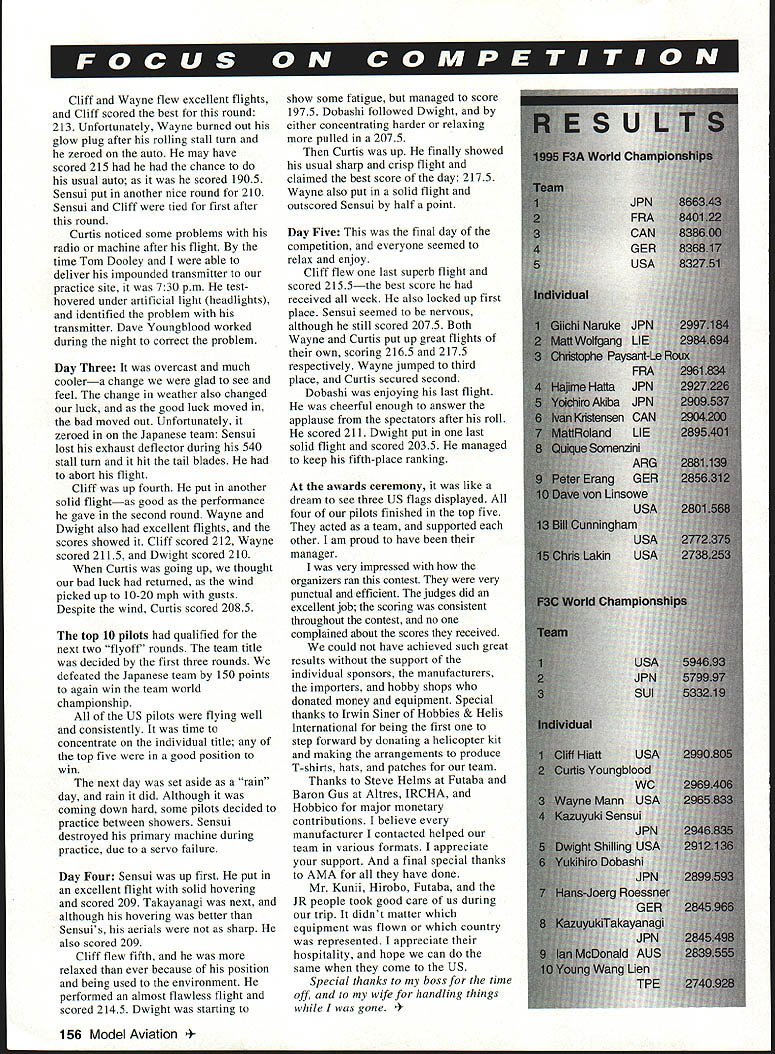
The U.S. F3A team placed fifth at the 1995 F3A World Championships held in Kasaoka, Japan. The team title went to Japan, with France second and Canada third. The individual champion was Giichi Naruke (Japan), Wolfgang Matt was second, and Christophe Paysant-Le Roux (France) was third.
The contest was very professionally run under Contest Director Tsugutaka Yoshioka (Yoshioka Model Company). Mr. Yoshioka assembled an outstanding contest staff; every detail was handled up front. Facilities were excellent — transmitter impound buildings were air-conditioned, and the breakfast/lunch facility was well designed, pleasant, and reasonably priced.
Logistics and support
- Many arrangements were handled by Steve Helms of Airborne, who helped secure practice sites, rental vans large enough for models, and economical hotels. The U.S. F3A team owes him a big thank you.
- Travel to Japan was long: hometowns → Los Angeles → Honolulu → Seoul → Okayama. The team found a practice site at Okayama provided by OK Model Company and practiced three days before moving to the contest site.
- The contest field was an agricultural runway reclaimed from Kasaoka Bay. The field faced west, so each competition day started early (with events beginning at 6:30 a.m.) and finished by mid-afternoon.
Team performance and contest summary
- Early rounds were affected by gusty winds from a passing typhoon at times exceeding FAI limits. Judges favored throttle changes and keeping models inside the 150-meter poles, so many competitors adjusted their styles accordingly.
- U.S. pilots included Chris Lakin, Bill Cunningham, and Dave Youngblood. All had strong moments, but issues (engine trouble, early lift-offs, or judges’ scoring preferences) limited high scores in certain rounds. Chris qualified in 16th — the last finals spot — after using his fourth round as his throwaway.
- In the finals, the Japanese and French teams displayed excellent throttle work and close-in flying. Christophe Paysant-Le Roux was particularly impressive and was a personal pick for champion.
- Ultimately, in team standings Japan finished first, France second, Canada third, Germany fourth, and the U.S. fifth.
Fundraising and thanks
- Thanks to supporters who purchased jackets, hats, or shirts, the team raised about $10,000 for the trip. AMA covers a large portion of expenses, but costs like model box transportation, rental vans, fuel, and uniforms require additional funding. The team appreciates donations and support.
- The next World Championships were scheduled for Poland in 1997.
F3C World Championship — Team Report
(The following report covers the U.S. team’s participation in a F3C/heli-style world championship event; no byline provided in source text.)
Registration and opening
- Registration was prompt and professional; four U.S. pilots completed registration without problems. Total entry was 49 pilots from 21 countries.
- The opening ceremony and reception went smoothly. A Japanese organizer donated two Challenge Cups to the FAI/F3C competition: one for individual and one for team champion.
Competition highlights (day-by-day)
- Monday, Aug 28: Competition began at 7:30 a.m. in hot, humid conditions. Pilot Dobashi (Japan) scored 190.15. U.S. pilots scored well: Dwight 188.5; Curtis 213.5; Cliff 202; Wayne 214.5; Sensui (Japan) 220.5. Top ten included Sensui (Japan), Mann (US), Youngblood (US), Hiatt (US), Kusayanagi (Japan), Roessner (Germany), Dobashi (Japan), Graber (Switzerland), Shilling (US), and Lien (Taipei).
- Day Two: Officials monitored RF interference and enforced delays when necessary. Scores improved: Dobashi 202.5; Dwight 209; Curtis 210; Cliff 213; Sensui 210. Wayne had a glow plug failure and zeroed on auto, scoring 190.5. Curtis encountered an intermittent short in his transmitter that was diagnosed and repaired that night.
- Day Three: Cooler, overcast conditions. Sensui suffered equipment failure and aborted a flight. Cliff 212, Wayne 211.5, Dwight 210, Curtis 208.5. The top 10 advanced to two “flyoff” rounds. The team title was decided by the first three rounds; the U.S. defeated Japan by 150 points to win the team world championship.
- Rain day: Heavy rain limited activity; some practiced between showers. Sensui destroyed his primary machine in practice due to a servo failure.
- Day Four: Sensui and Takayanagi scored 209. Cliff scored 214.5; Dwight 197.5; Dobashi 207.5; Curtis 217.5 (best score of the day); Wayne outscored Sensui by half a point.
- Day Five (final): Cliff scored 215 and locked up first place. Sensui 207.5. Wayne 216.5 (jumped to third). Curtis 217.5 (secured second). Dobashi 211, Dwight 203.5. All four U.S. pilots finished in the top five; the awards ceremony featured three U.S. flags displayed on the podium.
Acknowledgments
- The organizers, judges, and contest staff were punctual, efficient, and consistent in scoring. The U.S. team credited sponsors, manufacturers, importers, and hobby shops for donations of money and equipment.
- Special thanks to Irwin Siner (Hobbies & Helis International) for donating a helicopter kit and arranging team apparel; Steve Helms (Futaba), Baron Gus (Altrs), IRCHA, Hobbico, and many manufacturers for financial and material support; and to AMA for additional assistance.
- The author thanked Mr. Kurii, Hirobo, Futaba, JR representatives, the team’s sponsors, the manager’s boss for time off, and his wife for support while he was away.
Transcribed from original scans by AI. Minor OCR errors may remain.

