
Focus on Competition
Technical Director
Steve Kaluf
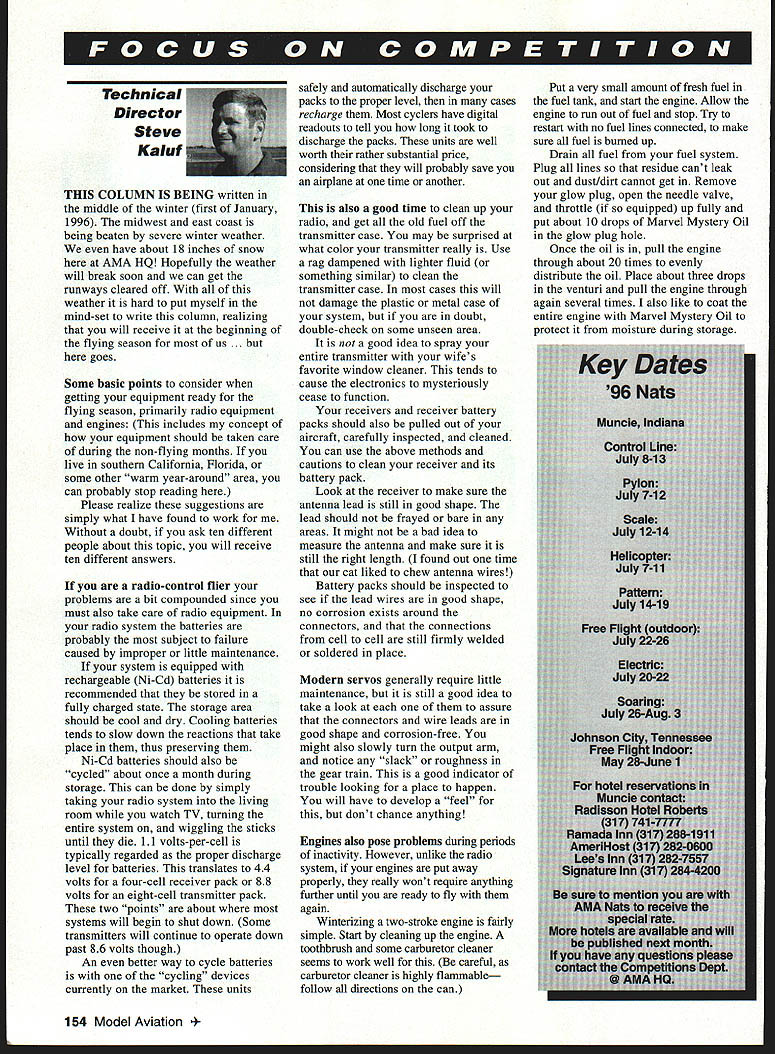
This column is being written in the middle of winter (first of January, 1996). The Midwest and East Coast are being hit by severe winter weather. We even have about 18 inches of snow here at AMA HQ! Hopefully the weather will break soon and we can get the runways cleared off. With all of this weather it is hard to put myself in the mind-set to write this column, realizing that you will receive it at the beginning of the flying season for most of us ... but here goes.
Some basic points to consider when getting your equipment ready for the flying season, primarily radio equipment and engines. This also includes my concept of how your equipment should be taken care of during the non-flying months. If you live in southern California, Florida, or some other "warm year-round" area, you can probably stop reading here. Please realize these suggestions are simply what I have found to work for me. Without a doubt, if you ask ten different people about this topic, you will receive ten different answers.
If you are a radio-control flier, your problems are a bit compounded since you must also take care of radio equipment. In your radio system the batteries are probably the most subject to failure caused by improper or little maintenance.
Batteries (Ni-Cd)
- If your system is equipped with rechargeable (Ni-Cd) batteries, it is recommended that they be stored in a fully charged state.
- The storage area should be cool and dry. Cooling batteries tends to slow down the reactions that take place in them, thus preserving them.
- Ni-Cd batteries should also be "cycled" about once a month during storage. This can be done by simply taking your radio system into the living room while you watch TV, turning the entire system on, and wiggling the sticks until they die. 1.1 volts per cell is typically regarded as the proper discharge level for batteries. This translates to 4.4 volts for a four-cell receiver pack or 8.8 volts for an eight-cell transmitter pack. These voltage points are about where most systems will begin to shut down. (Some transmitters will continue to operate down past 8.6 volts, though.)
- An even better way to cycle batteries is with one of the "cycling" devices currently on the market. These units safely and automatically discharge your packs to the proper level, then in many cases recharge them. Most cyclers have digital readouts that tell you how long it took to discharge the packs. These units are well worth their rather substantial price, considering that they will probably save you an airplane at one time or another.
Cleaning and inspection
- This is also a good time to clean up your radio, and get all the old fuel off the transmitter case. Use a rag dampened with lighter fluid (or something similar) to clean the transmitter case. In most cases this will not damage the plastic or metal case of your system, but if you are in doubt, double-check on some unseen area.
- It is not a good idea to spray your entire transmitter with your wife's favorite window cleaner. This tends to cause the electronics to mysteriously cease to function.
- Your receivers and receiver battery packs should also be pulled out of your aircraft, carefully inspected, and cleaned. You can use the above methods and cautions to clean the receiver and its battery pack.
- Look at the receiver to make sure the antenna lead is still in good shape. The lead should not be frayed or bare in any areas. It might not be a bad idea to measure the antenna and make sure it is still the right length. (I found out one time that our cat liked to chew antenna wires!)
- Battery packs should be inspected to see if the lead wires are in good shape, no corrosion exists around the connectors, and that the connections from cell to cell are still firmly welded or soldered in place.
Servos and connectors
- Modern servos generally require little maintenance, but it is still a good idea to take a look at each one of them to assure that the connectors and wire leads are in good shape and corrosion-free.
- Slowly turn the output arm and notice any "slack" or roughness in the gear train. This is a good indicator of trouble looking for a place to happen. You will have to develop a "feel" for this, but don't chance anything!
Engines also pose problems during periods of inactivity. However, unlike the radio system, if your engines are put away properly, they really won't require anything further until you are ready to fly with them again.
Winterizing two-stroke engines
- Clean the engine. A toothbrush and some carburetor cleaner seem to work well for this. Be careful, as carburetor cleaner is highly flammable—follow all directions on the can.
- Put a very small amount of fresh fuel in the fuel tank, and start the engine. Allow the engine to run out of fuel and stop. Try to restart with no fuel lines connected, to make sure all fuel is burned up.
- Drain all fuel from your fuel system. Plug all lines so that residue can't leak out and dust/dirt cannot get in.
- Remove your glow plug, open the needle valve, put the throttle (if so equipped) up fully, and put about 10 drops of Marvel Mystery Oil in the glow-plug hole.
- Once the oil is in, pull the engine through about 20 times to evenly distribute the oil into the engine. Place about three drops in the venturi and pull the engine through again several times.
- Coat the entire engine with Marvel Mystery Oil to protect it from moisture during storage.
- Replace the glow plug and wrap the engine loosely with a lint-free cloth coated with oil. I prefer to store engines cylinder head up; this tends to keep the oil from seeping up the glow plug and carburetor.
These methods have reliably stored my engines for a number of years. Some people feel that the oil can gum up if left in too long, but I've not experienced this problem with a month or two of storage.
Four-stroke engines
- In addition to the above procedures, remove the valve cover and place a couple of drops of oil on the valve train. Four-strokes are also best stored upright.
Dewinterizing engines
- Start by removing the glow plug and turning the engine over several times to see how freely it turns over. If it is still turning freely, add fuel and start it. The engine will cough and sputter a little, but as it cleans the oil out of its system it will run fine.
- If the engine is not turning freely, flush it out with glow fuel through the glow-plug hole with the engine upside down (so it drains). Also squirt some fuel up into the carburetor (again while the engine is upside down). This normally will clean out most of the oil. Then start the engine.
- Use caution that you don't get too much fuel into the engine, thus allowing it to fill the crankcase; this can cause the engine to lock up. If this happens you will have to carefully work the "lock" out with the engine inverted. Don't force it! Forcing can bend or break the crankshaft and possibly the connecting rod.
- On four-stroke engines you may also have to flush out the valve train by removing the valve cover, inverting the engine, and using a bit of fuel.
Aircraft inspection
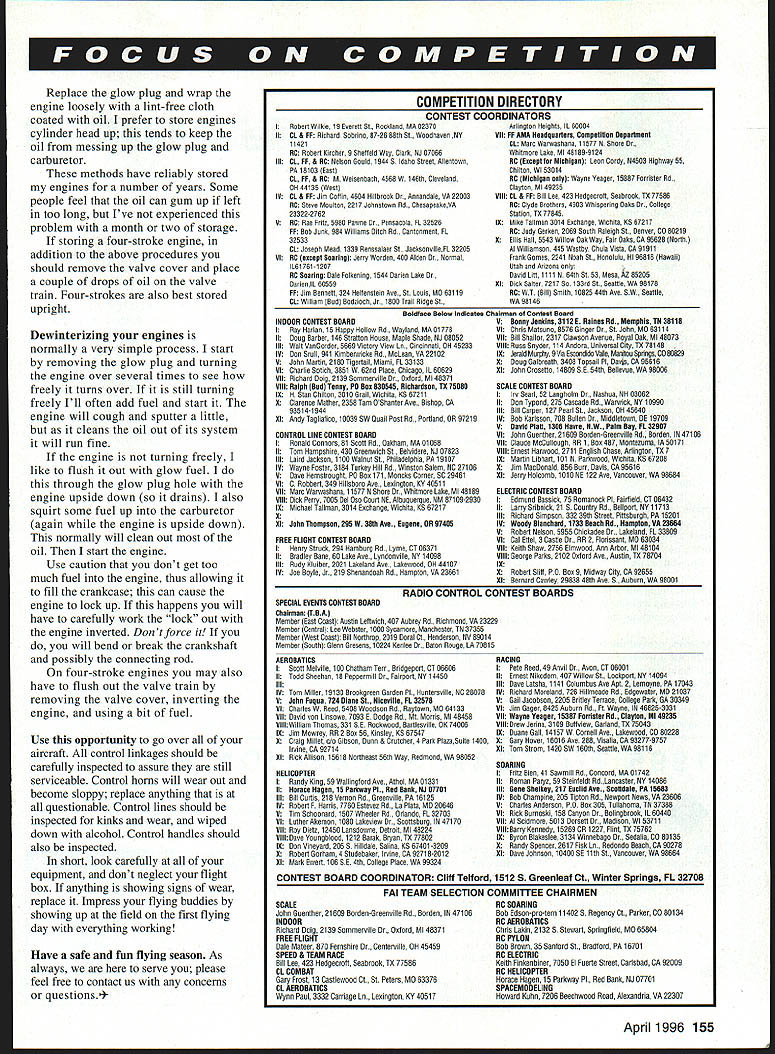
- Use this opportunity to go over all of your aircraft. All control linkages should be carefully inspected to assure they are still serviceable.
- Control horns will wear out and become sloppy; replace anything that is questionable.
- Control lines should be inspected for kinks and wear, and wiped down with alcohol.
- Control handles should also be inspected.
- In short, look carefully at all of your equipment, and don't neglect your flight box. If anything is showing signs of wear, replace it.
Impress your flying buddies by showing up at the field on the first flying day with everything working! Have a safe and fun flying season. As always, we are here to serve you; please feel free to contact us with any concerns or questions.
Focus on Competition
1995 F3B Team Manager's Report
Larry Jolly
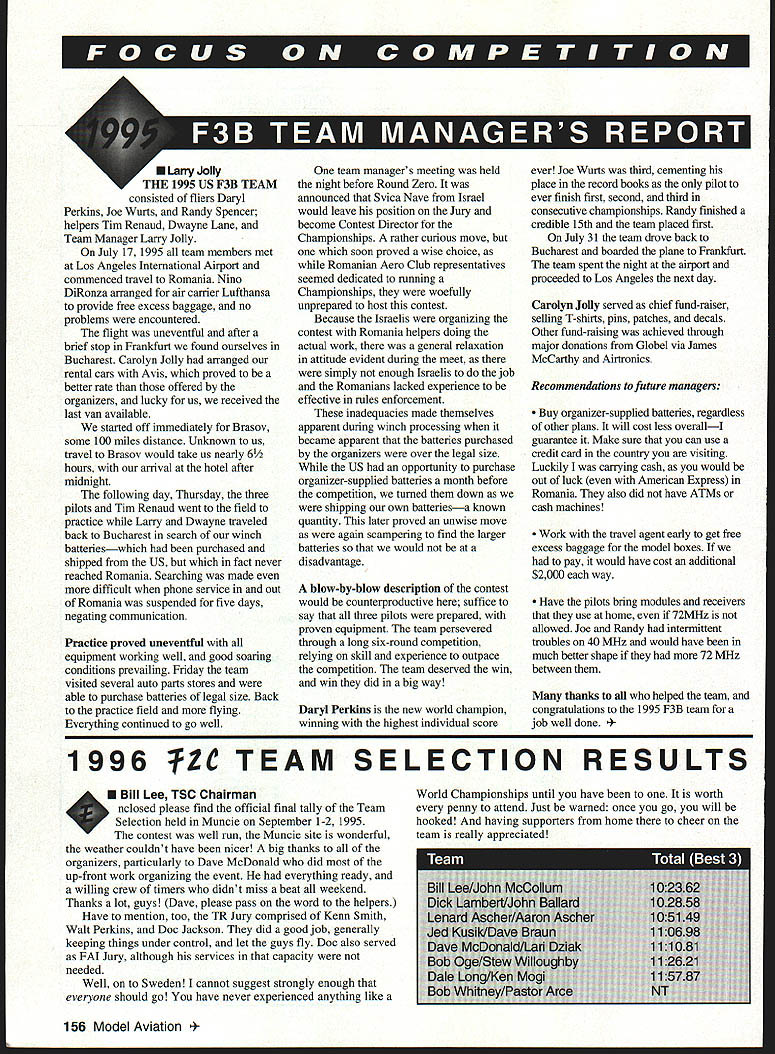
The 1995 US F3B Team consisted of fliers Daryl Perkins, Joe Wurts, and Randy Spencer; helpers Tim Renaud, Dwayne Lane, and Team Manager Larry Jolly.
On July 17, 1995 all team members met at Los Angeles International Airport and commenced travel to Romania. Nino DiRonza arranged for air carrier Lufthansa to provide free excess baggage, and no problems were encountered.
The flight was uneventful and after a brief stop in Frankfurt we found ourselves in Bucharest. Carolyn Jolly had arranged our rental cars with Avis, which proved to be a better rate than those offered by the organizers, and lucky for us, we received the last van available.
We started off immediately for Brașov, some 100 miles distant. Unknown to us, travel to Brașov would take nearly 6½ hours, with our arrival at the hotel after midnight.
The following day, Thursday, the three pilots and Tim Renaud went to the field to practice while Larry and Dwayne traveled back to Bucharest in search of our winch batteries—which had been purchased and shipped from the US, but which in fact never reached Romania. Searching was made even more difficult when phone service in and out of Romania was suspended for five days, negating communication.
Practice proved uneventful with all equipment working well, and good soaring conditions prevailing. Friday the team visited several auto parts stores and were able to purchase batteries of legal size. Back to the practice field and more flying. Everything continued to go well.
One team manager's meeting was held the night before Round Zero. It was announced that Svica Nave from Israel would leave his position on the Jury and become Contest Director for the Championships. A rather curious move, but one which soon proved a wise choice, as while Romanian Aero Club representatives seemed dedicated to running a Championships, they were woefully unprepared to host this contest.
Because the Israelis were organizing the contest with Romanian helpers doing the actual work, there was a general relaxation in attitude evident during the meet, as there were simply not enough Israelis to do the job and the Romanians lacked experience to be effective in rules enforcement.
These inadequacies made themselves apparent during winch processing when it became clear that the batteries purchased by the organizers were over the legal size. While the US had an opportunity to purchase organizer-supplied batteries a month before the competition, we turned them down as we were shipping our own batteries—a known quantity. This later proved an unwise move as we were again scampering to find the larger batteries so that we would not be at a disadvantage.
A blow-by-blow description of the contest would be counterproductive here; suffice to say that all three pilots were prepared, with proven equipment. The team persevered through a long six-round competition, relying on skill and experience to outpace the competition. The team deserved the win, and win they did in a big way!
- Daryl Perkins is the new world champion, winning with the highest individual score ever.
- Joe Wurts was third, cementing his place in the record books as the only pilot to ever finish first, second, and third in consecutive championships.
- Randy Spencer finished a credible fifth and the team placed first.
On July 31 the team drove back to Bucharest and boarded the plane to Frankfurt. The team spent the night at the airport and proceeded to Los Angeles the next day.
Carolyn Jolly served as chief fund-raiser, selling T-shirts, pins, patches, and decals. Other fund-raising was achieved through major donations from Global via James McCarthy and Airtronics.
Recommendations to future managers:
- Buy organizer-supplied batteries, regardless of other plans. It will cost less overall—I guarantee it. Make sure that you can use a credit card in the country you are visiting. Luckily I was carrying cash, as you would be out of luck (even with American Express) in Romania. They also did not have ATMs or cash machines.
- Work with the travel agent early to get free excess baggage for the model boxes. If we had to pay, it would have cost an additional $2,000 each way.
- Have the pilots bring modules and receivers that they use at home, even if 72 MHz is not allowed. Joe and Randy had intermittent troubles on 40 MHz and would have been in much better shape if they had more 72 MHz between them.
Many thanks to all who helped the team, and congratulations to the 1995 F3B team for a job well done.
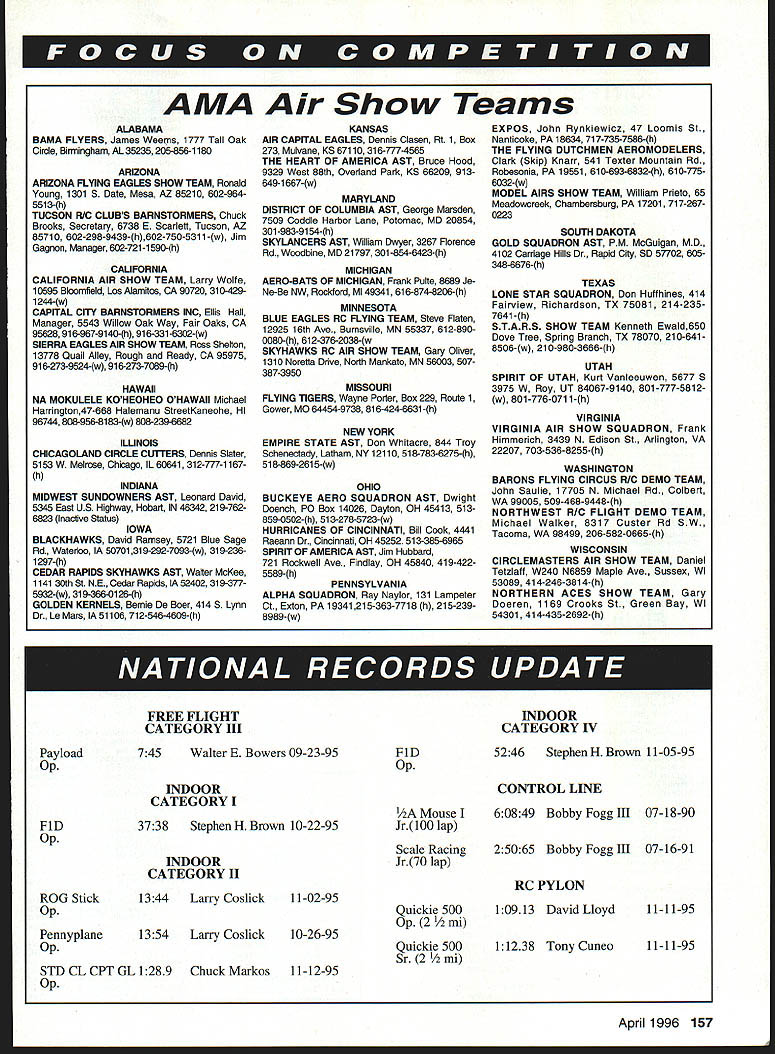
AMA Air Show Teams
ALABAMA
- Bama Flyers, James Weems, 1777 Tall Oak Circle, Birmingham, AL 35235, 205-856-1180
ARIZONA
- Arizona Flying Eagles Show Team, Ronald Young, 1301 S. Date, Mesa, AZ 85210, 602-964-5513 (h)
- Tucson R/C Club's Barnstormers, Chuck Brooks, Secretary, 6738 E. Scarlett, Tucson, AZ 85710, 602-298-4939 (h); Jim Gagnon, Manager, 602-721-1590 (h)
CALIFORNIA
- California Air Show Team, Larry Wolfe, 10695 Bloomfield, Los Alamitos, CA 90720, 310-429-1244 (h)
- Capital City Barnstormers Inc., Ellis Hall, Manager, 5543 Willow Oak Way, Fair Oaks, CA 95628, 916-967-9140 (h), 916-631-6320 (w)
- Sierra Eagles Air Show Team, Ross Shelton, 13778 Quail Alley, Rough and Ready, CA 95975, 916-273-0924 (w), 916-273-7069 (h)
HAWAII
- Na Mokulele Koehoehoe O'Hawaii, Michael Harrington, 47-664 Haleamanu Street, Keaau, HI 96744, 808-956-8183 (w), 808-839-6682 (h)
ILLINOIS
- Chicagoland Circle Cutters, Dennis Slater, 5153 W. Melrose, Chicago, IL 60641, 312-277-1167 (h)
INDIANA
- Midwest Sundowners AST, Leonard David, 5345 East US 40, Fishers, Hobart, IN 46342, 219-776-xxxx (inactive status)
IOWA
- Blackhawks, David Ramsey, 5721 Blue Sage Rd., Waterloo, IA 50701, 319-292-7093 (w), 319-236-1297 (h)
KANSAS
- Air Capital Eagles, Dennis Clasen, Rt. 1, Box 273, Mulvane, KS 67110, 316-777-4565
- The Heart of America AST, Bruce Hood, 9329 West 88th, Overland Park, KS 66209, 913-649-1667 (h)
MARYLAND
- District of Columbia AST, George Marsden, 7509 Coddle Harbor Lane, Potomac, MD 20854, 301-983-9154 (h)
- Skylaunchers AST, William Dwyer, 3267 Florence Rd., Woodbine, MD 21797, 301-854-6423 (h)
MICHIGAN
- Aero-Bats of Michigan, Frank Pulte, 8689 Je-Ne-Bee N.W., Rockford, MI 49341, 616-874-8206 (h)
MINNESOTA
- Blue Eagles R/C Flying Team, Steve Flaten, 12925 6th Ave., Burnsville, MN 55337, 612-890-0800 (h), 612-370-2038 (w)
- Skyhawks R/C Air Show Team, Gary Oliver, 13110 Norton Drive, North Mankato, MN 56003, 507-387-3950
MISSOURI
- Flying Tigers, Wayne Porter, Box 229, Route 1, Gower, MO 64454-9728, 816-424-6631 (h)
NEW YORK
- Empire State AST, Don Whitacre, 844 Troy-Schenectady, Latham, NY 12110, 518-783-6275 (h), 518-869-2615 (w)
OHIO
- Buckeye Aero Squadron AST, Dwight Doench, PO Box 1402, Dayton, OH 45402, 513-859-0502 (h), 513-278-5725 (w)
- Hurricanes of Cincinnati, Bill Cook, 4441 Reaven Dr., Cincinnati, OH 45252, 513-385-6965
- Spirit of America AST, Jim Hubbard, 721 Rockwell Ave., Findlay, OH 45840, 419-422-5589 (h)
PENNSYLVANIA
- Alpha Squadron, Ray Naylor, 131 Lampeter Ext., Ephrata, PA 19341, 215-363-7718 (h), 215-239-8989 (w)
- Expos, John Rynkiewicz, 47 Loomis St., Nanticoke, PA, 717-735-7586 (h)
- The Flying Dutchmen Aeromodelers, Clark (Skip) Knarr, 541 Texter Mountain Rd., Robesonia, PA 19551, 610-693-6832 (h), 610-775-6032 (w)
- Model Airs Show Team, William Prieto, 65 Caldwellwyre, Chambersburg, PA 17201, 717-267-0223
SOUTH DAKOTA
- Gold Squadron AST, P.M. McGuigan, M.D., 4102 Carriage Hills Dr., Rapid City, SD 57702, 605-348-6676 (h)
TEXAS
- Lone Star Squadron, Don Huffhines, 414 Fairview, Richardson, TX 75081, 214-235-7641 (h)
- S.T.A.R.S. Show Team, Kenneth Ewald, 650 Dove Tree, Spring Branch, TX 78070, 210-601-8506 (w), 210-980-3666 (h)
UTAH
- Spirit of Utah, Kurt VanLoeuwen, 5677 S. 3975 W., Roy, UT 84067-9140, 801-777-5812 (h), 801-776-0711 (w)
VIRGINIA
- Virginia Air Show Squadron, Frank Himmerich, 3493 N. Edison St., Arlington, VA 22207, 703-536-8255 (h)
WASHINGTON
- Barons Flying Circus R/C Demo Team, John Saulie, 17705 N. Michael Rd., Colbert, WA 99005, 509-468-9448 (h)
- Northwest R/C Flight Demo Team, Michael Walker, 8317 Custer Rd. S.W., Tacoma, WA 98499, 206-582-0665 (h)
WISCONSIN
- Circlemasters Air Show Team, Daniel Tetzlaff, W240 N6895 Maple Ave., Sussex, WI 53089, 414-246-8346 (h)
- Northern Aces Show Team, Gary Doerner, 119 Crooks St., Green Bay, WI 54301, 414-435-2692 (h)
NATIONAL RECORDS UPDATE
Free Flight Category III
- Payload 7:45 — Walter E. Bowers, 09-23-95 Op.
Indoor Category I
- FID 37:38 — Stephen H. Brown, 10-22-95 Op.
Indoor Category II
- ROG Stick 13:44 — Larry Coslick, 11-02-95 Op.
- Pennyplane 13:54 — Larry Coslick, 10-26-95 Op.
- STD CL CPT GL 1:28.9 — Chuck Markos, 11-12-95 Op.
Indoor Category IV
- FID 52:46 — Stephen H. Brown, 11-05-95 Op.
Control Line
- 1/2A Mouse I 6:08:49 — Bobby Fogg III, 07-18-90 Jr. (100 lap)
- Scale Racing 2:50:65 — Bobby Fogg III, 07-16-91 Jr. (70 lap)
RC Pylon
- Quickie 500 1:09.13 — David Lloyd, 11-11-95 Op. (2 1/2 mi)
- Quickie 500 1:12.38 — Tony Cuneo, 11-11-95 Sr. (2 1/2 mi)
Transcribed from original scans by AI. Minor OCR errors may remain.

