
Focus on Competition
Frequency concerns and resources
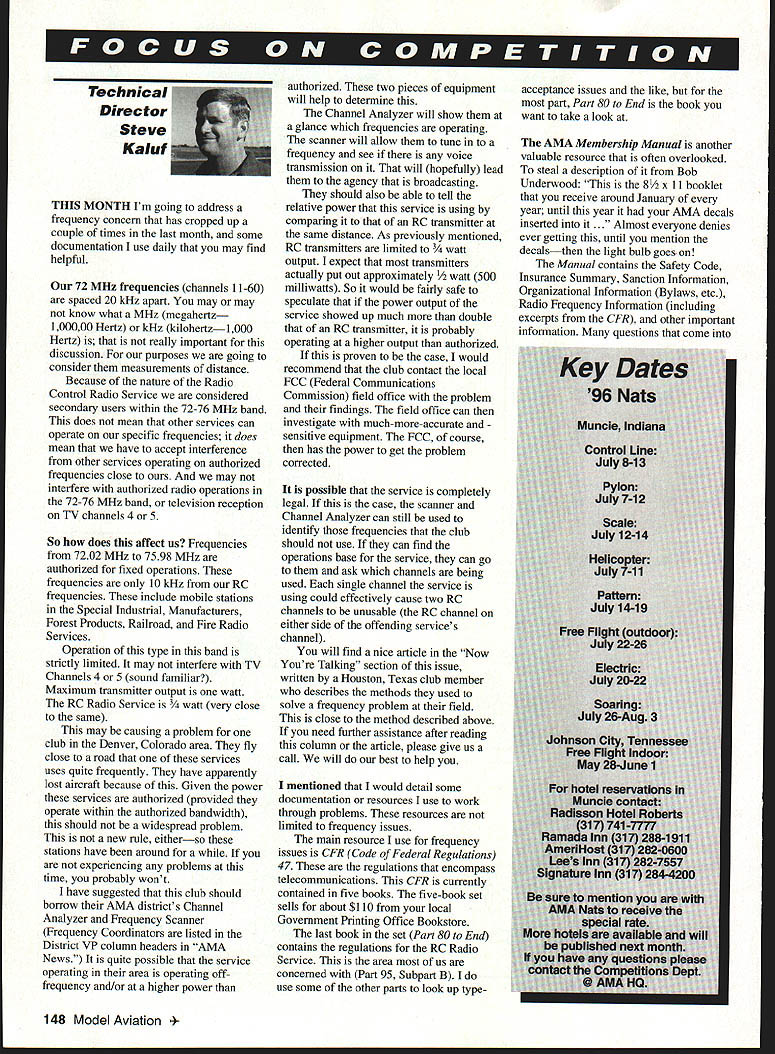
This month I'm addressing a frequency concern that has arisen recently, and some documentation you may find helpful.
- Our 72 MHz frequencies (channels 11–60) are spaced 20 kHz apart. For our purposes, consider these measurements in kHz.
- The Radio Control Radio Service (RC) is a secondary user within the 72–76 MHz band. That means other authorized services can operate on frequencies near ours and we must accept potential interference. We may not interfere with authorized radio operations in the 72–76 MHz band or with television reception on TV channels 4 or 5.
- Frequencies from 72.02 MHz to 75.98 MHz are authorized for fixed operations in 10 kHz increments. These include mobile stations in Special Industrial/Business, Forest Products, Railroad, Fire, and other radio services.
- Operation of those services is strictly limited; they must avoid interfering with TV channels 4 and 5. Maximum authorized transmitter output for many of these services is 1 watt. RC transmitters are limited to 3/4 watt; many actually output about 1/2 watt (500 milliwatts).
If you suspect interference in your area
- Borrow your AMA district’s Channel Analyzer and Frequency Scanner (Frequency Coordinators are listed in the District VP column headers in AMA News).
- The Channel Analyzer shows which frequencies are active.
- The scanner lets you tune to a frequency to hear voice transmissions and may help identify the broadcasting agency.
- You can estimate relative power by comparing the unknown service’s signal to that of an RC transmitter at the same distance. If the service’s signal is much more than double an RC transmitter’s, it may be operating at higher power than authorized.
- If you verify illegal operation, contact your local FCC field office with your findings. The FCC can investigate with more accurate equipment and has authority to correct the problem.
- If the service is operating legally, use the scanner and analyzer to identify frequencies to avoid. Note that a single off-frequency transmission can effectively render two RC channels unusable (the RC channels immediately adjacent to the offending channel).
Additional help and references
- See the "Now You're Talking" section in this issue for a Houston club member’s report on solving a field frequency problem; it follows similar methods. Contact the Technical Department if you need further assistance.
- Primary regulatory reference: Code of Federal Regulations (CFR), Title 47 — telecommunications. The full set is five books (available from the Government Printing Office bookstore). The last book (Part 80 to End) contains the RC Radio Service regulations (see Part 95, Subpart B).
- Other useful documents: the AMA Membership Manual (contains Safety Code, Insurance Summary, Sanction Information, Organizational Information, Radio Frequency Information including CFR excerpts) and the Competition Regulations (rules for AMA competitive events, sanctioning information, and procedures for rules-change proposals). The Competition Regulations are available to all AMA members at no additional charge but must be requested.
As always, we are here to help—please contact us as your needs dictate. Technical Director Steve Kaluf
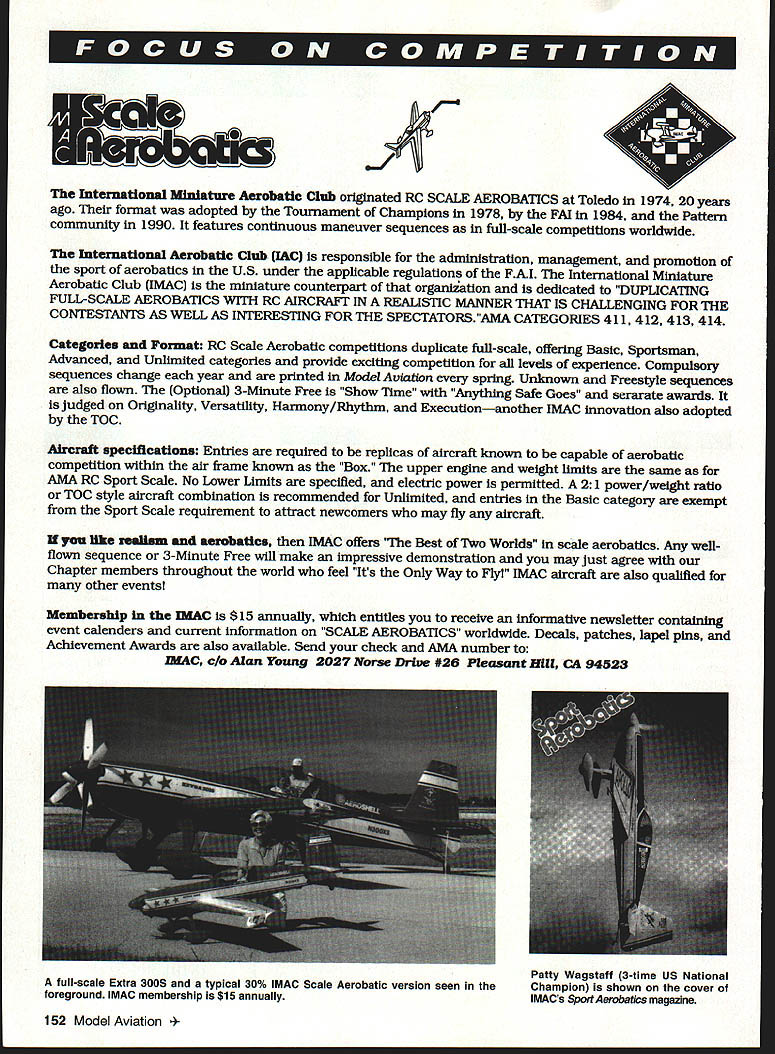
Scale Aerobatics and IMAC
- The International Miniature Aerobatic Club (IMAC) originated RC scale aerobatics at Toledo in 1974. The format was adopted by the Tournament of Champions (TOC) in 1978, by the FAI in 1984, and by the Pattern community in 1990. IMAC features continuous maneuver sequences similar to full-scale competitions.
- The International Aerobatic Club (IAC) administers and promotes full-scale aerobatics in the U.S. under FAI regulations. IMAC is the miniature counterpart, dedicated to "duplicating full-scale aerobatics with RC aircraft in a realistic manner that is challenging for the contestants as well as interesting for the spectators."
- AMA categories: 411, 412, 413, 414.
Categories and format
- RC scale aerobatic competitions duplicate full-scale events and provide Basic, Sportsman, Advanced, and Unlimited categories for all skill levels.
- Compulsory sequences change yearly and are printed in Model Aviation each spring. Unknown and Freestyle sequences are also flown.
- The optional 3-Minute Free ("Show Time") is judged on Originality, Versatility, Harmony/Rhythm, and Execution—an IMAC innovation adopted by the TOC.
Aircraft specifications
- Entries must be replicas of aircraft known to be capable of aerobatic competition and must fit within the defined airframe "Box."
- Upper engine and weight limits are the same as for AMA RC Sport Scale. No lower limits are specified. Electric power is permitted.
- A 2:1 power/weight ratio or a TOC-style aircraft combination is recommended for Unlimited. Basic entries are exempt from the Sport Scale requirement to attract newcomers.
Membership
- IMAC membership is $15 annually and includes a newsletter with event calendars and current information on scale aerobatics worldwide. Decals, patches, lapel pins, and Achievement Awards are available.
- Send check and AMA number to:
- IMAC, c/o Alan Young, 2027 Norse Drive #26, Pleasant Hill, CA 94523
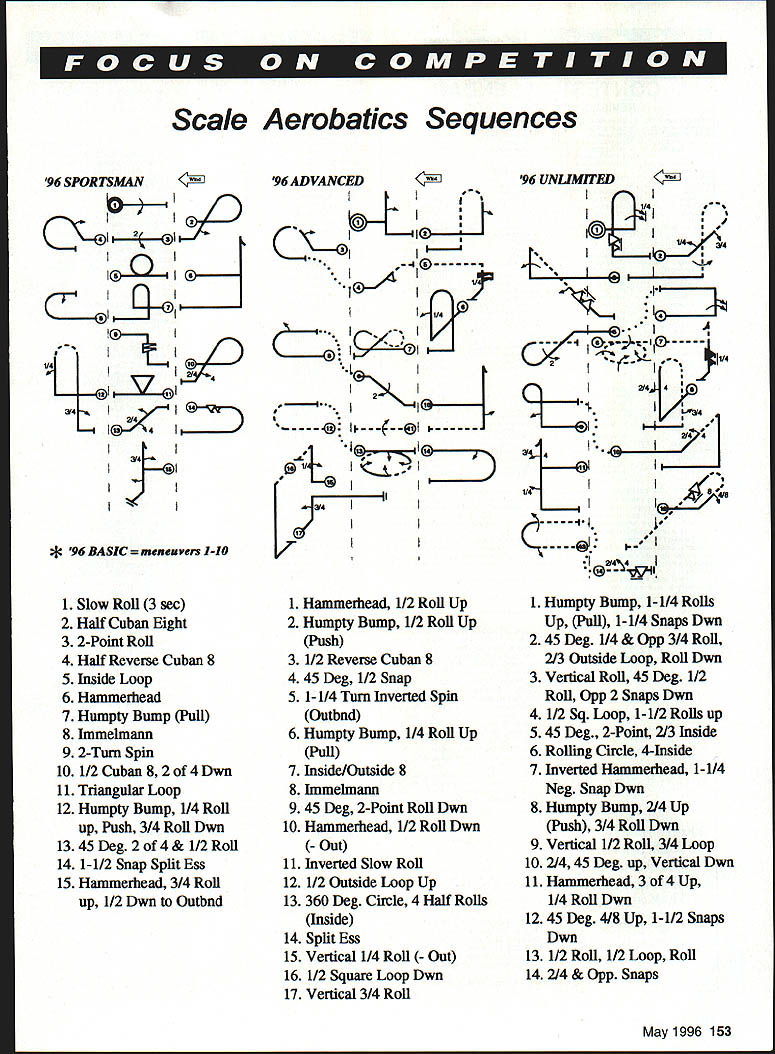
Scale Aerobatics Sequences
- '96 BASIC = maneuvers 1–10
'96 SPORTSMAN
- Slow Roll (3 sec)
- Half Cuban Eight
- 2-Point Roll
- Half Reverse Cuban 8
- Inside Loop
- Hammerhead
- Humpty Bump (Pull)
- Immelmann
- 2-Turn Spin
- 1/2 Cuban 8, 2 of 4 Down
- Triangular Loop
- Humpty Bump, 1/4 Roll up, Push, 3/4 Roll Down
- 45 Deg. 2 of 4 & 1/2 Roll
- 1-1/2 Snap Split S
- Hammerhead, 3/4 Roll up, 1/2 Down to Outbound
'96 ADVANCED
- Hammerhead, 1/2 Roll Up
- Humpty Bump, 1/2 Roll Up (Push)
- 1/2 Reverse Cuban 8
- 45 Deg, 1/2 Snap
- 1-1/4 Turn Inverted Spin (Outbound)
- Humpty Bump, 1/4 Roll Up (Pull)
- Inside/Outside 8
- Immelmann
- 45 Deg, 2-Point Roll Down
- Hammerhead, 1/2 Roll Down (Outbound)
- Inverted Slow Roll
- 1/2 Outside Loop Up
- 360 Deg. Circle, 4 Half Rolls (Inside)
- Split S
- Vertical 1/4 Roll (Outbound)
- 1/2 Square Loop Down
- Vertical 3/4 Roll
'96 UNLIMITED
- Humpty Bump, 1-1/4 Rolls Up (Pull), 1-1/4 Snaps Down
- 45 Deg. 1/4 & Opposite 3/4 Roll, 2/3 Outside Loop, Roll Down
- Vertical Roll, 45 Deg. 1/2 Roll, Opposite 2 Snaps Down
- 1/2 Square Loop, 1-1/2 Rolls Up
- 45 Deg., 2-Point, 2/3 Inside
- Rolling Circle, 4-Inside
- Inverted Hammerhead, 1-1/4 Negative Snap Down
- Humpty Bump, 2/4 Up (Push), 3/4 Roll Down
- Vertical 1/2 Roll, 3/4 Loop
- 2/4, 45 Deg. Up, Vertical Down
- Hammerhead, 3 of 4 Up, 1/4 Roll Down
- 45 Deg. 4/8 Up, 1-1/2 Snaps Down
- 1/2 Roll, 1/2 Loop, Roll
- 2/4 & Opposite Snaps
Transcribed from original scans by AI. Minor OCR errors may remain.

