
Focus on Competition
The Newcomer Issue
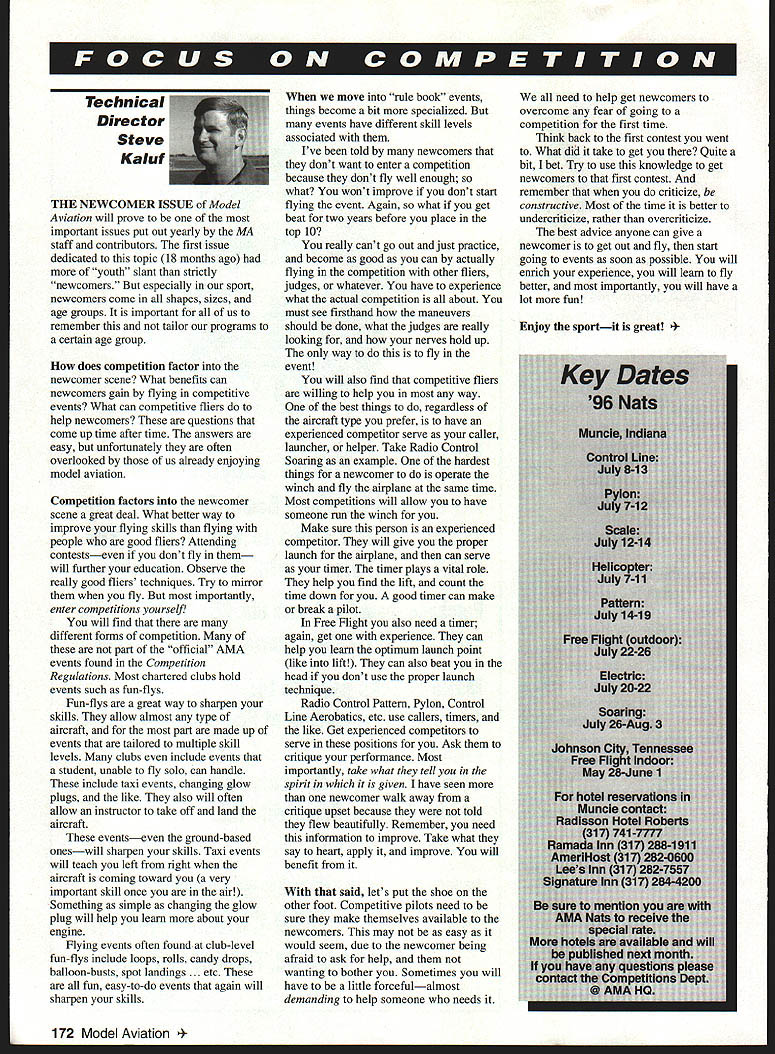
Model Aviation will present important topics yearly through MA staff contributions. The first issue dedicated to this topic appeared 18 months ago. With a youth slant, this piece focuses on newcomers—especially sport newcomers—who come in all shapes, sizes, and age groups. It is important to remember to tailor programs to different age groups and experience levels.
Does competition factor into the newcomer scene? What benefits can newcomers gain from flying competitive events? What can competitive fliers do to help newcomers? These questions arise repeatedly. The answers are straightforward but often overlooked by those already enjoying model aviation.
Why Competition Helps Newcomers
Competition plays a large role in skill development for newcomers. What better way to improve flying skills than flying alongside people who are already skilled? Benefits include:
- Observing advanced techniques and flight discipline.
- Experiencing maneuvers and judging criteria firsthand.
- Gaining confidence by facing and overcoming competition nerves.
- Receiving direct, practical feedback from experienced fliers and judges.
Attending contests—even without flying—will accelerate education. Watch good fliers, try mirror-flying, and, importantly, enter competitions yourself. Different forms of competition are part of official AMA events; see the Competition Regulations for details.
Club Events and Fun-Flys
Most chartered clubs hold events such as fun-flys. Fun-flys are an excellent, low-pressure way to sharpen skills and allow almost any type of aircraft to participate. Typical features:
- Events tailored to multiple skill levels.
- Activities suitable for students not yet flying solo, such as taxi events and simple maintenance tasks.
- Instructors often allowed to assist with takeoffs and landings—even in some ground-based events.
Common club-level flying events include:
- Loops and rolls
- Candy drops and balloon-busts
- Spot landings
- Taxi events (to build left/right orientation for aircraft coming toward you)
- Simple engine tasks like changing a glow plug (to learn about engines and maintenance)
These fun, easy-to-do events help newcomers practice basic skills in a supportive environment.
Rule-Book Events and Getting Started
Move to rule-book events and things become more specialized, with different skill levels associated with each event. Many newcomers say they don't want to enter competitions because they don't fly well enough. The reality:
- You won't improve if you don't start competing.
- You may get beaten for a while, but competition experience is the fastest way to learn.
- Practicing alone is valuable, but flying in events exposes you to judges, other fliers, and the pressure of real competition.
You must see maneuvers done correctly and understand what judges look for. Competing helps you manage nerves and learn performance under pressure.
Helpers and Their Roles
One of the best supports for a newcomer is an experienced competitor serving as caller, launcher, timer, or helper. Examples by discipline:
- Radio Control Soaring:
- Have someone run the winch so you can focus on flying.
- Use an experienced timer to help find lift and count down time.
- Free Flight:
- An experienced timer helps you learn optimum launch points and how to find lift.
- Radio Control Pattern, Pylon, Control Line, Aerobatics:
- Use callers, timers, and other experienced helpers and ask them to critique your performance.
A good helper can make or break a pilot. Take critiques in the spirit they’re given—apply the feedback and improve.
Advice for Competitive Pilots
Competitive pilots need to make themselves available to newcomers. This can require initiative because newcomers may be afraid to ask for help or reluctant to bother you. Suggestions:
- Be approachable and offer assistance proactively.
- Encourage newcomers to attend their first contest; recall how much it took for you to go to your first.
- When criticizing, be constructive and balanced—better to under-criticize than to overwhelm.
- Be a patient caller, launcher, timer, or mentor.
Sometimes you must be a little forceful in offering help to overcome a newcomer's fear of asking.
Final Advice
The best advice for newcomers is to get out and fly, then start attending events as soon as possible. You will enrich your experience, learn to fly better, and, most importantly, have a lot more fun. Enjoy the sport—it is great!
Transcribed from original scans by AI. Minor OCR errors may remain.

