
Focus on Competition
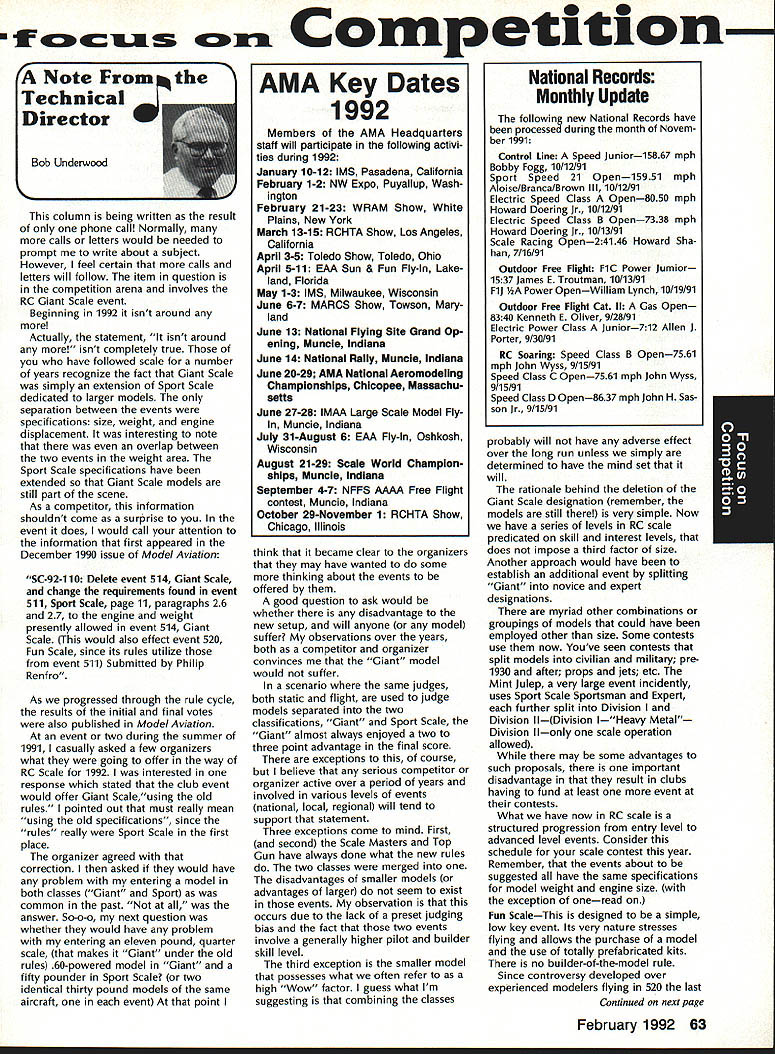
A Note From the Technical Director
Bob Underwood
This column is being written as the result of only one phone call. Normally many more calls or letters would be needed to prompt me to write about a subject; however, I feel certain that more calls and letters will follow. The item in question is in the competition arena and involves the RC Giant Scale event.
Beginning in 1992 it isn't around any more!
Actually, the statement "It isn't around any more!" isn't completely true. Those of you who have followed scale for a number of years recognize that Giant Scale was simply an extension of Sport Scale dedicated to larger models. The only separation between the events was specifications: size, weight, and engine displacement. There was even an overlap between the two events in the weight area. The Sport Scale specifications have been extended so that Giant Scale models are still part of the scene.
As a competitor, this information shouldn't come as a surprise. In case it does, note the item that first appeared in the December 1990 issue of Model Aviation:
- ISC-92-110: Delete event 514, Giant Scale, and change the requirements found in event 511, Sport Scale (page 11, paragraphs 26 and 27), to the engine and weight presently allowed in event 514, Giant Scale. (This would also affect event 520, Fun Scale, since its rules utilize event 511.) Submitted by Philip Renfro.
As we progressed through the rule cycle, the results of the initial and final votes were also published in Model Aviation. At an event during the summer of 1991 I casually asked a few organizers what they were going to offer in the way of RC Scale for 1992. I was interested in one response which stated that the club event would offer Giant Scale "using the old rules." I pointed out that that must really mean "using the old specifications," since the "rules" really were Sport Scale in the first place.
The organizer agreed with that correction. I then asked if they would have any problem with my entering a model in both classes ("Giant" and Sport) as was common in the past. "Not at all," was the answer.
So, my next question was whether they would have any problem with my entering an eleven-pound quarter-scale (that makes it "Giant" under the old rules), 60-powered model in Sport Scale, and a fifty-pounder in Sport Scale (or two identical thirty-pound models of the same aircraft, one in each event). At that point it became clear to the organizers that they might want to do some more thinking about the events they would offer.
A good question to ask is whether there is any disadvantage to the new setup, and will anyone (or any model) suffer? My observations over the years, both as a competitor and organizer, convince me that the "Giant" model would suffer.
In scenarios where the same judges, both static and flight, are used to judge models separated into the two classifications, "Giant" and Sport Scale, the "Giant" almost always enjoyed a two- or three-point advantage in the final score. There are exceptions, of course, but I believe any serious competitor or organizer active over a period of years and involved at various levels (national, local, regional) will tend to support that statement.
Three exceptions come to mind:
- Scale Masters and Top Gun. These events have always done what the new rules do: the two classes were merged into one. The disadvantages of smaller models (or advantages of larger models) do not seem to exist in those events. My observation is that this occurs due to the lack of a preset judging bias and the fact that those events involve generally higher pilot and builder skill levels.
- High-skill events. The higher the overall skill level of pilots and builders, the less size seems to bias judging.
- Smaller models with a high "wow" factor. A very well-detailed or striking small model can overcome any size bias.
Combining the classes probably will not have any adverse effect over the long run unless we are determined to have the mindset that it will.
The rationale behind the deletion of the Giant Scale designation (remember, the models are still there) is simple: we now have a series of levels in RC scale predicated on skill and interest levels that does not impose a third factor of size. Another approach would have been to establish an additional event by splitting "Giant" into novice and expert designations.
There are myriad other combinations or groupings of models that could have been employed other than size. Some contests split models into civilian and military, pre-1930 and post-1930, props and jets, etc. Very large events sometimes use Sport Scale Sportsman and Expert, each further split into Division I and Division II (Division II — "Heavy Metal" — allowing only one scale operation).
While there may be some advantages to such proposals, an important disadvantage is that they require clubs to find at least one more event at their contests.
What we have now in RC scale is a structured progression from entry level to advanced level events. Consider this as your selection guide for your scale contests this year. Remember that the events suggested below all have the same specifications for model weight and engine displacement (with the exception noted).
Fun Scale
- Designed to be a simple, low-key event.
- Emphasizes flying and allows purchase of a model and use of totally prefabricated kits.
- There is no builder-of-the-model rule.
- Because controversy developed over experienced modelers flying in 520 in recent years, the rules now suggest the possibility of offering levels or classifications of Fun Scale. Consider offering novice and expert classes so everyone can enjoy a low-key event.
Sport Scale
- Offer Sport Scale in both Sportsman and Expert classes.
- Differentiates the more serious newcomer to scale from the master who has honed his/her skills.
Precision Scale
- Many readers may recoil at the mention of Precision Scale because of memories of scale rulers and rivet counting, but that's not how Precision is judged today.
- The rulers are gone and nothing is measured. Judging can be done "up close and personal," but museum-type models are not required.
- Both Scale Masters and Top Gun have moved some judging closer to the model, similar to Precision.
- In recent years, many top Sport and Giant entries would stand up well in a Precision event; many are effectively Precision Scale models already, with detailed cockpits and fine features that often aren't visible from 15 feet.
- Precision offers 15 maneuvers and operations to perform — a much fuller presentation than Sport Scale when scale operations shorten the flight. Also, for those who like larger engines and models, note that Precision has no engine size limit.
The menu served up in RC scale now has a level for everyone's interest. The potential for a natural skill-level progression is there. The model specifications don't limit your differing weight and size requirements. Think about it — there are some exciting prospects!
We'll close with one little problem you may have to address. There are individuals who may never have flown in Sport Scale competition but have competed, perhaps even at the Scale Masters and Top Gun level, with Giant Scale models.
The one call that prompted this column was from a person who had done this and he asked whether he could fly Sport Scale under the new rules. He stated, technically, that he would not be violating the rules to do so since he had not accumulated the points requiring him to fly in Expert Sport Scale, nor declared himself as an Expert-class flier. An interesting question. I won't pass along the personal opinion I offered — you can guess.
Until next month.
---
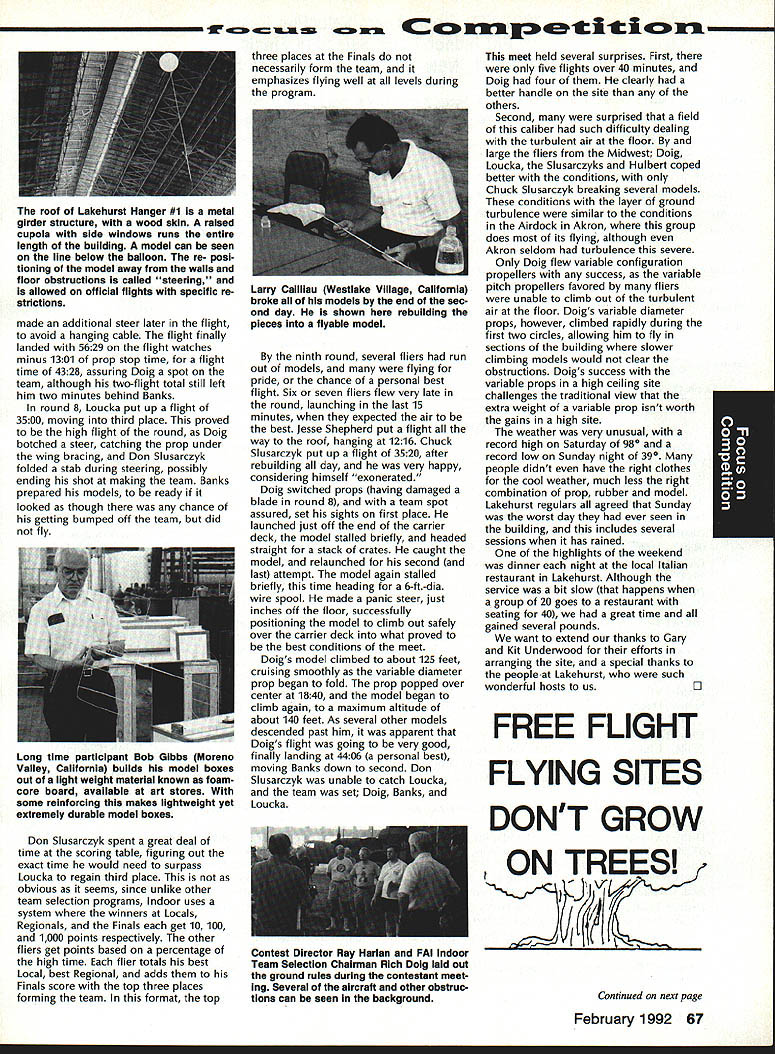
F1D Indoor Meet — Lakehurst Report
This report covers an F1D indoor rubber meet at Lakehurst with variable and often severe conditions. The meet featured many dramatic flights, equipment breakages, and surprising performances.
Early rounds and incidents
- One competitor stalled on launch and broke the prop while catching the model on his first attempt. Another was seen catching a model by the wingtip as it flew through the safety railing on the carrier deck.
- Bob Randolph flew straight for the roof, did several tail slides in the violent jetstream at the top, and finally blew sideways onto the center catwalk for a time of 10:05.
- Larry Cailliau had problems with the jetstream, eventually hanging on to the top of the west hangar door and posting a time of 12:05.
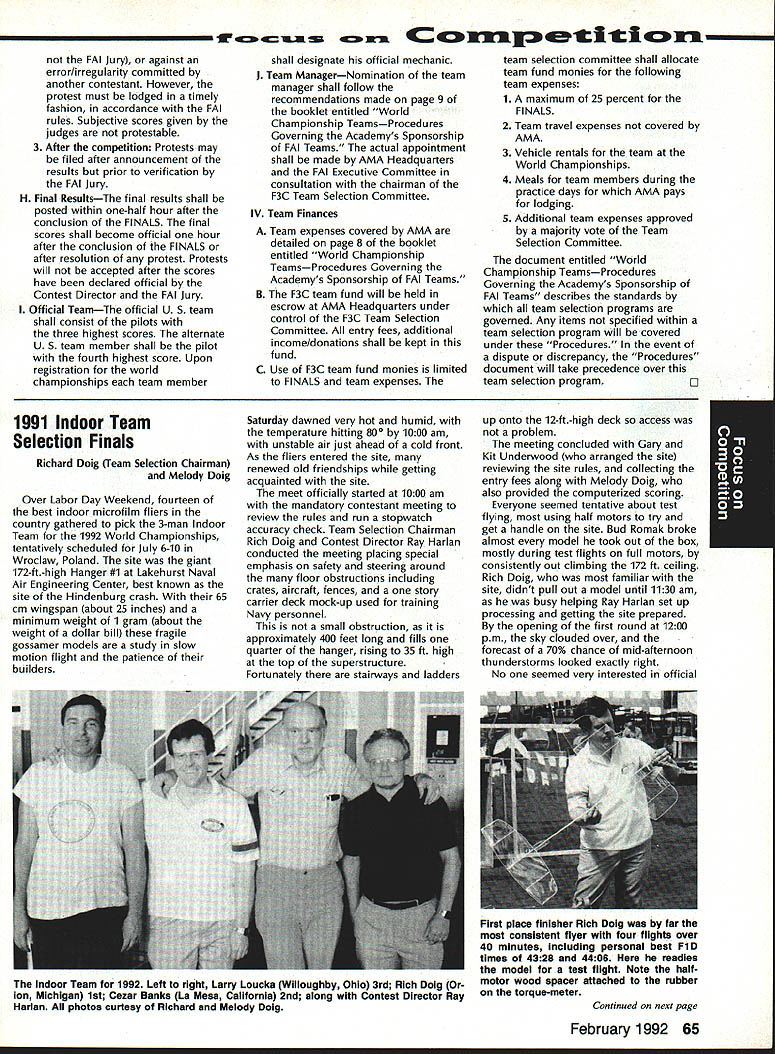
- After repairs, Rich Doig underwound his second attempt but still posted the high time of the round at 34:14. Cezar Banks posted 32:27.
- Most fliers seemed surprised when the first round ended with only five flights.
Overlapping rounds, increasing turbulence
- In the overlapping-round format, the second round was already over an hour old when Doig processed for it. The air near the floor was getting turbulent, magnifying stalling problems at launch.
- Doig launched next to the carrier deck, drifted east over the deck, and flew a 40:15 while staying well below the jetstream; his variable-diameter prop folded at 17:50.
- Banks followed with 36:54 that wandered around the building. Increased low-level turbulence caused problems; Randolph couldn't get off a flight. Cailliau and Romak posted the only other 35-plus minute flights that round.
Heat, lift, and record flights
- By the third round the temperature hit 90° at the floor and the air became buoyant, especially in the west end. Only Doig continued to fly in the east end, posting 38:39 to briefly take the lead in the best-two-of-nine format.
- Rain threatened as the sky grew dark, but the thunderstorms missed the site. About 15 minutes before the end of the round the sun popped out, creating lift. Two broken roof windows combined with late-afternoon sun to form a mild thermal.
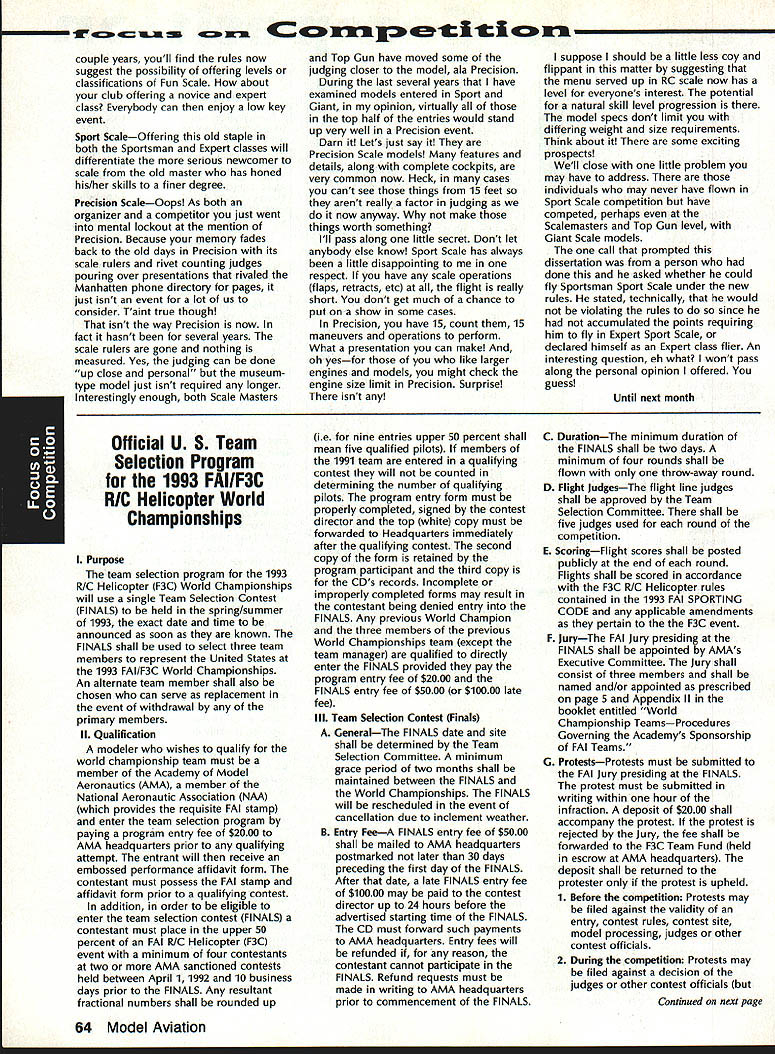
- At least seven models were launched into the rising air; several drifted into the walls. Jesse Shepherd, in his first Finals, posted a personal best 35:36. Larry Loucka posted 39:27. Banks flew a spectacular 49:00, setting a new F1D single-flight record and assuring a spot on the team.
Sunday — wind and difficulty
- Sunday morning was cold and crisp, with a strong 20-knot wind behind a cold front. The site was drafty and turbulent; temperatures only reached 74°.
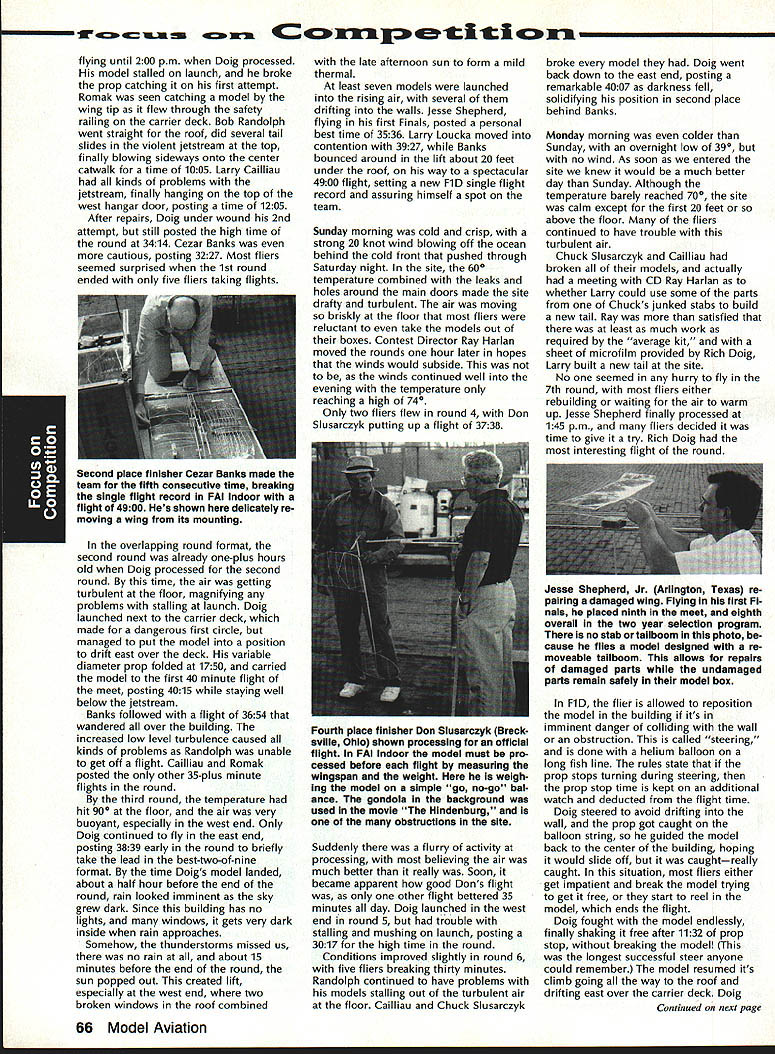
- Only two fliers flew in round 4; Don Slusarczyk put up 37:38.
- Doig launched in the west end in round 5 but had stalling and handling trouble, posting 30:17 as the high time.
- Conditions improved slightly in round 6; five fliers broke 30 minutes. Randolph continued to have problems. Cailliau and Chuck Slusarczyk broke every model they had. Doig flew 40:07 as darkness fell, solidifying his second place behind Banks.
Monday — calm and dramatic steering
- Monday dawned colder (low 39°) but calm. The site was much better, though the first 20 feet above the floor was still turbulent.
- Chuck Slusarczyk and Cailliau had broken all their models; Larry built a new tail at the site using parts and a sheet of microfilm provided by Rich Doig.
- Few were eager to fly in round 7; Jesse Shepherd processed at 1:45 p.m. and many decided to try.
- Rich Doig had the meet's most interesting flight involving "steering" — repositioning the model with a helium balloon and line if it faced imminent collision. If the prop stops during steering, prop-stop time is kept and deducted from flight time.
- Doig fought with his model, incurring 11:32 of prop-stop time (the longest successful steer anyone could remember). The model resumed climb, made the roof, drifted east over the carrier deck, and later required another steer to avoid a hanging cable. The flight registered 56:29 on the watches minus 13:01 of prop-stop time, for a net 43:28 — enough to assure Doig a team spot, though his two-flight total remained two minutes behind Banks.
Late rounds and team selection
- In round 8, Loucka flew 35:00, moving into third place — the round's high flight. Doig botched a steer and caught the prop under a wing bracing; Don Slusarczyk folded a stab during steering, possibly ending his team chances. Banks prepared models but did not fly.
- Don Slusarczyk calculated scoring permutations at the table to see if he could regain third place. Indoor team selection uses points from Locals (10), Regionals (100), and the Finals (1,000), with other flights scored as percentages of the high time; the team totals best Locals and Regionals plus Finals, so top three at the Finals don't necessarily compose the team.
- By round 9 several fliers had run out of models and many flew for pride or personal bests. Several launched late, expecting the best air then. Jesse Shepherd hung a flight at 12:16 at the roof. Chuck Slusarczyk flew 35:20 after rebuilding all day.
- Doig switched props (he had damaged a blade in round 8). With a team spot assured he aimed for first place: he launched off the carrier deck, had two brief stalls and steer-relaunches, then climbed to about 125–140 feet. The variable-diameter prop popped over center at 18:40 and the model climbed again, finally landing at 44:06 (a personal best), moving Banks to second. Don Slusarczyk couldn't catch Loucka; the team was set: Doig, Banks, Loucka.
Meet observations and thanks
- Only five flights exceeded 40 minutes; Doig had four of them and clearly handled the site best.
- Many top fliers struggled with severe low-level turbulence. Midwest fliers (Doig, Loucka, the Slusarczyks, and Hulbert) coped better; their experience in Airdock conditions likely helped.
- Only Doig flew variable-configuration (variable-diameter) propellers with success; other variable-pitch props failed to climb out of the turbulent floor layer. Doig's variable-diameter props climbed rapidly during the first two circles, enabling him to fly where slower-climbing models couldn't — challenging the view that the added weight of a variable prop isn't worth it in a high site.
- Weather was unusual: a record high Saturday of 98° and a record low Sunday night of 39°. Many entrants lacked clothing or the right prop/rubber/model combinations for such swings.
- One meet highlight was nightly dinners at a local Italian restaurant in Lakehurst — slow service with a large group, but a great time.
Thanks are extended to Gary and Kit Underwood for arranging the site, and special thanks to the people at Lakehurst for being such wonderful hosts.
Transcribed from original scans by AI. Minor OCR errors may remain.

