
Focus on Competition
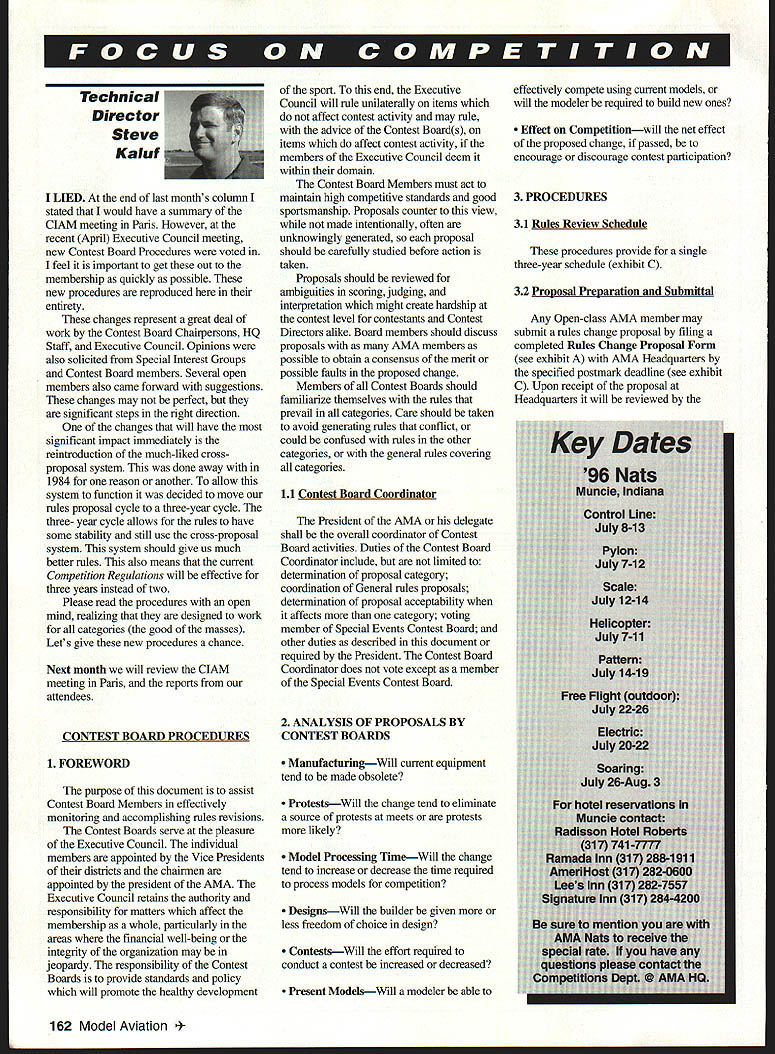
Technical Director Steve Kaluf
I lied. At the end of last month's column I stated that I would have a summary of the CIAM meeting in Paris. However, at the recent (April) Executive Council meeting, new Contest Board Procedures were voted in. I feel it is important to get these out to the membership as quickly as possible. These new procedures are reproduced here in their entirety.
These changes represent a great deal of work by the Contest Board chairpersons, HQ staff, and Executive Council. Opinions were also solicited from special interest groups and Contest Board members. Several open members also came forward with suggestions. These changes may not be perfect, but they are significant steps in the right direction.
One of the changes that will have the most significant immediate impact is the reintroduction of the much-liked cross-proposal system. This was done away with in 1984 for one reason or another. To allow this system to function it was decided to move our rules proposal cycle to a three-year cycle. The three-year cycle allows for the rules to have some stability and still use the cross-proposal system. This system should give us much better rules. This also means that the current Competition Regulations will be effective for three years instead of two.
Please read the procedures with an open mind, realizing that they are designed to work for all categories (the good of the masses). Let's give these new procedures a chance.
Next month we will review the CIAM meeting in Paris, and the reports from our attendees.
Contest Board Procedures
1. Foreword
The purpose of this document is to assist Contest Board members in effectively monitoring and accomplishing rules revisions.
The Contest Boards serve at the pleasure of the Executive Council. Individual members are appointed by the Vice Presidents of their districts and the chairpersons are appointed by the President of the AMA. The Executive Council retains the authority and responsibility for matters which affect the membership as a whole, particularly in areas where the financial well-being or the integrity of the organization may be in jeopardy. The responsibility of the Contest Boards is to provide standards and policy which will promote the healthy development of the sport. To this end, the Executive Council will rule unilaterally on items which do not affect contest activity and may rule, with the advice of the Contest Board(s), on items which do affect contest activity if the members of the Executive Council deem it within their domain.
Contest Board members must act to maintain high competitive standards and good sportsmanship. Proposals counter to this view, while not made intentionally, often are unknowingly generated, so each proposal should be carefully studied before action is taken.
Proposals should be reviewed for ambiguities in scoring, judging, and interpretation which might create hardship at the contest level for contestants and Contest Directors alike. Board members should discuss proposals with as many AMA members as possible to obtain a consensus of the merit or possible faults in the proposed change.
Members of all Contest Boards should familiarize themselves with the rules that prevail in all categories. Care should be taken to avoid generating rules that conflict with, or could be confused with, rules in other categories or with the general rules covering all categories.
1.1 Contest Board Coordinator
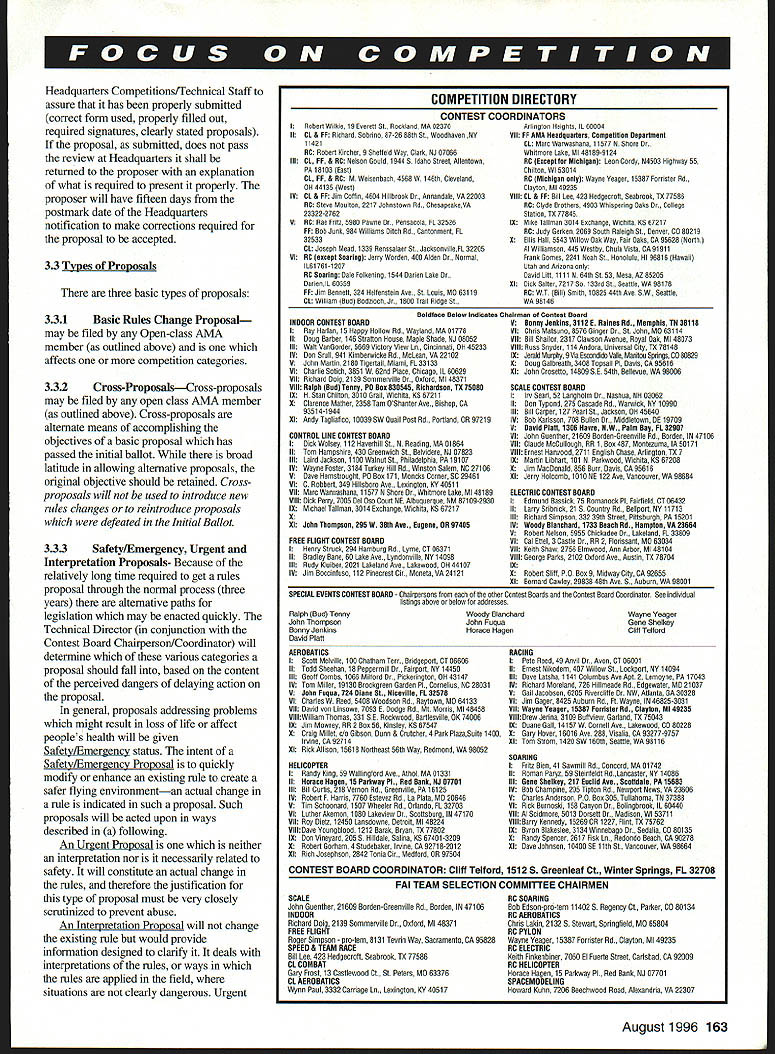
The President of the AMA or his delegate shall be the overall coordinator of Contest Board activities. Duties of the Contest Board Coordinator include, but are not limited to: determination of proposal category; coordination of General Rules proposals; determination of proposal acceptability when it affects more than one category; voting member of the Special Events Contest Board; and other duties as described in this document or required by the President. The Contest Board Coordinator does not vote except as a member of the Special Events Contest Board.
2. Analysis of Proposals by Contest Boards
When analyzing proposals, Contest Board members should consider:
- Manufacturing — Will current equipment tend to be made obsolete?
- Protests — Will the change tend to eliminate a source of protests at meets or are protests more likely?
- Model Processing Time — Will the change tend to increase or decrease the time required to process models for competition?
- Designs — Will the builder be given more or less freedom of choice in design?
- Contests — Will the effort required to conduct a contest be increased or decreased?
- Present Models — Will a modeler be able to effectively compete using current models, or will the modeler be required to build new ones?
- Effect on Competition — Will the net effect of the proposed change, if passed, be to encourage or discourage contest participation?
3. Procedures
#### 3.1 Rules Review Schedule
These procedures provide for a single three-year schedule (see exhibit C).
#### 3.2 Proposal Preparation and Submittal
Any Open-class AMA member may submit a rules change proposal by filing a completed Rules Change Proposal Form (see exhibit A) with AMA Headquarters by the specified postmark deadline (see exhibit C). Upon receipt of the proposal at Headquarters it will be reviewed by the Headquarters Competitions/Technical Staff to assure that it has been properly submitted (correct form used, properly filled out, required signatures, clearly stated proposals). If the proposal, as submitted, does not pass the review at Headquarters it shall be returned to the proposer with an explanation of what is required to present it properly. The proposer will have fifteen days from the postmark date of the Headquarters notification to make corrections required for the proposal to be accepted.
3.3 Types of Proposals
There are three basic types of proposals:
#### 3.3.1 Basic Rules Change Proposal
May be filed by any Open-class AMA member (as outlined above) and is one which affects one or more competition categories.
#### 3.3.2 Cross-Proposals
Cross-proposals may be filed by any Open-class AMA member (as outlined above). Cross-proposals are alternate means of accomplishing the objectives of a basic proposal which has passed the initial ballot. While there is broad latitude in allowing alternative proposals, the original objective should be retained. Cross-proposals will not be used to introduce new rules changes or to reintroduce proposals which were defeated in the Initial Ballot.
#### 3.3.3 Safety/Emergency, Urgent and Interpretation Proposals
Because of the relatively long time required to get a rules proposal through the normal process (three years), there are alternative paths for legislation which may be enacted quickly. The Technical Director (in conjunction with the Contest Board Chairperson/Coordinator) will determine which of these various categories a proposal shall fall into, based on the content or the perceived dangers of delaying action on the proposal.
- Safety/Emergency Proposals generally address problems which might result in loss of life or affect people's health and are intended to quickly modify or enhance an existing rule to create a safer flying environment—an actual change in a rule is indicated in such a proposal. These will be acted upon as described in (a) following.
- An Urgent Proposal is one which is neither an interpretation nor necessarily related to safety. It will constitute an actual change in the rules, and therefore the justification for this type of proposal must be very closely scrutinized to prevent abuse.
- An Interpretation Proposal will not change the existing rule but would provide an interpretation designed to clarify it. It deals with interpretations of the rules, or ways in which the rules are applied in the field, where situations are not clearly dangerous.
The Technical Director will inform the author of a proposal which method has been chosen to deal with his proposal. The Technical Director may also deny a proposal. The proposer may appeal the decision of the Technical Director, by letter to the President and Contest Board Coordinator, within 15 days. Postmark date will be used to determine timing in all cases. The President's decision will be final.
Once the Technical Director accepts the proposal, assigns its category, and Contest Board jurisdiction have been determined, the Technical Director will forward the proposal to the President and to the chairperson of each affected Contest Board, along with any information or opinions which the Technical Director may have gathered while processing the proposal. The Contest Board Chairperson will carry through by method (a) or (b) below depending on the category of the proposal. Any Safety/Emergency, Urgent, or Interpretation proposal that passes will be referred to as an "interim rule" until published in a regular edition of the Competition Regulations (see "Publication of Interim Rules" below).
If the Technical Director determines that the Contest Board Coordinator, rather than the chairman of a particular Contest Board, is the appropriate person to oversee further processing, the Technical Director will forward the proposal to the President and to the Contest Board Coordinator, who will then follow through with method (a) or (b) below. In such a case, all references to the "Contest Board Chairperson" should be read as referring to the "Contest Board Coordinator".
#### 3.3.3.1 (a) Safety/Emergency Proposals
Safety/Emergency Proposals may be put in force immediately if the chairperson of each affected Contest Board, the Contest Board Coordinator, and the President concur that immediate enforcement is desirable. If this route is chosen, notice of the action and the rationale behind it will be published in the earliest possible issue of an official Academy publication. Each Contest Board chairperson will submit immediately to his or her Contest Board(s) a brief describing the action and the reasons for taking it, along with any opinions immediately available. Not less than four weeks and not more than six weeks after publication, the Contest Board chairperson will send a ballot with a 15-day turnaround to his or her Board(s) to obtain ratification. If a 60% majority of those responding from each of the affected Contest Boards concur, the ruling will be considered final. At least 50% of the total possible voters must reply for such a vote to be valid if the final results are contrary to the previous immediate enforcement ruling.
If the President, Contest Board Coordinator, and chairperson of each affected Contest Board do not concur unanimously that immediate enforcement is desirable, the following method will be used: Each Contest Board chairperson will immediately submit to each member of his or her board a copy of the proposal, any comments or opinions available, and a ballot requiring a fifteen-day turnaround which allows each Board member to choose among three methods of handling the proposal.
Those methods are:
- A. Immediate Enforcement — This requires a followup ballot after publication as described in the opening paragraph above.
- B. Immediate action, but no immediate enforcement — This is similar to option "A" above, but the ruling is not enforced until the proposal is first published, a ballot is taken, and a 60% majority favorable result is obtained.
- C. Denial of Immediate Action — This results in the return of the proposal to the proposer with a recommendation that it be submitted as a regular rules proposal during the regular three-year cycle.
Each Contest Board member will rank the three alternatives as 1 (most desirable), 2 (next most desirable), 3 (least desirable). The chairperson will then sum the rankings for each of the alternatives and select the one with the lowest score.
#### 3.3.3.2 (b) Interpretations and Urgent Proposals (not related to safety)
Proposals which are judged by the Technical Director not to qualify as Safety/Emergency proposals will be handled in the same way as Safety/Emergency proposals (see above), except that choice "A", immediate enforcement, is not available.
#### 3.4 Publication of Interim Rules
A special addendum to the Competition Regulations will be produced and distributed between December 1 and December 31 to members who have requested Competition Regulations for the first two years of the three-year cycle. It will also be available upon request. New rules outside of the normal rules cycle shall become effective on January 1 following their issue in December. In any case, the chairperson (or coordinator) will make every effort to see that the membership is informed of the progress of the proposal and any action taken on the proposal through the Academy's official publication.
#### 3.5 Forms of Proposals
All proposals shall be submitted on the standard proposal form (see exhibit A) or a facsimile that contains all of the endorsement requirements as a normal proposal and shall have the full addresses of all three signatories.
#### 3.6 Provisional/Supplementary Rules
Acceptance of a new set of rules or a new event by the Contest Board automatically places the event in either a Provisional or Supplemental status.
- Provisional status will be assigned if the event does not already have moderator support and widespread testing of rules is desired before adoption. The Contest Board shall decide such matters at the time of voting. Provisional rules may be continued from year to year, and modified by the Contest Board through normal procedures, until such time as official adoption or rejection is determined by Contest Board vote.
- Supplemental rules may be adopted, through normal Contest Board procedures, to provide a national standard (with particular respect to safety) for activity which is essentially local in nature but apparently popular in several areas.
Provisional and Supplemental rules are not intended to be included as part of official events in the National Model Airplane Championships but may be included in all other sanctioned contests. No records will be recognized for Provisional or Supplemental events.
#### 3.7 FAI Rules
FAI rules are automatically part of the AMA rules. They normally require no AMA Contest Board action, so that once passed by the FAI's Committee for International Aeromodelling (CIAM), they also become official for AMA. The AMA President and/or appropriate Contest Board chairperson and/or the Coordinator may determine the effective date for AMA, in those cases where application sooner than scheduled by the FAI would benefit AMA contest activity or other AMA activities. FAI rules change proposals submitted from the U.S. and U.S. participation in voting on proposals is in accordance with policy or decisions of the AMA President and/or the Executive Council.
#### 3.8 Proposal Numbering
The system outlined below shall be used by all Contest Boards. A standard basic numbering system for all categories will be helpful during Contest Board and Headquarters administration and publication of proposals. A basic numbering system will permit ready reference to any proposal by the general membership.
A proposal number will have three basic sections:
- Category for which the proposal is filed.
- Year in which the proposal is to become effective.
- Proposal number.
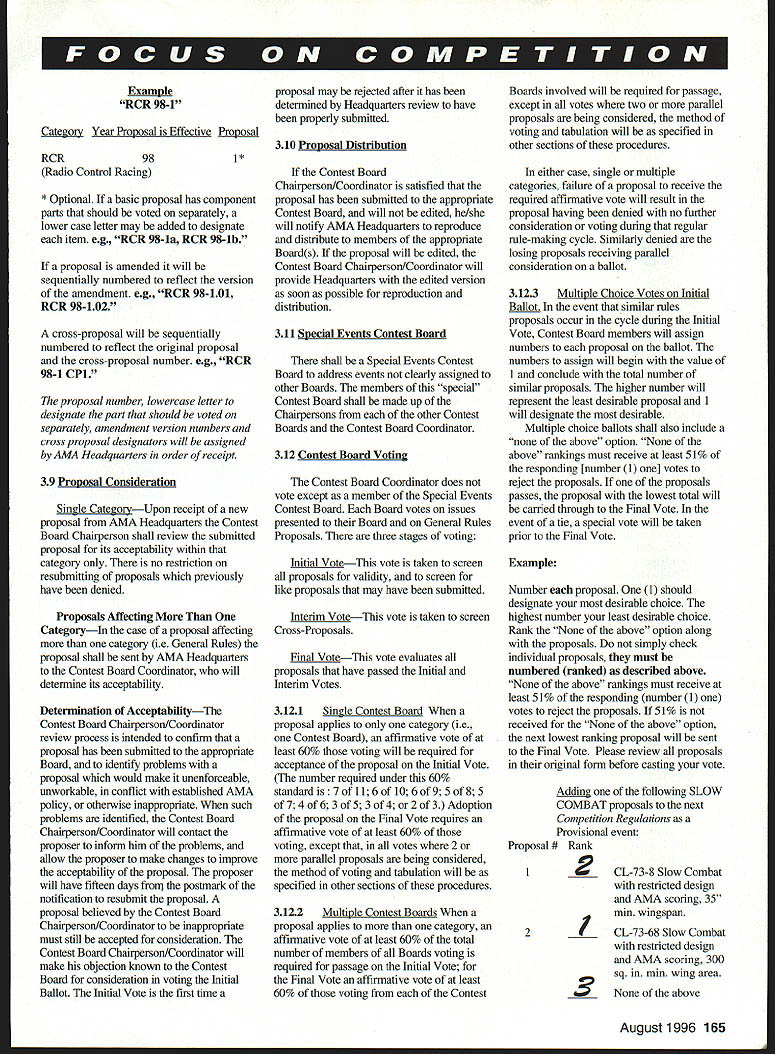
Example:
- "RCR 98-1"
Mapping:
- Category: RCR (Radio Control Racing)
- Year Proposal is Effective: 98
- Proposal: 1
Notes:
- If a basic proposal has component parts that should be voted on separately, a lower case letter may be added to designate each item, e.g., "RCR 98-1a, RCR 98-1b."
- If a proposal is amended it will be sequentially numbered to reflect the version of the amendment, e.g., "RCR 98-1.01, RCR 98-1.02."
- A cross-proposal will be sequentially numbered to reflect the original proposal and the cross-proposal number, e.g., "RCR 98-1 CP1."
- The proposal number, lowercase letter to designate the part that should be voted on separately, amendment version numbers and cross-proposal designators will be assigned by AMA Headquarters in order of receipt.
#### 3.9 Proposal Consideration
- Single Category — Upon receipt of a new proposal from AMA Headquarters the Contest Board chairperson shall review the submitted proposal for its acceptability within that category only. There is no restriction on resubmitting proposals which previously have been denied.
- Proposals Affecting More Than One Category — In the case of a proposal affecting more than one category (i.e., General Rules) the proposal shall be sent by AMA Headquarters to the Contest Board Coordinator, who will determine its acceptability.
- Determination of Acceptability — The Contest Board chairperson/coordinator review process is intended to confirm that a proposal has been submitted to the appropriate Board, and to identify problems with a proposal which would make it unenforceable, unworkable, in conflict with established AMA policy, or otherwise inappropriate. When such problems are identified, the Contest Board chairperson/coordinator will contact the proposer to inform him of the problems and allow the proposer to make changes to improve the acceptability of the proposal. The proposer will have fifteen days from the postmark of the notification to resubmit the proposal. A proposal believed by the Contest Board chairperson/coordinator to be inappropriate must still be accepted for consideration. The Contest Board chairperson/coordinator will make his objection known to the Contest Board for consideration in voting the Initial Ballot. The Initial Vote is the first time a proposal may be rejected after it has been determined by Headquarters review to have been properly submitted.
#### 3.10 Proposal Distribution
If the Contest Board chairperson/coordinator is satisfied that the proposal has been submitted to the appropriate Contest Board, and will not be edited, he/she will notify AMA Headquarters to reproduce and distribute to members of the appropriate Board(s). If the proposal will be edited, the Contest Board chairperson/coordinator will provide Headquarters with the edited version as soon as possible for reproduction and distribution.
#### 3.11 Special Events Contest Board
There shall be a Special Events Contest Board to address events not clearly assigned to other boards. The members of this "special" Contest Board shall be made up of the chairpersons from each of the other Contest Boards and the Contest Board Coordinator.
#### 3.12 Contest Board Voting
The Contest Board Coordinator does not vote except as a member of the Special Events Contest Board. Each Board votes on issues presented to their Board and on General Rules proposals. There are three stages of voting:
- Initial Vote — This vote is taken to screen all proposals for validity, and to screen for like proposals that may have been submitted.
- Interim Vote — This vote is taken to screen Cross-Proposals.
- Final Vote — This vote evaluates all proposals that have passed the Initial and Interim Votes.
##### 3.12.1 Single Contest Board
When a proposal applies to only one category (i.e., one Contest Board), an affirmative vote of at least 60% of those voting will be required for acceptance of the proposal on the Initial Vote. The numbers required under this 60% standard are: 7 of 11; 6 of 10; 6 of 9; 5 of 8; 5 of 7; 4 of 6; 3 of 5; 3 of 4; or 2 of 3. Adoption of the proposal on the Final Vote requires an affirmative vote of at least 60% of those voting, except that in all votes where two or more parallel proposals are being considered, the method of voting and tabulation will be as specified in other sections of these procedures.
In either case, single or multiple categories, failure of a proposal to receive the required affirmative vote will result in the proposal having been denied with no further consideration or voting during that regular rule-making cycle. Similarly denied are the losing proposals receiving parallel consideration on a ballot.
##### 3.12.2 Multiple Contest Boards
When a proposal applies to more than one category, an affirmative vote of at least 60% of the total number of members of all Boards voting is required for passage on the Initial Vote; for the Final Vote an affirmative vote of at least 60% of those voting from each of the Contest Boards involved will be required for passage, except in all votes where two or more parallel proposals are being considered, the method of voting and tabulation will be as specified in other sections of these procedures.
##### 3.12.3 Multiple Choice Votes on Initial Ballot
In the event that similar rules proposals occur in the cycle during the Initial Vote, Contest Board members will assign numbers to each proposal on the ballot. The numbers to assign will begin with the value of 1 and conclude with the total number of similar proposals. The higher number will represent the least desirable proposal and 1 will designate the most desirable. Multiple choice ballots shall also include a "none of the above" option. "None of the above" rankings must receive at least 51% of the responding (number 1) votes to reject the proposals. If one of the proposals passes, the proposal with the lowest total will be carried through to the Final Vote. In the event of a tie, a special vote will be taken prior to the Final Vote.
Example instructions to voters:
- Number each proposal. One (1) should designate your most desirable choice. The highest number your least desirable choice.
- Rank the "None of the above" option along with the proposals. Do not simply check individual proposals; they must be numbered (ranked) as described above.
- "None of the above" rankings must receive at least 51% of the responding (number 1) votes to reject the proposals. If 51% is not received for the "None of the above" option, the next lowest ranking proposal will be sent to the Final Vote.
- Please review all proposals in their original form before casting your vote.
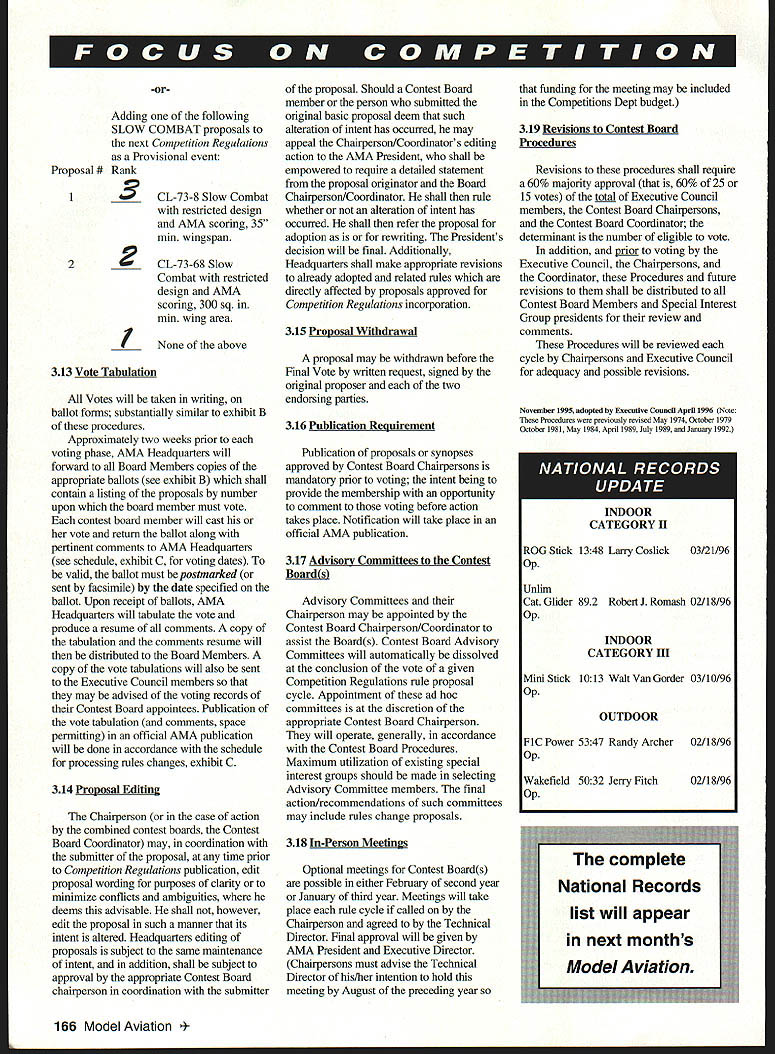
Ballot example (for adding one of the following SLOW COMBAT proposals to the next Competition Regulations as a Provisional event):
- Proposal 1 — CL-73-8: Slow Combat with restricted design and AMA scoring, 35" min. wingspan. — Rank 2
- Proposal 2 — CL-73-68: Slow Combat with restricted design and AMA scoring, 300 sq. in. min. wing area. — Rank 1
- Proposal 3 — None of the above — Rank 3
#### 3.13 Vote Tabulation
All votes will be taken in writing, on ballot forms, substantially similar to exhibit B of these procedures.
Approximately two weeks prior to each voting phase, AMA Headquarters will forward to all Board members copies of the appropriate ballots (see exhibit B) which shall contain a listing of the proposals by number upon which the board member must vote. Each contest board member will cast his or her vote and return the ballot along with pertinent comments to AMA Headquarters (see schedule, exhibit C, for voting dates). To be valid, the ballot must be postmarked (or sent by facsimile) by the date specified on the ballot. Upon receipt of ballots, AMA Headquarters will tabulate the vote and produce a resume of all comments. A copy of the tabulation and the comments resume will then be distributed to the Board members. A copy of the vote tabulations will also be sent to the Executive Council members so that they may be advised of the voting records of their Contest Board appointees. Publication of the vote tabulation (and comments, space permitting) in an official AMA publication will be done in accordance with the schedule for processing rules changes (exhibit C).
#### 3.14 Proposal Editing
The chairperson (or in the case of action by the combined Contest Boards, the Contest Board Coordinator) may, in coordination with the submitter of the proposal, at any time prior to Competition Regulations publication, edit proposal wording for purposes of clarity or to minimize conflicts and ambiguities, where he deems this advisable. He shall not, however, edit the proposal in such a manner that its intent is altered. Headquarters editing of proposals is subject to the same maintenance of intent, and in addition, shall be subject to approval by the appropriate Contest Board chairperson in coordination with the submitter of the proposal. Should a Contest Board member or the person who submitted the original basic proposal deem that such alteration of intent has occurred, he may appeal the chairperson/coordinator's editing action to the AMA President, who shall be empowered to require a detailed statement from the proposal originator and the Board chairperson/coordinator. He shall then rule whether or not an alteration of intent has occurred. He shall then refer the proposal for adoption as is or for rewriting. The President's decision will be final. Additionally, Headquarters shall make appropriate revisions to already adopted and related rules which are directly affected by proposals approved for Competition Regulations incorporation.
#### 3.15 Proposal Withdrawal
A proposal may be withdrawn before the Final Vote by written request, signed by the original proposer and each of the two endorsing parties.
#### 3.16 Publication Requirement
Publication of proposals or synopses approved by Contest Board chairpersons is mandatory prior to voting; the intent being to provide the membership with an opportunity to comment to those voting before action takes place. Notification will take place in an official AMA publication.
#### 3.17 Advisory Committees to the Contest Board(s)
Advisory committees and their chairperson may be appointed by the Contest Board chairperson/coordinator to assist the Board(s). Contest Board advisory committees will automatically be dissolved at the conclusion of the vote of a given Competition Regulations rule proposal cycle. Appointment of these ad hoc committees is at the discretion of the appropriate Contest Board chairperson. They will operate, generally, in accordance with the Contest Board procedures. Maximum utilization of existing special interest groups should be made in selecting Advisory Committee members. The final actions/recommendations of such committees may include rules change proposals.
#### 3.18 In-Person Meetings
Optional meetings for Contest Board(s) are possible in either February of the second year or January of the third year. Meetings will take place each rule cycle if called on by the chairperson and agreed to by the Technical Director. Final approval will be given by the AMA President and Executive Director. (Chairpersons must advise the Technical Director of his/her intention to hold this meeting by August of the preceding year so that funding for the meeting may be included in the Competitions Department budget.)
#### 3.19 Revisions to Contest Board Procedures
Revisions to these procedures shall require a 60% majority approval (that is, 60% of 25 or 15 votes) of the total of Executive Council members, the Contest Board chairpersons, and the Contest Board Coordinator; the determinant is the number eligible to vote. In addition, and prior to voting by the Executive Council, the chairpersons, and the Coordinator, these procedures and future revisions to them shall be distributed to all Contest Board members and Special Interest Group presidents for their review and comments.
These procedures will be reviewed each cycle by chairpersons and Executive Council for adequacy and possible revisions.
November 1995, adopted by Executive Council April 1996 (Note: These procedures were previously revised May 1974, October 1979, October 1981, May 1984, April 1989, July 1991, and January 1992).
Transcribed from original scans by AI. Minor OCR errors may remain.

