
Focus on Competition
Technical Director Steve Kaluf
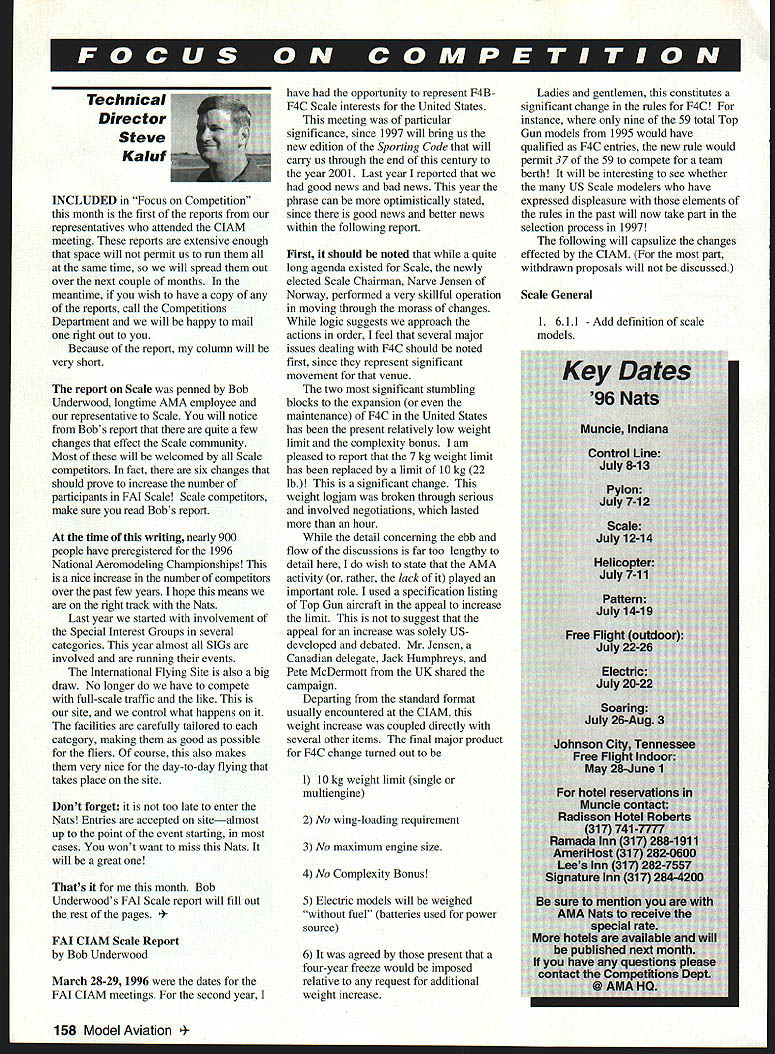
Included in "Focus on Competition" this month is the first of the reports from our representatives who attended the CIAM meeting. These reports are extensive, so we will spread them out over the next couple of months. In the meantime, if you wish to have a copy of any report, call the Competitions Department and we will be happy to mail one to you.
Because of the report, my column will be very short.
The report on Scale was penned by Bob Underwood, a longtime AMA employee and our representative to Scale. You will notice from Bob's report that there are quite a few changes that affect the Scale community. Most of these will be welcomed by Scale competitors. In fact, there are six changes that should prove to increase the number of participants in FAI Scale. Scale competitors, make sure you read Bob's report.
At the time of this writing, nearly 900 people have preregistered for the 1996 National Aeromodeling Championships — a nice increase in competitors over the past few years. I hope this means we are on the right track with the Nats.
Last year we started involving Special Interest Groups in several categories. This year almost all SIGs are involved and are running their events.
The International Flying Site is also a big draw. We no longer have to compete with full-scale traffic and the like. This is our site, and we control what happens on it. The facilities are carefully tailored to each category, making them as good as possible for the fliers. Of course, this also makes them very nice for day-to-day flying on the site.
Don't forget: it is not too late to enter the Nats! Entries are accepted on site—almost up to the point the event starts in most cases. You won't want to miss this Nats. It will be a great one!
That's it for me this month. Bob Underwood's FAI Scale report fills out the rest of the pages.
FAI CIAM Scale Report
by Bob Underwood March 28–29, 1996
March 28–29, 1996 were the dates for the FAI CIAM meetings. For the second year I had the opportunity to represent F4B–F4C Scale interests for the United States. This meeting was of particular significance, since 1997 will bring a new edition of the Sporting Code that will carry us through to 2001. Last year I reported that we had good news and bad news; this year the news is better.
The newly elected Scale Chairman, Narve Jensen of Norway, moved skillfully through a long agenda of changes. Several major issues dealing with F4C deserve note, since they represent significant movement for that venue.
Two of the most significant stumbling blocks to the expansion (or even the maintenance) of F4C in the United States have been the relatively low weight limit and the Complexity Bonus. I am pleased to report that the 7 kg weight limit has been increased to 10 kg (22 lb.). This was a significant change reached after serious negotiations that lasted more than an hour. The effort was supported by representatives from several countries, including Canada and the U.K.
Departing from the standard CIAM format, this weight increase was coupled directly with several other items. The final major changes for F4C are:
- 10 kg weight limit (single or multiengine).
- No wing-loading requirement.
- No maximum engine size.
- No Complexity Bonus.
- Electric models will be weighed without fuel (batteries used as the power source).
- A four-year freeze on requests for further weight increases.
This constitutes a significant change in the F4C rules. For example, under the old rules only 9 of the 59 total Top Gun models from 1995 would have qualified as F4C entries; under the new rules 37 of the 59 would qualify. It will be interesting to see whether U.S. Scale modelers who have been dissatisfied with past rules will now participate in the selection process for 1997.
The following capsulizes the changes effected by CIAM. (Withdrawn proposals are generally not discussed.)
Scale — General
- 6.1.1 — Add definition of scale models.
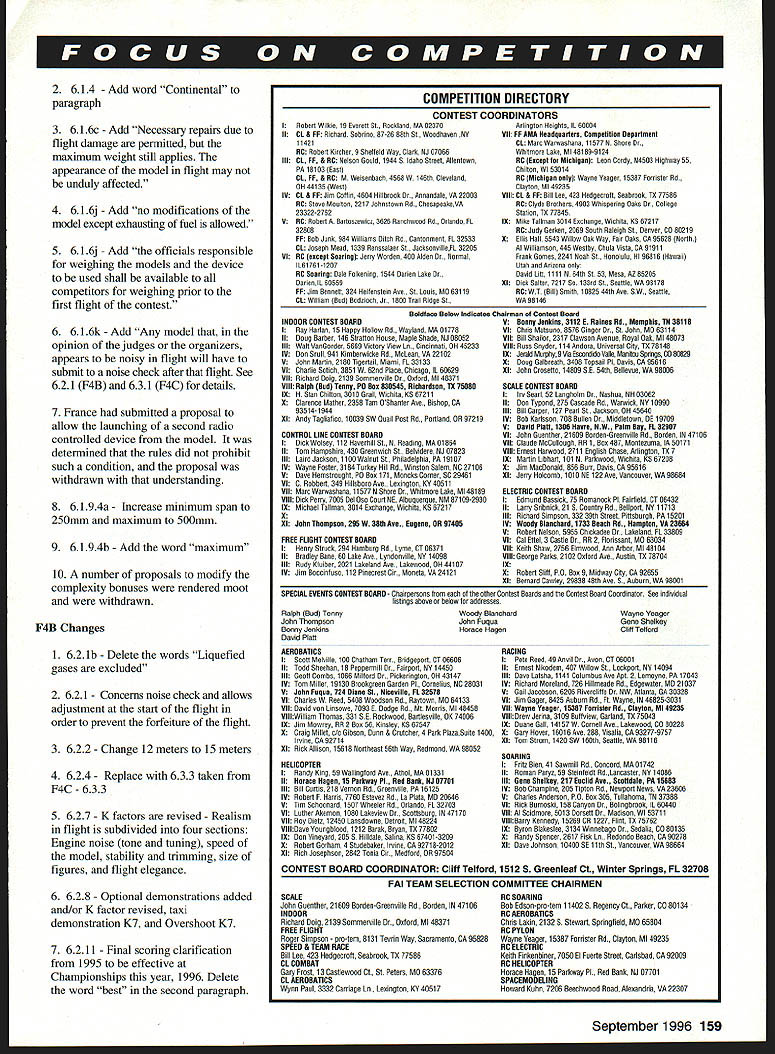
- 6.1.4 — Add the word "Continental" to paragraph 3.
- 6.16c — Add: Necessary repairs due to flight damage permitted; maximum weight still applies; appearance of model in flight may be unduly affected.
- 6.16j — Add: No modifications to model except exhausting fuel allowed.
- 6.16j — Add: Officials responsible for weighing models; device used shall be available to competitors for weighing prior to first flight of contest.
- 6.16k — Add: Any model, in the opinion of judges or organizers, that appears noisy in flight will have to submit evidence or be subject to action.
- France had proposed allowing the launching of a second radio-controlled device from the model. It was determined the rules did not prohibit such a condition, and the proposal was withdrawn with that understanding.
- 6.1.9.4a — Increase minimum span to 250 mm and maximum to 500 mm.
- 6.1.9.4b — Add the word "maximum."
- A number of proposals to modify the complexity bonuses were rendered moot and withdrawn.
F4B Changes
- 6.2.1.b — Delete the words "Liquefied gases are excluded."
- 6.2.1 — Clarification on noise checks; allows adjustment at the start of flight to prevent forfeiture.
- 6.2.2 — Change 12 meters to 15 meters.
- 6.2.4 — Replace with 6.3.3 taken from F4C (6.3.3).
- 6.2.7 — K factors revised. Realism in flight is subdivided into: engine noise (tone and tuning), speed of the model, stability and trimming, size of figures, and flight elegance.
- 6.2.8 — Optional demonstrations added and/or K factor revised; taxi modification K7, overshoot K7.
- 6.2.11 — Final scoring clarification from 1995 to be effective at Championships in 1996. Delete the word "best" in the second paragraph.
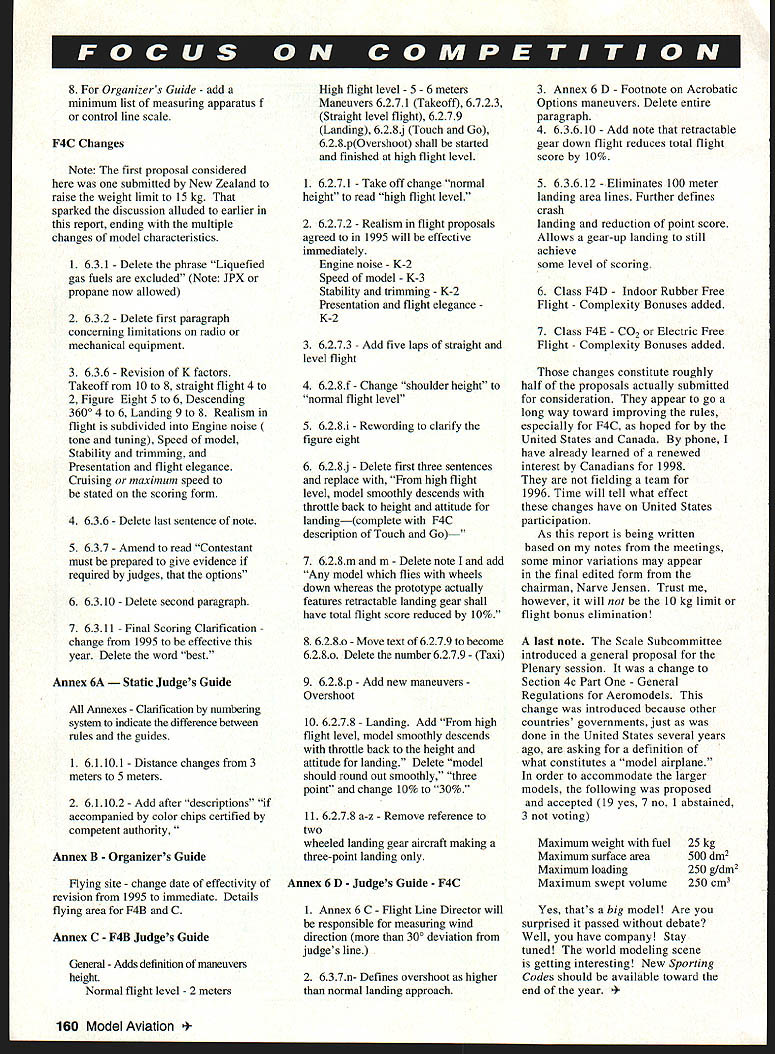
- Organizer's Guide — add a minimum list of measuring apparatus for control-line scale.
F4C Changes
(Note: New Zealand had proposed raising the weight limit to 15 kg. That proposal prompted the discussions that resulted in the changes summarized above.)
- 6.3.1 — Delete the phrase "Liquefied gas fuels are excluded" (JPX or propane now allowed).
- 6.3.2 — Delete first paragraph concerning limitations on radio or mechanical equipment.
- 6.3.6 — Revision of K factors: Takeoff from 10 to 8, Straight flight 4 to 2, Figure Eight 5 to 6, Descending 360° 4 to 6, Landing 9 to 8. Realism in flight subdivided into: engine noise (tone and tuning), speed of model, stability and trimming, and presentation and flight elegance. Cruising or maximum speed to be stated on the scoring form.
- 6.3.6 — Delete last sentence of note.
- 6.3.7 — Clarify contestant obligations to provide evidence or otherwise satisfy judges regarding options required by judges.
- 6.3.10 — Delete second paragraph.
- 6.3.11 — Final scoring clarification — change from 1995 to be effective this year. Delete the word "best."
Annex 6A — Static Judge's Guide
- All annexes — Clarification by a numbering system to indicate the difference between rules and guides.
- 6.1.10.1 — Distance changes from 3 meters to 5 meters.
- 6.1.10.2 — Add after "descriptions": "if accompanied by color chips certified by a competent authority."
Annex B — Organizer's Guide
- Flying site — change date of effectivity of revision from 1995 to immediate. Details flying area for F4B and F4C.
Annex C — F4B Judge's Guide
- General — Adds definition of maneuver heights.
- Normal flight level — 2 meters.
- High flight level — 5–6 meters.
- Maneuvers (6.2.7.1 Takeoff, 6.2.7.3 Straight level flight, 6.2.7.9 Landing, 6.2.8.3 Touch and Go, 6.2.8.p Overshoot) shall be started and finished at high flight level.
- 6.2.7.1 — Takeoff: change "normal height" to "high flight level."
- 6.2.7.2 — Realism in flight proposals agreed to in 1995 will be effective immediately:
- Engine noise — K-2
- Speed of model — K-3
- Stability and trimming — K-2
- Presentation and flight elegance — K-2
- 6.2.7.3 — Add five laps of straight and level flight.
- 6.2.8.f — Change "shoulder height" to "normal flight level."
- 6.2.8.i — Rewording to clarify the figure eight.
- 6.2.8.j — Replace first three sentences with: "From high flight level, model smoothly descends with throttle back to height and attitude for landing (complete with F4C description of Touch and Go)."
- 6.2.8.m and 6.2.8.n — Delete note 1 and add: "Any model which flies with wheels down whereas the prototype actually features retractable landing gear shall have total flight score reduced by 10%."
- 6.2.8.o — Move text of 6.2.7.9 to become 6.2.8.o. Delete the number 6.2.7.9 (Taxi).
- 6.2.8.p — Add new maneuver: Overshoot.
- 6.2.7.8 — Landing: Add "From high flight level, model smoothly descends with throttle back to the height and attitude for landing." Delete "model should round out smoothly," delete "three point" and change reduction from 10% to 30%.
- 6.2.7.8 a–z — Remove reference limiting two-wheeled landing gear aircraft to three-point landings only.
Annex 6D — Judge's Guide — F4C
- Annex 6C — Flight Line Director will be responsible for measuring wind direction (more than 30° deviation from judge's line).
- 6.3.7.n — Defines overshoot as higher-than-normal landing approach.
- Annex 6D — Delete footnote paragraph on Acrobatic Options maneuvers.
- 6.3.6.10 — Add note that retractable gear-down flight reduces total flight score by 10%.
- 6.3.6.12 — Eliminate 100-meter landing area lines. Further define crash landing and reduction of point score. Allow a gear-up landing to still achieve some scoring.
- Class F4D — Indoor Rubber Free Flight — Complexity Bonuses added.
- Class F4E — CO2 or Electric Free Flight — Complexity Bonuses added.
Those changes constitute roughly half of the proposals submitted for consideration. They appear to go a long way toward improving the rules, especially for F4C, as hoped for by the United States and Canada. By phone, I have already learned of renewed interest by Canadians for 1998. Time will tell what effect these changes have on U.S. participation.
As this report is based on my notes from the meetings, some minor variations may appear in the final edited form from the chairman, Narve Jensen. Rest assured, however, it will not change the 10 kg limit or the elimination of the Complexity Bonus.
A last note: the Scale Subcommittee introduced a general proposal to the Plenary session — a change to Section 4C Part One: General Regulations for Aeromodels. Other countries' governments are asking for a definition of what constitutes a "model airplane." To accommodate larger models, the following limits were proposed and accepted (19 yes, 7 no, 1 abstained, 3 not voting):
- Maximum weight with fuel: 25 kg
- Maximum surface area: 500 dm²
- Maximum loading: 250 g/dm²
- Maximum swept volume: 250 cm³
Yes, that's a big model! The world modeling scene is getting interesting. New Sporting Codes should be available toward the end of the year.
Transcribed from original scans by AI. Minor OCR errors may remain.

