
Focus on Competition
Technical Director — Steve Kaluf
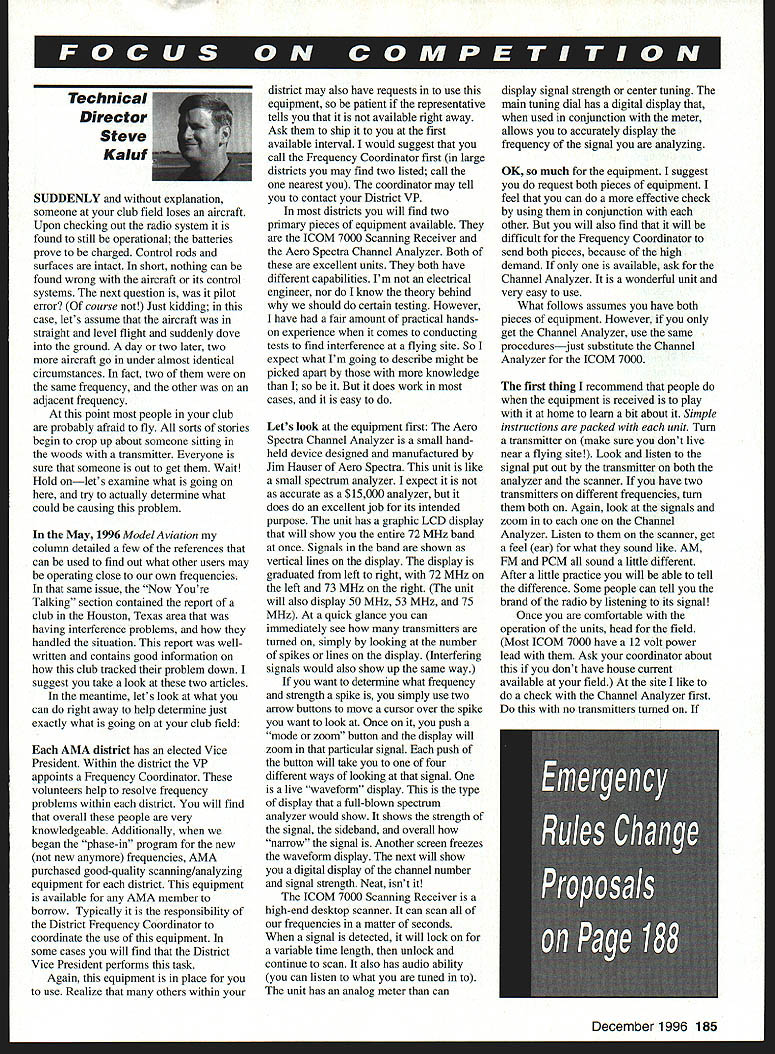
Suddenly and without explanation, someone at your club field loses an aircraft. The radio system checks out as operational, the batteries are charged, control rods and surfaces are intact. In short, nothing can be found wrong with the aircraft or its control systems. Was it pilot error? (Just kidding.) In this scenario the aircraft was in straight-and-level flight and suddenly dove to the ground. A day or two later, two more aircraft go down under almost identical circumstances — two on the same frequency and another on an adjacent frequency. At this point most people in the club are probably afraid to fly and all sorts of stories begin to crop up about someone sitting in the woods with a transmitter.
Wait. Before jumping to conclusions, let's examine what's going on and try to determine the real cause.
In the May 1996 Model Aviation I described references that can be used to find what other users may be operating close to your frequencies. The same issue's "Now You're Talking" section reported how a Houston-area club tracked and handled interference problems. I suggest you read those two items. In the meantime, here are some steps you can take right away at your club field.
Who to contact
- Each AMA district has an elected Vice President. Within the district the VP appoints Frequency Coordinators (volunteers) who help resolve frequency problems. These coordinators are generally very knowledgeable.
- AMA purchased scanning/analyzing equipment for each district as part of the phase-in of new frequencies. That equipment is available for AMA members to borrow. Typically the District Frequency Coordinator coordinates use (in some cases the District VP performs this task).
- Call the Frequency Coordinator first (in large districts you may find two listed; call the one nearest you). Ask about borrowing the equipment and be patient — demand can be high.
Equipment available
You will typically find two primary pieces of equipment available:
- Aero-Spectra Channel Analyzer
- A small handheld device (designed by Jim Hauser) that functions like a compact spectrum analyzer. It will not match a $15,000 analyzer in accuracy, but it does an excellent job for field work.
- Graphic LCD shows an entire band (72 MHz band is displayed with 72 MHz on the left and 73 MHz on the right). It can also display 50 MHz, 53 MHz, and 75 MHz bands.
- Signals appear as vertical spikes. Use the arrow buttons to move a cursor over a spike and push the Mode/Zoom button to zoom in.
- Four display modes include a live waveform (shows strength, sidebands, and signal width), a frozen waveform, and a digital display of channel number and signal strength.
- ICOM 7000 Scanning Receiver
- A high-end desktop scanner that can sweep all relevant frequencies in seconds. When it detects a signal it locks briefly, then resumes scanning.
- Has audio capability so you can listen to emissions, and an analog meter that displays signal strength/center tuning.
- The main tuning dial and digital display, used with the meter, allow accurate readout of the detected frequency.
I recommend requesting both units if possible — they work very well together. If only one can be sent, ask for the Aero-Spectra Channel Analyzer first; it is very easy to use and effective.
How to use the gear
- Practice at home
- Before going to the field, practice with the equipment at home. Turn a transmitter on (not at a flying site) and observe its signal on both the analyzer and the scanner.
- If you have transmitters of different types (AM, FM, PCM), listen and watch — after some practice you will learn how each sounds and looks on the displays.
- Field checks
- Start with the Channel Analyzer with no club transmitters turned on. If it shows a signal, the source is external to your transmitters.
- Use the ICOM 7000 to scan for the signal. If the scanner locks on, listen; if it carries voice or identifiable audio, you may be able to identify the source.
- If it is a carrier or tone, zoom in with the Channel Analyzer and study the waveform — the waveform often indicates the type of source.
- Direction finding
- If you suspect the signal originates from a nearby home or business, drive around with the ICOM and the analyzer connected and watch the strength. If it gets stronger near a building, investigate that location.
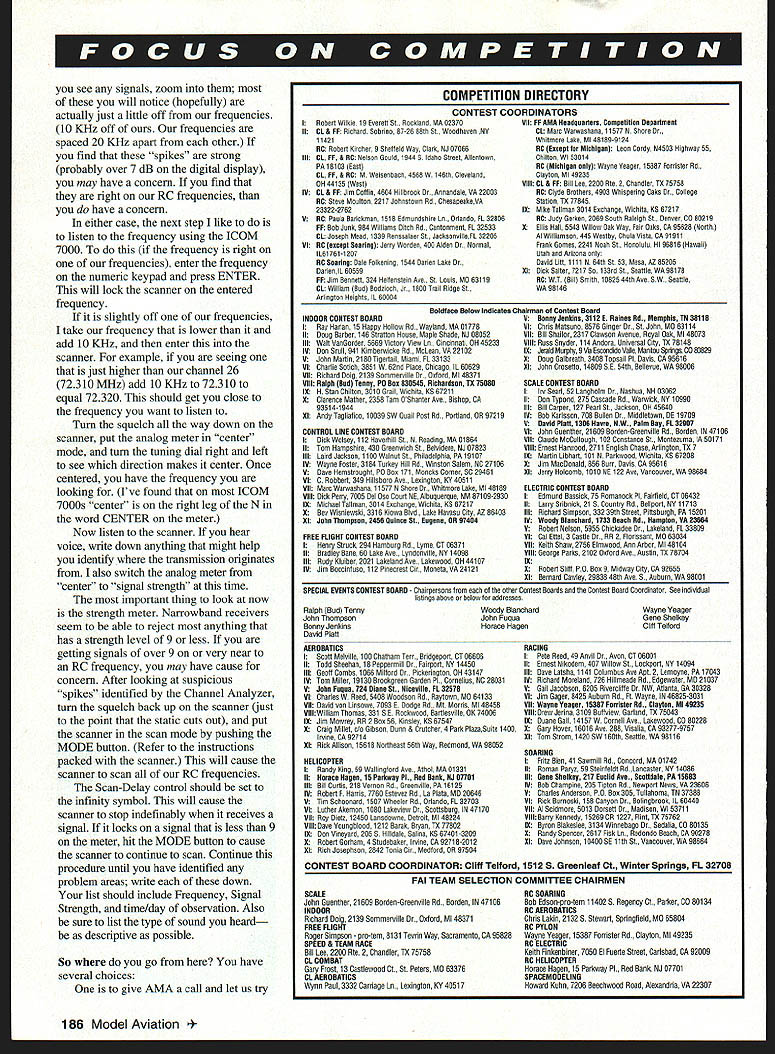
- The Channel Analyzer can help approximate direction: collapse a section or two of the antenna and rotate it slowly while watching the digital strength display. When the signal dips (a null), the antenna is pointing toward the source's approximate direction.
Options for resolving interference
- Contact AMA: AMA staff or your District Frequency Coordinator may help determine the source or point you to references and procedures.
- Contact the FCC: Some local FCC field offices can help locate illegal or harmful transmitters, though success varies depending on office workload.
- Approach the source: If you locate the origin, politely explain who you are and your concerns. Often the operator is cooperative and adjustments resolve the problem. If you suspect illegal transmissions, contact the FCC — do not attempt enforcement yourself.
A little courtesy goes a long way. Also understand that many interfering stations may be perfectly legal; in those cases you may need to vacate the affected channels. Fortunately, there are many channels available, so relocation is usually possible.
If you have questions, contact your district Frequency Coordinator or AMA. They can answer many questions or refer you to someone who can.
Final notes
This is the Nats issue — I hope you enjoyed the articles and scrapbook presentation of the 1996 Nats. It was a great event, the first time all outdoor events were flown at the Muncie site. Improvements are already planned for next year. To all competitors, volunteers, and HQ staff: thank you — each of you did a super job!
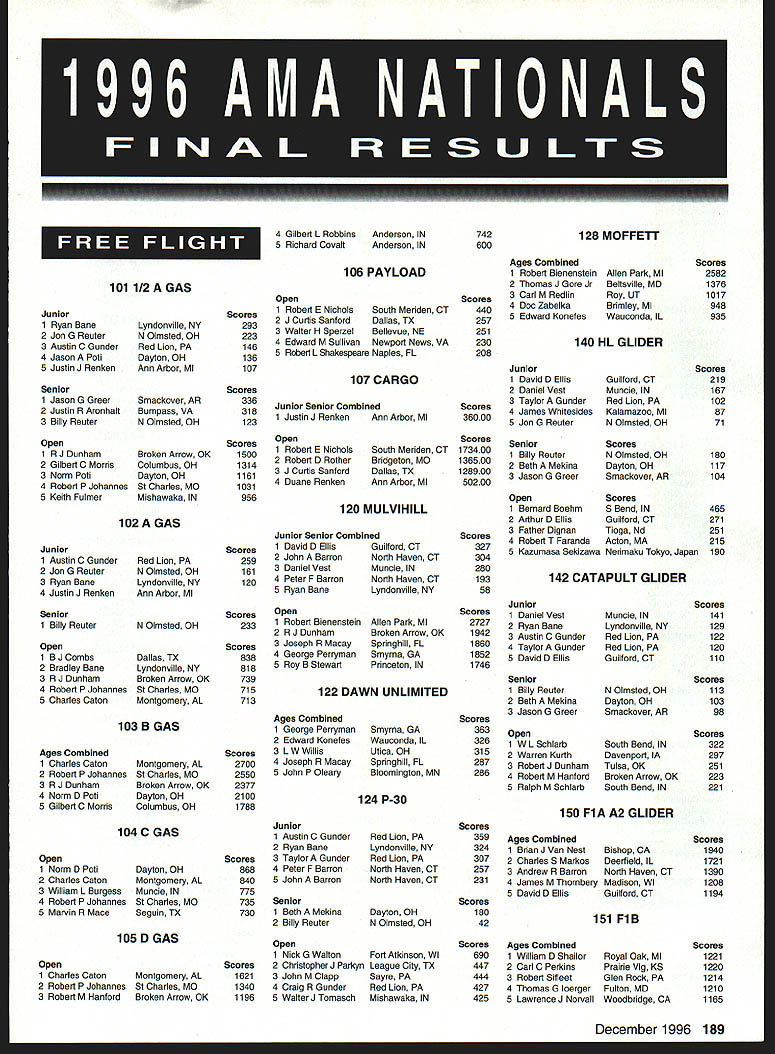
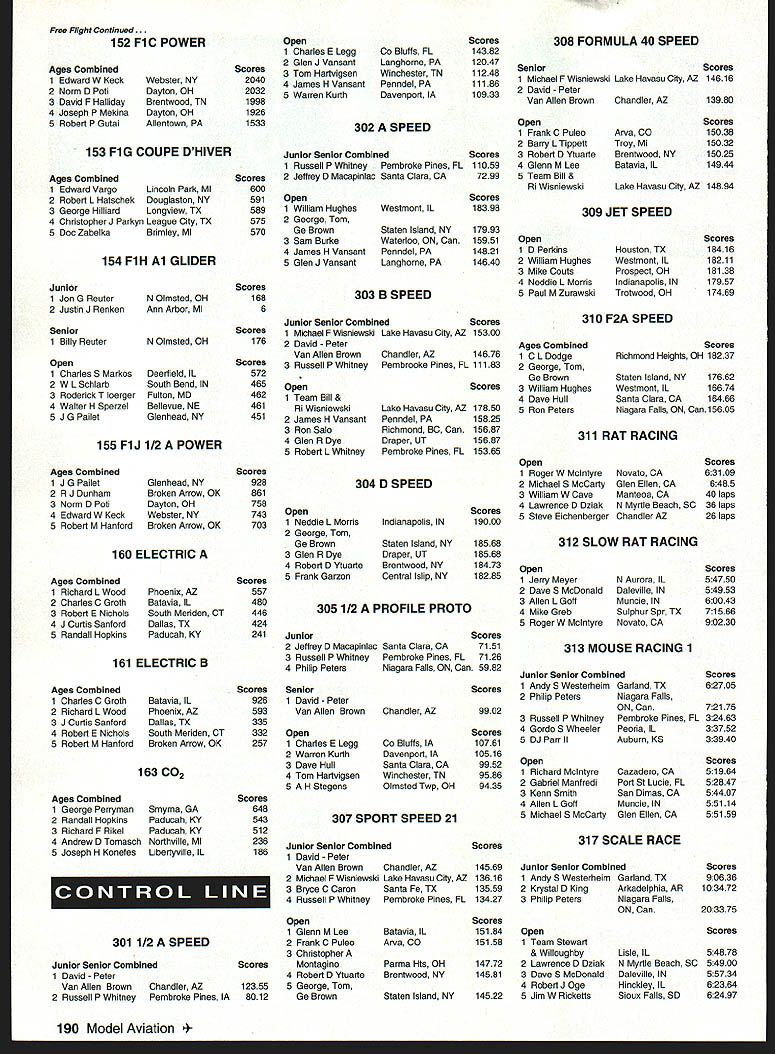
Competition Results
152 F1C POWER
Ages — Combined Scores
- Edward W Keck, Webster, NY — 2040
- Norm D Poti, Dayton, OH — 2032
- David F Halliday, Brentwood, TN — 1998
- Joseph P Menke, Dayton, OH — 1926
- Robert P Guati, Allentown, PA — 1533
153 F1G COUPE D'HIVER
Ages — Combined Scores
- Edward Varon, Lincoln Park, MI — 680
- Robert L Hatschke, Douglaston, NY — 620
- George Hillard, Lowry, TX — 570
- Christopher J Pavlovic, League City, TX — 575
- Doc Zabelka, Brimley, MI — 570
154 F1H A1 GLIDER
Junior Scores
- Jon G Reuter, N Olmsted, OH — 168
- Justin J Renken, Ann Arbor, MI — 6
Senior Scores
- Billy Reuter, N Olmsted, OH — 176
Open Scores
- Charles S Markos, Deerfield, IL — 572
- W L Schlab, South Bend, IN — 465
- Roderick T Joerger, Fulton, MO — 462
- Walter H Sperzel, Bellevue, NE — 446
- J G Pailet, Glenhead, NY — 432
155 F1J 1/2 A POWER
Ages — Combined Scores
- J G Pailet, Glenhead, NY — 928
- R J Dunham, Broken Arrow, OK — 861
- Norm D Poti, Dayton, OH — 757
- Edward W Keck, Webster, NY — 743
- Robert M Hanford, Broken Arrow, OK — 703
160 ELECTRIC A
Ages — Combined Scores
- Richard L Wood, Phoenix, AZ — 557
- Charles C Groth, Batavia, IL — 490
- Robert E Nichols, South Meriden, CT — 446
- J Curtis Sanford, Dallas, TX — 424
- Randall Hopkins, Paducah, KY — 322
161 ELECTRIC B
Ages — Combined Scores
- Charles C Groth, Batavia, IL — 926
- Richard L Wood, Phoenix, AZ — 593
- J Curtis Sanford, Dallas, TX — 335
- Robert E Nichols, South Meriden, CT — 332
- Robert M Hanford, Broken Arrow, OK — 257
163 CO2
Ages — Combined Scores
- George Perryman, Smyrna, GA — 648
- Randall Hopkins, Paducah, KY — 543
- Richard F Riffel, Paducah, KY — 512
- Andrew D Tomasch, Northville, MI — 236
- Joseph H Kontes, Libertyville, IL — 235
CONTROL LINE
301 1/2 A SPEED
Junior/Senior Combined Scores
- David–Peter Van Allen Brown, Chandler, AZ — 123.55
- Russell P Whitney, Pembroke Pines, FL — 80.12
Open Scores
- Charles E Legg, Council Bluffs, IA — 143.82
- Glen J Vansant, Langhorne, PA — 142.48
- Tom Harvitson, Winchester, TN — 112.46
- James H Vansant, Penndel, PA — 111.86
- Warren Kurth, Davenport, IA — 109.33
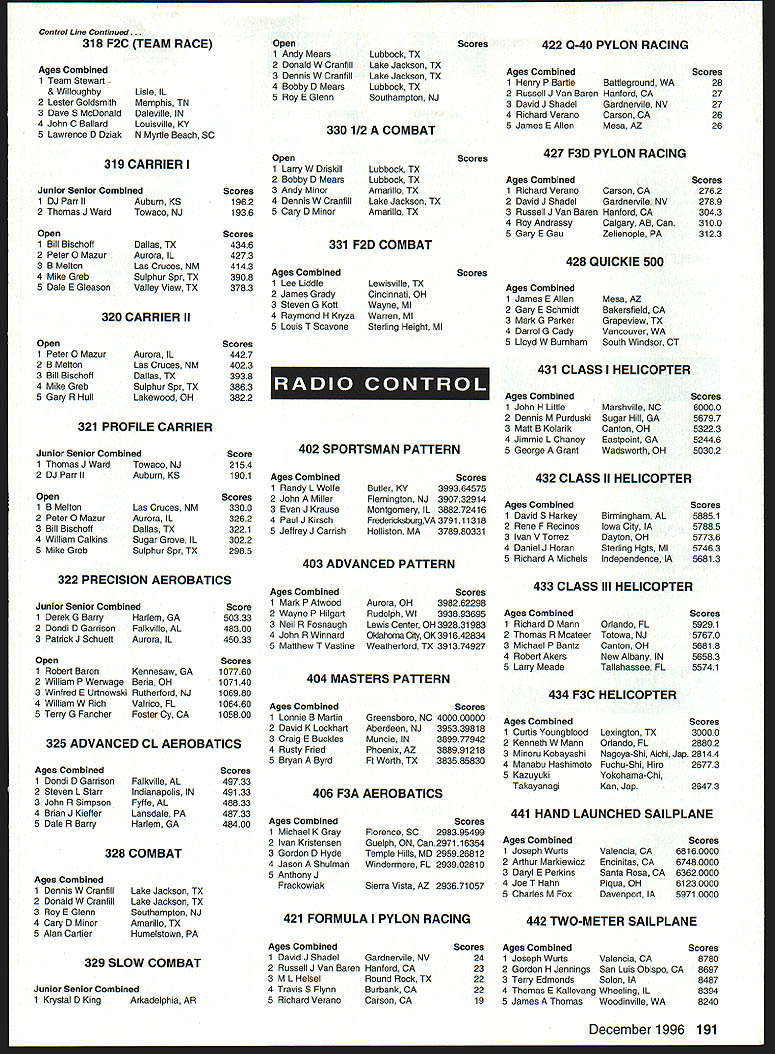
302 A SPEED
Junior/Senior Combined Scores
- Russell P Whitney, Pembroke Pines, FL — 110.59
- Jeffrey D Macapinalc, Santa Clara, CA — 72.99
Open Scores
- William Hughes, Westmont, IL — 183.93
- Joe Brown, Staten Island, NY — 179.93
- Sam Burke, Waterloo, ON, CAN — 159.51
- James H Vansant, Penndel, PA — 148.21
- Glen J Vansant, Langhorne, PA — 146.40
303 B SPEED
Junior/Senior Combined Scores
- Michael F Wisniewski, Lake Havasu City, AZ — 153.00
- David–Peter Van Allen Brown, Chandler, AZ — 146.76
- Russell P Whitney, Pembroke Pines, FL — 111.83
Open Scores
- Team Bill & H Wisniewski, Lake Havasu City, AZ — 178.50
- Tom Ball & R Vig, Richmond, BC, CAN — 168.25
- Ron Sala, Richmond, BC, CAN — 156.87
- Glen R Dye, Draper, UT — 155.65
- Robert L Whitney, Pembroke Pines, FL — 153.65
304 D SPEED
Open Scores
- Nedile L Morris, Indianapolis, IN — 190.00
- George, Tom, Staten Island, NY — 185.68
- Glen R Dye, Draper, UT — 185.68
- Robert D Vaurto, Brentwood, NY — 185.65
- Frank Garzon, Central Islip, NY — 182.85
305 1/2 A PROFILE PROTO
Junior
- Jeffrey D Macapinalc, Santa Clara, CA — 71.51
- Russell P Whitney, Pembroke Pines, FL — 71.26
- Philip Peters, Niagara Falls, ON, CAN — 59.82
Senior Scores
- David–Peter Van Allen Brown, Chandler, AZ — 99.02
- Charles E Legg, Council Bluffs, IA — 107.61
- Aaron Kurtz, Davenport, IA — 105.16
- Dave Hull, Santa Clara, CA — 99.56
- Tom Harvitson, Winchester, TN — 95.86
- A H Stegengs, Olmsted Twp, OH — 94.36
307 SPORT SPEED 21
Junior/Senior Combined Scores
- David–Peter Van Allen Brown, Chandler, AZ — 145.69
- Michael F Wisniewski, Lake Havasu City, AZ — 136.16
- Bryce R Carson, Santa Fe, TX — 135.59
- Russell P Whitney, Pembroke Pines, FL — 134.27
Open Scores
- Glenn M Lee, Batavia, IL — 151.84
- Frank C Puleo, Arva, CO — 151.58
- Christopher A Parma, Parma Heights, OH — 147.72
- Robert V Dutton, Brentwood, NY — 147.22
- George, Tom, Staten Island, NY — 145.22
308 FORMULA 40 SPEED
Senior Scores
- Michael F Wisniewski, Lake Havasu City, AZ — 146.16
- David–Peter Van Allen Brown, Chandler, AZ — 139.80
Open Scores
- Frank C Puleo, Arva, CO — 150.38
- Barry L Tippett, Troy, MI — 150.32
- Robert D Yuarte, Brentwood, NY — 150.25
- Glen M Lee, Batavia, IL — 149.44
- Tom Bill & R Wisniewski, Lake Havasu City, AZ — 148.94
309 JET SPEED
Open Scores
- D P Perkins, Houston, TX — 184.16
- William Hughes, Westmont, IL — 182.11
- Mike Couts, Prospect, OH — 181.82
- Eddie J Morris, Indianapolis, IN — 179.57
- Paul M Zurawski, Trotwood, OH — 174.69
310 F2A SPEED
Ages — Combined Scores
- C L Dodge, Richmond Heights, OH — 182.37
- George, Tom, Staten Island, NY — 176.62
- William Hughes, Westmont, IL — 166.74
- Dave Hull, Santa Clara, CA — 166.46
- Ron Peters, Niagara Falls, ON, CAN — 166.45
311 RAT RACING
Open Scores
- Roger W McIntyre, Novato, CA — 6:31.09
- Michael S McCarty, Glen Ellen, CA — 6:48.65
- William W Cave, Manteca, CA — 4 laps
- Lawrence D Dziak, N Myrtle Beach, SC — 36 laps
- Steve Eichenberger, Chandler, AZ — 26 laps
312 SLOW RAT RACING
Open Scores
- Jerry Meyer, N Aurora, IL — 5:47.70
- Dave S McDonald, Daleville, IN — 5:49.53
- Allen L Gott, Muncie, IN — 5:49.60
- Mike Gree, Sulphur Springs, TX — 7:15.56
- Roger W McIntyre, Novato, CA — 9:02.30
313 MOUSE RACING 1
Junior/Senior Combined Scores
- Andy S Westerhiem, Garland, TX — 627.05
- Philip Peters, Niagara Falls, ON, CAN — 721.75
- Russell P Whitney, Pembroke Pines, FL — 324.63
- Gordon S Wheeler, Peoria, IL — 3:39.40
- DJ Parr II, Auburn, KS — 2:35.40
Open Scores
- Richard McIntyre, Cazadero, CA — 5:19.64
- Gabriel Manfredi, Port St. Lucie, FL — 5:28.47
- Ken Smith, San Dimas, CA — 5:51.09
- Allan L Gott, Muncie, IN — 5:11.14
- Michael S McCarty, Glen Ellen, CA — 5:51.59
317 SCALE RACE
Junior/Senior Combined Scores
- Andy S Westerhiem, Garland, TX — 9:06.36
- Krystol D King, Arapahoe, AR — 10:04.72
- Philip Peters, Niagara Falls, ON, CAN — 20:33.75
Open Scores
- Tom Stewart, Lisle, IL — 5:48.78
- Willoughby M, Myrtle Beach, SC — 5:49.40
- Dave S McDonald, Daleville, IN — 5:53.71
- Robert J Oge, Hinckley, IL — 6:10.97
- Jim W Ricketts, Sioux Falls, SD — 6:24.97
Transcribed from original scans by AI. Minor OCR errors may remain.

