
Focus on Competition
Technical Director — Steve Kaluf
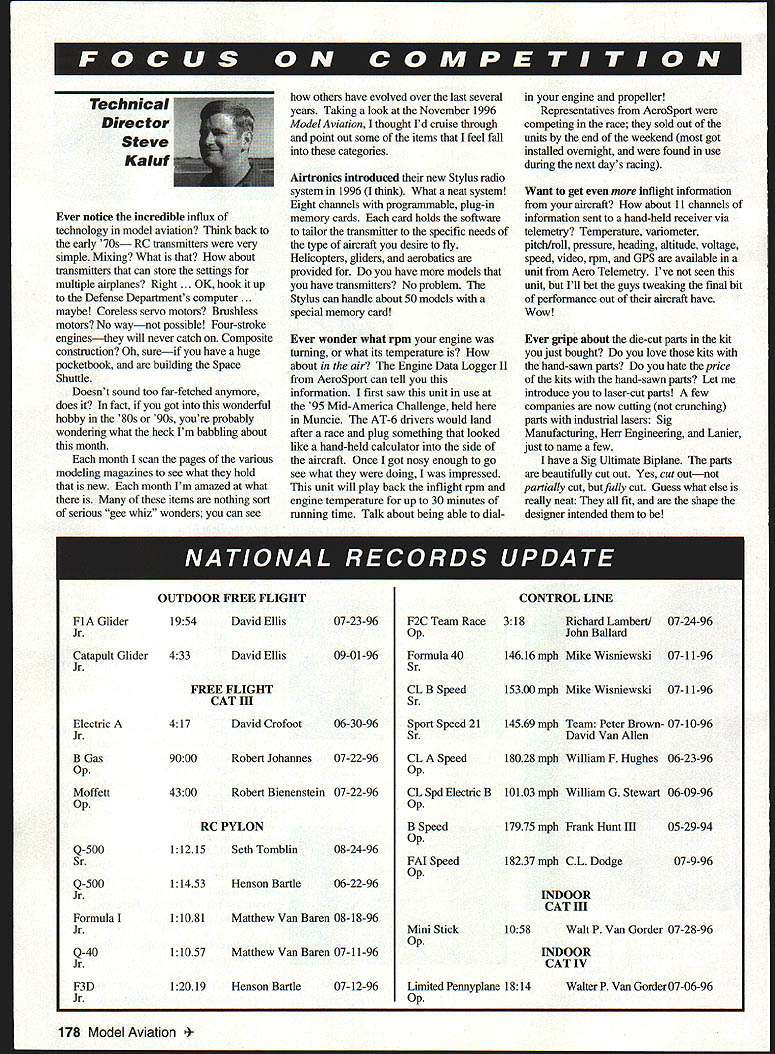
Ever notice the incredible influx of technology into model aviation? Think back to the early '70s — RC transmitters were very simple. Mixing? What about transmitters that can store settings for multiple airplanes? Right.
Coreless servo motors? Brushless motors? No way — not possible. Four-stroke engines — they will never catch on. Composite construction? Oh sure, if you have a huge pocketbook and are building the Space Shuttle. Doesn't sound too far-fetched anymore, does it? In fact, we've got a wonderful hobby.
Month after month I scan the pages of various modeling magazines to see what they hold that is new. I'm amazed at what appears — many items are nothing short of serious "gee-whiz" wonders. Taking a look at the November 1996 Model Aviation, here are some items I think fall into that category.
Airtronics introduced the Stylus radio system in 1996. What a neat system: eight channels with programmable, plug-in memory cards. Each card holds the software to tailor the transmitter to the specific needs of the type of aircraft you fly — helicopters, gliders, aerobatics. Have more models than transmitters? No problem. The Stylus can handle about 50 models with a special memory card.
Ever wonder what rpm your engine is turning, or what its temperature is — in the air? The Engine Data Logger II from AeroSport can tell you. I first saw this unit in use at the '95 Mid-America Challenge held in Muncie. The AT-6 drivers would land after a race and plug something that looked like a hand-held calculator into the side of the aircraft. The unit will play back inflight rpm and engine temperature for up to 30 minutes of running time. Talk about being able to dial in your engine and propeller! Representatives from AeroSport were competing in the race and sold out of the units by the end of the weekend; most were installed overnight and found in use during the next day's racing.
Want to get even more inflight information from your aircraft? How about 11 channels of information sent to a hand-held receiver via telemetry? Temperature, variometer, pitch/roll, pressure, heading, altitude, voltage, speed, video, rpm, and GPS are available in a unit from Aero Telemetry. I've seen the unit — I bet the guys tweaking the final bit of performance out of their aircraft have.
Ever gripe about the die-cut parts in a kit you just bought? Love kits with hand-sawn parts but hate the price of those kits? Let me introduce you to laser-cut parts. A few companies are now cutting parts with industrial lasers: Sig Manufacturing, Herr Engineering, and Lanier, just to name a few. I have a Sig Ultimate Biplane. The parts are beautifully cut out — fully cut, not partially cut — and they fit the shape the designer intended.
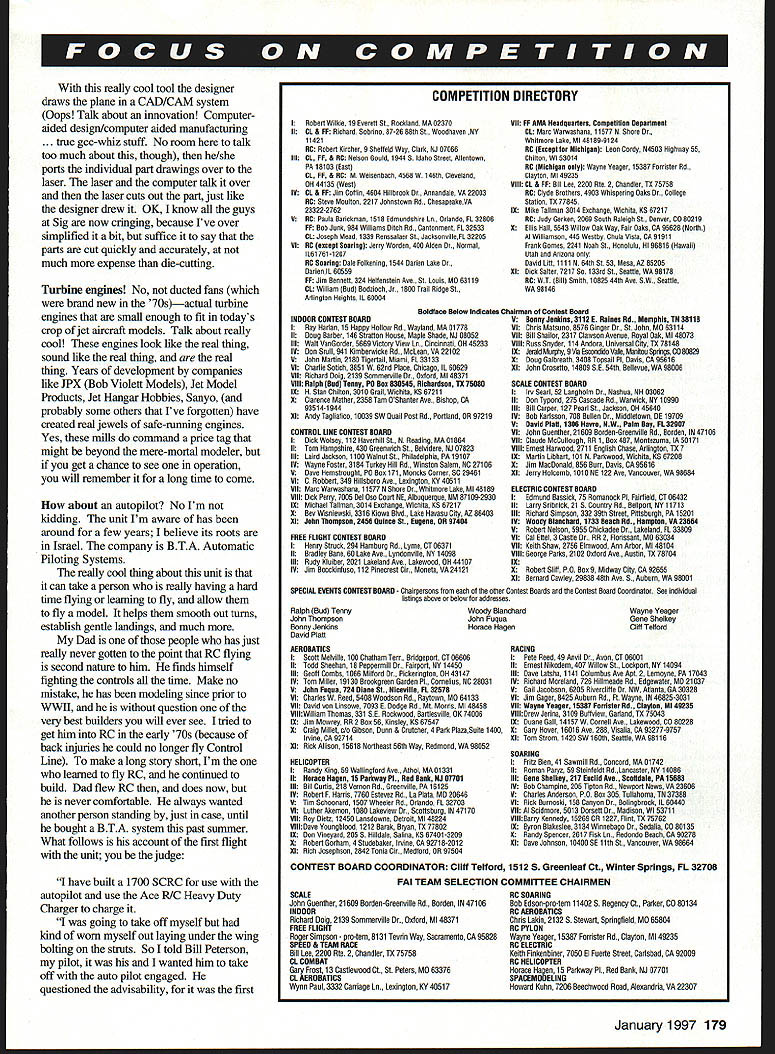
Talk about innovation: computer-aided design/computer-aided manufacturing. CAD/CAM is true gee-whiz stuff. The designer ports individual part drawings over to the laser computer and the laser cuts out the part just like the designer drew. Parts are cut quickly and accurately without the expense of die-cutting.
Turbine engines? Not ducted fans — actual small turbine engines, the real thing. Years of development by companies like JPX (Bob Violett Models), Jet Model Products, Jet Hangar Hobbies, and Sanyo (among others) have produced jewels of safe-running engines. Yes, these engines command a price that might be beyond the mere-mortal modeler, but if you see one in operation you will remember it for a long time.
How about an autopilot? No — I'm not kidding. The unit I'm aware of has been around for a few years; I believe its roots are in Israel. The company is B.T.A. Automatic Piloting Systems.
The really cool thing about this unit is that it can take a person who is having a hard time flying or learning to fly and allow them to fly a model. It helps smooth out turns, establish gentle landings, and much more.
My dad is one of those people who has never quite made RC flying second nature. He has modeled since before WWII and is one of the very best builders you'll ever see. I tried to get him into RC in the early '70s (because of back injuries he could no longer fly Control Line). To make a long story short, I'm the one who learned to fly RC, and he continued to build. He flew RC then and does now, but he's never comfortable — he always wanted another person standing by, just in case, until he bought a B.T.A. system this past summer. What follows is his account of the first flight with the unit; you be the judge:
"I have built a 1700 SCRC for use with the autopilot and use the Ace RC/Heavy Duty Charger to charge it.
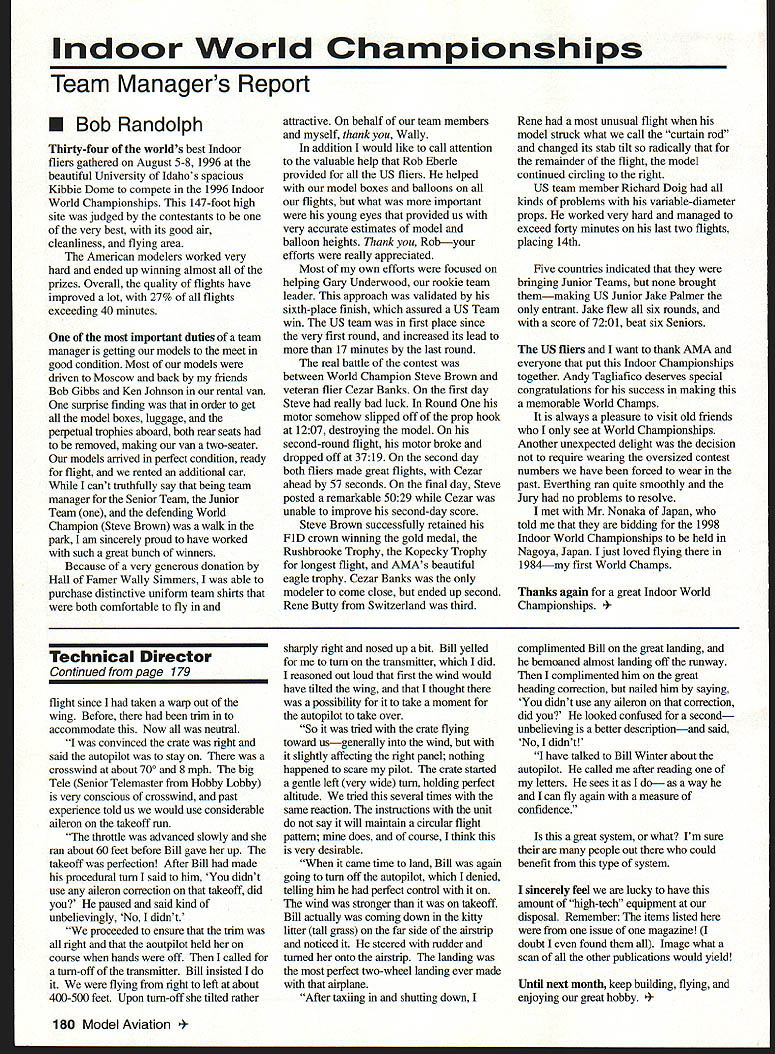
"I was going to take off myself but had kind of worn myself out laying under the wing bolting on the struts. So I told Bill Peterson, my pilot, it was his and I wanted him to take off with the autopilot engaged. He questioned the advisability, for it was the first flight since I had taken a warp out of the wing. Before, there had been trim in to accommodate this. Now all was neutral.
"I was convinced the crate was right and said the autopilot was to stay on. There was a crosswind of about 7–8 mph. The Big Tele (Senior Telemaster from Hobby Lobby) is very conscious of crosswind, and past experience told us we would use considerable aileron on the takeoff run.
"The throttle was advanced slowly and she was about 60 feet before Bill gave her up. The takeoff was perfect! After Bill had made his procedural turn I said to him, 'You didn't use any aileron correction on that takeoff, did you?' He paused and said, kind of unbelievingly, 'No, I didn't.'
"We proceeded to ensure that the trim was all right and that the autopilot held her on course when the wind was down on the field. I asked Bill if he thought he could take a turn off the transmitter. Bill insisted I do it. We were lifting from right to left at about 400–500 feet. Upon turn-off she tilted rather sharply right and nosed up a bit. Bill yelled for me to turn on the transmitter, which I did. I reasoned out loud that first the wind would have tilted the wing, and that I thought there was a possibility for it to take a moment for the autopilot to take over.
"So it was tried with the crate flying toward us — generally into the wind, but with it slightly affecting the right panel; nothing happened to scare my pilot. The crate started a gentle left (very wide) turn, holding perfect altitude. We tried this several times with the same reaction. The instructions with the unit do not say it will maintain a circular flight pattern; mine does, and of course, I think this is very desirable.
"When it came time to land, Bill was again going to turn off the autopilot, which I denied, telling him he had perfect control with it on. The wind was stronger than it was on takeoff. Bill actually was coming down in the kitty litter (tall grass) on the far side of the runway and noticed it. He steered with rudder and turned her onto the airstrip. The landing was the most perfect two-wheel landing ever made with that airplane.
"After taxiing in and shutting down, I complimented Bill on the great landing, and he bemoaned almost landing off the runway. Then I complimented him on the great heading correction, but nailed him by saying, 'You didn't use any aileron on that correction, did you?' He looked confused for a second — unbelieving is a better description — and said, 'No, I didn't!'
"I have talked to Bill Winter about the autopilot. He called me after reading one of my letters. He sees it as I do — as a way he and I can fly again with a measure of confidence."
This is a great system. I'm sure many people could benefit from this type of system.
I sincerely feel we are lucky to have this amount of "high-tech" equipment at our disposal. Remember: the items listed here were from one issue of one magazine! Imagine what a scan of all the other supplements would yield.
Until next month, keep building, flying, and enjoying our great hobby.
FF Junior World Championships — Team Manager's Report
Cracow, Poland — August 17–23, 1996
George Batiuk
We arrived in Cracow August 14. The biggest contingent (the Batiuks, the Sessums, and the Porters) got in about 2 p.m. Art and David Ellis had flown in about an hour earlier and already had our rental cars lined up. Jody Miller, a former junior glider flier, came in that night. Dorothy Fee and her parents arrived on the train from Berlin the next day.
We were met by a wonderful Polish RC flier named Stanislaw Roman. He became a real friend to the American team — showing us around, taking us on special excursions, and teaching us a lot about Polish culture. That first day he led our caravan across Cracow to the AWF Sports Complex that houses the youth hostel where we stayed. The rooms were not too fancy, but certainly adequate and comfortable.
The next day we drove out to find the Aero Club (flying field), about 12 kilometers east of the hostel. It was a blue lake just like most Eastern European fields — accommodating all sorts of sport aviation: small airplanes, full-size gliders, parachutists, model airplanes, etc. The field is about 1.5 x 2 km. We did some test flying, just enough to get our feet wet, and decided we would try the contest in Gliwice the next day.
We assembled the troops at 5:30 the next morning, ate breakfast, and drove for 2.5 hours to Gliwice. This is a very small World Cup contest held on an even smaller field (about 1 km round). It is organized by a Polish glider flyer named Stanislaw Kubit and is very well run. All four team members (Dorothy Fee, David Ellis, Allen Porter, and Tim Sessums) flew, getting in some very good practice.
By the time we got back to the hostel and ate dinner that night, it was 10 p.m. The next day (the first practice day of the Champs) found us exhausted, and the weather cold and windy, so we rested and held a late-afternoon team meeting. I deliberately had the entire American contingent attend, because I wanted to tell the adults as well as the team members what I expected.
I told the adults I did not want any undue pressure put on the team members, and that I wanted them to fly by themselves (this was according to the new rule, which was strictly enforced that year). I told the team members I did not care where they ended up in the standings — I wanted them to do the best they possibly could, function well as a team, represent the United States better than any other team had, and to have fun! After the meeting we checked all the models and documentation to make sure they were correct before processing the next day.
The next day was more practice and the opening ceremonies. I was very proud of these kids — they acted happy, proud, and they knew why they were there. I could see other teams looking at us with admiration.
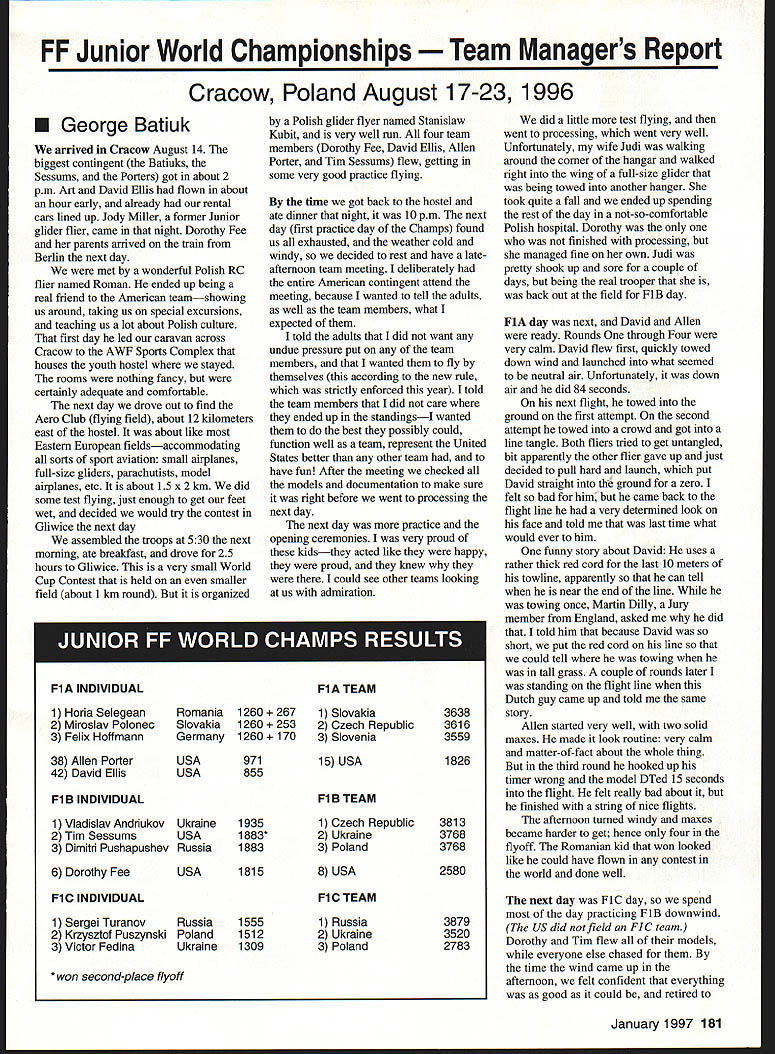
Junior FF World Champs Results
F1A Individual
- Horia Selegean — Romania — 1260 + 267
- Miroslav Polonec — Slovakia — 1260 + 253
- Felix Hoffmann — Germany — 1260 + 170
- Allen Porter — USA — 971
- David Ellis — USA — 855
F1A Team
- Slovakia — 3638
- Czech Republic — 3616
- Slovenia — 3559
- USA — 1826
F1B Individual
- Vladislav Andriukov — Ukraine — 1935
- Tim Sessums — USA — 1883*
- Dimitri Pushapushev — Russia — 1883*
- Dorothy Fee — USA — 1815
F1B Team
- Czech Republic — 3813
- Ukraine — 3768
- Poland — 3768
- USA — 2580
F1C Individual
- Sergei Turanov — Russia — 1555
- Krzysztof Puszynski — Poland — 1512
- Victor Fedina — Ukraine — 1309
F1C Team
- Russia — 3879
- Ukraine — 3520
- Poland — 2783
*Won second-place flyoff
We did a little more test flying, and then went to processing, which went very well. Unfortunately, my wife Judi was walking around the corner of the hangar and walked right into the wing of a full-size glider that was being towed into another hangar. She took quite a fall and we ended up spending the rest of the day in a not-so-comfortable Polish hospital. Dorothy was the only one not finished with processing, but she managed fine on her own. Judi was pretty shook up and sore for a couple of days, but being the real trooper that she is, she was back out at the field for F1B day.
F1A day was next, and David and Allen were ready. Rounds One through Four were very calm. David flew first, quickly towed downwind and launched into what seemed to be neutral air. Unfortunately, it was down air and he scored 84 seconds.
On his next flight he towed into good air and had a good flight. It got a little rough at the top end — the model drifted a little — but it landed in the field.
One funny story about David: he uses a rather thick cord for the last 10 meters of his towline, apparently so he can tell when he is near the end of the line. While he was towing once, Martin Dilly, a jury member from England, asked me why he did that. I told him that because David was so short, we put the red cord on his line so we could tell where he was towing when he was in tall grass. A couple of rounds later a Dutch guy came up and told me the same story.
Allen started very well, with two solid maxes. He made it look routine: very calm and matter-of-fact. But in the third round he hooked up his timer wrong and the model DTed 15 seconds into the flight. He felt really bad about it, but he finished with a string of nice flights.
The afternoon turned windy and maxes became harder to get; hence only four in the flyoff. The Romanian kid that won looked like he could have flown in any contest in the world and done well.
The next day was F1C day, so we spent most of the day practicing F1B (the U.S. did not field an F1C team). Dorothy and Tim flew all of their models while everyone else chased for them. By the time the wind came up in the afternoon, we felt confident that everything was as good as it could be, and retired to the hostel for rest and to check timers.
F1B day started just like F1A day: dead calm. Dorothy was a little unsure of her Andriukov-type model, and decided to fly an older one, which maxed fine in the first round. In the second round the timer did not start and the model went over the top and into the ground on that attempt. There were only about five minutes left in the round, but she put the Andriukov model together, wound it, and launched with just eight seconds left in the round. Fortunately, there was good lift then and she maxed easily. The rest of her flights were routine compared to that one, and at the end of the day she was in the flyoff.
Tim made his seven rounds look like a cakewalk. He was calm, cool, and serious — almost scary. I really think this kid could teach the Open fliers a thing or two. He even knew where the five- and seven-minute settings were on his timer before the flyoff started. There were eleven in the flyoff, and everyone made the five-minute flight. The breeze had picked up a little and it was colder by the time the seven-minute round started. I advised both of our fliers that I thought this would be the last flight, and it would be best to wind and launch as soon as possible. Tim got his model off first and looked pretty good. Dorothy took a little longer to get ready and flew midway through the round. She was still flying her Andriukov model and made a good flight of 225 seconds for sixth place.
Tim ended up tied with a Russian competitor for second place with a flight of 293 seconds. Vladi Andriukov won with 345 seconds. Tim and the Russian had to fly a flyoff; Tim took out a little turn to help glide performance, which probably made the difference — he won by eight seconds!
Next was collecting the hardware. Nobody knew the organizers had a special treat for two of our fliers. We all thought Tim would be the only one to get anything, and everyone was very proud of him and their own effort to help him.
What we were not expecting was that Dorothy received a trophy for being the highest-placing female competitor (there were several). Just when we thought it was all over, they awarded David a trophy (a huge crystal vase) for being the youngest competitor. When he went to the stand to get it, he was so happy he kind of skipped along to the biggest round of applause of the ceremony. I was so proud of our team.
Thanks to all of the parents who went along: for being there when we needed help, for chasing and for technical assistance, but especially for letting the kids fly the contest themselves. And we never could have done as well without Jody Miller, who paid his own way to be here to help and assist me. Jody told me he wanted to try to help keep the Junior Program going because it had meant so much to him the two times he went.
The Polish organizers were outstanding. Everything they did was in an effort to put on the best and most-fair competition possible. The jury of Pierre Chaussebourg, Martin Dilly, and Eugene Verbitsky did an excellent job. We are getting to expect that from any meet Mr. Chaussebourg is involved with.
I am grateful for the opportunity to have served, and I can assure you I was very proud to be the United States Team Manager. These kids worked very hard and they worked very well as a team. Everyone associated with Free Flight in this country can be very proud of them. This Junior Program is a worthwhile venture, and every effort should be made to sustain it.
Transcribed from original scans by AI. Minor OCR errors may remain.

