
Focus on Competition
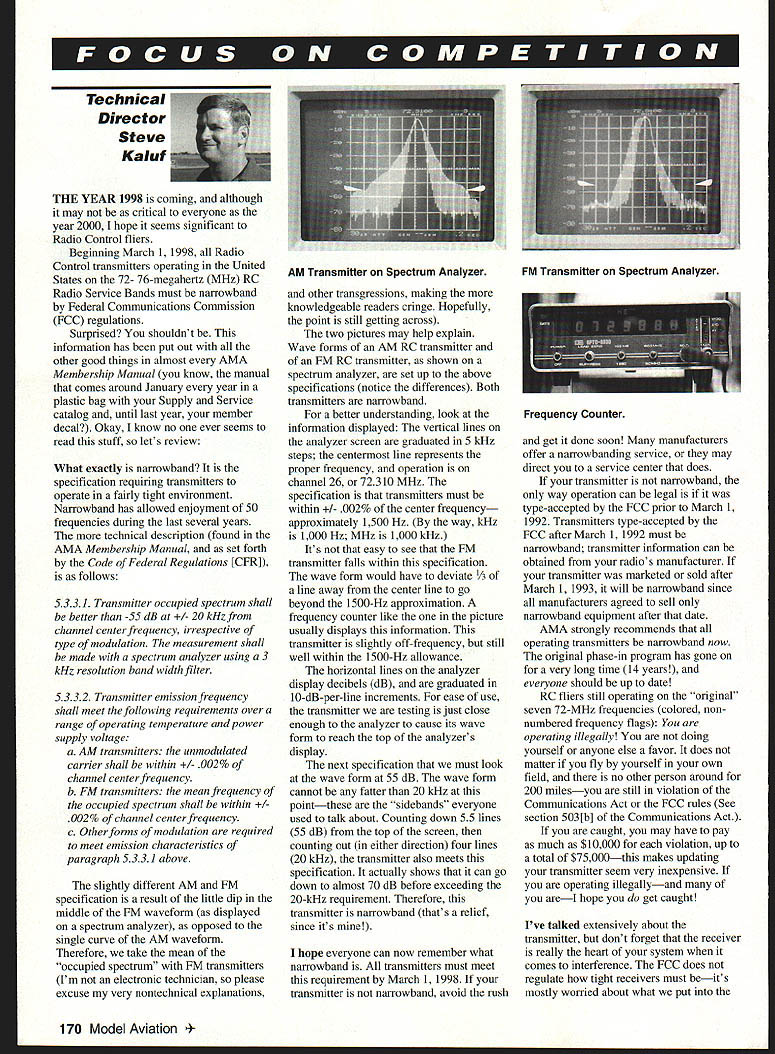
Technical Director
Steve Kaluf
The year 1998 is coming, and although it may not be as critical to everyone as the year 2000, I hope it seems significant to Radio Control fliers.
Beginning March 1, 1998, all radio control transmitters operating in the United States on the 72–76 megahertz (MHz) RC Radio Service bands must be narrowband by Federal Communications Commission (FCC) regulations.
Surprised? You shouldn't be. This information has been included in almost every AMA Membership Manual (you know, the manual that comes around January every year in a plastic bag with your Supply and Service catalog, and until last year, your member decal). Okay, I know no one ever seems to read this stuff, so let's review.
What exactly is narrowband? It is the specification requiring transmitters to operate in a fairly tight environment. Narrowband has allowed enjoyment of 50 frequencies during the last several years. The more technical description (found in the AMA Membership Manual, and as set forth by the Code of Federal Regulations [CFR]) is as follows:
5.3.3.1. Transmitter occupied spectrum shall be better than -55 dB at +/- 20 kHz from channel center frequency, irrespective of type of modulation. The measurement shall be made with a spectrum analyzer using a 3 kHz resolution bandwidth filter.
5.3.3.2. Transmitter emission frequency shall meet the following requirements over a range of operating temperature and power supply voltages:
- a. AM transmitters: the unmodulated carrier shall be within +/- .002% of channel center frequency.
- b. FM transmitters: the mean frequency of the occupied spectrum shall be within +/- .002% of channel center frequency.
- c. Other forms of modulation are required to meet emission characteristics of paragraph 5.3.3.1 above.
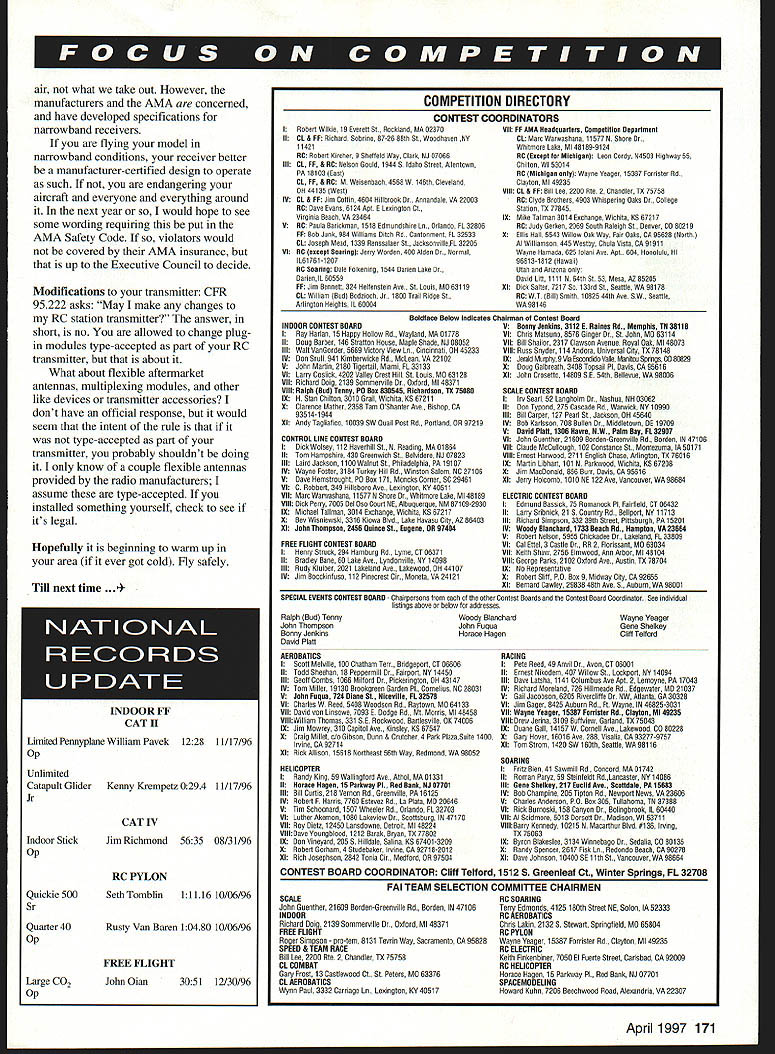
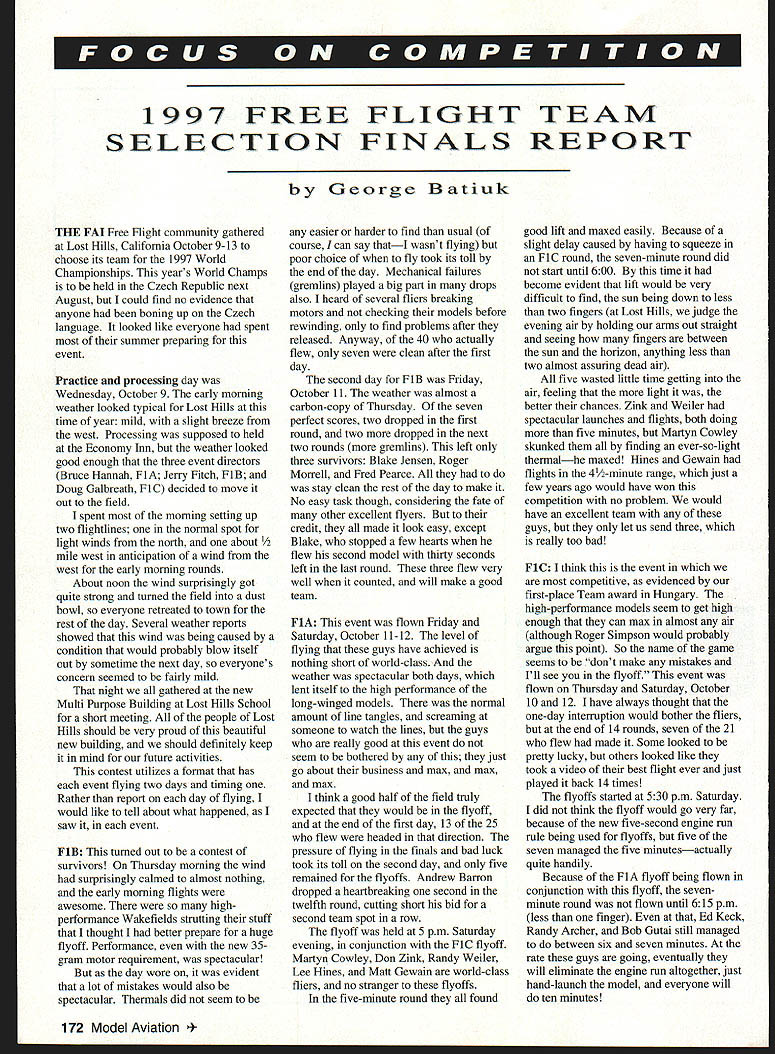
The slightly different AM and FM specification is a result of the little dip in the middle of the FM waveform (as displayed on a spectrum analyzer), as opposed to the single curve of the AM waveform. Therefore, we take the mean of the "occupied spectrum" with FM transmitters. I'm not an electronic technician, so please excuse my very nontechnical explanations and other transgressions that may make more knowledgeable readers cringe. Hopefully the point still gets across.
The two pictures may help explain. Waveforms of an AM RC transmitter and of an FM RC transmitter, as shown on a spectrum analyzer, are set up to the above specifications (notice the differences). Both transmitters are narrowband.
For a better understanding, look at the information displayed: The vertical lines on the analyzer screen are graduated in 5 kHz steps; the centermost line represents the proper frequency, and operation is on channel 26, or 72.310 MHz. The specification is that transmitters must be within +/- .002% of the center frequency—approximately 1,500 Hz. (By the way, kHz is 1,000 Hz; MHz is 1,000 kHz.)
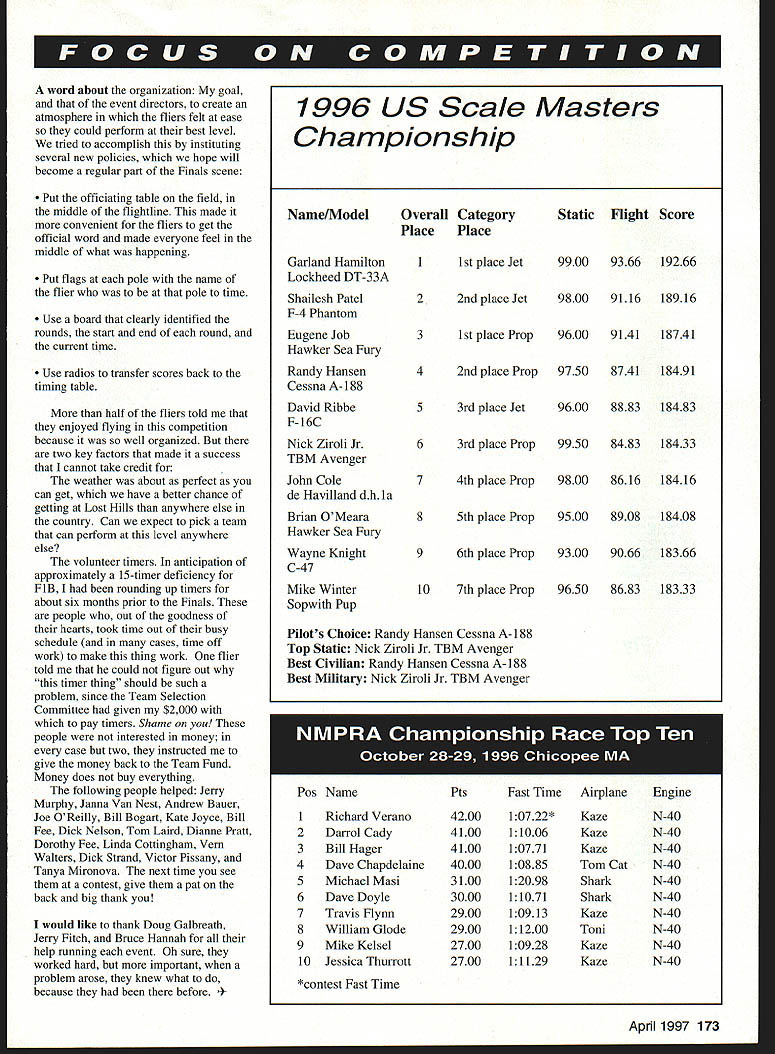
It's not that easy to see that the FM transmitter falls within this specification. The waveform would have to deviate 1/3 of a line away from the center line to go beyond the 1,500-Hz approximation. A frequency counter like the one in the picture usually displays this information. This transmitter is slightly off-frequency, but still well within the 1,500-Hz allowance.
Horizontal lines on the analyzer display show decibels (dB), and are graduated in 10-dB-per-line increments. For ease of use, the transmitter we are testing is just close enough to the analyzer to cause its waveform to reach the top of the analyzer's display.
The next specification that we must look at is the waveform at -55 dB. The waveform cannot be any fatter than 20 kHz at this point—these are the "sidebands" everyone used to talk about. Counting down 5.5 lines (55 dB) from the top of the screen, there isn't much out in either direction; four lines (20 kHz), the transmitter also meets this specification. It actually shows that it can go down almost 70 dB before exceeding the 20-kHz requirement. Therefore, this transmitter is narrowband (that's a relief, since it's mine!).
I hope everyone can now remember what narrowband is. All transmitters must meet this requirement by March 1, 1998. If your transmitter is not narrowband, avoid the rush and get it done soon! Many manufacturers offer a narrowbanding service, or they may direct you to a service center that does.
If your transmitter is not narrowband, the only way operation can be legal is if it was type-accepted by the FCC prior to March 1, 1992. Transmitters type-accepted by the FCC after March 1, 1992 must be narrowband; transmitter information can be obtained from your radio's manufacturer. If your transmitter was marketed or sold after March 1, 1993, it will be narrowband since all manufacturers agreed to sell only narrowband equipment after that date.
AMA strongly recommends that all operating transmitters be narrowband now. The original phase-in program has gone on for a very long time (14 years!), and everyone should be up to date. RC fliers still operating on the "original" seven 72-MHz frequencies (colored, non-numbered frequency flags) are operating illegally. You are not doing yourself or anyone else a favor. It does not matter if you fly by yourself in your own field, and there is no other person around for 200 miles—you are still in violation of the Communications Act or the FCC rules (Section 503(b) of the Communications Act). If you are caught, you may have to pay as much as $10,000 for each violation, up to a total of $75,000—this makes updating your transmitter seem very inexpensive. If you are operating illegally—and many of you are—hope you do get caught!
I've talked extensively about the transmitter, but don't forget that the receiver is really the heart of your system when it comes to interference. The FCC does not regulate how tight receivers must be—it's mostly worried about what we put into the air.
If you are flying your model in narrowband conditions, your receiver better be a manufacturer-certified design to operate as such. If not, you are endangering your aircraft and everyone and everything around it. In the next year or so, I would hope to see some wording requiring this be put in the AMA Safety Code. If so, violators would not be covered by their AMA insurance, but that is up to the Executive Council to decide.
Modifications to your transmitter: CFR 95.222 asks: "May I make any changes to my RC station transmitter?" The answer, in short, is no. You are allowed to change plug-in modules type-accepted as part of your RC transmitter, but that is about it.
What about flexible aftermarket antennas, multiplexing modules, and other similar devices or transmitter accessories? I don't have an official response, but it would seem that the intent of the rule is that if it was not type-accepted as part of your transmitter, you probably shouldn't be doing it. I only know of a couple flexible antennas provided by the radio manufacturers; I assume these are type-accepted. If you installed something yourself, check to see if it's legal.
Hopefully it is beginning to warm up in your area (if it ever got cold). Fly safely.
Till next time ...
1997 Free Flight Team Selection Finals Report
By George Batiuk
The FAI Free Flight community gathered at Lost Hills, California, October 9–13 to choose its team for the 1997 World Championships. This year's World Champs is to be held in the Czech Republic next August, but I could find no evidence that anyone had been boning up on the Czech language. It looked like everyone had spent most of their summer preparing for this event.
Practice and processing day was Wednesday, October 9. The early morning weather looked typical for Lost Hills at this time of year: mild, with a slight breeze from the west. Processing was supposed to be held at the Economy Inn, but the weather looked good enough that the three event directors (Bruce Hinnah, F1A; Jerry Fitch, F1B; and Doug Galbreath, F1C) decided to move it out to the field.
I spent most of the morning setting up two flightlines: one in the normal spot for light winds from the north, and one about 1/2 mile west in anticipation of a wind from the west for the early morning rounds.
About noon the wind surprisingly got quite strong and turned the field into a dust bowl, so everyone retreated to town for the rest of the day. Several weather reports showed that this wind was being caused by a condition that would probably blow itself out by sometime the next day, so everyone's concern seemed fairly mild.
That night we all gathered at the new Multi Purpose Building at Lost Hills School for a short meeting. All of the people of Lost Hills should be very proud of this beautiful new building, and we should definitely keep it in mind for our future activities.
This contest utilizes a format that has each event flying two days and timing one. Rather than report on each day of flying, I would like to tell about what happened, as I saw it, in each event.
F1B
This turned out to be a contest of survivors. On Thursday morning the wind had surprisingly calmed to almost nothing, and the early morning flights were awesome. There were so many high-performance Wakefields strutting their stuff that I thought I had better prepare for a huge flyoff. Performance, even with the new 35-gram motor torque requirement, was spectacular. But as the day wore on, it was evident that a lot of mistakes would also be spectacular. Thermals did not seem to be any easier or harder to find than usual (of course, I can say that—I wasn't flying), but poor choice of when to fly took its toll by the end of the day. Mechanical failures (gremlins) played a big part in many drops also. I heard of several fliers breaking motors and not checking their models before rewinding, only to find problems after they released. Anyway, of the 40 who actually flew, only seven were clean after the first day.
The second day for F1B was Friday, October 11. The weather was almost a carbon-copy of Thursday. Of the seven perfect scores, two dropped in the first round, and two more dropped in the next two rounds (more gremlins). This left only three survivors: Blake Jensen, Roger Morrell, and Fred Pearce. All they had to do was stay clean the rest of the day to make it. No easy task though, considering the fate of many other excellent flyers. But to their credit, they all made it look easy, except Blake, who stopped a few hearts when he flew his second model with thirty seconds left in the last round. These three flew very well when it counted, and will make a good team.
F1A
This event was flown Friday and Saturday, October 11–12. The level of flying that these guys have achieved is nothing short of world-class. And the weather was spectacular both days, which lent itself to the high performance of the long-winged models. There was the normal amount of line tangles, and screaming at someone to watch the lines, but the guys who are really good at this event do not seem to be bothered by any of this; they just go about their business and max, and max, and max.
I think a good half of the field truly expected that they would be in the flyoff, and at the end of the first day, 13 of the 25 who flew were headed in that direction. The pressure of flying in the finals and bad luck took its toll on the second day, and only five remained for the flyoffs. Andrew Barron dropped a heartbreaking one second in the twelfth round, cutting short his bid for a second team spot in a row.
The flyoff was held at 5 p.m. Saturday evening, in conjunction with the F1C flyoff. Martyn Cowley, Don Zink, Randy Weiler, Lee Hines, and Matt Gewain are world-class fliers, and no strangers to these flyoffs. In the five-minute round they all found good lift and maxed easily. Because of a slight delay caused by having to squeeze in an F1C round, the seven-minute round did not start until 6:00 p.m. By this time it had become evident that lift would be very difficult to find, the sun being down to less than two fingers (at Lost Hills, we judge the evening air by holding our arms out straight and seeing how many fingers are between the sun and the horizon—anything less than two almost assures dark air).
All five wasted little time getting into the air, feeling that the more light it was, the better their chances. Zink and Weiler had spectacular launches and flights both doing more than five minutes, but Martyn Cowley skunked them all by finding an ever-so-light thermal—he maxed! Hines and Gewain had flights in the 4 1/2-minute range, which just a few years ago would have won this competition with no problem. We would have an excellent team with any of these guys, but they only let us send three, which is really too bad.
F1C
I think this is the event in which we are most competitive, as evidenced by our first-place Team award in Hungary. The high-performance models seem to get high enough that they can max in almost any air (I know Roger Simpson would probably disagree with this point). So the name of the game seems to be "don't make any mistakes and you'll see you in the flyoff." This event was flown on Thursday and Saturday, October 10 and 12. I have always thought that the one-day interruption would bother the fliers, but at the end of 14 rounds, seven of the 21 who flew had made it. Some looked to be very lucky, others looked like they took a video of their best flight ever and just replayed it back 14 times.
The flyoffs started at 5:30 p.m. Saturday. I did not think the flyoff would go very far, because of the new five-second engine run rule being used for flyoffs, but five of the seven managed the five minutes—actually quite handy.
Because of the F1A flyoff being flown in conjunction with this flyoff, the seven-minute round was not flown until 6:15 p.m. (less than one finger). Even at that time, Ed Keck, Randy Archer, and Bob Gutai still managed to do between six and seven minutes. At the rate these guys are going, eventually they will eliminate the engine run altogether, just hand-launch the model, and everyone will do ten minutes!
A word about the organization
My goal, and that of the event directors, was to create an atmosphere in which the fliers felt at ease so they could perform at their best level. We tried to accomplish this by instituting several new policies, which we hope will become a regular part of the Finals scene:
- Put the officiating table on the field, in the middle of the flightline. This made it more convenient for the fliers to get the official word and made everyone feel in the middle of what was happening.
- Put flags at each pole with the name of the flier who was to be at that pole to time.
- Use a board that clearly identified the rounds, the start and end of each round, and the current time.
- Use radios to transfer scores back to the timing table.
More than half of the fliers told me that they enjoyed flying in this competition because it was so well organized. But there are two key factors that made it a success that I cannot take credit for:
The weather was about as perfect as you can get, which we have a better chance of getting at Lost Hills than anywhere else in the country. Can we expect to pick a team that can perform at this level anywhere else?
The volunteer timers. In anticipation of approximately a 15-timer deficiency for F1B, I had been rounding up timers for about six months prior to the Finals. These are people who, out of the goodness of their hearts, took time out of their busy schedule (and in many cases, time off work) to make this thing work. One flier told me that he could not figure out why "this timer thing" should be such a problem, since the Team Selection Committee had given me $2,000 with which to pay timers. Shame on you! These people were not interested in money; in every case but two, they instructed me to give the money back to the Team Fund. Money does not buy everything.
The following people helped: Jerry Murphy, Janna Van Nest, Andrew Bauer, Joe O'Reilly, Bill Bogart, Kate Joyce, Bill Fee, Dick Nelson, Tom Laird, Dianne Pratt, Dorothy Fee, Linda Cottingham, Vern Walters, Dick Strand, Victor Pissany, and Tanya Mironova. The next time you see them at a contest, give them a pat on the back and a big thank you!
I would like to thank Doug Galbreath, Jerry Fitch, and Bruce Hinnah for all their help running each event. Oh sure, they worked hard, but more important, when a problem arose, they knew what to do, because they had been there before.
Transcribed from original scans by AI. Minor OCR errors may remain.

