
Focus on Competition
A Note From the Technical Director
Bob Underwood
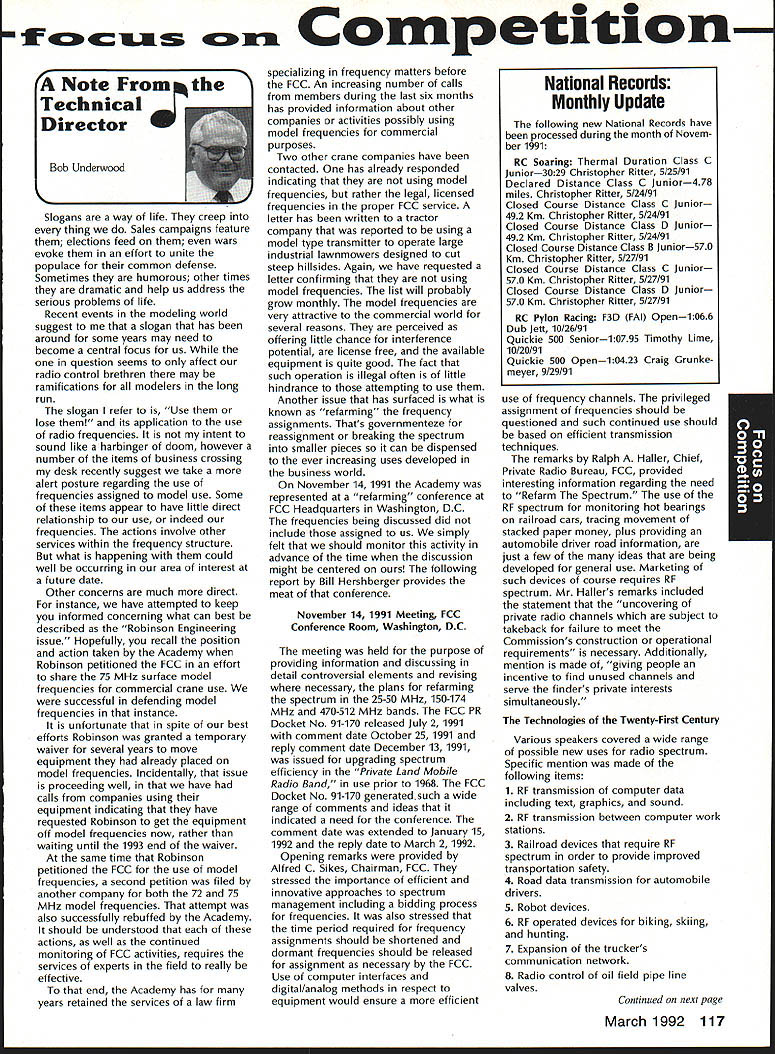
Slogans are a way of life. They creep into everything we do. Sales campaigns feature them; elections feed on them; even wars evoke them in an effort to unite the populace for their common defense. Sometimes they are humorous; other times they are dramatic and help us address the serious problems of life.
Recent events in the modeling world suggest to me that a slogan that has been around for some years may need to become a central focus for us. While the one in question seems to only affect our radio control brethren there may be ramifications for all modelers in the long run.
The slogan I refer to is, "Use them or lose them!" and its application to the use of radio frequencies. It is not my intent to sound like a harbinger of doom; however, a number of items on my desk recently suggest we take a more alert posture regarding the use of frequencies assigned to model use. Some of these items appear to have little direct relationship to our use, or indeed our frequencies. The actions involve other services within the frequency structure. But what is happening with them could well be occurring in our area of interest at a future date.
Other concerns are much more direct. For instance, we have attempted to keep you informed concerning what can best be described as the "Robinson Engineering" issue. Hopefully you recall the position and action taken by the Academy when Robinson petitioned the FCC in an effort to share the 75 MHz surface-model frequencies for commercial crane use. We were successful in defending model frequencies in that instance.
It is unfortunate that despite our best efforts Robinson was granted a temporary waiver for several years to move equipment they had already placed on model frequencies. Incidentally, that issue is proceeding well: we have had calls from companies using the equipment indicating that they have requested Robinson to get the equipment off model frequencies now, rather than waiting until the 1993 end of the waiver.
At the same time Robinson petitioned the FCC for the use of model frequencies, a second petition was filed by another company for both the 72 and 75 MHz model frequencies. That attempt was also successfully rebuffed by the Academy. It should be understood that these actions, as well as the continued monitoring of FCC activities, require the services of experts in the field to be effective.
To that end, the Academy has for many years retained the services of a law firm specializing in frequency matters before the FCC. An increasing number of calls from members during the last six months has provided information about other companies or activities possibly using model frequencies for commercial purposes.
Two other crane companies have been contacted. One has already responded indicating that they are not using model frequencies, but rather the legal, licensed frequencies in the proper FCC service. A letter has been written to a tractor company that was reported to be using a model-type transmitter to operate large industrial lawnmowers designed to cut steep hillsides. Again, we have requested a letter confirming that they are not using model frequencies. The list will probably grow month by month. Model frequencies are very attractive to the commercial world for several reasons: they are perceived as offering little chance for interference, are license-free, and the available equipment is quite good. The fact that such operation is illegal often is of little hindrance to those attempting to use them.
Another issue that has surfaced is what is known as "refarming" the frequency assignments — government-eze for reassignment or breaking the spectrum into smaller pieces so it can be dispensed to the ever-increasing uses developed in both leisure and business.
On November 14, 1991 the Academy was represented at a "refarming" conference at FCC Headquarters in Washington, D.C. The frequencies being discussed did not include those assigned to us. We simply felt that we should monitor this activity in advance of the time when the discussion might be centered on ours. The following report by Bill Hershberger provides the meat of the conference.
November 14, 1991 Meeting, FCC Conference Room, Washington, D.C.
The meeting was held for the purpose of providing information and discussing in detail controversial elements and revising where necessary the plans for refarming the spectrum in the 25–50 MHz, 150–174 MHz and 470–512 MHz bands. FCC PR Docket No. 91-170 (released July 2, 1991; comment date October 25, 1991; reply comment date December 13, 1991) addresses upgrading spectrum efficiency in the "Private Land Mobile Radio Band" in use prior to 1968. The docket generated such a wide range of comments and ideas that a conference was deemed necessary. The comment date was extended to January 15, 1992 and the reply date to March 2, 1992.
Opening remarks were provided by Alfred C. Sikes, Chairman, FCC. He stressed the importance of efficient and innovative approaches to spectrum management including a bidding process for assignments. He also stressed that the time period required for frequency assignments should be shortened and that dormant frequencies should be released for assignment as necessary by the FCC. Use of computer interfaces and digital/analog methods in equipment would ensure a more efficient use of frequency channels. The privileged assignment of frequencies should be questioned and continued use should be based on efficient transmission techniques.
Remarks by Ralph A. Haller, Chief, Private Radio Bureau, FCC, provided information regarding the need to "refarm" the spectrum. The use of the RF spectrum for monitoring hot bearings on railroad cars, tracing movement of stacked paper money, and providing automobile driver road information are just a few of the many ideas being developed for general use. Marketing such devices requires RF spectrum. Mr. Haller included the statement that the "uncovering of private radio channels which are subject to takeback for failure to meet the Commission's construction or operational requirements" is necessary. Additionally, he mentioned a mode of "giving people an incentive to find unused channels and serve the finder" as being in private interests simultaneously.
The Technologies of the Twenty-First Century
Various speakers covered a wide range of possible new uses for radio spectrum. Specific mention was made of the following items:
- RF transmission of computer data including text, graphics, and sound.
- RF transmission between computer workstations.
- Railroad devices that require RF spectrum to provide improved transportation safety.
- Road data transmission for automobile drivers.
- Robotic devices.
- RF-operated devices for biking, skiing, and hunting.
- Expansion of the trucker's communication network.
- Radio control of oil field pipeline valves.
Focus on Transmission Modes
Considerable time was devoted to discussing the merits of the following transmission modes:
- FDMA — Frequency Division Multiple Access
- TDMA — Time Division Multiple Access
- CDMA — Code Division Multiple Access
Bandwidth requirements for these systems included 5 kHz, 6.25 kHz, 7.5 kHz, 12.5 kHz, and 15 kHz. Relative advantages were discussed in reference to overall reliability. One speaker recommended that the low band, 25–50 MHz, should not be refarmed in part due to the nature of RF transmission characteristics in this band.
How to Refarm the Spectrum?
Comments by various speakers indicated a trend toward assigning frequencies to a central company in an area that would allocate service via a radio channel as needed by the user (a trunked service). The user would be charged a fee for the trunked service. Certain groups proposed such action since actual radio contact would not be under their direct control, but fire departments, police and ambulance services did not consider this viable.
Bandwidth was discussed, and it was generally considered proper that bits per second per hertz (bits/s/Hz) would be the correct method for determining whether a technology produced efficient use of spectrum. It was suggested that the FCC should collect data loads (bits/s/Hz) on spectrum assignments before a new technology is implemented. It was suggested that the 150–174 MHz and 470–512 MHz bands be revised through procedures used for frequency assignments above 800 MHz.
U.S. Spectrum Management
It was reported that Congress has in the past three years completed more work on frequency matters than in the previous 30 years. They favor the auction of frequencies over awards by lottery. Congressional interest is higher in part due to high-definition TV and the widespread use of personal devices that require RF spectrum. The House of Representatives has an active interest in a review of the RF spectrum including the radio broadcasting band.
It was stated that the FCC licensing procedure is outdated and that a new procedure must be implemented.
While not directly related to the bands under FCC Docket No. 91-170 (except 25–30 MHz), the 3–30 MHz high-frequency band is also under intensive study. Changes are expected in this band and considerable work has been completed for participation at the upcoming International Telecommunication Conference.
Observations and Recommendations
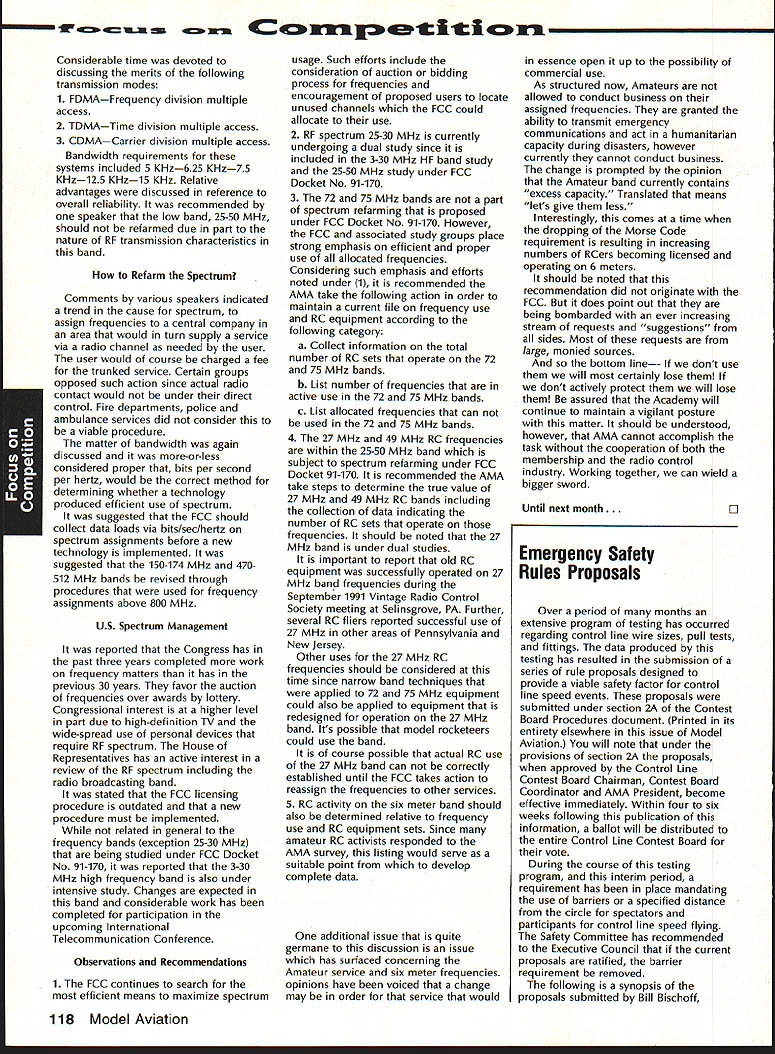
- The FCC continues to search for the most efficient means to maximize spectrum usage. Such efforts include consideration of auction or bidding processes for frequencies and encouragement of proposed users to locate unused channels which the FCC could allocate to their use.
- The 25–30 MHz portion of the spectrum is currently undergoing dual study since it is included in the 3–30 MHz HF band study and the 25–50 MHz study under FCC Docket No. 91-170.
- The 72 and 75 MHz bands are not part of the spectrum refarming proposed under FCC Docket No. 91-170. However, the FCC and associated study groups place strong emphasis on efficient and proper use of all allocated frequencies. Considering such emphasis and the efforts noted above, it is recommended the AMA take the following actions in order to maintain a current file on frequency use and RC equipment according to the following categories:
a. Collect information on the total number of RC sets that operate on the 72 and 75 MHz bands. b. List the number of frequencies that are in active use in the 72 and 75 MHz bands. c. List allocated frequencies that cannot be used in the 72 and 75 MHz bands. d. Determine the true value of the 27 MHz and 49 MHz RC bands (both within the 25–50 MHz band, which is subject to refarming under FCC Docket No. 91-170) including collection of data indicating the number of RC sets that operate on those frequencies. Note that the 27 MHz band is under dual studies.
- It is important to report that old RC equipment was successfully operated on 27 MHz band frequencies during the September 1991 Vintage Radio Control Society meeting at Selinsgrove, PA. Further, several RC fliers reported successful use of 27 MHz in other areas of Pennsylvania and New Jersey.
Other uses for the 27 MHz RC frequencies should be considered at this time since narrow-band techniques that were applied to 72 and 75 MHz equipment could also be applied to equipment redesigned for operation on the 27 MHz band. It's possible model rocketeers could use the band. It is, of course, possible that actual RC use of the 27 MHz band cannot be correctly established until the FCC takes action to reassign the frequencies to other services.
- RC activity on the six-meter band (50–54 MHz) should also be determined relative to frequency use and RC equipment sets. Many amateur RC activists responded to the AMA survey; this listing would serve as a suitable point from which to develop complete data.
One additional issue germane to this discussion concerns the Amateur service and six-meter frequencies. Opinions have been voiced that a change may be in order for that service that would, in essence, open it up to the possibility of commercial use.
As structured now, Amateurs are not allowed to conduct business on their assigned frequencies. They are granted the ability to transmit emergency communications and act in a humanitarian capacity during disasters; however, currently they cannot conduct business. The change is prompted by the opinion that the Amateur band currently contains "excess capacity." Translated, that means "let's give them less."
Interestingly, this comes at a time when the dropping of the Morse Code requirement is resulting in increasing numbers of R/Cers becoming licensed and operating on six meters.
It should be noted that this recommendation did not originate with the FCC, but it does point out that they are being bombarded with an ever-increasing stream of requests and "suggestions" from all sides — most of these requests are from large, moneyed sources.
And so the bottom line — If we don't vote them we'll most certainly lose them! If we don't actively protect them we will lose them! Be assured that the Academy will continue to maintain a vigilant posture on this matter. It should be understood, however, that AMA cannot accomplish this task without the cooperation of both the membership and the radio control industry. Working together, we can wield a bigger sword.
Until next month ...
---
1991 F3A World Championships Team Manager's Report To The Academy of Model Aeronautics
John Britt, Team Manager
The 1991 F3A World Championships at Wangaratta, Victoria, Australia are history. After countless hours of preparation, complicated by endless details, everything finally came together as Chip Hyde, Dave von Linsowe, Bill Cunningham, and I met at Los Angeles International Airport (LAX) on Saturday, Oct. 12, 1991 for the long trip to Australia. We were accompanied by Merle Hyde, Janell von Linsowe, and my wife Carol.
When I say "complicated by details" I mean things like: moving model boxes halfway across LAX from the domestic terminals (everyone arriving at different places) to the international terminal; Cunningham's boxes apparently not showing up at LAX from Dallas; Qantas Airlines ticket agent not knowing anything about our arrangements for box transportation; etc.
Previously, I had called Nino Dironzo, AMA's travel agent, to find out what I should do regarding Qantas' apparent lack of knowledge about our team and the supposedly prearranged no-cost model box transportation. After three calls to D.C., Nino provided the name of the person at Qantas-L.A. who would take care of us.
Once we had a name, things smoothed out. Mr. Brett Kear, the Qantas supervisor in L.A., saw to it that everything was handled promptly and carefully when we finally checked in at about 9:30 p.m. We departed L.A. at 10:30 p.m., Saturday, Oct. 12, right on time. From this point on, Qantas' service was superb.
We arrived in Sydney about 5:45 a.m., Monday, Oct. 14, and after a two-hour layover flew on to Melbourne. The bags and boxes all arrived promptly and Qantas representatives assisted us through Customs. We were met by Australian modeling association members, including their president, Chris Greenwood. Their assistance was invaluable. Hire cars were ready as promised, and after loading up we were off toward Wangaratta. By now we had been awake about 37 hours.
The drive northeast from Melbourne was beautiful — grasslands, eucalyptus trees, wildflowers, birdlife, and sheep. After three hours on the road we arrived in Wangaratta about 2:45 p.m., Monday. After moving in and cleaning up, our three intrepid pilots decided to go flying. Keep in mind most of us had been awake for over 40 hours by then. However, there was no fuel for Chip's Power Master; after several phone calls the fuel was located and arrived on Wednesday.
Chip led the way to a nearby site he had used before — a beautiful closely cut grass field. Each man flew to shake out the bugs. The Peachbush practice site (one of the F3A practice sites), about 20 minutes away, was another good site, especially after some deep hoof-print holes were filled. Dave liked that site and did most of his practicing. Another site at Bowser was only 4 km from the motel; a restaurant beside it cooked breakfast nearly every morning. This runway was short and rougher than Peachbush but very convenient.
Merle and Chip had to replace the gear struts in their Jekyll the first day because the originals bent or were damaged rather regularly. One interesting note: we rarely shared a practice site, and when we did it was never with more than two teams. Most of the time we had the site to ourselves.
The opening ceremonies were somewhat disappointing: just a couple of remarks from the mayor and modeling dignitaries and the simultaneous raising of national flags. Model and transmitter check-in was held the same day; transmitters were all checked in on 36.050 MHz.
The official practice day, Monday, 10/21, was very windy. The Australians organized practice differently than expected. Instead of reserving a 30-minute slot for each team, the Contest Director required competitors to fly in the same order as the first round of preliminaries. At the team manager's meeting it was also stated that all transmitters must be turned in at 10:00 a.m. and would not be released until all competitors had been given their chance to practice; if not turned in the team would forfeit the first round. The Canadians filed a protest regarding transmitter impounding and the jury ruled in favor of the Canadians: transmitters did not have to be impounded if a team member did not wish to practice. The ruling was supposedly posted but team managers were not notified.
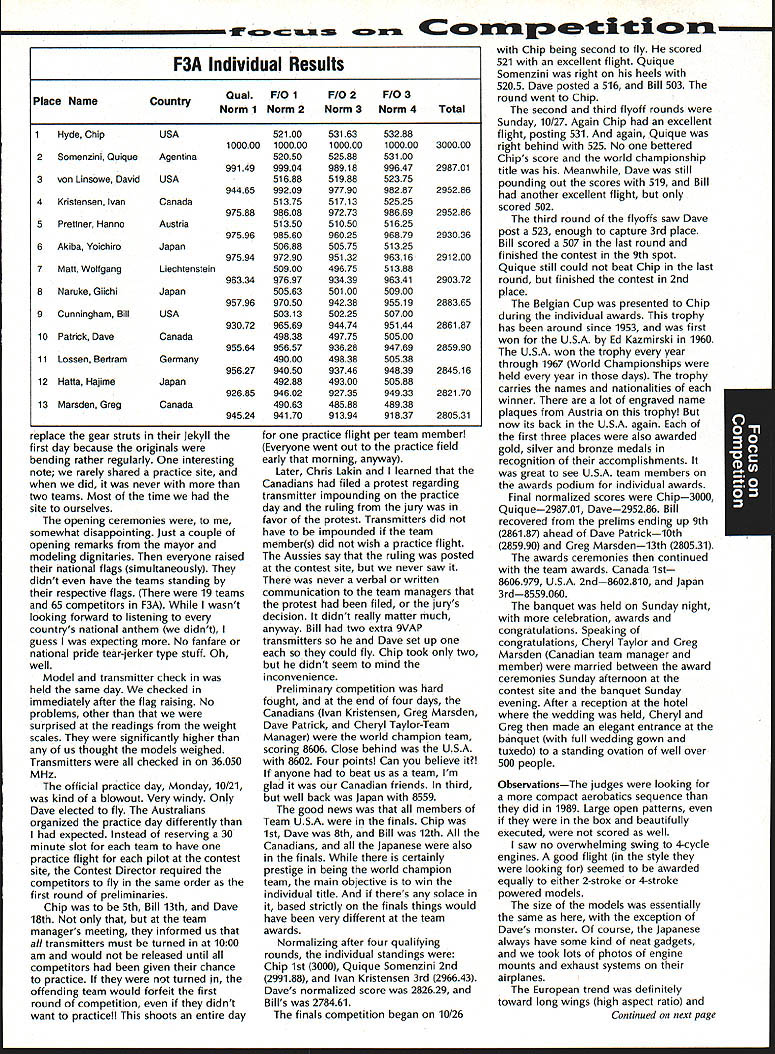
Preliminary competition was hard fought. After four days of preliminaries, the Canadians (Ivan Kristensen, Greg Marsden, Dave Patrick, and Team Manager Cheryl Taylor) were the world champion team, scoring 8606. The U.S.A. was second with 8602 — four points behind. Japan was third with 8559.
All members of Team U.S.A. were in the finals: Chip was 1st in qualifying, Dave 8th, and Bill 12th. Normalized after four qualifying rounds, the individual standings were: Chip 1st (3000), Quique Somenzini 2nd (2991.88), and Ivan Kristensen 3rd (2966.43). Dave's normalized score was 2826.29, and Bill's was 2784.61.
The finals competition began on 10/26 with Chip scoring 521 in the first flyoff round; Quique scored 520.25, Dave 516, and Bill 503. Chip won the round. On 10/27 Chip posted 531 in the second flyoff round and Quique 525. No one bettered Chip and the world championship title was his. Dave posted a 523 in the third flyoff round, enough for 3rd place overall. Final normalized scores were Chip — 3000, Quique — 2987.01, Dave — 2952.86, Bill — 2861.87, and Greg Marsden — 2831.70.
The Belgian Cup was presented to Chip during the awards. The trophy dates from 1953 and was first given to the U.S.A. by Ed Kazimirski in 1960. Gold, silver, and bronze medals were awarded to the first three places. The awards banquet was held Sunday night. Between the awards ceremony and the banquet Cheryl Taylor and Greg Marsden were married at the contest site and made a celebrated entrance at the banquet.
Observations:
- Judges were looking for a more compact aerobatic sequence than in 1989. Large open patterns, even if well executed, were not scored as highly.
- No overwhelming swing to 4-cycle engines; good flights were awarded equally to 2-stroke or 4-stroke powered models.
- Model sizes were essentially the same as in the U.S., with exceptions such as Dave's larger model. European trends favored long wings (high aspect ratio) and relatively short fuselages, which sometimes led to dutch roll and poor rolling characteristics.
- Only one model was significantly quieter; many were quite loud.
- Nitro content in fuel varied; many used 20% and higher, the Japanese commonly used 30% and some used 40%.
- The YS engine was by far the most popular 4-stroke. The O.S. and YS were commonly used; 2-strokes were distributed among manufacturers.
- Futaba and JR were fairly equally distributed, with some Multiplex and Simprop.
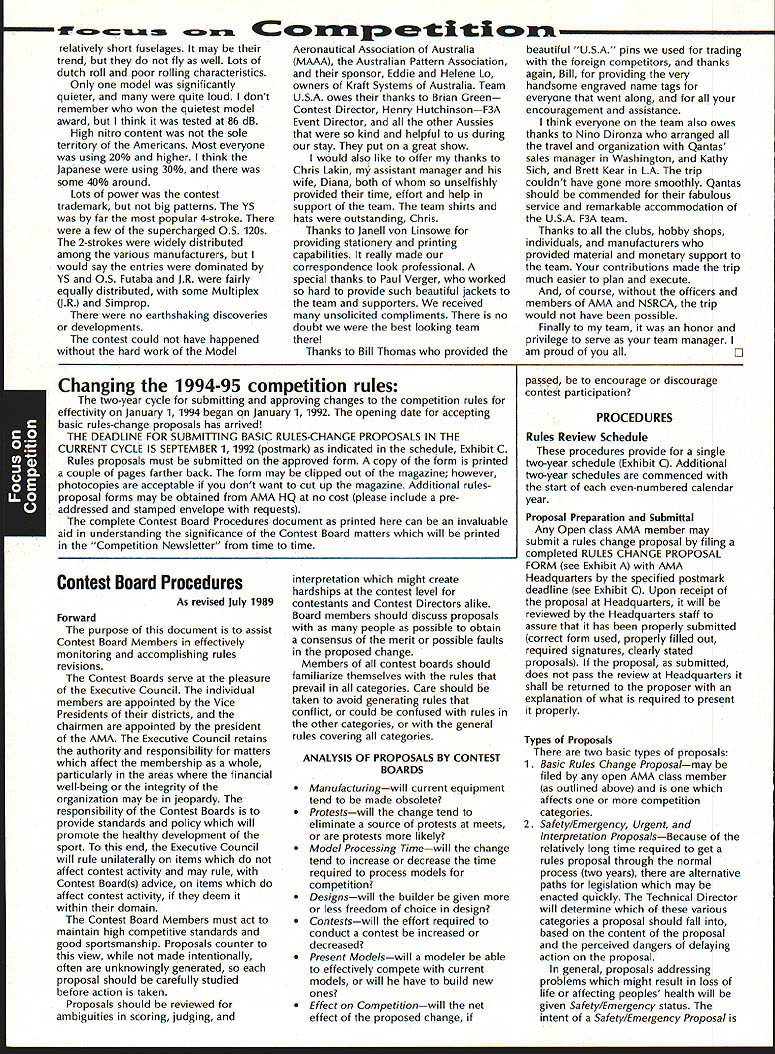
The contest could not have happened without the hard work of the Model Aeronautical Association of Australia (MAAA), the Australian Pattern Association, and their sponsor Eddie and Helene Lo of Kraft Systems of Australia. Special thanks to Contest Director Brian Green, F3A Event Director Terry Hutchinson, Chris Lakin (assistant manager), Janell von Linsowe, Paul Verger (team jackets), Bill Thomas (U.S.A. pins and engraved name tags), Nino Dironzo and Kathy Sich, Brett Kear (Qantas), and to the clubs, hobby shops, individuals, manufacturers, AMA and NSRCA. It was an honor to serve as team manager.
---
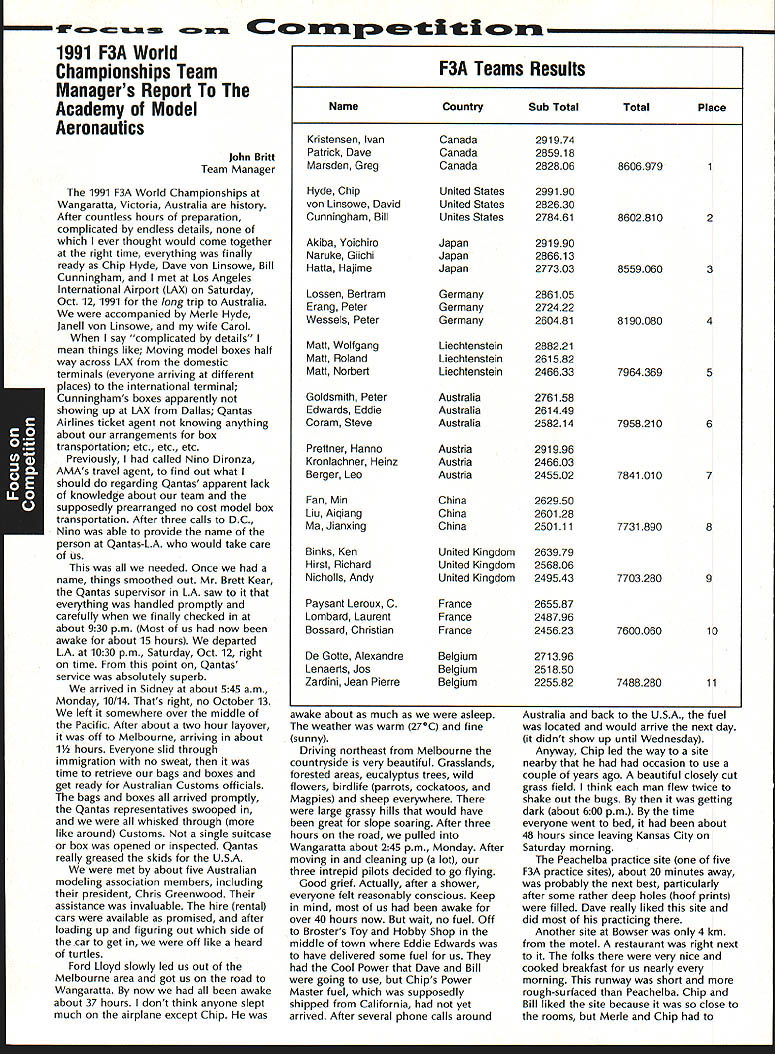
F3A Teams Results
- Canada — Ivan Kristensen, Dave Patrick, Greg Marsden — Sub Total: 2919.74 / Total: 8606.979 — Place: 1
- United States — Chip Hyde, David von Linsowe, Bill Cunningham — Sub Total: 2391.90 / Total: 8602.810 — Place: 2
- Japan — Yoichiro Akiba, Guichi Naruke, Hajime Hatta — Sub Total: 2919.90 / Total: 8559.060 — Place: 3
- Germany — Bertram Lossen, Peter Erang, Peter Wessels — Sub Total: 2861.05 / Total: 8190.080 — Place: 4
- Liechtenstein — Wolfgang Matt, Roland Matt, Norbert Matt — Sub Total: 2582.21 / Total: 7964.369 — Place: 5
- Australia — Peter Goldsmith, Eddie Edwards, Steve Coram — Sub Total: 2761.58 / Total: 7958.210 — Place: 6
- Austria — Hanno Prettiner, Heinz Kronlacher, Leo Berger — Sub Total: 2919.96 / Total: 7841.010 — Place: 7
- China — Min Fan, Aiqiang Liu, Jianxing Ma — Sub Total: 2629.50 / Total: 7731.890 — Place: 8
- United Kingdom — Ken Binks, Richard Hirst, Andy Nicholls — Sub Total: 2639.79 / Total: 7703.280 — Place: 9
- France — C. Paysant Leroux, Laurent Lombard, Christian Bossard — Sub Total: 2655.87 / Total: 7600.050 — Place: 10
- Belgium — Alexandre De Gotte, Jos Lenaerts, Jean Pierre Zardini — Sub Total: 2713.96 / Total: 7488.280 — Place: 11
---
Changing the 1994–95 Competition Rules
The two-year cycle for submitting and approving changes to the competition rules effective January 1, 1994 began on January 1, 1992. The opening date for accepting basic rules-change proposals has arrived.
DEADLINE FOR SUBMITTING BASIC RULES-CHANGE PROPOSALS IN THE CURRENT CYCLE IS SEPTEMBER 1, 1992 (postmark) as indicated in the schedule (Exhibit C). Rules proposals must be submitted on the approved form. Photocopies of the form are acceptable. Additional rules-proposal forms may be obtained from AMA HQ at no cost (please include a pre-addressed and stamped envelope with request).
The complete Contest Board Procedures document as printed here can be an invaluable aid in understanding the significance of Contest Board matters which will be printed in the "Competition Newsletter" from time to time.
---
Contest Board Procedures
As revised July 1989
Forward
The purpose of this document is to assist Contest Board members in effectively monitoring and accomplishing rules revisions.
The Contest Boards serve at the pleasure of the Executive Council. Individual members are appointed by the Vice Presidents of their districts, and the chairmen are appointed by the president of the AMA. The Executive Council retains authority and responsibility for matters affecting the membership as a whole, particularly where the financial well-being or integrity of the organization may be in jeopardy. The responsibility of the Contest Boards is to provide standards and policy which will promote the healthy development of the sport. The Executive Council may rule unilaterally on items which do not affect contest activity and may rule, with Contest Board advice, on items which do affect contest activity if deemed within their domain.
Contest Board members must act to maintain high competitive standards and good sportsmanship. Proposals counter to this view, while not made intentionally, are often unknowingly generated, so each proposal should be carefully studied prior to action.
Proposals should be reviewed for ambiguities in scoring and judging, and for hardships that might affect contestants and Contest Directors alike. Board members should discuss proposals with as many people as possible to obtain a consensus on the merit or possible faults in the proposed change.
Members of all contest boards should familiarize themselves with rules that prevail in all categories. Care should be taken to avoid generating rules that conflict with rules in other categories or with general rules covering all categories.
Analysis of Proposals by Contest Boards
Consider the following when analyzing proposals:
- Manufacturing — Will current equipment tend to be made obsolete?
- Protests — Will the change tend to eliminate a source of protests at meets, or are protests more likely?
- Model Processing Time — Will the change increase or decrease time required to process models for competition?
- Designs — Will the builder be given more or less freedom of choice in design?
- Contests — Will the effort required to conduct a contest be increased or decreased?
- Present Models — Will a modeler be able to effectively compete with current models, or will he have to build new ones?
- Effect on Competition — Will the net effect of the proposed change be to encourage or discourage contest participation?
Procedures
#### Rules Review Schedule These procedures provide for a single two-year schedule (Exhibit C). Additional two-year schedules commence with the start of each even-numbered calendar year.
#### Proposal Preparation and Submittal Any Open class AMA member may submit a rules change proposal by filing a completed RULES CHANGE PROPOSAL FORM (see Exhibit A) with AMA Headquarters by the specified postmark deadline (see Exhibit B). Headquarters staff will review submissions for proper form, required signatures, and clarity. If a proposal does not pass review it will be returned to the proposer with an explanation.
#### Types of Proposals There are two basic types of proposals:
- Basic Rules Change Proposal — may be filed by any open AMA member and affects one or more competition categories.
- Safety/Emergency, Urgent, and Interpretation Proposals — Because of the relatively long time required to get a rules proposal through the normal process (two years), there are alternative paths for legislation which may be enacted quickly.
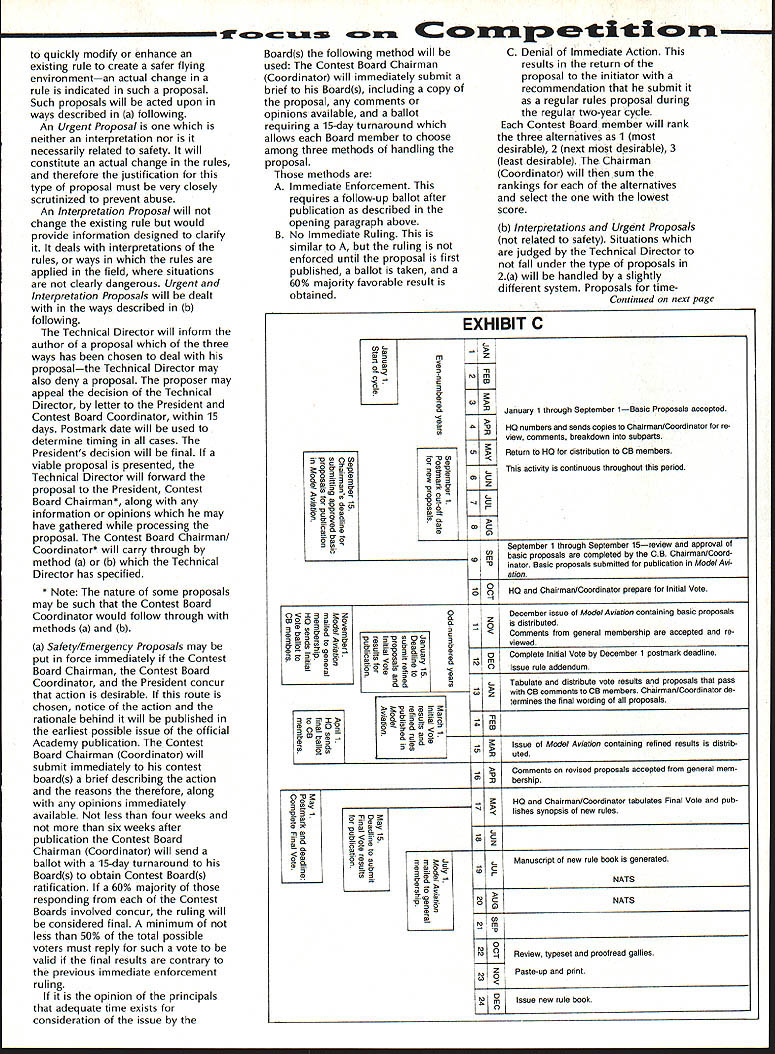
- Safety/Emergency Proposals: Address problems which might result in loss of life or affect people's health. The intent is to quickly modify or enhance an existing rule to create a safer flying environment — an actual change in a rule is indicated in such a proposal. Such proposals will be acted upon as described in method (a) below.
- Urgent Proposals: Not necessarily related to safety; they constitute an actual change in the rules and must be closely scrutinized to prevent abuse.
- Interpretation Proposals: Do not change existing rules but provide clarification on how rules are applied in the field.
The Technical Director will inform the author which category is chosen — the Technical Director may also deny a proposal. The proposer may appeal the Technical Director's decision by letter to the President and Contest Board Coordinator within 15 days (postmark date used). The President's decision is final. If a viable proposal is presented, the Technical Director will forward it to the President and Contest Board Chairman/Coordinator along with any information or opinions gathered. The Contest Board Chairman/Coordinator will carry through by method (a) or (b) as specified.
(a) Safety/Emergency Proposals
- These may be put in force immediately if the Contest Board Chairman, the Contest Board Coordinator, and the President concur that action is desirable. Notice of the action and rationale will be published in the earliest possible issue of the official Academy publication. The Contest Board Chairman/Coordinator will submit immediately to his contest board(s) a brief describing the action and reasons.
- Not less than four weeks and not more than six weeks after publication the Contest Board Chairman/Coordinator will send a ballot with a 15-day turnaround to his Contest Board(s) to obtain ratification. If a 60% majority of those responding from each contest board concurs, the ruling will be final. A minimum of 50% of the total possible voters must reply for the vote to be valid. If principals believe adequate time exists for consideration of the issue by the Board(s), the Chairman/Coordinator will send a brief and ballot allowing each board member to choose among three methods of handling the proposal:
A. Immediate Enforcement (requires a follow-up ballot after publication). B. No Immediate Ruling (ruling is not enforced until published, balloted, and 60% majority obtained). C. Denial of Immediate Action (proposal returned to initiator with recommendation to submit in regular two-year cycle).
- Each Contest Board member will rank the three alternatives; the Chairman/Coordinator will sum rankings and select the method with the lowest score.
(b) Interpretations and Urgent Proposals (not safety-related)
- These proposals will be published and circulated to the boards with a 15-day-turnaround ballot asking each Board member to choose:
A. Immediate Action B. Denial of Immediate Action
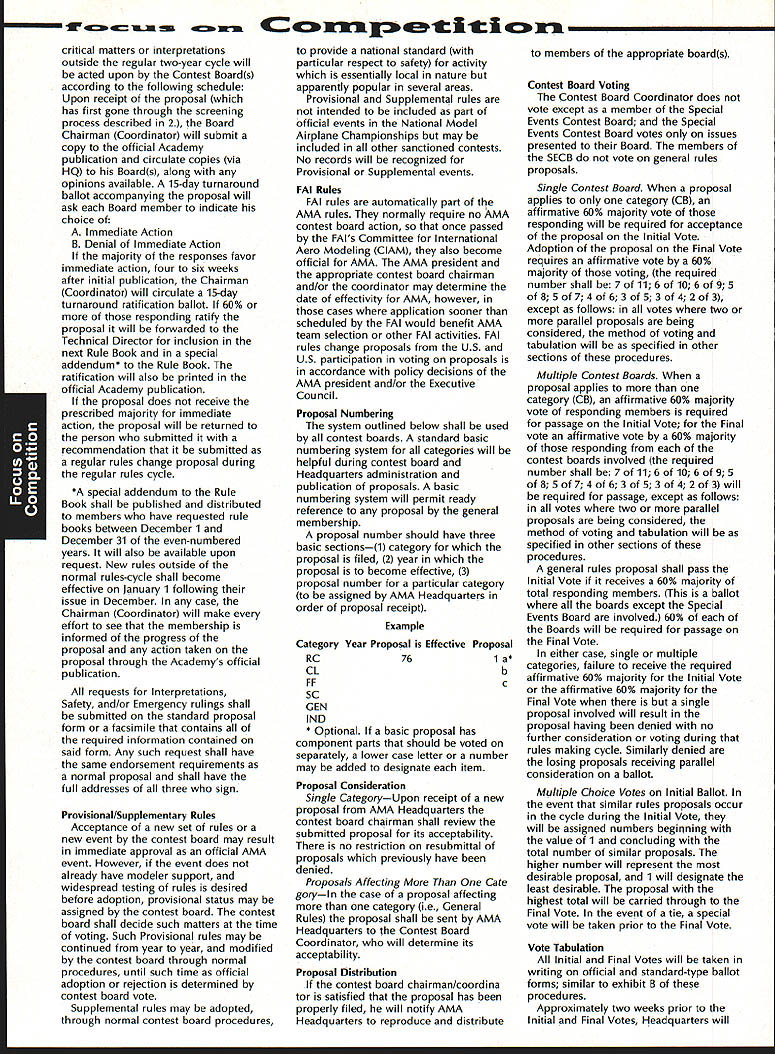
- If the majority favor immediate action, within six weeks after the initial publication the Chairman/Coordinator will circulate a 15-day ratification ballot. If 60% or more of those responding ratify, the proposal is forwarded to the Technical Director for inclusion in the next Rule Book and in a special addendum. The ratification will be printed in the official Academy publication.
- If the proposal does not receive the prescribed majority for immediate action, it will be returned to the submitter with a recommendation to file in the regular rules cycle.
Note: A special addendum to the Rule Book shall be published and distributed to members who request rule books between December 1 and December 31 of even-numbered years. New rules outside the normal cycle shall become effective on January 1 following their issue in December.
All requests for Interpretations, Safety, and/or Emergency rulings shall be submitted on the standard proposal form or a facsimile containing all required information and endorsements.
Provisional/Supplemental Rules
Acceptance of a new set of rules or a new event by the contest board may result in immediate approval as an official AMA event. If the event lacks modeler support and widespread testing is desired before adoption, provisional status may be assigned. Provisional rules may be continued year to year and modified until official adoption or rejection. Supplemental rules may be adopted to provide a national standard for activity essentially local in nature. Provisional and Supplemental rules are not intended to be part of the National Model Airplane Championships but may be included in other sanctioned contests. No records will be recognized for Provisional or Supplemental events.
FAI Rules
FAI rules are automatically part of the AMA rules. Once passed by the FAI's Committee for International Aero Modeling (CIAM), they also become official for AMA. The AMA president and appropriate contest board chairman/coordinator may determine the date of effectivity for AMA. FAI rules change proposals from the U.S. and U.S. participation in voting on proposals are in accordance with policy decisions of the AMA president and/or the Executive Council.
Proposal Numbering
A proposal number should have three basic sections:
- Category for which the proposal is filed
- Year in which the proposal is to become effective
- Proposal number for that category (assigned by AMA Headquarters in order of receipt)
Example:
- RC — 76 — 1a
- CL — 76 — 1b
- FF — 76 — 1c
- SC — 76 — 1d
- GEN — 76 — 1e
- IND — 76 — 1f
If a basic proposal has component parts that should be voted on separately, a lowercase letter or number may be added.
Proposal Consideration
- Single Category: Upon receipt of a new proposal the contest board chairman shall review it for acceptability. There is no restriction on resubmittal of proposals previously denied.
- Proposals Affecting More Than One Category: These proposals will be sent by Headquarters to the Contest Board Coordinator for acceptability determination.
Proposal Distribution
If the contest board chairman/coordinator is satisfied the proposal has been properly filed, he will notify AMA Headquarters to reproduce and distribute it to members of the appropriate board(s).
Contest Board Voting
#### Single Contest Board
- An affirmative 60% majority of those responding is required for acceptance on the Initial Vote.
- Adoption on the Final Vote requires an affirmative 60% majority of those voting (examples: 7 of 11; 6 of 10; 6 of 9; etc.).
- When two or more parallel proposals are being considered, a specified tabulation method applies.
#### Multiple Contest Boards
- When a proposal applies to more than one category, an affirmative 60% majority of responding members is required on the Initial Vote.
- For the Final Vote, an affirmative 60% majority of those responding from each contest board involved is required for passage (same numeric thresholds apply).
- General rules proposals pass the Initial Vote if they receive a 60% majority of total responding members. A 60% majority of each board is required for passage on the Final Vote.
- Failure to receive the required 60% majority results in denial with no further consideration in that rules-making cycle.
Multiple Choice Votes on Initial Ballot
If similar proposals occur in the cycle, they will be assigned numbers (1 to N) with N representing the most desirable. The proposal with the highest total will be carried through to the Final Vote. In the event of a tie, a special vote will be taken prior to the Final Vote.
Vote Tabulation
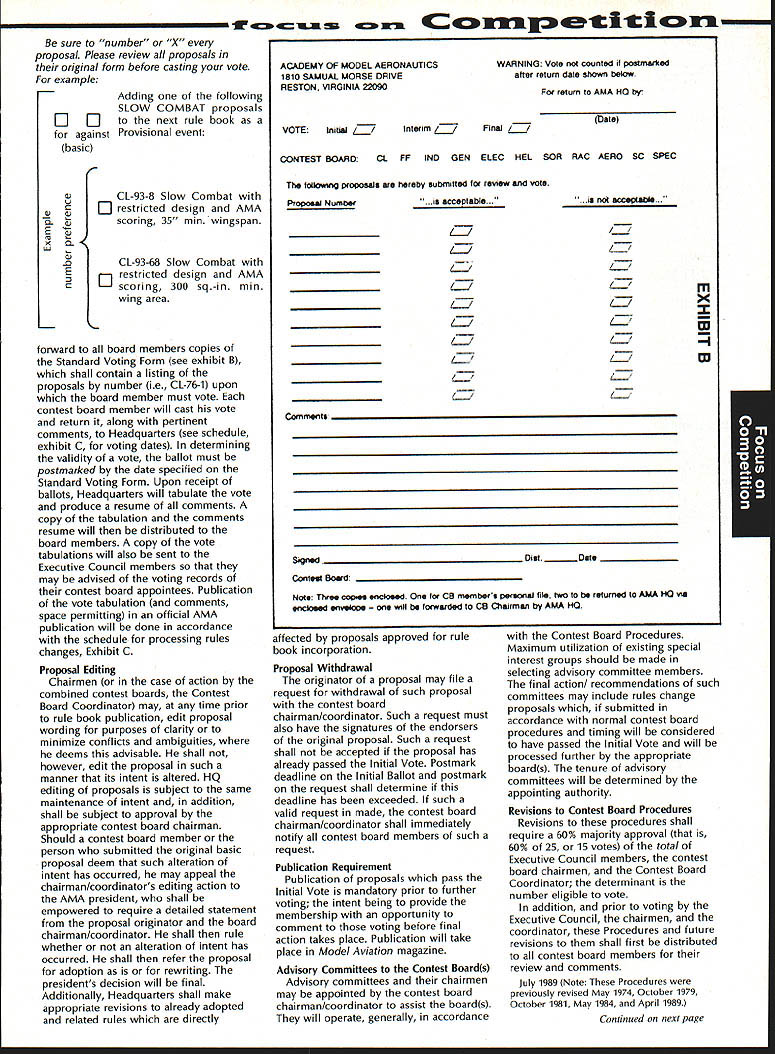
All Initial and Final Votes will be taken in writing on official ballot forms. Approximately two weeks prior to Initial and Final Votes, Headquarters will forward Standard Voting Forms listing proposals by number. Contest board members cast votes and return them with comments to Headquarters by the postmark date. Headquarters tabulates votes and produces a comments resume, distributing the tabulation and comments to board members and Executive Council members. Publication in an official AMA publication will follow the schedule in Exhibit C.
Proposal Editing
Chairmen (or the Contest Board Coordinator for combined actions) may edit proposal wording for clarity or to minimize conflicts, but shall not alter intent. HQ editing is subject to approval by the appropriate contest board chairman. If a contest board member or the originator deems an alteration of intent has occurred, an appeal may be made to the AMA president, whose decision is final.
HQ shall make appropriate revisions to already adopted related rules directly affected by proposals approved for rule book incorporation.
Proposal Withdrawal
The originator may request withdrawal of a proposal by filing with the contest board chairman/coordinator. The request must have the signatures of the original endorsers. A request cannot be accepted if the proposal has already passed the Initial Vote. Postmark deadlines determine validity. If accepted, the chairman/coordinator shall immediately notify all contest board members.
Publication Requirement
Publication of proposals that pass the Initial Vote is mandatory prior to further voting; this provides membership opportunity to comment before final action. Publication will take place in Model Aviation magazine.
Advisory Committees to the Contest Board(s)
Advisory committees and their chairmen may be appointed to assist the contest board chairman/coordinator. They operate generally in accordance with these procedures. Maximum utilization of existing special interest groups is recommended. Final recommendations of such committees may include rules change proposals which, if submitted according to normal procedures, will be considered to have passed the Initial Vote.
Revisions to Contest Board Procedures
Revisions require a 60% majority approval (60% of the total eligible voters: Executive Council members, contest board chairmen, and the Contest Board Coordinator). Prior to voting, these Procedures and future revisions shall be distributed to all contest board members for review and comment.
July 1989 (Note: These Procedures were previously revised May 1974, October 1979, October 1981, May 1984, and April 1989.)
Transcribed from original scans by AI. Minor OCR errors may remain.

