
Focus on Competition
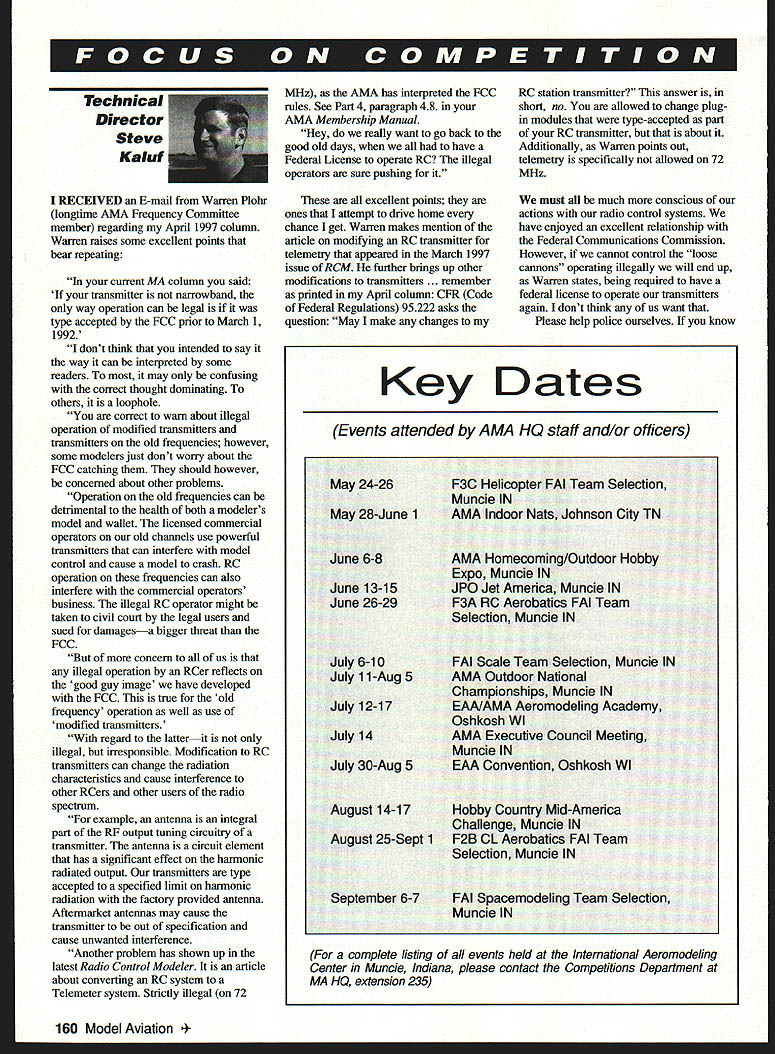
Technical Director
Steve Kaluf
I received an email from Warren Plohr (longtime AMA Frequency Committee member) regarding my April 1997 column. Warren raises some excellent points that bear repeating.
Email from Warren Plohr
"In your current MA column you said: 'If your transmitter is not narrowband, the only way operation can be legal is if it was type accepted by the FCC prior to March 1, 1992.'
"I don't think that you intended to say it the way it can be interpreted by some readers. To most, it may only be confusing with the correct thought dominating. To others, it is a loophole.
"You are correct to warn about illegal operation of modified transmitters and transmitters on the old frequencies; however, some modelers just don't worry about the FCC catching them. They should, however, be concerned about other problems. Operation on the old frequencies can be detrimental to the health of both a modeler's model and wallet. The licensed commercial operators on our old channels use powerful transmitters that can interfere with model control and cause a model to crash. RC operation on these frequencies can also interfere with the commercial operators' business. The illegal RC operator might be taken to civil court by the legal users and sued for damages — a bigger threat than the FCC.
"But of more concern to all of us is that any illegal operation by an RCer reflects on the 'good guy image' we have developed with the FCC. This is true for the 'old frequency' operation as well as use of 'modified transmitters.'
"With regard to the latter — it is not only illegal, but irresponsible. Modification to RC transmitters can change the radiation characteristics and cause interference to other RCers and other users of the radio spectrum.
"For example, an antenna is an integral part of the RF output tuning circuitry of a transmitter. The antenna is a circuit element that has a significant effect on the harmonic radiated output. Our transmitters are type accepted to a specified limit on harmonic radiation with the factory-provided antenna. Aftermarket antennas may cause the transmitter to be out of specification and cause unwanted interference.
"Another problem has shown up in the latest Radio Control Modeler. It is an article about converting an RC system to a Telemeter system. Strictly illegal (on 72 MHz), as the AMA has interpreted the FCC rules. See Part 4, paragraph 4.8 in your AMA Membership Manual.
"'Hey, do we really want to go back to the good old days, when we all had to have a Federal License to operate RC? The illegal operators are sure pushing for it.'"
My response and clarification
These are all excellent points; they are ones that I attempt to drive home every chance I get. Warren mentions the article on modifying an RC transmitter that appeared in the March 1997 issue of Radio Control Modeler and brings up other transmitter modifications.
As printed in my April column, CFR 95.922 asks the question: "May I make any changes to my RC station transmitter?" The answer is, in short, no. You are allowed to change plug-in modules that were type-accepted as part of your RC transmitter, but that is about it. Additionally, as Warren points out, telemetry is specifically not allowed on 72 MHz.
We must all be much more conscious of our actions with our radio control systems. We have enjoyed an excellent relationship with the Federal Communications Commission. However, if we cannot control the "loose cannons" operating illegally, we will end up, as Warren states, being required to have a federal license to operate our transmitters again. I don't think any of us want that. Please help police ourselves. If you know of someone operating illegally, tell them about your displeasure. If enough pressure is put on people, the problem will go away.
Cross-proposal phase (three-year rule cycle)
The next phase in our three-year rule cycle is the cross-proposal phase. Cross proposals may be filed by any Open-class AMA member. Cross proposals are alternate means of accomplishing the objectives of a basic proposal which has passed the Initial Ballot. While there is broad latitude in allowing alternative proposals, the original objective should be retained.
- Cross proposals will not be used to introduce new rule changes or to reintroduce proposals that were defeated in the Initial Ballot.
- If a proposal has passed the Initial Ballot and you are not happy with the way the proposal accomplishes the objective, submit a cross proposal.
- Cross proposals must be postmarked no later than July 15, 1997 to be considered.
- Send cross proposals to: AMA HQ, attention Competitions Department.
That is it for this month. Remember, if you have a technical topic you would like to see covered here, please let me know. In the meantime... fly safely!
Transcribed from original scans by AI. Minor OCR errors may remain.

