
Focus on Competition
Technical Director — Steve Kaluf
Rumors always seem to abound in our hobby/sport. Most are propagated by very well‑intended but misinformed people. One topic that crops up from time to time concerns the discontinuation of AM (Amplitude Modulation) radios. While it is true that most manufacturers no longer make AM aircraft radios, AM is still very much alive and legal for use in this country. Remember, AM is just a different form of modulation used by radio system manufacturers. The bulk of current radios use FM (Frequency Modulation); many also have PCM (Pulse Code Modulation) tacked on. Our normal model aircraft link is PPM (Pulse Position Modulation).
The AMA does its best to keep close tabs on frequency‑related issues. We retain an attorney who specializes in these matters and issue a periodic newsletter to keep members up to speed. I've mentioned the CFRs (Code of Federal Regulations); we also maintain a current set of these important documents. The FCC (Federal Communications Commission) regulations contain the rules that govern our radio systems at the federal level. We study the sections that pertain to us to determine whether changes might affect our activities. So let the rumors cease: AM is still around and still works well in many applications (though FM/PCM is superior in some).
This was written on the last day of official National Aeromodeling Championships events. The electric fliers were the last group on site; they had great weather and a strong turnout—much larger than in past years. Lots of discussion has ensued in the electric community about the future of electric flight. Performance of electric equipment has improved every year. Flight times are much better than they were two years ago. Aircraft in the sailplane events are now very similar (identical, in many cases) to those flown in soaring events—except, of course, they have electric power plants installed.
Four official events were flown: Sailplane A & B and Oldtimer A & B. Only three rounds were flown, so I feel some pilots would have liked more flying time. Three rounds is the bare minimum for a contest, let alone a National Championship. Nonetheless, everyone had a great time.
A suggestion was made at the Electric banquet to structure electric events so pilots could fly more rounds. This would require a little (but not a lot) more regimentation in the way the contest is run. Currently, each round consists of a one‑hour open window in which a pilot has time to complete a flight. That works fine now, but if entries increase the one‑hour window will become insufficient. You could simply increase the time for the round, but that could make the contest day too long.
In my opinion there are a couple of good options—the same issues the soaring community wrestled with several years ago. Most of their problems were initially addressed by calling the fliers to the winches (as opposed to having open winches and a fly‑when‑you‑want‑to system); however, as things progressed the Soaring Nats switched to a man‑on‑man format. This normalized scores within each flight group and made it much fairer to everyone. Flight groups launch in the same air and are scored only within that group.
In lieu of that, electric sailplane events could be flown on the same day—even at the same time—and six to eight rounds would be possible. There is a lot of concern about recharge time, which is certainly needed; however, more than enough time would exist for recharging between rounds.
So, just some food for thought for the electric fliers. You've got a great Nats—let's move it to a new level and get the competition up to the national level it deserves.
I have recently been learning to fly a helicopter because I was getting bored flying the same aircraft day after day. Last year I started flying control line again after a many‑year absence; that has been great fun and filled my craving for variety. The helicopter is also helping. Throw in a hand‑launch glider and I'm back to flying a lot and enjoying it more and more.
The point of all this is: if you find you don't fly as much as you used to (and it's not because of family obligations, work, etc.), consider trying another aspect of our great hobby/sport. That is not to say you won't still have one primary interest, but trying something different can revitalize you and will also improve your flying ability and overall knowledge.
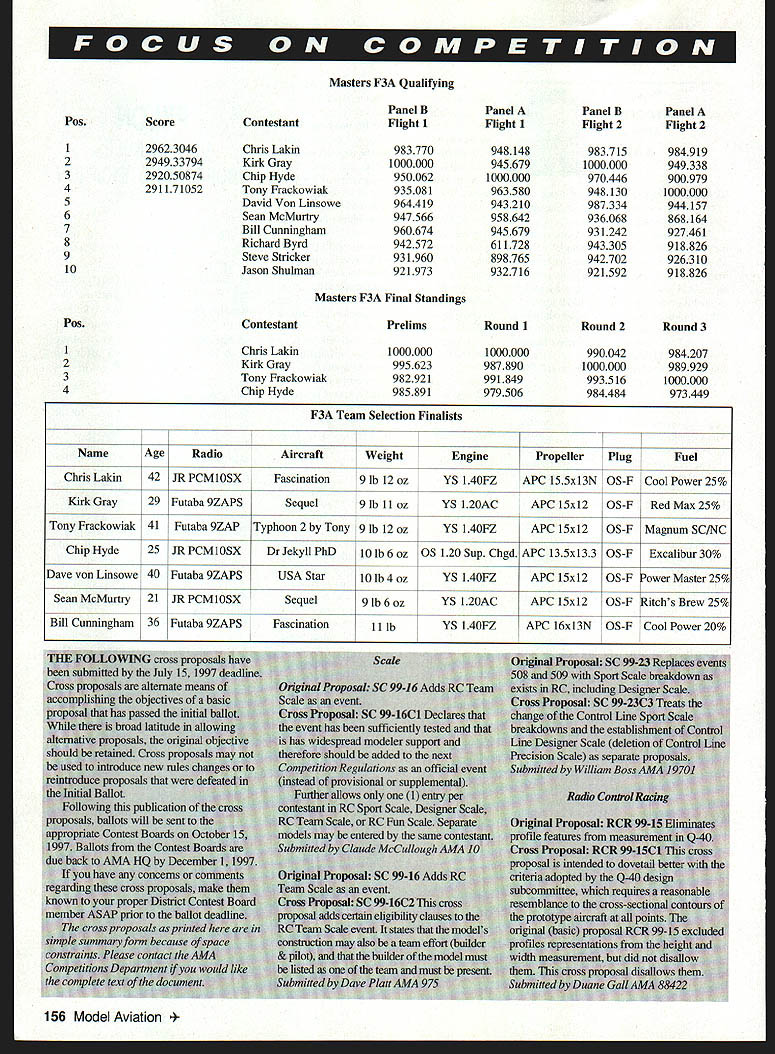
Masters F3A Qualifying
Pos. Score Contestant Panel B Flight 1 Panel A Flight 1 Panel B Flight 2 Panel A Flight 2
- 2962.3046 Chris Lakin 983.770 948.148 983.715 984.919
- 2949.3379 Kirk Gray 1000.000 945.679 1000.000 949.338
- 2920.5087 Chip Hyde 950.062 1000.000 970.446 900.979
- 2911.7105 Tony Frackowiak 935.081 963.580 948.130 1000.000
- N/A Dave von Linsowe 964.419 943.210 987.334 944.157
- N/A Sean McMurtry 947.566 958.642 936.068 868.164
- N/A Bill Cunningham 960.674 945.679 931.242 927.461
- N/A Richard Byrd 942.572 911.728 943.305 918.286
- N/A Steve Stricker 931.960 898.765 942.702 926.310
- N/A Jason Shulman 921.973 932.716 921.592 918.826
(Note: some total scores were unreadable in the source and are listed as N/A.)
Masters F3A Final Standings
Pos. Contestant Prelims Round 1 Round 2 Round 3
- Chris Lakin 1000.000 1000.000 990.042 984.207
- Kirk Gray 995.623 987.890 1000.000 989.929
- Tony Frackowiak 982.921 991.849 993.516 1000.000
- Chip Hyde 985.891 979.506 984.484 973.449
F3A Team Selection Finalists
- Chris Lakin — Age: 42
- Radio: JR PCM10SX
- Aircraft: Fascination
- Weight: 9 lb 12 oz
- Engine: YS 1.40FZ
- Propeller: APC 15.5x13N
- Plug: OS-F
- Fuel: Cool Power 25%
- Kirk Gray — Age: 42
- Radio: Futaba 92APS
- Aircraft: Sequel
- Weight: 9 lb 11 oz
- Engine: YS 1.20AC
- Propeller: APC 15x12
- Plug: OS-F
- Fuel: Red Max 25%
- Tony Frackowiak — Age: 41
- Radio: Futaba 92AP
- Aircraft: Typhoon 2 by Tony
- Weight: 9 lb 12 oz
- Engine: YS 1.40FZ
- Propeller: APC 15x12
- Plug: OS-F
- Fuel: Magnum SC/NC
- Chip Hyde — Age: 25
- Radio: JR PCM10SX
- Aircraft: Dr Jekyll PhD
- Weight: 10 lb 6 oz
- Engine: OS 1.20 Supercharged
- Propeller: APC 13.5x13.3
- Plug: OS-F
- Fuel: Excalibur 30%
- Dave von Linsowe — Age: 40
- Radio: Futaba 92APS
- Aircraft: USA Star
- Weight: 10 lb 4 oz
- Engine: YS 1.40FZ
- Propeller: APC 15x15
- Plug: OS-F
- Fuel: Power Master 25%
- Sean McMurtry — Age: 21
- Radio: JR PCM10SX
- Aircraft: Sequel
- Weight: 9 lb 6 oz
- Engine: YS 1.20AC
- Propeller: APC 15x12
- Plug: OS-F
- Fuel: Ritch’s Brew 25%
- Bill Cunningham — Age: 36
- Radio: Futaba 92APS
- Aircraft: Fascination
- Weight: 11 lb
- Engine: YS 1.40FZ
- Propeller: APC 16x13N
- Plug: OS-F
- Fuel: Cool Power 20%
Transcribed from original scans by AI. Minor OCR errors may remain.

