
Focus on Competition
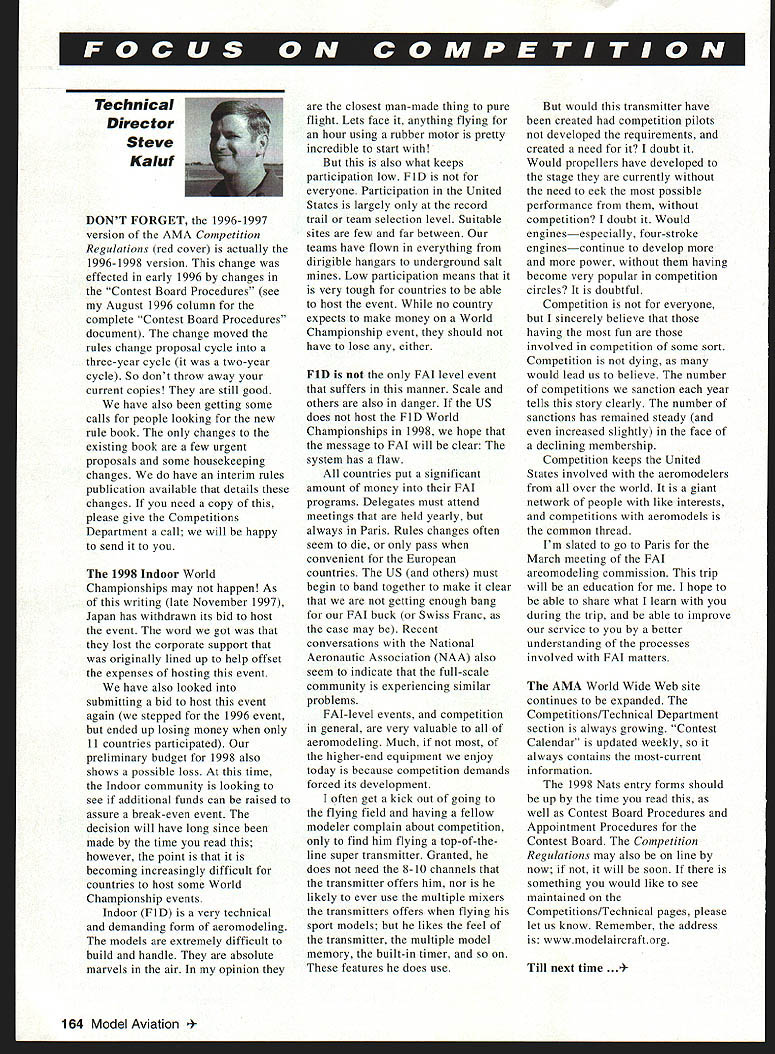
Technical Director Steve Kaluf
Don't forget: the 1996–1997 version of the AMA Competition Regulations (red cover) is actually the 1996–1998 version. This change was effected in early 1996 by revisions to the Contest Board Procedures (see my August 1996 column for the complete Contest Board Procedures document). The change moved the rules-change proposal cycle to a three-year cycle (it was previously a two-year cycle). So don't throw away your current copies — they're still valid.
We have received calls about the new rule book. The existing book has only a few urgent proposals and some housekeeping changes. We do have an interim rules publication that details these changes. If you need a copy or want details, please call the Competitions Department and we will be happy to send one.
The 1998 Indoor World Championships may not happen. As I write (late November 1997), Japan has withdrawn its bid to host the event after losing the corporate support that had been lined up to offset hosting expenses. We have looked into submitting a bid to host the event again — we stepped in for 1996 but ended up losing money when only 11 countries participated. Our preliminary budget for 1998 also shows a possible loss. At the time, the Indoor community was exploring whether additional funds could be raised to assure a break-even event. The decision will likely have been made by the time you read this; the larger point is that it is becoming increasingly difficult for countries to host some World Championship events.
Indoor F1D is a very technical and demanding form of aeromodeling. The models are extremely difficult to build and handle — absolute marvels in the air. In my opinion, they are the closest man-made thing to pure flight. Anything flying for an hour using a rubber motor is pretty incredible.
That technical level is also what keeps participation low. F1D is not for everyone. In the United States, participation is largely at the record-trial or team-selection level. Suitable sites are few and far between — our teams have flown in dirigible hangars and underground salt mines. Low participation makes it very tough for countries to be able to host these events. While no country expects to make money on a World Championship event, they should not have to lose money either.
F1D is not the only FAI-level event that suffers this way; Scale and others are also in danger. If the U.S. does not host the F1D World Championships in 1998, I hope the message to the FAI will be clear: the system has a flaw. All countries put significant money into their FAI programs. Delegates must attend annual meetings (always in Paris), and rules changes often seem to stall or pass in ways that favor European countries. The U.S. (and others) must begin to coordinate and make clear we are not getting sufficient value from our FAI contributions. Recent conversations with the National Aeronautic Association (NAA) indicate the full-scale community is experiencing similar problems.
FAI-level events and competition in general are very valuable to the aeromodeling community. Much of the higher-end equipment we enjoy today exists because competition-driven requirements forced its development.
- Example: the fellow who complains about competition at the flying field will often be flying a top-of-the-line transmitter. He may not need the 8–10 channels or multiple mixers, but he values the feel, multiple-model memory, and built-in timer — features developed because competition pilots demanded them.
- Would propellers have reached their current level of refinement without competition-driven performance demands? Doubtful.
- Would engines — especially modern four-stroke engines — have continued to develop more power and popularity without competition? Doubtful.
Competition is not for everyone, but those involved in some form of competition often have the most fun. Competition is not dying, despite what some suggest. The number of competitions we sanction each year tells the story: sanctions have remained steady or even increased slightly despite a declining membership. Competition keeps the United States engaged with aeromodelers around the world — a giant network of people with shared interests.
I'm slated to go to Paris for the March meeting of the FAI aeromodeling commission. The trip will be an education for me; I hope to share what I learn and to improve our service by better understanding the FAI processes.
The AMA World Wide Web site continues to expand. The Competitions/Technical Department section is always growing; the "Contest Calendar" is updated weekly and contains the most current information. By the time you read this, the following should be available online:
- 1998 Nats entry forms
- Contest Board Procedures
- Appointment Procedures for the Contest Board
- Competition Regulations (if not already posted, they will be soon)
If there is something you would like to see maintained on the Competitions/Technical pages, please let us know. The Competitions Department can also send interim rules publications or answer questions; for web access, visit: www.modelaircraft.org.
Till next time, Technical Director Steve Kaluf
Transcribed from original scans by AI. Minor OCR errors may remain.

