
Focus on Competition
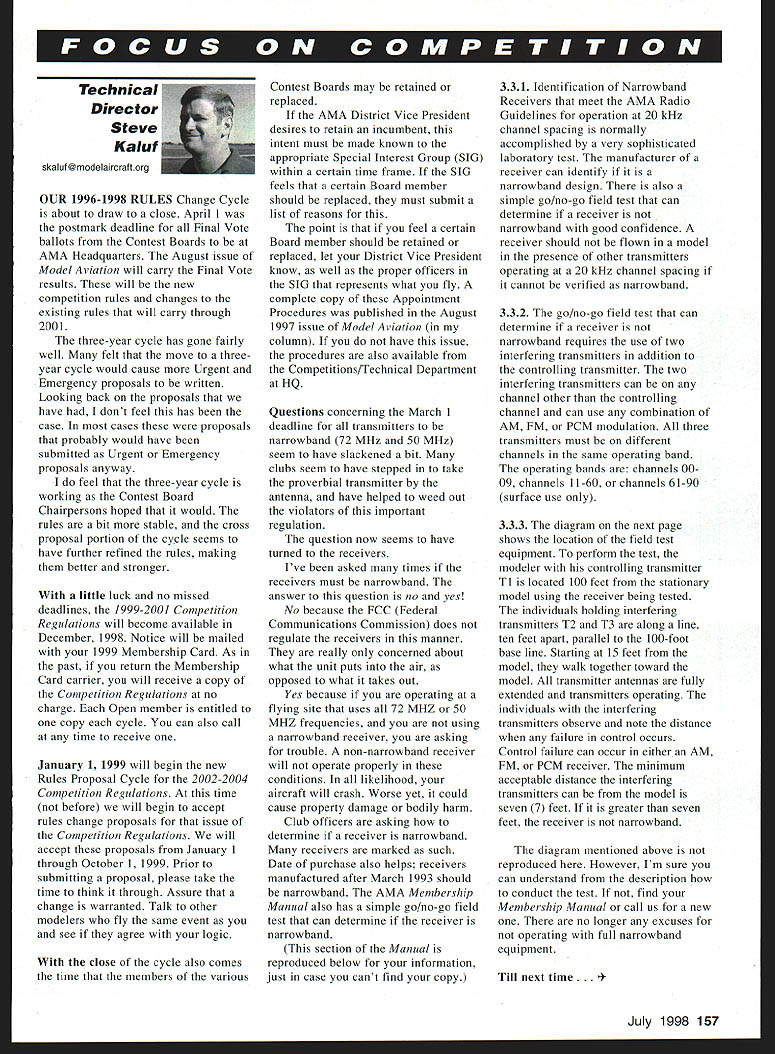
Technical Director
Steve Kaluf skaluf@modelaircraft.org
Rules Change Cycle (1996–1998)
Our 1996–1998 Rules Change Cycle is about to draw to a close. April 1 was the postmark deadline for all Final Vote ballots from the Contest Boards to be at AMA Headquarters. The August issue of Model Aviation will carry the Final Vote results. These will be the new competition rules and the changes to existing rules that will carry through 2001.
The three-year cycle has gone fairly well. Many felt that the move to a three-year cycle would cause more Urgent and Emergency proposals to be written. Looking back on the proposals we received, I don’t feel this has been the case. In most instances, these were proposals that probably would have been submitted as Urgent or Emergency proposals anyway.
I do feel the three-year cycle is working as the Contest Board chairpersons hoped. The rules are a bit more stable, and the cross-proposal portion of the cycle seems to have further refined the rules, making them better and stronger.
Distribution of the 1999–2001 Competition Regulations
With a little luck and no missed deadlines, the 1999–2001 Competition Regulations will become available in December 1998. Notice will be mailed with your 1999 Membership Card. As in the past, if you return the Membership Card carrier, you will receive a copy of the Competition Regulations at no charge. Each Open member is entitled to one copy each cycle. You can also call at any time to request one.
Rules Proposal Cycle (2002–2004)
January 1, 1999 will begin the new Rules Proposal Cycle for the 2002–2004 Competition Regulations. At that time (not before) we will begin to accept rules change proposals for that issue of the Competition Regulations. We will accept these proposals from January 1 through October 1, 1999.
Prior to submitting a proposal, please take the time to think it through. Ensure that a change is warranted. Talk to other modelers who fly the same event as you and see if they agree with your logic.
Contest Board Appointments
With the close of the cycle also comes the time when the members of the various Contest Boards may be retained or replaced.
- If an AMA District Vice President desires to retain an incumbent, this intent must be made known to the appropriate Special Interest Group (SIG) within a specified time frame.
- If the SIG feels that a certain Board member should be replaced, they must submit a list of reasons for this.
If you feel a certain Board member should be retained or replaced, let your District Vice President know, as well as the proper officers in the SIG that represents what you fly. A complete copy of these Appointment Procedures was published in the August 1997 issue of Model Aviation (in my column). If you do not have that issue, the procedures are also available from the Competitions/Technical Department at HQ.
Narrowband Transmitters and Receivers
Questions concerning the March 1 deadline for all transmitters to be narrowband (72 MHz and 50 MHz) seem to have slackened a bit. Many clubs have stepped in to help identify violators of this important regulation.
The question now seems to have turned to receivers. I’ve been asked many times if receivers must be narrowband. The answer is both no and yes.
- No: The FCC does not regulate receivers in this manner. The commission is concerned about what a unit puts into the air, not what it receives.
- Yes: If you are operating at a flying site that uses all 72 MHz or 50 MHz frequencies and you are not using a narrowband receiver, you are asking for trouble. A non-narrowband receiver will not operate properly in these conditions. In all likelihood, your aircraft will crash. Worse yet, it could cause property damage or bodily harm.
Club officers are asking how to determine if a receiver is narrowband. Many receivers are marked as such. Date of purchase also helps: receivers manufactured after March 1993 should be narrowband. The AMA Membership Manual also has a simple go/no-go field test that can determine if the receiver is narrowband.
The following section of the Manual is reproduced for your information in case you can’t find your copy.
Go/No-Go Field Test (from the AMA Membership Manual)
3.3.1. Identification of narrowband receivers that meet the AMA Radio Guidelines for operation at 20 kHz channel spacing is normally accomplished by a very sophisticated laboratory test. The manufacturer of a receiver can identify if it is a narrowband design. There is also a simple go/no-go field test that can determine if a receiver is narrowband with good confidence. A receiver should not be flown in a model in the presence of other transmitters operating at a 20 kHz channel spacing if it cannot be verified as narrowband.
3.3.2. The go/no-go field test that can determine if a receiver is not narrowband requires the use of two interfering transmitters in addition to the controlling transmitter. The two interfering transmitters can be on any channel other than the controlling channel and can use any combination of AM, FM, or PCM modulation. All three transmitters must be on different channels in the same operating band. The operating bands are: channels 00–09, channels 11–60, or channels 61–90 (surface use only).
3.3.3. To perform the test:
- The modeler with the controlling transmitter T1 is located 100 feet from the stationary model using the receiver being tested.
- The individuals holding interfering transmitters T2 and T3 are along a line, ten feet apart, parallel to the 100-foot baseline.
- Starting at 15 feet from the model, they walk together toward the model. All transmitter antennas are fully extended and transmitters are operating. The individuals with the interfering transmitters observe and note the distance when any failure in control occurs.
Control failure can occur in AM, FM, or PCM receivers. The minimum acceptable distance the interfering transmitters can be from the model is seven (7) feet. If it is greater than seven feet, the receiver is not narrowband.
The diagram mentioned in the Manual is not reproduced here, but the description above should make the procedure clear. If not, find your Membership Manual or call us for one. There are no longer any excuses for not operating with full narrowband equipment.
Till next time ...
Transcribed from original scans by AI. Minor OCR errors may remain.

