
Focus on Competition
Technical Director Steve Kaluf skaluf@modelaircraft.org
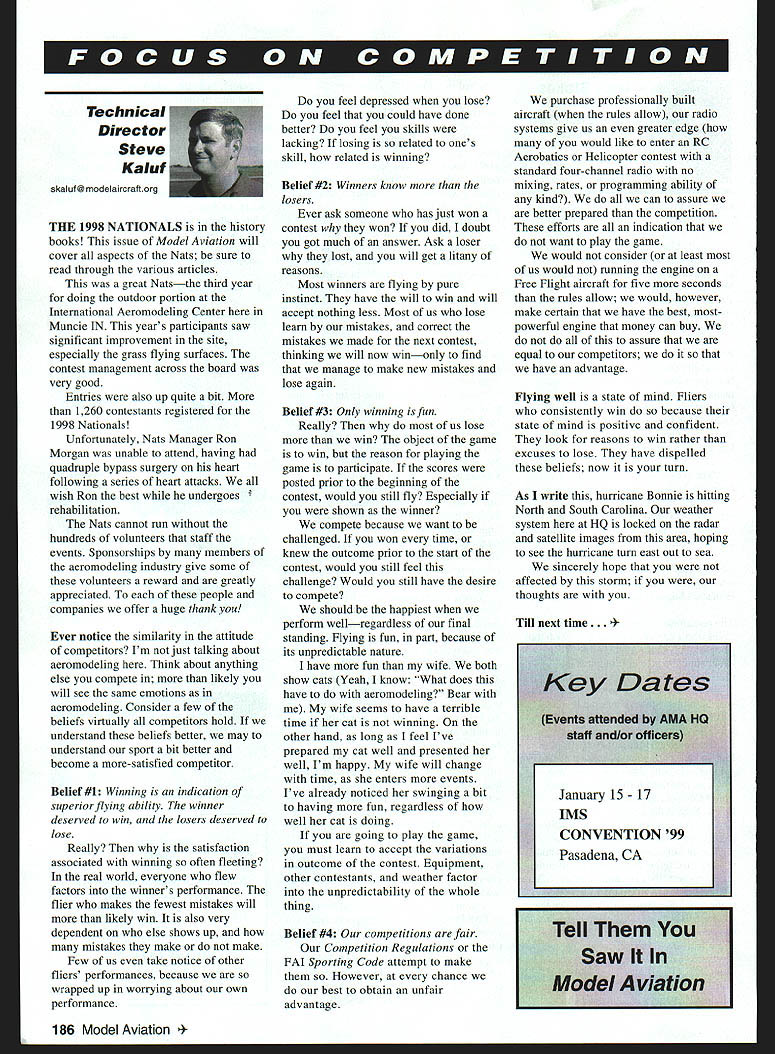
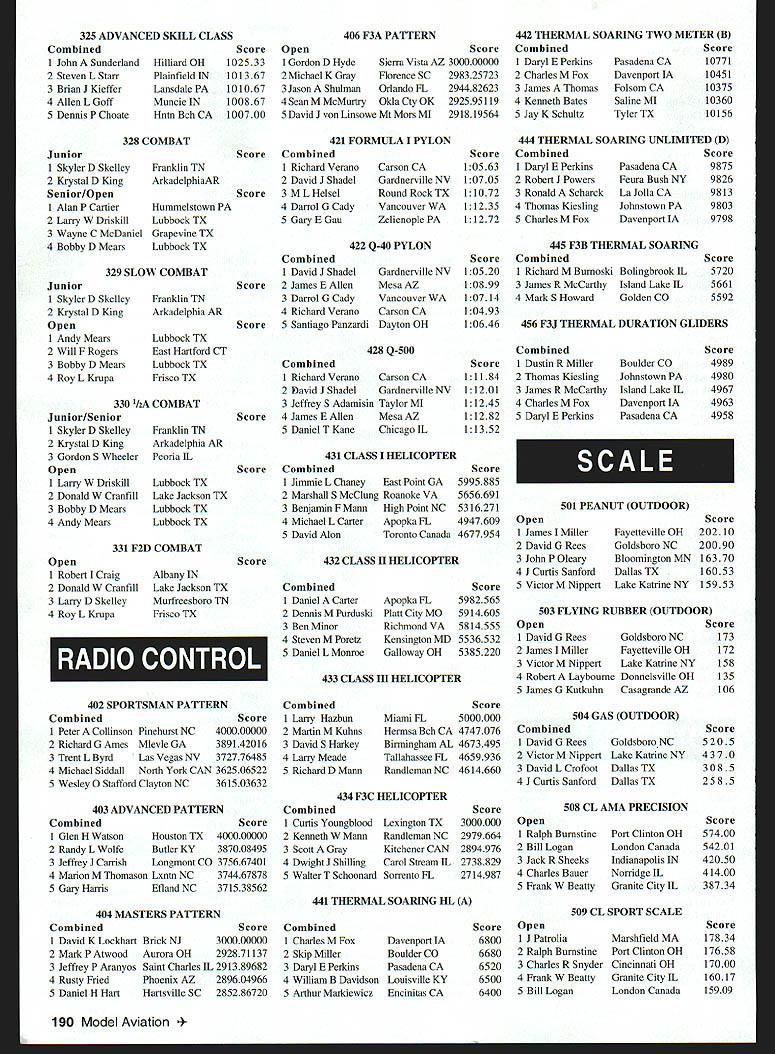
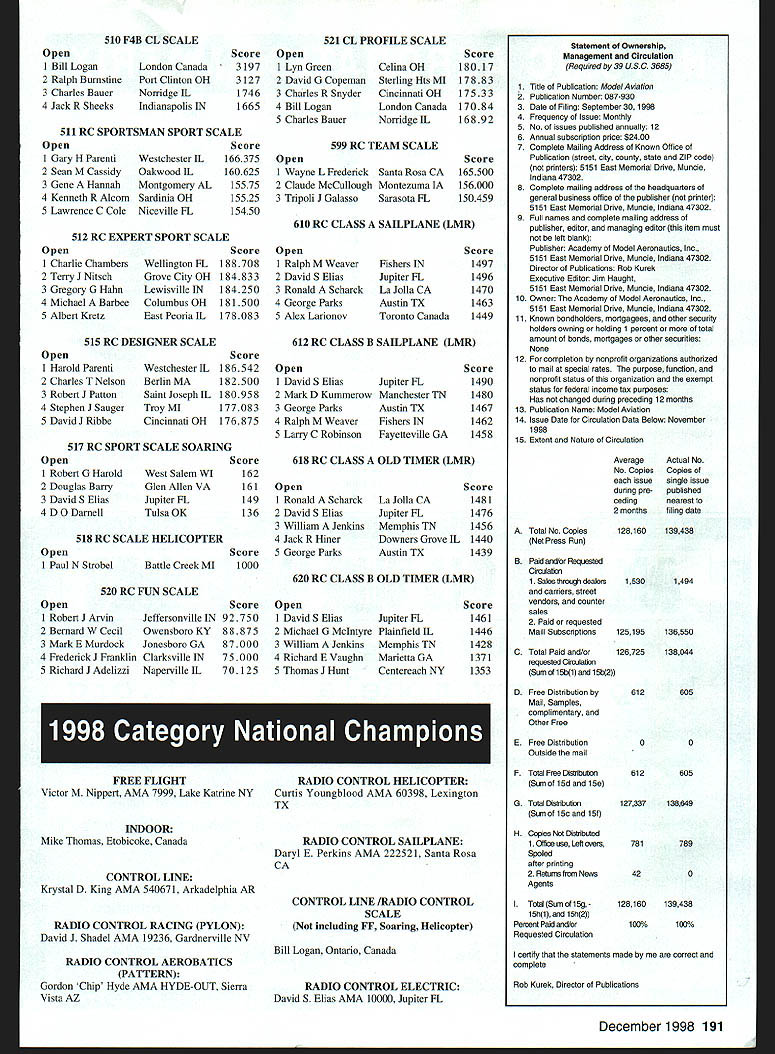
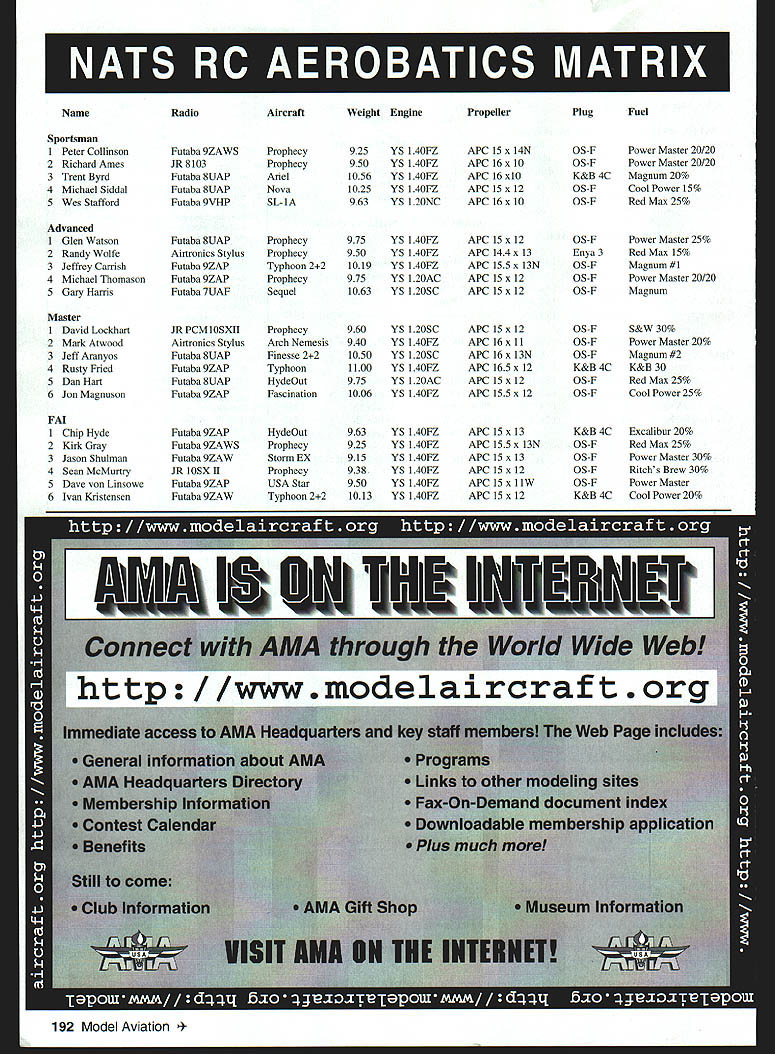
The 1998 Nationals is in the history books! This issue of Model Aviation will cover all aspects of the Nats; be sure to read through the various articles.
This was a great Nats — the third year for doing the outdoor portion at the International Aeromodeling Center in Muncie, IN. Participants noted significant improvements at the site, especially the grass flying surfaces, and contest management across the board was very good. Entries were also up quite a bit: more than 1,260 contestants registered for the 1998 Nationals.
Unfortunately, Nats Manager Ron Morgan was unable to attend; he underwent quadruple bypass surgery following a series of heart attacks. We all wish Ron the best as he undergoes rehabilitation.
The Nats cannot run without the hundreds of volunteers who staff the events. Sponsorships from many members of the aeromodeling industry give some volunteers a reward and are greatly appreciated. To all the volunteers and sponsoring companies: a huge thank you!
Ever notice the similarity in the attitudes of competitors? I’m not just talking about aeromodeling — think about any other competitive activity and you’ll see the same emotions. Consider a few beliefs virtually all competitors hold. If we understand these beliefs better, we may understand our sport a bit better and become more satisfied competitors.
Belief #1: Winning is an indication of superior flying ability. The winner deserved to win, and the losers deserved to lose.
Really? The satisfaction associated with winning is often fleeting. In the real world, everyone who flew factors into the winner’s performance. The flier who makes the fewest mistakes will more than likely win. It is also very dependent on who else shows up and how many mistakes they make (or don’t make).
Few of us notice other fliers’ performances because we’re so wrapped up worrying about our own. Do you feel depressed when you lose? Do you feel you could have done better or that your skills were lacking? If losing is so tightly related to skill, how closely is winning related to skill?
Belief #2: Winners know more than the losers.
Ask someone who has just won why they won and you’ll likely get little of an answer. Ask a loser why they lost and you’ll get a litany of reasons.
Most winners fly by instinct. They have the will to win and will accept nothing less. Most of us who lose learn from our mistakes and correct them for the next contest — only to make new mistakes and lose again.
Belief #3: Only winning is fun.
Really? Most of us lose more than we win. The object of the game is to win, but the reason for playing is to participate. If scores were posted prior to the contest, would you still fly — especially if you were shown as the winner?
We compete because we want to be challenged. If you won every time, or knew the outcome before the contest began, would you still feel challenged? Would you still have the desire to compete?
We should be happiest when we perform well — regardless of final standing. Flying is fun in part because of its unpredictable nature. I have more fun than my wife when we show cats. She has a terrible time if her cat is not winning; I am happy as long as I feel I prepared and presented the cat well. With time she is learning to enjoy the events more regardless of the results.
If you are going to play the game, you must learn to accept variations in contest outcomes. Equipment, other contestants, and weather all factor into the unpredictability.
Belief #4: Our competitions are fair.
Our Competition Regulations and the FAI Sporting Code attempt to make them fair. However, at every chance many of us seek an unfair advantage.
We buy professionally built aircraft when rules allow it, and our radio systems give us an edge (how many of you would want to enter RC aerobatics or helicopter contests with a standard four-channel radio with no mixing, rates, or programming?). We do all we can to be better prepared than the competition. These efforts indicate that many of us do not truly want to “play the game” on equal terms.
We would not consider (or most of us would not) running the engine on a free-flight aircraft five seconds longer than rules allow; we will, however, make sure we have the best, most powerful engine money can buy. We do this not to be equal to our competitors but to gain an advantage.
Flying well is a state of mind. Fliers who consistently win do so because their state of mind is positive and confident. They look for reasons to win rather than excuses to lose. They have dispelled these limiting beliefs — now it’s your turn.
As I write this, Hurricane Bonnie is hitting North and South Carolina. Our HQ weather team is locked on radar and satellite images, hoping the hurricane will turn east and out to sea. We sincerely hope you were not affected; if you were, our thoughts are with you.
Till next time...
Transcribed from original scans by AI. Minor OCR errors may remain.

