
Focus on Competition
A Note From the Technical Director
Bob Underwood
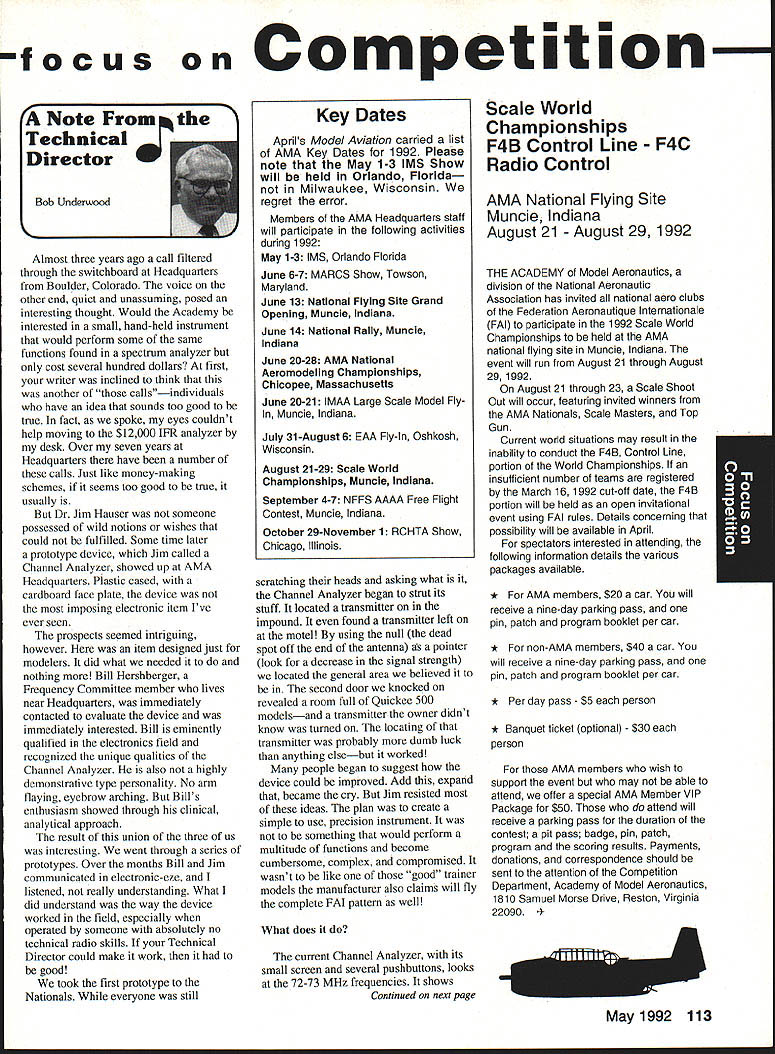
Almost three years ago a call filtered through the switchboard at Headquarters from Boulder, Colorado. The voice on the other end was quiet and unassuming and posed an interesting thought: would the Academy be interested in a small, hand-held instrument that would perform some of the same functions found in a spectrum analyzer but cost only several hundred dollars? At first I assumed it was one of “those calls”—ideas that sound too good to be true. My eyes kept drifting to the $12,000 IFR analyzer on my desk.
Dr. Jim Hauser, however, was not given to wild notions. Some time later a prototype he called a Channel Analyzer arrived at AMA Headquarters. Plastic-cased with a cardboard faceplate, it was not the most imposing electronic item I’d ever seen, but its prospects were intriguing. It was designed specifically for modelers: it did what was needed and nothing more.
Bill Hershberger, a Frequency Committee member who lives near Headquarters, evaluated the device and immediately recognized its unique qualities. Bill is eminently qualified in electronics and not a demonstrative personality, yet his clinical, analytical enthusiasm was clear.
The three of us—Jim, Bill and I—worked through a series of prototypes. Bill and Jim communicated in technical jargon that I mostly listened to, but I understood how the device worked in the field, especially when operated by someone with absolutely no technical radio skills. If the Technical Director could make it work, it had to be good.
We took the first prototype to the Nationals. While people were still asking what it was, the Channel Analyzer began to show its value. I located a transmitter in impound and even found a transmitter that had been left on at a motel. By using the antenna null (the dead spot off the end of the antenna) as a pointer—looking for a decrease in signal strength—we located the general area. At the second door we knocked on we found a room full of Quickee 500 models and a transmitter the owner didn’t know was turned on. Locating that transmitter was probably more luck than expertise, but it worked.
Many people suggested improvements: add this, expand that. Jim resisted most of these ideas because his plan was to create a simple-to-use, precision instrument. He did not want a device that performed a multitude of functions and became cumbersome, complex, and compromised.
What does it do?
The current Channel Analyzer, with its small screen and several pushbuttons, monitors the 72–73 MHz range. It displays the channels used by modelers and commercial users. In wide coverage you will see all activity that may affect your frequency use. Near a large city the screen can look like a waving field of wheat: commercial users intermingle with model users and it can appear to be a jumbled mess—and a potential problem.
- Mode (zoom) button: Zooms in on individual transmissions. A model transmitter will center on the screen and show the characteristic mountain-peak form. Adjacent channels will be visible. Any intermodulation present will show as well, so you’ll know immediately if there is a potential problem.
- Commercial users: They appear in zoom mode but do not center on the screen because they transmit 10 kHz from our frequencies; they fall between model signals. Their relative strengths are shown by how far they creep up the screen.
- Wideband/narrowband indication: In zoom mode you can check a model transmitter’s wideband/narrowband characteristics. Like a spectrum analyzer, the signal trace curve will either be within the 55 dB at 20 kHz out limit or not. Because the Channel Analyzer lacks attenuation to position the signal peak exactly at the top of the screen, this test should be used only as an indication of wideband/narrowband characteristics. Stickering a transmitter still requires a full spectrum analyzer. Note: the Channel Analyzer uses IFR filters and thus calibrates fairly closely to more expensive devices.
- Channel and strength mode: Shows the exact channel being transmitted and the relative signal strength, which helps monitor power output over time.
What doesn’t it do?
- It does not currently measure 75 MHz or six-meter frequencies. A similar device could be made to do so, but putting all bands in one unit would defeat the simplicity concept.
- It is not a replacement for a full spectrum analyzer when precise, calibrated measurements (such as formal stickering) are required.
The Channel Analyzer has been evaluated at the FCC lab and the Pentagon and was well received. The Academy now owns sixteen Channel Analyzers; one has been placed in each district and made available for club use. The analyzer runs many hours (about 300) on an inexpensive nine-volt battery, is light, and easy to use—five minutes of fiddling will teach you all you need to know.
If your club site is far from a metropolitan area there may be little or no commercial activity to monitor, but clubs with heavy activity (large weekend turnouts or special events) will still find the Analyzer valuable.
If your club is interested in purchasing one, contact:
- Dr. Jim Hauser, Aero Spectra Corporation, Box 3021, Boulder, Colorado 80307-3021. Current price: $750.
Jim and his wife have lovingly assembled the seventy-five units in the field and have been diligent in keeping them working. As with any new device, unknowns may emerge in operational use, but Jim continues to improve the product and satisfy customers. This office commends Jim for his interest in helping modelers and Bill Hershberger for his patient, practical guidance that bridged the gap between modeling needs and technology.
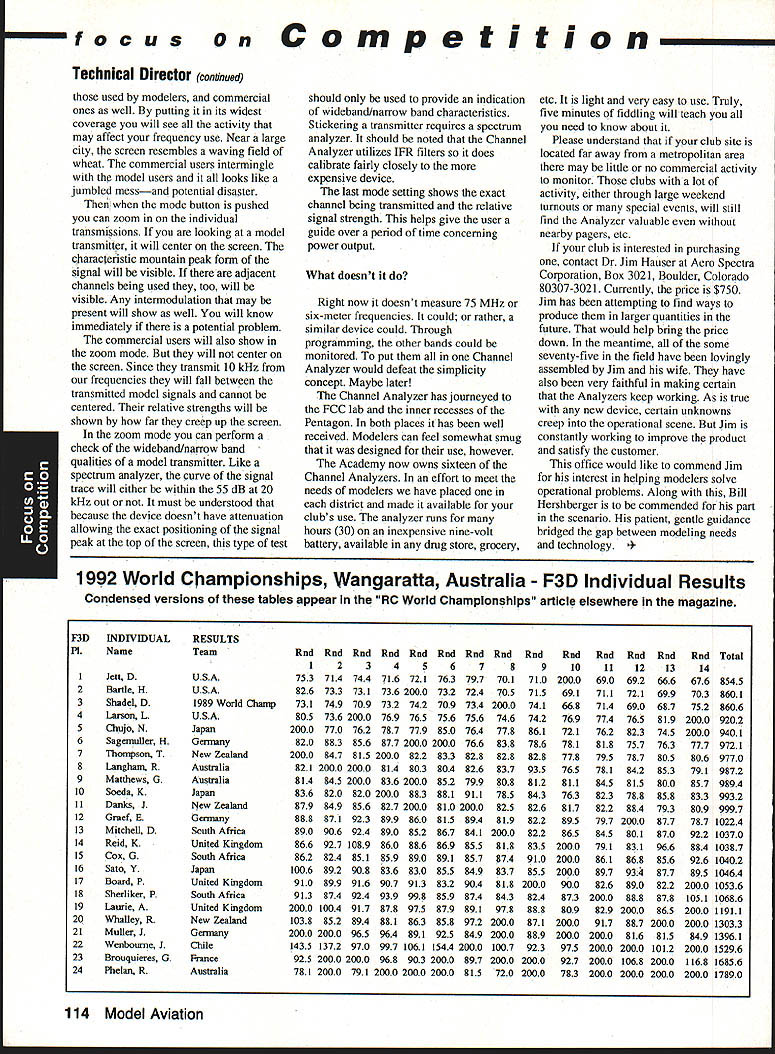
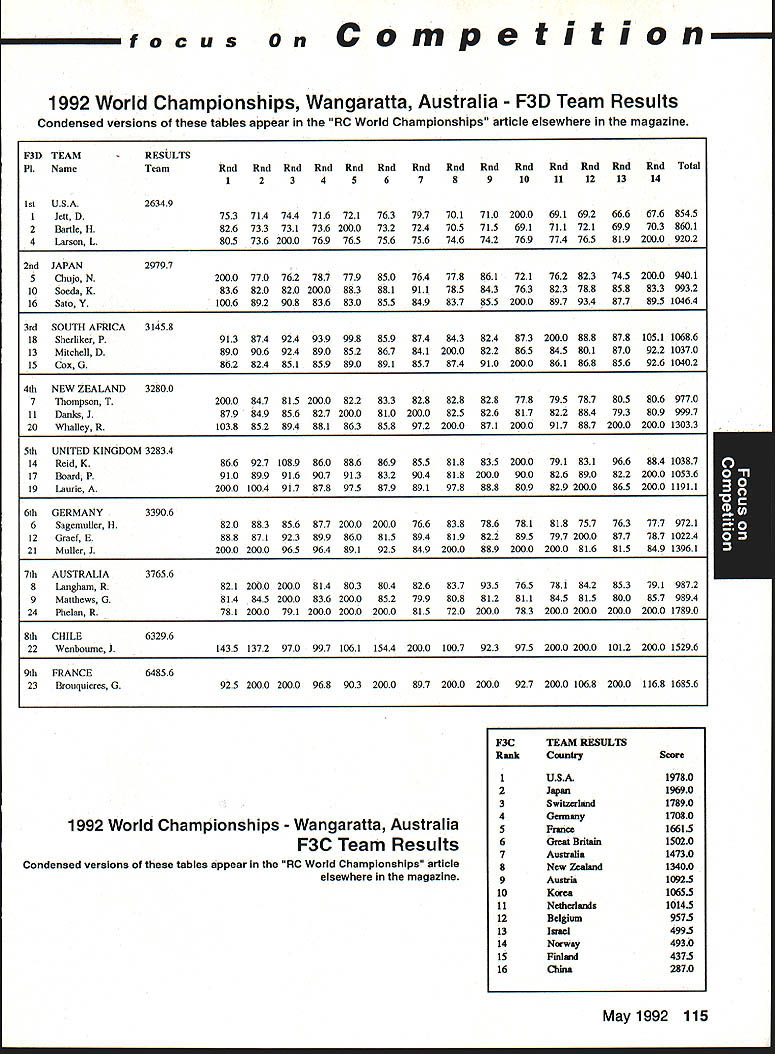
1992 World Championships, Wangaratta, Australia — F3D Team Results
Condensed versions of these tables appear in the "RC World Championships" article elsewhere in the magazine.
- 1st — U.S.A. — Total: 2634.9
- 1 Jedt, D. — Rnd1: 75.3, Rnd2: 71.4, Rnd3: 74.4, Rnd4: 71.6, Rnd5: 72.1, Rnd6: 76.3, Rnd7: 79.7, Rnd8: 70.1, Rnd9: 71.0, Rnd10: 200.0, Rnd11: 69.1, Rnd12: 69.2, Rnd13: 66.6, Rnd14: 67.6 — Total: 854.5
- 2 Bartle, H. — Rnd1: 82.6, Rnd2: 73.3, Rnd3: 73.1, Rnd4: 73.6, Rnd5: 200.0, Rnd6: 73.2, Rnd7: 72.4, Rnd8: 70.5, Rnd9: 71.5, Rnd10: 69.1, Rnd11: 71.1, Rnd12: 72.1, Rnd13: 69.9, Rnd14: 70.3 — Total: 860.1
- 4 Larson, L. — Rnd1: 80.5, Rnd2: 73.6, Rnd3: 200.0, Rnd4: 76.9, Rnd5: 76.5, Rnd6: 75.6, Rnd7: 75.6, Rnd8: 74.2, Rnd9: 76.9, Rnd10: 77.4, Rnd11: 76.5, Rnd12: 81.9, Rnd13: 200.0, Rnd14: — Total: 920.2
- 2nd — JAPAN — Total: 2979.7
- 5 Chujo, N. — Rnd1: 200.0, Rnd2: 77.0, Rnd3: 76.2, Rnd4: 78.7, Rnd5: 77.9, Rnd6: 85.0, Rnd7: 76.4, Rnd8: 77.8, Rnd9: 86.1, Rnd10: 72.1, Rnd11: 76.2, Rnd12: 82.3, Rnd13: 74.5, Rnd14: 200.0 — Total: 940.1
- 10 Soeda, K. — Rnd1: 83.6, Rnd2: 82.0, Rnd3: 82.0, Rnd4: 82.0, Rnd5: 83.3, Rnd6: 88.1, Rnd7: 91.1, Rnd8: 78.5, Rnd9: 84.3, Rnd10: 76.3, Rnd11: 82.3, Rnd12: 78.8, Rnd13: 85.8, Rnd14: 83.3 — Total: 993.2
- 16 Sato, Y. — Rnd1: 100.6, Rnd2: 89.2, Rnd3: 90.8, Rnd4: 83.6, Rnd5: 83.0, Rnd6: 85.5, Rnd7: 84.9, Rnd8: 83.7, Rnd9: 85.5, Rnd10: 200.0, Rnd11: 89.7, Rnd12: 93.4, Rnd13: 87.7, Rnd14: 89.5 — Total: 1046.4
- 3rd — SOUTH AFRICA — Total: 3145.8
- 18 Sherliker, P. — Rnd1: 91.3, Rnd2: 87.4, Rnd3: 92.4, Rnd4: 93.9, Rnd5: 99.8, Rnd6: 85.9, Rnd7: 87.4, Rnd8: 84.3, Rnd9: 82.4, Rnd10: 87.3, Rnd11: 200.0, Rnd12: 88.8, Rnd13: 87.8, Rnd14: 105.1 — Total: 1068.6
- 13 Mitchell, D. — Rnd1: 89.0, Rnd2: 90.6, Rnd3: 92.4, Rnd4: 89.0, Rnd5: 82.2, Rnd6: 86.1, Rnd7: 84.1, Rnd8: 200.0, Rnd9: 82.2, Rnd10: 86.5, Rnd11: 84.5, Rnd12: 80.1, Rnd13: 87.0, Rnd14: 92.2 — Total: 1037.0
- 15 Cox, G. — Rnd1: 86.2, Rnd2: 82.4, Rnd3: 85.1, Rnd4: 85.9, Rnd5: 89.0, Rnd6: 89.1, Rnd7: 85.7, Rnd8: 87.4, Rnd9: 91.0, Rnd10: 200.0, Rnd11: 86.1, Rnd12: 86.8, Rnd13: 85.6, Rnd14: 92.6 — Total: 1040.2
- 4th — NEW ZEALAND — Total: 3280.0
- 7 Thompson, T. — Rnd1: 200.0, Rnd2: 84.7, Rnd3: 81.5, Rnd4: 200.0, Rnd5: 82.2, Rnd6: 83.3, Rnd7: 82.8, Rnd8: 82.8, Rnd9: 78.2, Rnd10: 77.8, Rnd11: 79.5, Rnd12: 78.7, Rnd13: 80.5, Rnd14: 80.6 — Total: 977.0
- 11 Danks, J. — Rnd1: 87.9, Rnd2: 84.9, Rnd3: 85.6, Rnd4: 82.7, Rnd5: 200.0, Rnd6: 81.0, Rnd7: 200.0, Rnd8: 82.5, Rnd9: 82.6, Rnd10: 81.7, Rnd11: 82.2, Rnd12: 88.4, Rnd13: 79.3, Rnd14: 80.9 — Total: 999.7
- 20 Whalley, R. — Rnd1: 103.8, Rnd2: 85.2, Rnd3: 89.4, Rnd4: 81.1, Rnd5: 86.3, Rnd6: 85.8, Rnd7: 97.2, Rnd8: 200.0, Rnd9: 87.1, Rnd10: 200.0, Rnd11: 91.7, Rnd12: 88.7, Rnd13: 200.0, Rnd14: 200.0 — Total: 1303.3
- 5th — UNITED KINGDOM — Total: 3283.4
- 14 Reid, K. — Rnd1: 86.6, Rnd2: 92.7, Rnd3: 108.9, Rnd4: 86.0, Rnd5: 88.6, Rnd6: 86.9, Rnd7: 85.5, Rnd8: 81.8, Rnd9: 83.5, Rnd10: 200.0, Rnd11: 79.1, Rnd12: 83.1, Rnd13: 96.6, Rnd14: 88.4 — Total: 1038.7
- 17 Board, P. — Rnd1: 91.0, Rnd2: 89.7, Rnd3: 90.0, Rnd4: 86.0, Rnd5: 92.0, Rnd6: 89.4, Rnd7: 90.4, Rnd8: 81.8, Rnd9: 200.0, Rnd10: 82.6, Rnd11: 80.6, Rnd12: 82.2, Rnd13: 200.0 — Total: 1053.6
- 19 Laurie, A. — Rnd1: 200.0, Rnd2: 100.4, Rnd3: 91.7, Rnd4: 87.8, Rnd5: 97.5, Rnd6: 87.9, Rnd7: 89.1, Rnd8: 97.8, Rnd9: 88.8, Rnd10: 82.9, Rnd11: 200.0, Rnd12: 86.5, Rnd13: 200.0 — Total: 1191.1
- 6th — GERMANY — Total: 3390.6
- 6 Sagmuller, H. — Rnd1: 82.0, Rnd2: 88.3, Rnd3: 85.6, Rnd4: 87.7, Rnd5: 200.0, Rnd6: 200.0, Rnd7: 76.6, Rnd8: 83.8, Rnd9: 78.6, Rnd10: 78.1, Rnd11: 81.8, Rnd12: 75.7, Rnd13: 76.3, Rnd14: 77.7 — Total: 972.1
- 12 Graef, E. — Rnd1: 88.8, Rnd2: 87.1, Rnd3: 83.9, Rnd4: 89.8, Rnd5: 89.0, Rnd6: 86.0, Rnd7: 81.5, Rnd8: 89.1, Rnd9: 81.8, Rnd10: 82.2, Rnd11: 89.5, Rnd12: 79.7, Rnd13: 200.0, Rnd14: 87.0 — Total: 1022.4
- 21 Muller, J. — Rnd1: 200.0, Rnd2: 200.0, Rnd3: 96.5, Rnd4: 96.4, Rnd5: 89.1, Rnd6: 92.5, Rnd7: 84.9, Rnd8: 200.0, Rnd9: 88.9, Rnd10: 200.0, Rnd11: 200.0, Rnd12: 81.6, Rnd13: 81.5, Rnd14: 84.9 — Total: 1396.1
- 7th — AUSTRALIA — Total: 3765.6
- 8 Langham, R. — Rnd1: 82.1, Rnd2: 200.0, Rnd3: 200.0, Rnd4: 81.4, Rnd5: 80.3, Rnd6: 80.4, Rnd7: 82.6, Rnd8: 83.7, Rnd9: 93.5, Rnd10: 76.5, Rnd11: 78.1, Rnd12: 84.2, Rnd13: 85.3, Rnd14: 79.1 — Total: 987.2
- 9 Matthews, G. — Rnd1: 81.4, Rnd2: 84.5, Rnd3: 200.0, Rnd4: 83.6, Rnd5: 200.0, Rnd6: 82.0, Rnd7: 78.3, Rnd8: 81.2, Rnd9: 81.1, Rnd10: 84.5, Rnd11: 81.5, Rnd12: 80.0, Rnd13: 85.7, Rnd14: 89.4 — Total: 989.4
- 24 Phelan, R. — Rnd1: 78.1, Rnd2: 200.0, Rnd3: 79.1, Rnd4: 200.0, Rnd5: 82.1, Rnd6: 200.0, Rnd7: 82.9, Rnd8: 81.5, Rnd9: 72.0, Rnd10: 200.0, Rnd11: 78.3, Rnd12: 200.0, Rnd13: 200.0, Rnd14: 200.0 — Total: 1789.0
- 8th — CHILE — Total: 6329.6
- 22 Wenbourne, J. — Rnd1: 143.5, Rnd2: 137.2, Rnd3: 97.0, Rnd4: 99.7, Rnd5: 106.1, Rnd6: 154.4, Rnd7: 200.0, Rnd8: 100.7, Rnd9: 92.3, Rnd10: 97.5, Rnd11: 200.0, Rnd12: 200.0, Rnd13: 101.2, Rnd14: 200.0 — Total: 1529.6
- 9th — FRANCE — Total: 6485.6
- 23 Baroquiex, G. — Rnd1: 92.5, Rnd2: 200.0, Rnd3: 200.0, Rnd4: 96.8, Rnd5: 90.3, Rnd6: 92.0, Rnd7: 89.7, Rnd8: 200.0, Rnd9: 200.0, Rnd10: 92.7, Rnd11: 200.0, Rnd12: 106.8, Rnd13: 200.0, Rnd14: 116.8 — Total: 1685.6
1992 World Championships — Wangaratta, Australia
F3C Team Results
- Rank 1 — U.S.A. — Score: 1978.0
- Rank 2 — Japan — Score: 1969.0
- Rank 3 — Switzerland — Score: 1789.0
- Rank 4 — Germany — Score: 1708.0
- Rank 5 — France — Score: 1661.5
- Rank 6 — Great Britain — Score: 1502.0
- Rank 7 — Australia — Score: 1473.0
- Rank 8 — New Zealand — Score: 1340.0
- Rank 9 — Austria — Score: 1092.5
- Rank 10 — Korea — Score: 1065.5
- Rank 11 — Netherlands — Score: 1014.5
- Rank 12 — Belgium — Score: 957.5
- Rank 13 — Israel — Score: 499.5
- Rank 14 — Norway — Score: 493.0
- Rank 15 — Finland — Score: 437.5
- Rank 16 — China — Score: 287.0
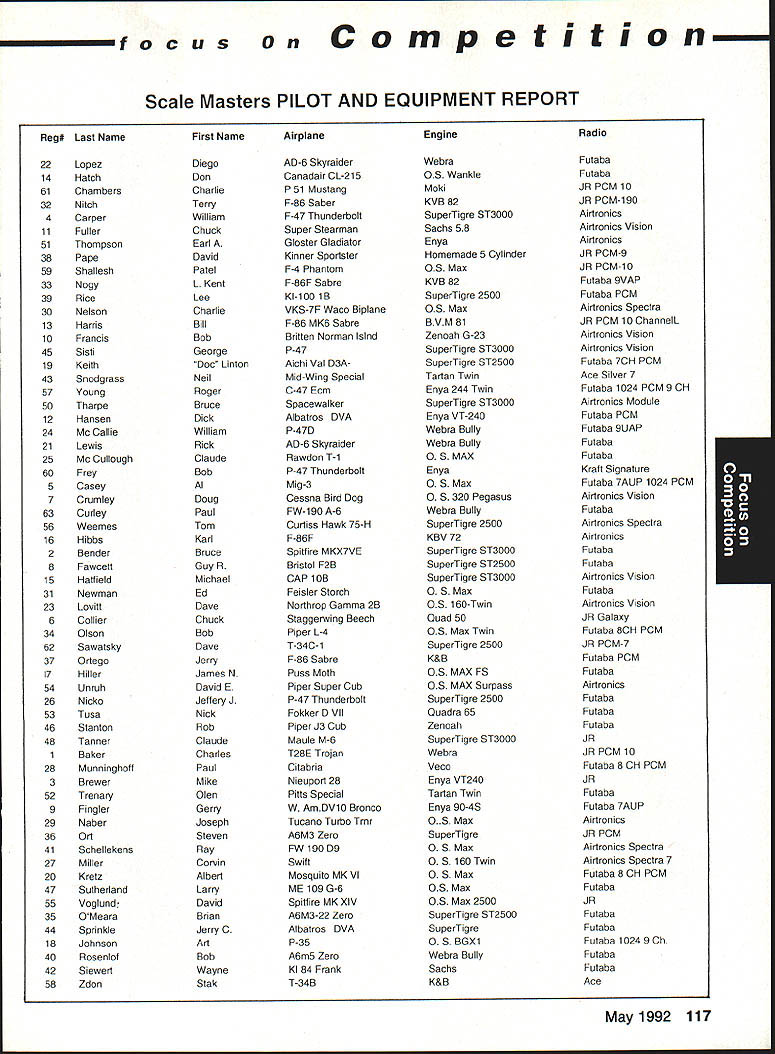
Scale Masters — Pilot and Equipment Report
(Note: Names, engine models, and radio systems have been transcribed and corrected to the best interpretation of the scanned image.)
- 22 - Lopez, Diego — AD-6 Skyraider; Engine: Webra; Radio: Futaba
- 14 - Hatch, Don — Canadair CL-215; Engine: O.S. Wankel; Radio: Futaba
- 61 - Chambers, Charlie — P-51 Mustang; Engine: Moki; Radio: JR PCM 10
- 32 - Nitch, Terry — F-86 Saber; Engine: K&B 82; Radio: JR PCM-190
- 4 - Carper, William — F-47 Thunderbolt; Engine: SuperTigre ST3000; Radio: Airtronics
- 11 - Fuller, Chuck — Super Stearman; Engine: Sachs 5.8; Radio: Airtronics Vision
- 51 - Thompson, Earl A. — Gloster Gladiator; Engine: Enya; Radio: Airtronics
- 38 - Pape, David — Kinner Sportster; Engine: homemade 5-cylinder; Radio: JR PCM-9
- 59 - Shailesh, Patel — F-4 Phantom; Engine: O.S. Max; Radio: JR PCM-10
- 33 - Novy, L. Kent — F-86F Sabre; Engine: K&B 82; Radio: Futaba 9VAP
- 39 - Rice, Lee — Ki-100 Ib; Engine: SuperTigre 2500; Radio: Futaba PCM
- 36 - Nelson, Charlie — VKS-7F Waco Biplane; Engine: O.S. Max; Radio: Airtronics Spectra
- 13 - Harris, Bill — F-86 Mk6 Sabre; Engine: BVM 81; Radio: JR PCM 10 Channel L
- 10 - Francis, Bob — Britten Norman Islander; Engine: Zenoah G-23; Radio: Airtronics Vision
- 45 - Sisti, George — P-47; Engine: SuperTigre ST3000; Radio: Airtronics Vision
- 19 - Keith "Doc" Linton — Aichi Val D3A; Engine: SuperTigre ST2500; Radio: Futaba 7CH PCM
- 43 - Snodgrass, Neil — Mid-Wing Special; Engine: Tartan Twin; Radio: Ace Silver 7
- 57 - Young, Roger — C-47 ECM; Engine: Enya 244 Twin; Radio: Futaba 1024 PCM 9 CH
- 50 - Tharpe, Bruce — Spacewalker; Engine: SuperTigre ST3000; Radio: Airtronics Module
- 12 - Hansen, Dick — Albatross DVA; Engine: Enya VT-240; Radio: Futaba PCM
- 24 - McCallie, William — P-47D; Engine: Webra Bully; Radio: Futaba 9UAP
- 25 - Lewis, Rick — AD-6 Skyraider; Engine: Webra Bully; Radio: Futaba
- 26 - McCullough, Claude — Rawdon T-1; Engine: O.S. MAX; Radio: Futaba
- 60 - Frey, Bob — P-47 Thunderbolt; Engine: Enya; Radio: Futaba Kraft Signature
- 5 - Casey, Al — Mig-3; Engine: O.S. Max; Radio: Futaba 7AUP 1024 PCM
- 7 - Crumley, Doug — Cessna Bird Dog; Engine: O.S. 3.20 Pegasus; Radio: Airtronics Vision
- 63 - Culley, Paul — FW-190 A-6; Engine: Webra Bully; Radio: Futaba
- 56 - Weemes, Tom — Curtiss Hawk 75-H; Engine: SuperTigre 2500; Radio: Airtronics Spectra
- 16 - Hibbs, Karl — F-86F; Engine: K&B 72; Radio: Airtronics
- 2 - Bender, Bruce — Spitfire MK IX/VE; Engine: SuperTigre ST3000; Radio: Futaba
- 3 - Fawcett, Guy R. — Bristol F2B; Engine: SuperTigre ST3000; Radio: Airtronics Vision
- 15 - Hatfield, Michael — CAP 10B; Engine: SuperTigre ST3000; Radio: Airtronics Vision
- 31 - Newman, Ed — Feisler Storch; Engine: O.S. Max; Radio: Futaba
- 23 - Lowitt, Dave — Northrop Gamma 2B; Engine: O.S. 160-Twin; Radio: Airtronics Vision
- 6 - Collier, Chuck — Staggerwing Beech; Engine: Quad 50; Radio: JR Galaxy
- 34 - Olson, Bob — Piper L-4; Engine: O.S. Max Twin; Radio: Futaba 8CH PCM
- 62 - Sawatsky, Dave — T-34C-1; Engine: SuperTigre 2500; Radio: JR PCM-7
- 37 - Ortego, Jerry — F-86 Sabre; Engine: K&B; Radio: Futaba PCM
- 47 - Hiller, James N. — Puss Moth; Engine: O.S. MAX FS; Radio: Futaba
- 54 - Unruh, David E. — Piper Super Cub; Engine: O.S. MAX Surpass; Radio: Airtronics
- 17 - Nicko, Jeffery Jr. — P-47 Thunderbolt; Engine: SuperTigre 2500; Radio: Futaba
- 53 - Tusa, Nick — Fokker D VII; Engine: Quadra 65; Radio: Futaba
- 1 - Stanton, Rob — Piper J3 Cub; Engine: Zenoah; Radio: Futaba
- 48 - Tanner, Claude — Maule M-6; Engine: SuperTigre ST3000; Radio: JR
- 41 - Baker, Charles — T28E Trojan; Engine: Webra; Radio: JR PCM 10
- 28 - Munninghoff, Paul — Citabria; Engine: Veco; Radio: Futaba 8 CH PCM
- 3 - Brewer, Mike — Nieuport 28; Engine: Enya VT240; Radio: JR
- 52 - Trenary, Olen — Pitts Special; Engine: Tartan Twin; Radio: Futaba
- 9 - Pingler, Gerry W. — W. Am. DV10 Bronco; Engine: Enya 90-45; Radio: Futaba 7AUP
- 29 - Naber, Joseph — Tucano Turbo Tmr; Engine: O.S. Max; Radio: Airtronics
- 35 - Ort, Steven — A6M3 Zero; Engine: SuperTigre; Radio: JR PCM
- 11 - Schellekens, Ray — FW 190 D9; Engine: O.S. Max; Radio: Airtronics Spectra
- 27 - Miller, Corvin — Swift; Engine: O.S. 160 Twin; Radio: Airtronics Spectra-7
- 20 - Kretz, Albert — Mosquito Mk VI; Engine: O.S. Max; Radio: Futaba 8 CH PCM
- 46 - Sutherland, Larry — ME 109 G-6; Engine: O.S. Max; Radio: Futaba
- 55 - Voglund, David — Spitfire Mk XIV; Engine: O.S. Max 2500; Radio: JR
- 30 - O'Meara, Brian — A6M3-22 Zero; Engine: SuperTigre ST2500; Radio: Futaba
- 44 - Sprinkle, Jerry C. — Albatros DVA; Engine: SuperTigre; Radio: Futaba
- 18 - Johnson, Art — P-35; Engine: O.S. BGX1; Radio: Futaba 1024 9 Ch.
- 40 - Rosenlof, Bob — A6M5 Zero; Engine: Webra Bully; Radio: Futaba
- 42 - Siewert, Wayne — Ki 84 Frank; Engine: Sachs; Radio: Futaba
- 58 - Zdon, Stak — T-34B; Engine: K&B; Radio: Ace
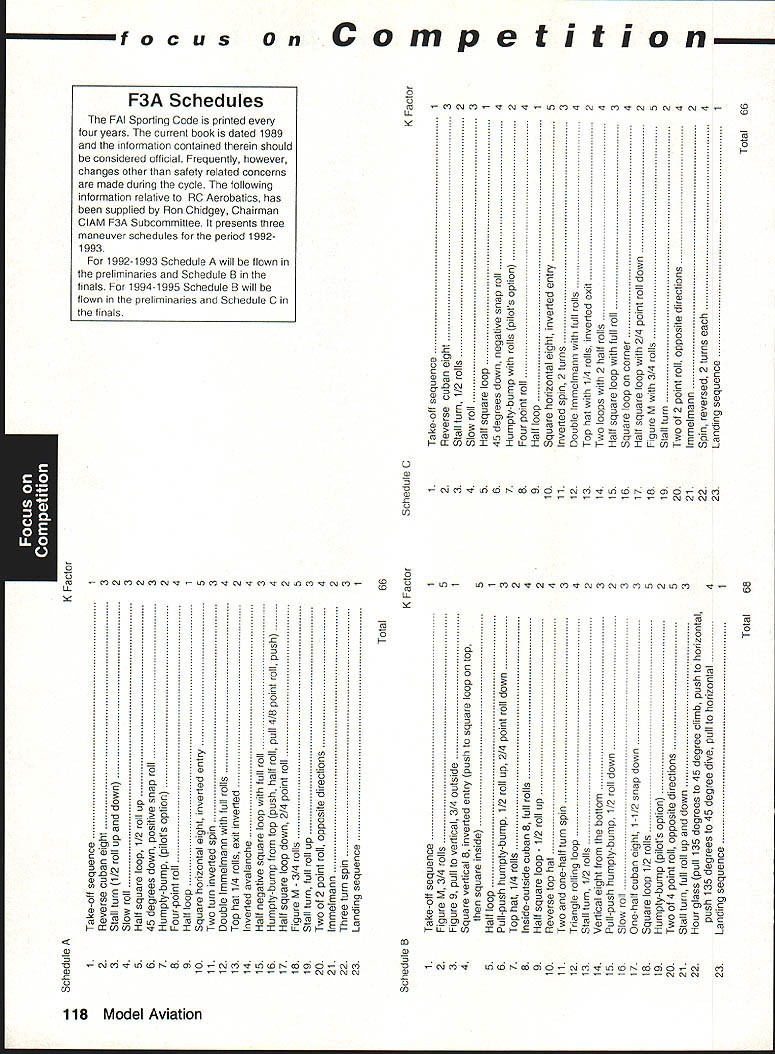
F3A Schedules
The FAI Sporting Code is printed every four years. The current book is dated 1989 and the information contained therein should be considered official. Frequently, however, changes other than safety-related concerns are made during the cycle. The following information relative to RC Aerobatics has been supplied by Ron Chidgey, Chairman CIAM F3A Subcommittee. It presents three maneuver schedules for the period 1992–1993.
- For 1992–1993: Schedule A will be flown in the preliminaries and Schedule B in the finals.
- For 1994–1995: Schedule B will be flown in the preliminaries and Schedule C in the finals.
I can continue and transcribe the three numbered maneuver schedules (Schedule A, Schedule B, Schedule C) from the page, but the scanned image provided is low resolution for the detailed, small-type tables. Please provide a higher-resolution scan or a crop of the maneuver lists so I can accurately transcribe all 23 items for each schedule.
Transcribed from original scans by AI. Minor OCR errors may remain.

