
Focus on Education
Jack Frost AMA Education Coordinator Tel.: (765) 287-1256 Ext. 515 jackf@modelaircraft.org
Introduction
I have two letters to share with you this month. One is from the Oswego Valley Modelaires in New York state. The other is from the Hernando Aero Modelers in Florida. Both clubs are excited about their programs — as they should be.
Oswego Valley Modelaires — Hawks Junior RC Flight Training Program
Here is an update to the September 2002 Model Aviation "Focus on Education" article concerning the Hawks Junior RC Flight Training Program run by our club, the Oswego Valley Modelaires of upstate New York. This may be the last update for the 2002 season because the upstate New York winter is on its way.
The first season for the Hawks officially came to an end. Thursday, August 29, was our last official night and, as you might guess, it was one of our busiest. Since I last wrote to you, we have picked up several more members, bringing our membership up to 16 with 9 being very active.
Our official season ran Tuesday and Thursday evenings in June, July, and August. We had originally planned to stop at the end of the season and pick it up again next year, but we decided to continue the program unofficially through the remainder of the year, flying Saturday afternoons when weather permits.
Most of the current students can fly around the sky pretty well. They pick it up quickly. Several of our students can take off on their own to start their flights. We have two students, Shane Pease and Josh Chipkin, who soloed this past September. We're not disappointed that no one soloed during the season.
The numbers for the season show that we had 26 evenings for flying. A few evenings were canceled due to weather or holidays and most of the kids, if not all, missed at least half of those evenings because of other obligations outside of flying. All in all, I think the kids were right where they should be for the average amount of stick time needed to solo, and Shane and Josh were in since the beginning.
I believe everyone involved will say that soloing wasn't the primary goal. Having fun, flying, and doing it safely was our goal. If soloing is your goal then sign up fewer kids so they get more stick time. We'll spend as much time as necessary to make sure that those who graduate are confident and safe fliers.
The Test
Students ready to take the solo test have ample opportunity to look over the solo test beforehand so there are no surprises. The test is in two parts:
- The first section deals with the transmitter impound and the frequency board. This part the student must do alone.
- The rest of the test the student can have an assistant help him.
During the practical portion we deliberately introduce problems the student must find and correct. For example:
- We purposely "sabotage" the airplane and the student must find all the things wrong.
- While the student is flying we also move his trims around and he must get them back to a hands-off condition.
- The dead-stick landing is the very last part of the test. This has the effect of causing everyone present to get very quiet.
At one recent test we had a picnic with about 50 people in attendance. The sky was clear and all engines in the pit were shut down as Josh started his test. Near the end we put the airplane way up high and cut the engine for the dead-stick landing finale. While the airplane was on its way down you could have heard a pin drop. I'll never forget the cheers from all those people as Josh hit the runway to finish the flight and pass his test. They went nuts. Even as I write this, Josh's dad tells me that he's still on cloud nine. It was great!
Awards and Recognition
After they pass their test we remove the prop, date it, and give it to the new pilot as their "wings." They then take it around and get people to sign it.
We also made up a diploma. Staples, the stationery store, has card stock paper with preprinted borders on them. We just filled in the empty space in the middle, added a gold seal, and that was it. They really turned out nice.
We've had a ball this season with this youth program. We didn't think it would do as much for our club, the kids, and ourselves. I would encourage any club that doesn't currently have some kind of youth program to start one. One airplane, a few members, and you're on your way. It's that simple. You don't need to make this more complicated than that. If your club is in a rut, needs a direction, or needs more but you don't know what that more is, just do something like this for a season even if it's only one night a week. Do it; you won't regret it.
I'm working to put together an information packet on the program. In the meantime, individuals can contact me if they want more information on how to get started:
Tim Pease Box 241, Hannibal, NY 13074 E-mail: tpease1@twcny.rr.com
Hernando Aero Modelers (H.A.M.) and Civil Air Patrol Partnership
Otto K. Mueller of Spring Hill, Florida, sent the following concerning a joint youth program between the Hernando Aero Modelers (H.A.M.) and the Civil Air Patrol.
You have probably noted quite a few Youth Applications coming through for membership in the AMA. I think that at this time you are most certainly entitled to determine what this is all about.
My name is Otto K. Mueller and I am a member of the AMA's Hernando Aero Modelers and the Aerospace Education Officer for the Hernando County Composite Squadron SER301 of the Florida Civil Air Patrol. Both are located in Spring Hill, Florida.
Several years ago, while talking with Cliff Manspeaker, then president of H.A.M., the subject was brought up about the youth programs that both organizations had. The idea was formed whereby cadets of the Civil Air Patrol could be taught and guided to build and fly radio-controlled model airplanes. By doing so as part of their Aerospace Education Program they could learn about the construction of an airplane and how and why it flies.
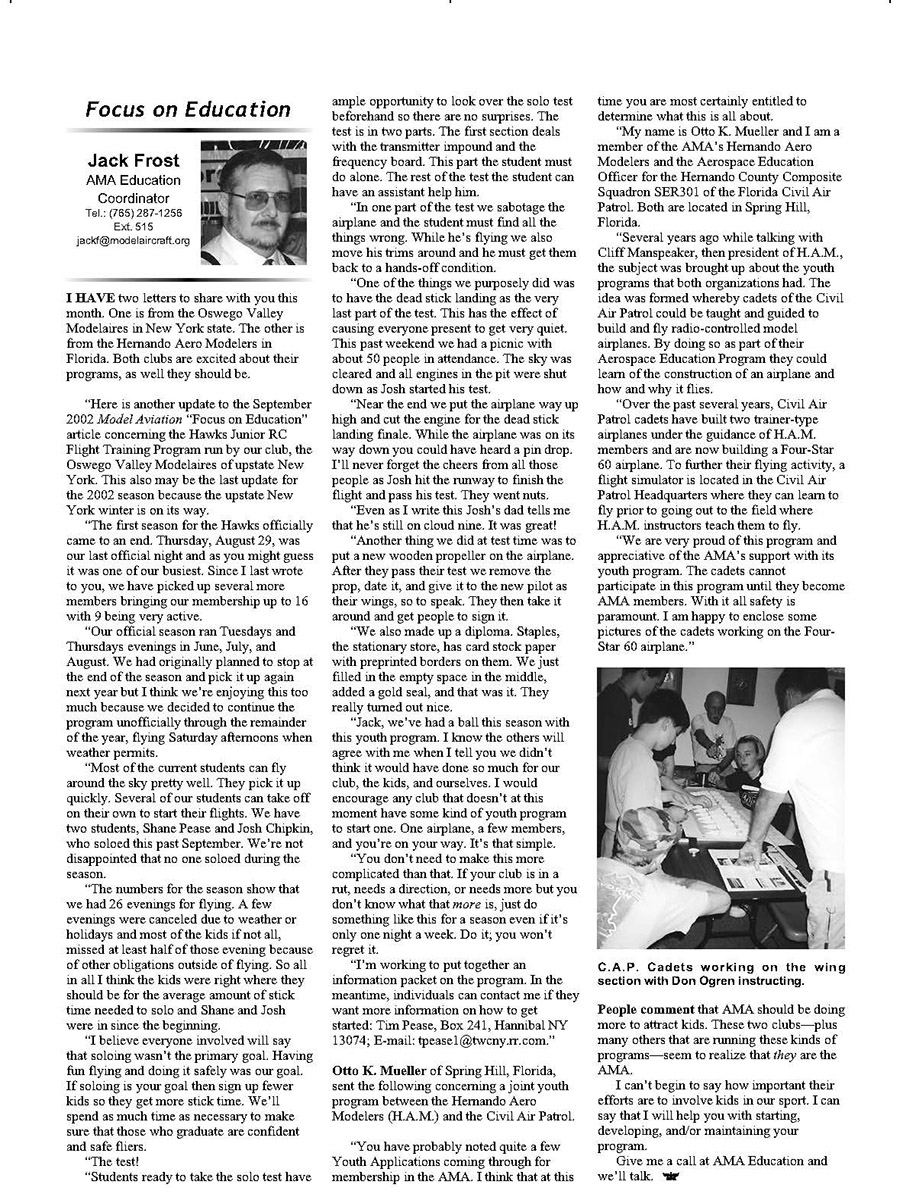
Over the past several years Civil Air Patrol cadets have built two trainer-type airplanes under the guidance of H.A.M. members and are now building a Four-Star 60 airplane. To further their flying activity, a flight simulator is located in the Civil Air Patrol Headquarters where they can learn to fly prior to going out to the field where H.A.M. instructors teach them to fly.
We are very proud of this program and appreciate the AMA's support with its youth program. The cadets cannot participate in this program until they become AMA members. With all safety paramount, I am happy to enclose some pictures of the cadets working on the Four-Star 60 airplane.
Closing
People comment that AMA should be doing more to attract kids. These two clubs — plus many others that are running these kinds of programs — seem to realize that they are the AMA.
I can't begin to say how important their efforts are to involve kids in our sport. I can say that I will help you with starting, developing, and/or maintaining your program. Give me a call at AMA Education and we'll talk.
Transcribed from original scans by AI. Minor OCR errors may remain.

