
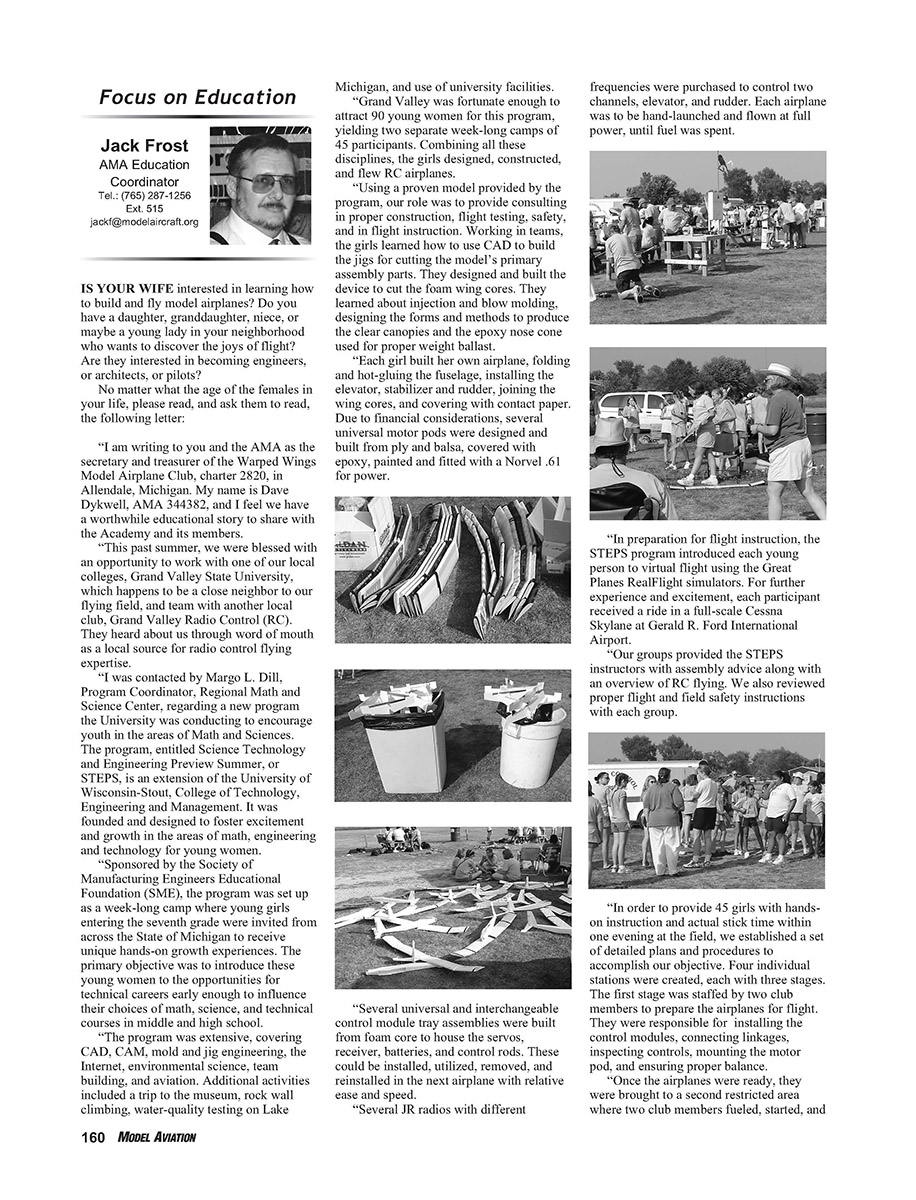
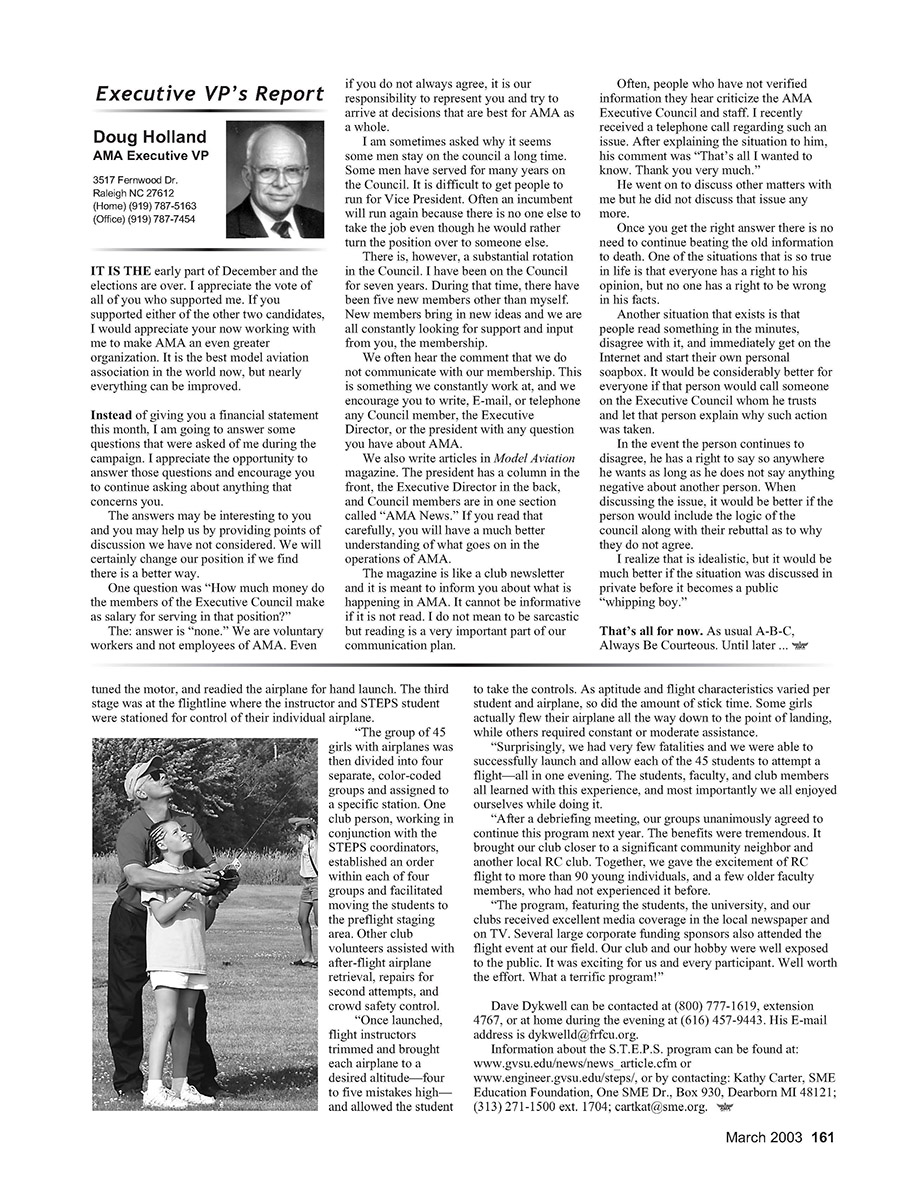
Focus on Education - 2003/03
Author / Contact
Jack Frost AMA Education Coordinator Tel.: (765) 287-1256 ext. 515 jackf@modelaircraft.org
Introduction
Is your wife interested in learning how to build and fly model airplanes? Do you have a daughter, granddaughter, niece, or a young woman in your neighborhood who wants to discover the joys of flight? Are they interested in becoming engineers, architects, or pilots? No matter the age of the females in your life, please read — and ask them to read — the following letter describing a successful educational outreach program.
Letter from Dave Dykwell
I am writing as the secretary and treasurer of the Warped Wings Model Airplane Club, charter 2820, in Allendale, Michigan. My name is Dave Dykwell, AMA 344382, and I feel we have a worthwhile educational story to share with the Academy and its members.
This past summer we were fortunate to work with Grand Valley State University, a close neighbor to our flying field, and to team with another local club, Grand Valley Radio Control (RC). They heard about us through word of mouth as a local source for radio control flying expertise.
I was contacted by Margo L. Dill, Program Coordinator, Regional Math and Science Center, regarding a new program the university was conducting to encourage youth in the areas of math and science. The program, entitled Science, Technology, and Engineering Preview Summer (STEPS), is an extension of the University of Wisconsin–Stout, College of Technology, Engineering and Management. It was founded and designed to foster excitement and growth in math, engineering, and technology for young women.
Sponsored by the Society of Manufacturing Engineers Educational Foundation (SME), the program was set up as a week-long camp where girls entering the seventh grade were invited from across the State of Michigan to receive unique hands-on growth experiences. The primary objective was to introduce these young women to opportunities for technical careers early enough to influence their course choices in middle and high school.
The program was extensive, covering a broad range of disciplines and activities:
- CAD and CAM
- Mold and jig engineering
- The Internet
- Environmental science
- Team building
- Aviation
- Field trips to the museum
- Rock wall climbing
- Water-quality testing on Lake Michigan
- Use of university facilities
Grand Valley attracted 90 young women for the program, yielding two separate week-long camps of 45 participants each. Combining the disciplines, the girls designed, constructed, and flew RC airplanes.
Our Role and Project Details
Using a proven model provided by the STEPS program, our role was to provide consulting in proper construction, flight testing, safety, and flight instruction. Working in teams, the girls learned how to use CAD to build jigs for cutting the model’s primary assembly parts. They designed and built the device to cut the foam wing cores and learned about injection and blow molding, designing the forms and methods to produce clear canopies and the epoxy nose cones used for proper weight ballast.
Each girl built her own airplane: folding and hot-gluing the fuselage, installing the elevator, stabilizer and rudder, joining the wing cores, and covering with contact paper. Due to financial considerations, several universal motor pods were designed and built from plywood and balsa, covered with epoxy, painted and fitted with a Norvel .61 for power.
Several universal and interchangeable control-module tray assemblies were built from foam core to house the servos, receiver, batteries, and control rods. These could be installed, removed, and reinstalled in the next airplane with relative ease and speed.
We purchased several JR radios with different frequencies to control two channels (elevator and rudder). Each airplane was hand-launched and flown at full power until fuel was spent.
In preparation for flight instruction, the STEPS program introduced each participant to virtual flight using the Great Planes RealFlight simulators. For further experience and excitement, each participant received a ride in a full-scale Cessna Skylane at Gerald R. Ford International Airport.
Our groups provided the STEPS instructors with assembly advice and an overview of RC flying. We also reviewed proper flight and field safety instructions with each group.
Flight Instruction and Field Operations
To provide 45 girls with hands-on instruction and actual stick time in a single evening at the field, we established detailed plans and procedures. Four individual stations were created, each with three stages:
- Preflight staging — staffed by two club members to prepare the airplanes for flight: install control modules, connect linkages, inspect controls, mount the motor pod, and ensure proper balance.
- Fueling and engine prep — a restricted area where two club members fueled, started, and tuned the motor and readied the airplane for hand launch.
- Flightline — where the instructor and STEPS student were stationed for control of the individual airplane.
The group of 45 girls with airplanes was divided into four color-coded groups and assigned to a specific station. One club person, working with the STEPS coordinators, established an order within each group and facilitated movement to the preflight staging area. Other club volunteers assisted with after-flight airplane retrieval, repairs for second attempts, and crowd safety control.
Once launched, flight instructors trimmed and brought each airplane to a desired altitude (a comfortable height) and allowed the student to take the controls. Student aptitude and airplane characteristics varied, so the amount of stick time varied accordingly. Some girls flew their airplane all the way to landing, while others required moderate or constant assistance.
Surprisingly, we had very few fatalities and were able to successfully launch and allow each of the 45 students to attempt flight — all in one evening. The students, faculty, and club members all learned from the experience, and most importantly, we all enjoyed ourselves.
After a debriefing meeting, our groups unanimously agreed to continue this program next year. The benefits were tremendous: it brought our club closer to a significant community neighbor and another local RC club. Together, we gave the excitement of RC flight to more than 90 young individuals (and a few older faculty members) who had not experienced it before.
The program, featuring the students, the university, and our clubs, received excellent media coverage in the local newspaper and on TV. Several large corporate funding sponsors also attended the flight event at our field. Our club and our hobby were well exposed to the public. It was exciting for us and every participant — well worth the effort. What a terrific program!
Contacts and Additional Information
Dave Dykwell — Warped Wings Model Airplane Club
- Work: (800) 777-1619 ext. 4767
- Home (evenings): (616) 457-9443
- Email: dykwell@frucco.org
Information about the S.T.E.P.S. program:
Or contact: Kathy Carter, SME Education Foundation One SME Dr., Box 930, Dearborn, MI 48121 Phone: (313) 271-1500 ext. 1704 Email: carterk@sme.org
Transcribed from original scans by AI. Minor OCR errors may remain.

