
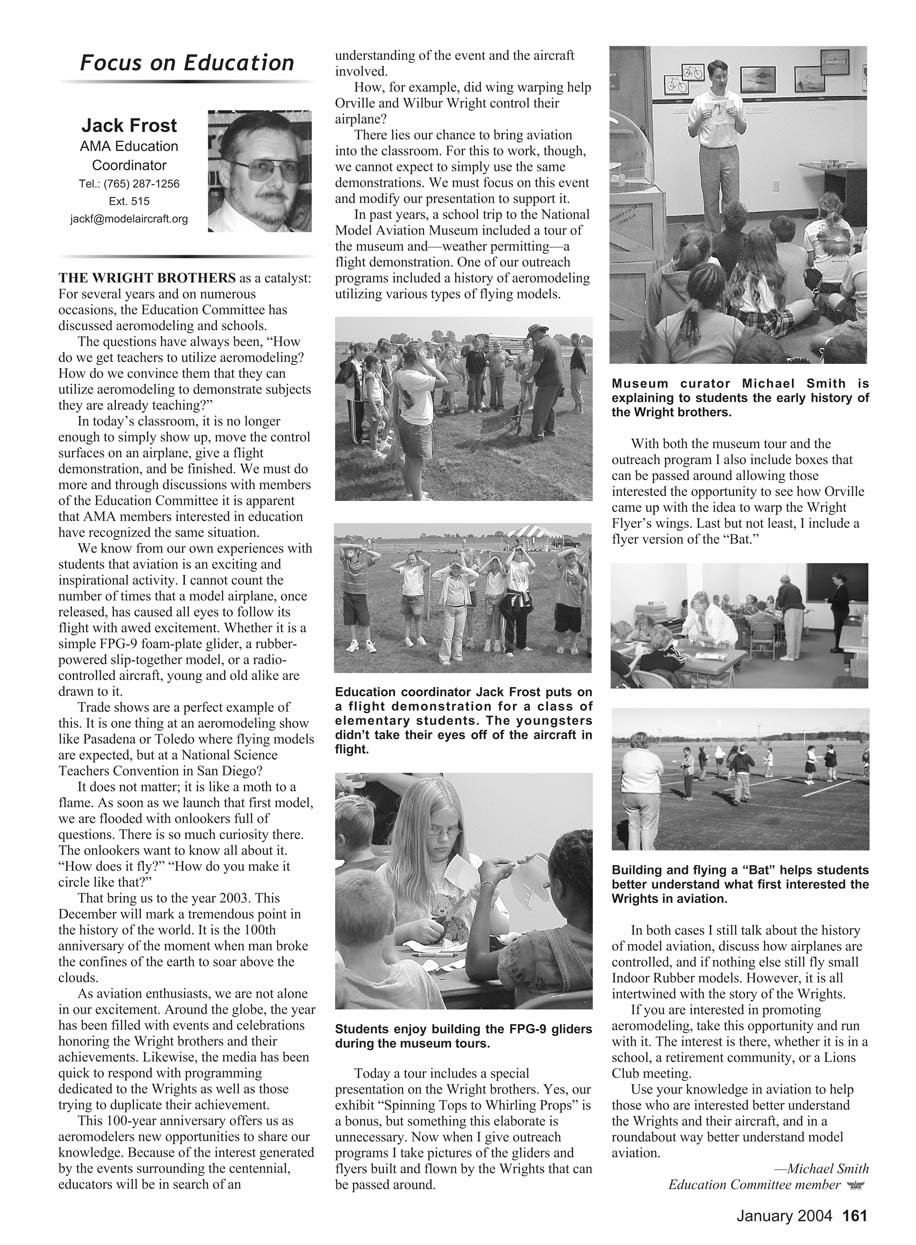
Focus on Education
The Wright Brothers as a catalyst
For several years and on numerous occasions, the Education Committee has discussed aeromodeling and schools.
The questions have always been:
- "How do we get teachers to utilize aeromodeling?"
- "How do we convince them that they can utilize aeromodeling to demonstrate subjects they are already teaching?"
In today's classroom, it is no longer enough to simply show up, move the control surfaces on an airplane, give a flight demonstration, and be finished. We must do more. Through discussions with members of the Education Committee, it is apparent that AMA members interested in education have recognized the same situation.
We know from our own experiences with students that aviation is an exciting and inspirational activity. I cannot count the number of times that a model airplane, once released, has caused all eyes to follow its flight with awed excitement. Whether it is a simple FPG-9 foam-plate glider, a rubber-powered slip-together model, or a radio-controlled aircraft, young and old alike are drawn to it.
Trade shows are a perfect example. It is one thing at an aeromodeling show like Pasadena or Toledo, where flying models are expected, but at a National Science Teachers Convention in San Diego? It does not matter; it is like a moth to a flame. As soon as we launch that first model, we are flooded with onlookers full of questions. There is so much curiosity. The onlookers want to know all about it: "How does it fly?" "How do you make it circle like that?"
That brings us to the year 2003. This December will mark a tremendous point in the history of the world: the 100th anniversary of the moment when man broke the confines of the earth to soar above the clouds.
As aviation enthusiasts, we are not alone in our excitement. Around the globe, the year has been filled with events and celebrations honoring the Wright brothers and their achievements. Likewise, the media has been quick to respond with programming dedicated to the Wrights as well as those trying to duplicate their achievement.
This 100-year anniversary offers us as aeromodelers new opportunities to share our knowledge. Because of the interest generated by the centennial events, educators will be in search of an understanding of the event and the aircraft involved.
How, for example, did wing warping help Orville and Wilbur Wright control their airplane? There lies our chance to bring aviation into the classroom. For this to work, though, we cannot expect to simply use the same demonstrations. We must focus on this event and modify our presentation to support it.
Outreach and presentation ideas
In past years, a school trip to the National Model Aviation Museum included a tour of the museum and—weather permitting—a flight demonstration. One of our outreach programs included a history of aeromodeling utilizing various types of flying models.
Items and activities I include in outreach programs:
- Boxes that can be passed around so participants can see how Orville came up with the idea to warp the Wright Flyer's wings.
- A flyer version of the "Bat." Building and flying a "Bat" helps students better understand what first interested the Wrights in aviation.
- Discussions about the history of model aviation and how airplanes are controlled.
- Flying small indoor rubber models when appropriate.
In both the museum tour and the outreach program, everything is intertwined with the story of the Wrights. If you are interested in promoting aeromodeling, take this opportunity and run with it. The interest is there—whether it is in a school, a retirement community, or a Lions Club meeting.
Use your knowledge in aviation to help those who are interested better understand the Wrights and their aircraft, and in a roundabout way, better understand model aviation.
—Michael Smith Education Committee member
Transcribed from original scans by AI. Minor OCR errors may remain.

