
Focus on Education - 2004/02
Author
Jack Frost AMA Education Coordinator Tel.: (765) 287-1256 Ext. 515 jackf@modelaircraft.org
Project background
For several months I have been working on the 1905 Wright Flyer exhibit for the National Model Aviation Museum. I have had more than a few revelations while involved in this project. Some concerned the actual building of the exhibit; others had to do with the personal interaction that might have occurred between Orville and Wilbur.
The Wright Flyer exhibit is the brainchild of Michael Smith, our museum curator. After he and I completed the museum’s Remotely Controlled Aircraft Simulator (RCAD), Michael thought it would be great to replace the transmitter that controls the aircraft with a working, semi-scale replica of the 1905 Flyer. This project has taken on a life of its own.
Design and construction
Although it is close to completion, I feel it only right to admit that I seriously underestimated many aspects of the design and construction. First, this exhibit was never intended to fly; however, I believe that it may have been easier to build this aircraft to fly once than it was to build it to last for two years of daily, non-flying use.
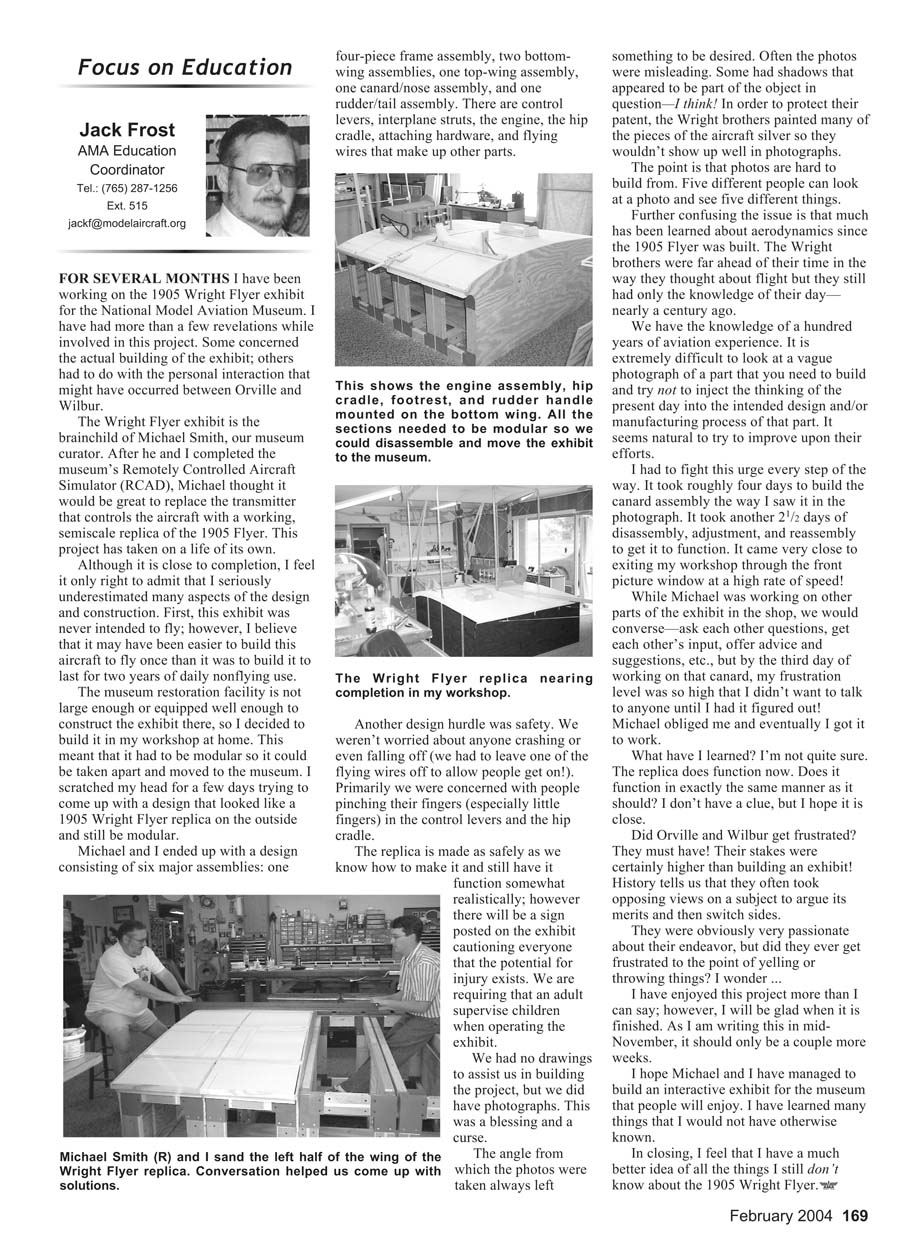
The museum restoration facility is not large enough or equipped well enough to construct the exhibit there, so I decided to build it in my workshop at home. This meant that it had to be modular so it could be taken apart and moved to the museum. Michael and I ended up with a design consisting of six major assemblies:
- One four-piece frame assembly
- Two bottom-wing assemblies
- One top-wing assembly
- One canard/nose assembly
- One rudder/tail assembly
Other parts include:
- Control levers
- Interplane struts
- The engine
- The hip cradle
- Attaching hardware and flying wires
Safety
Another design hurdle was safety. We weren't worried about anyone crashing or even falling off (we had to leave one of the flying wires off to allow people to get on!). Primarily we were concerned with people pinching their fingers (especially little fingers) in the control levers and the hip cradle.
The replica is made as safely as we know how to make it and still have it function somewhat realistically; however, there will be a sign posted on the exhibit cautioning everyone that the potential for injury exists. We are requiring that an adult supervise children when operating the exhibit.
Building from photographs and historical accuracy
We had no drawings to assist us in building the project, but we did have photographs. This was a blessing and a curse. The angle from which the photos were taken often left something to be desired. Sometimes the photos were misleading; some had shadows that appeared to be part of the object in question. In order to protect their patent, the Wright brothers painted many of the pieces of the aircraft silver so they wouldn't show up well in photographs.
Photos are hard to build from. Five different people can look at a photo and see five different things. Further confusing the issue is that much has been learned about aerodynamics since the 1905 Flyer was built. The Wright brothers were far ahead of their time in the way they thought about flight, but they still had only the knowledge of their day—nearly a century ago. We have the knowledge of a hundred years of aviation experience. It is extremely difficult to look at a vague photograph of a part that you need to build and try not to inject present-day thinking into the intended design and/or manufacturing process of that part. It seems natural to try to improve upon their efforts. I had to fight this urge every step of the way.
The canard episode
It took roughly four days to build the canard assembly the way I saw it in the photograph. It took another 2½ days of disassembly, adjustment, and reassembly to get it to function. It came very close to exiting my workshop through the front picture window at a high rate of speed!
While Michael was working on other parts of the exhibit in the shop, we would converse—ask each other questions, get each other's input, offer advice and suggestions—but by the third day of working on that canard, my frustration level was so high that I didn't want to talk to anyone until I had it figured out. Michael obliged me, and eventually I got it to work.
Reflections and conclusion
What have I learned? I'm not quite sure. The replica does function now. Does it function in exactly the same manner as it should? I don't have a clue, but I hope it is close.
Did Orville and Wilbur get frustrated? They must have. Their stakes were certainly higher than building an exhibit! History tells us that they often took opposing views on a subject to argue its merits and then switch sides. They were obviously very passionate about their endeavor, but did they ever get frustrated to the point of yelling or throwing things? I wonder.
I have enjoyed this project more than I can say; however, I will be glad when it is finished. As I am writing this in mid-November, it should only be a couple more weeks.
I hope Michael and I have managed to build an interactive exhibit for the museum that people will enjoy. I have learned many things that I would not have otherwise known. In closing, I feel that I have a much better idea of all the things I still don't know about the 1905 Wright Flyer.
Transcribed from original scans by AI. Minor OCR errors may remain.

