
Foiling Around With a Computer
By David Garwood
You say you'd be a scratch-building demon if you knew an easy way to make accurate wing-rib patterns? Or you'd try a new airfoil in foam if you could easily make accurate cutting templates? Or maybe you'd repair that elliptical-tip sailplane wing — if only you didn't have to calculate five rib lengths and draw them all on graph paper?
Computer technology can help builders make balsa wing ribs and plywood templates. It eliminates tedious hand-plotting of airfoils on graph paper, as well as calculating rib length and spacing distances for tapered wing sections. Not only can a computer airfoil-plotting program make patterns for traditional (built-up construction) wing ribs, but the same technology will also help template-makers who cut foam wing cores.
Using a Computer to Plot Airfoils
The FOILED AGAIN!!! program
For this project I used the FOILED AGAIN!!! PC program published by Cygnet Software (3525 Del Mar Heights Road, Suite 237, San Diego, CA 92130; Tel.: (619) 792-8021). FOILED AGAIN!!! has an excellent instruction manual and sample airfoils. To use additional airfoils, you type in data published in books and magazines. Supplementary airfoil data disks are available from Cygnet Software.
How it works
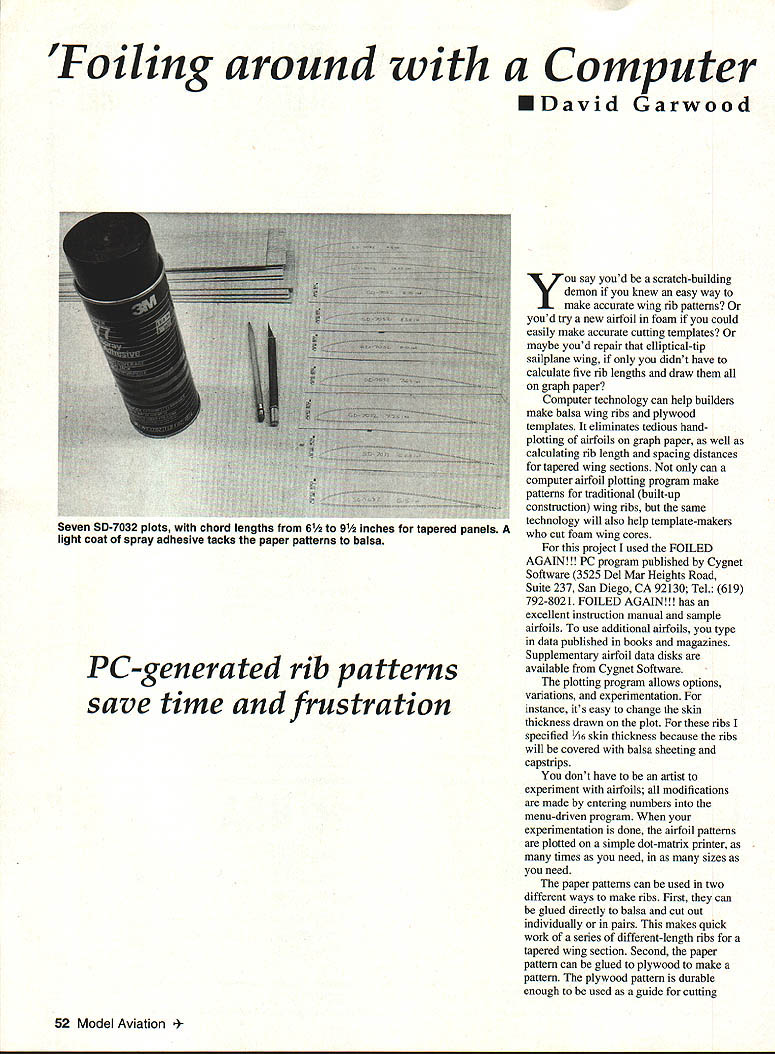
The plotting program allows options, variations, and experimentation. For instance, it's easy to change the skin thickness drawn on the plot; for these ribs I specified 1/16" skin thickness because the ribs will be covered with balsa sheeting and capstrips.
You don't have to be an artist to experiment with airfoils — all modifications are made by entering numbers into the menu-driven program. When your experimentation is done, the airfoil patterns are plotted on a simple dot-matrix printer, as many times as you need, in as many sizes as you need.
Making Ribs and Templates
The paper patterns can be used in two different ways to make ribs:
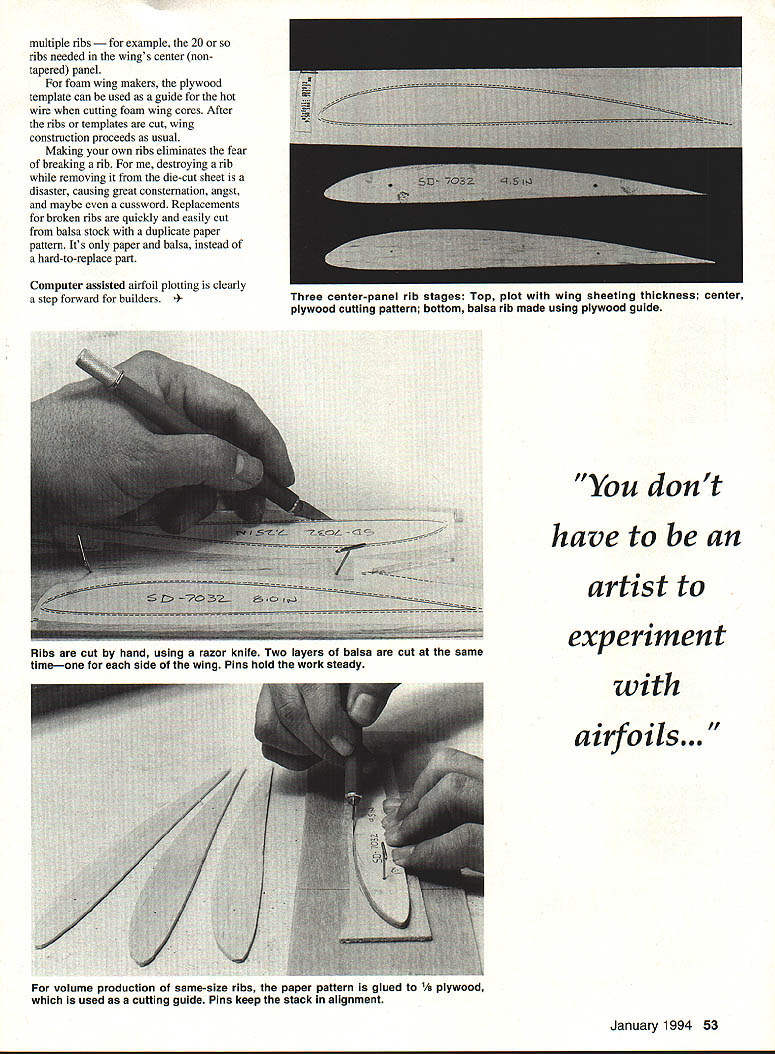
- Glue the paper patterns directly to balsa and cut out individual ribs or pairs. This makes quick work of a series of different-length ribs for a tapered wing section.
- Glue the paper pattern to plywood to make a durable template. The plywood pattern can be used as a guide for cutting multiple balsa ribs or, for foam wing makers, as a guide for the hot wire when cutting foam wing cores.
After rib templates are cut, wing construction proceeds as usual.
Advantages of Computer-Assisted Airfoil Plotting
- Eliminates tedious hand-plotting and manual calculations for rib length and spacing.
- Lets you experiment with airfoils and variations by changing numerical inputs.
- Produces repeatable paper patterns in multiple sizes on a dot-matrix printer.
- Durable plywood templates allow quick duplication of many ribs (for example, the 20 or so ribs needed in a wing's center, non-tapered panel).
- Simplifies replacement of broken ribs: a duplicate paper pattern lets you cut a new balsa rib quickly instead of struggling to replace a hard-to-find part.
Computer-assisted airfoil plotting is a clear step forward for builders who aren't artists but want to experiment with airfoils and speed up the rib-making process.
Transcribed from original scans by AI. Minor OCR errors may remain.

