
Fourth of July: Picnic
Maynard L. Hill
Crew
- John Patton
- George Pickrell
- Mel Newcomer
- The author
- Mr. Butts (owner of the pasture)
Background
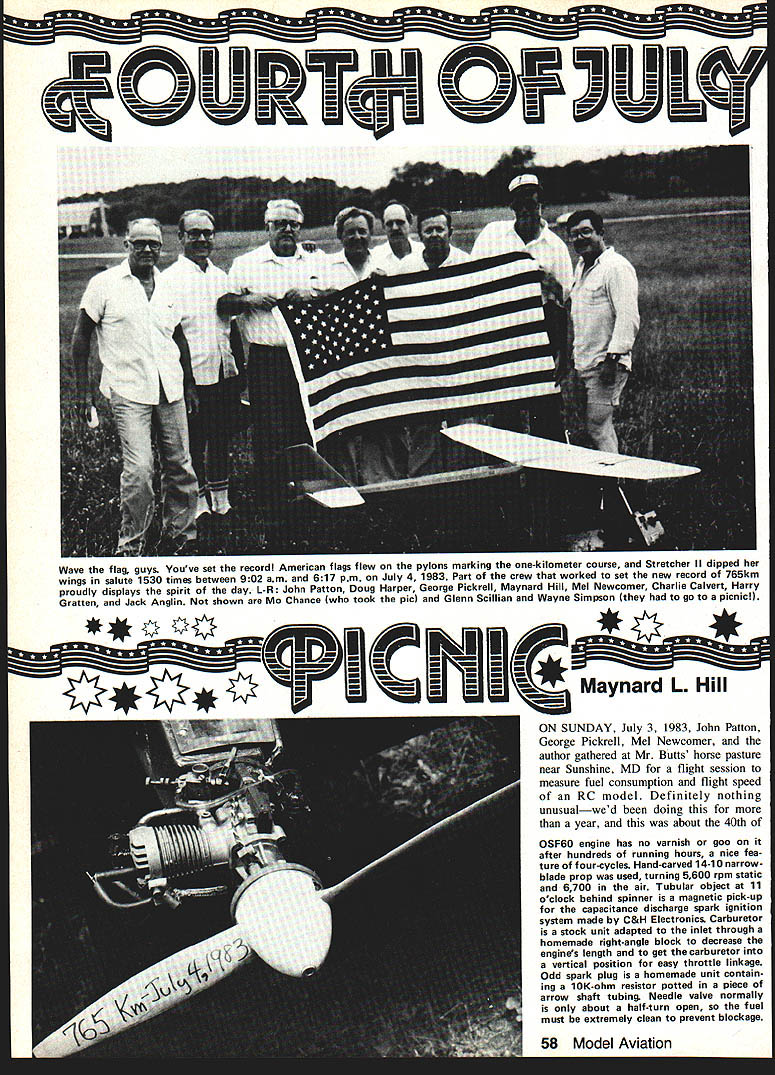
On Sunday, July 3, 1983, John Patton, George Pickrell, Mel Newcomer, and I gathered at Mr. Butts' horse pasture near Sunshine, Md., for a flight session to measure fuel consumption and flight speed of an RC model. Nothing unusual—we'd been doing this for more than a year, and this was about the 40th session of the year.
In addition, we had already made four official attempts to break the FAI world record of 740 km for RC models in closed-course distance, a record set by two Soviet modelers, Y. Saslavski and A. Smolentsev, in 1979. (When I say those names out loud, they come out with an intonation of disrespect. I'll explain the reasons later.) Furthermore, we had totally destroyed four models in crashes and had experienced three other crashes in which the damage was major but repairable. Mother Nature kept reminding me that we were up against a tough challenge in this effort.
The airplane and engine
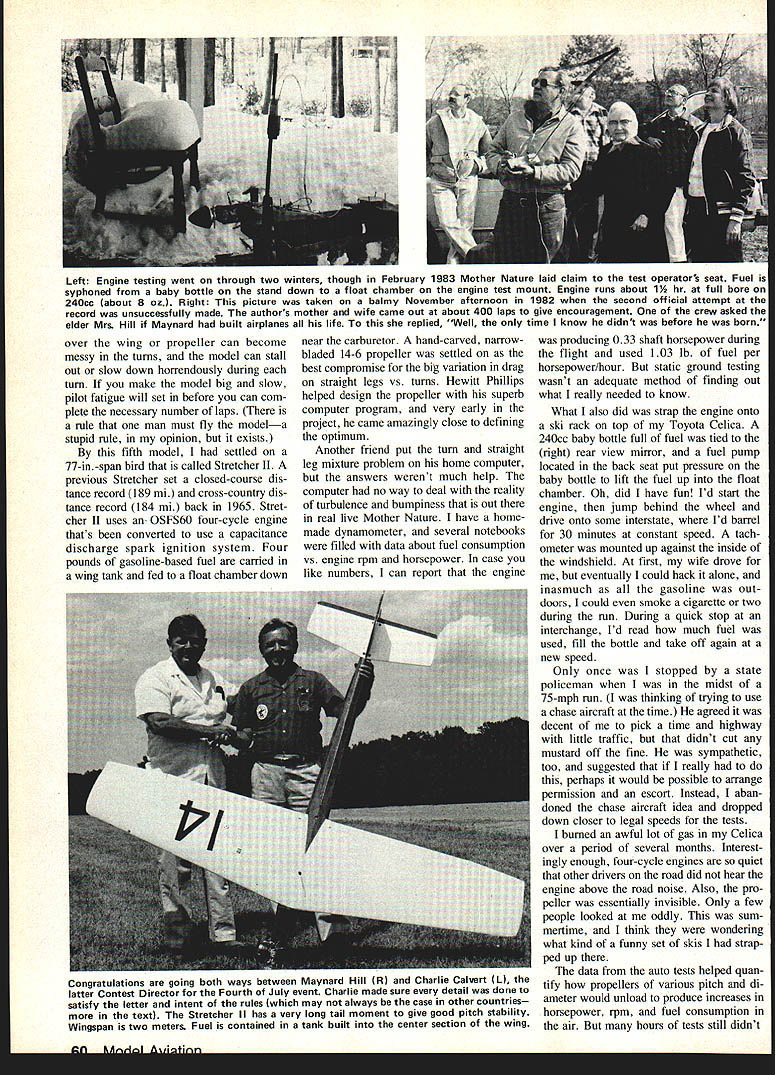
By this fifth model, I had settled on a 77-inch-span bird called Stretcher II. A previous Stretcher set a closed-course distance record (189 mi.) and cross-country distance record (184 mi.) back in 1965. Stretcher II uses an OS F60 four-cycle engine converted to use a capacitance-discharge spark ignition system. Four pounds of gasoline-based fuel are carried in a wing tank and fed to a float chamber down near the carburetor.
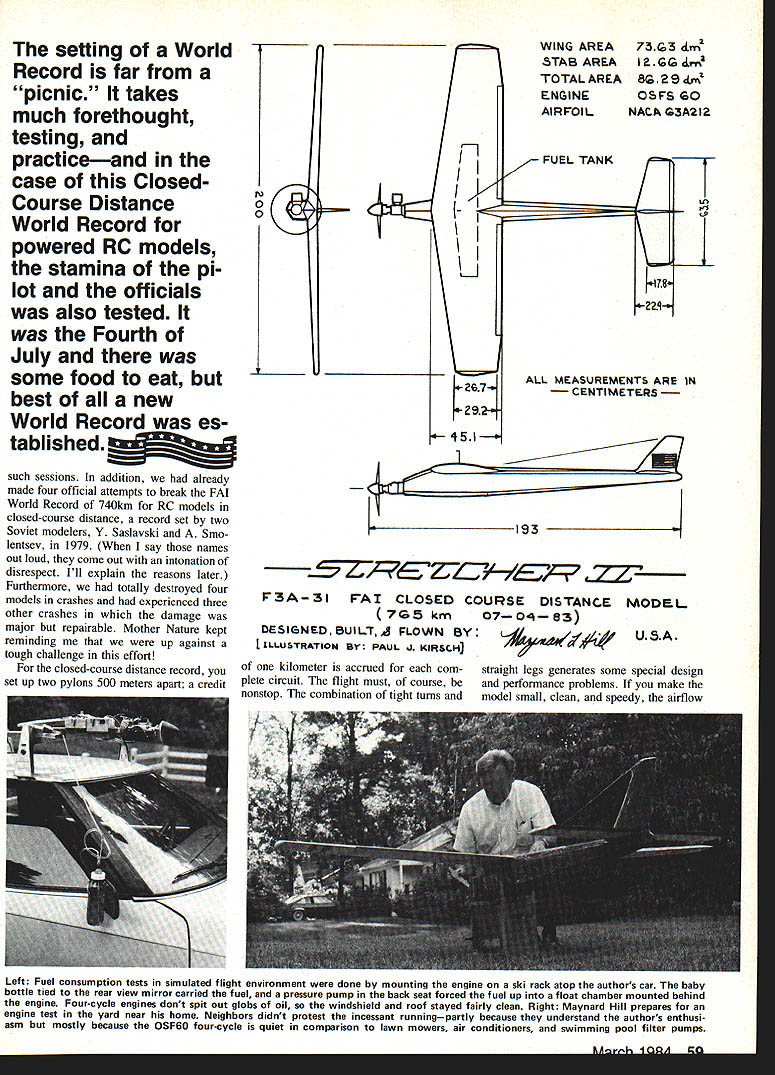
The engine had no varnish or goo on it after hundreds of running hours, a nice feature of four-cycles. A hand-carved narrow-blade prop was used early on: a 14x10 turning 5,600 rpm static and 6,700 rpm in the air. Later we settled on a hand-carved, narrow-bladed 14x6 propeller as the best compromise for the big variation in drag on straight legs versus turns. Hewitt Phillips helped design the propeller with his superb computer program, and very early in the project he came amazingly close to defining the optimum.
A tubular object at 11 o'clock behind the spinner is a magnetic pick-up for the capacitance-discharge ignition system made by C&H Electronics. The carburetor is a stock unit adapted to the inlet through a homemade right-angle block to decrease the engine's length and get the carburetor into a vertical position for easy throttle linkage. The odd spark plug is a homemade unit containing a 10 kΩ resistor potted in a piece of arrow-shaft tubing. The needle valve normally is only about a half-turn open, so the fuel must be extremely clean to prevent blockage.
The model weighs 67½ lb. empty and 107½ lb. full.
Ground and road testing
Another friend put the turn-and-straight-leg mixture problem on his home computer, but the answers weren't much help. The computer had no way to deal with the reality of turbulence and bumpiness that is out there in real live Mother Nature. I built a homemade dynamometer and filled several notebooks with data about fuel consumption versus engine rpm and horsepower. In case you like numbers: during flight the engine was producing about 0.33 shaft horsepower and used 1.03 lb. of fuel per horsepower-hour. But static ground testing still didn't spell out the whole story.
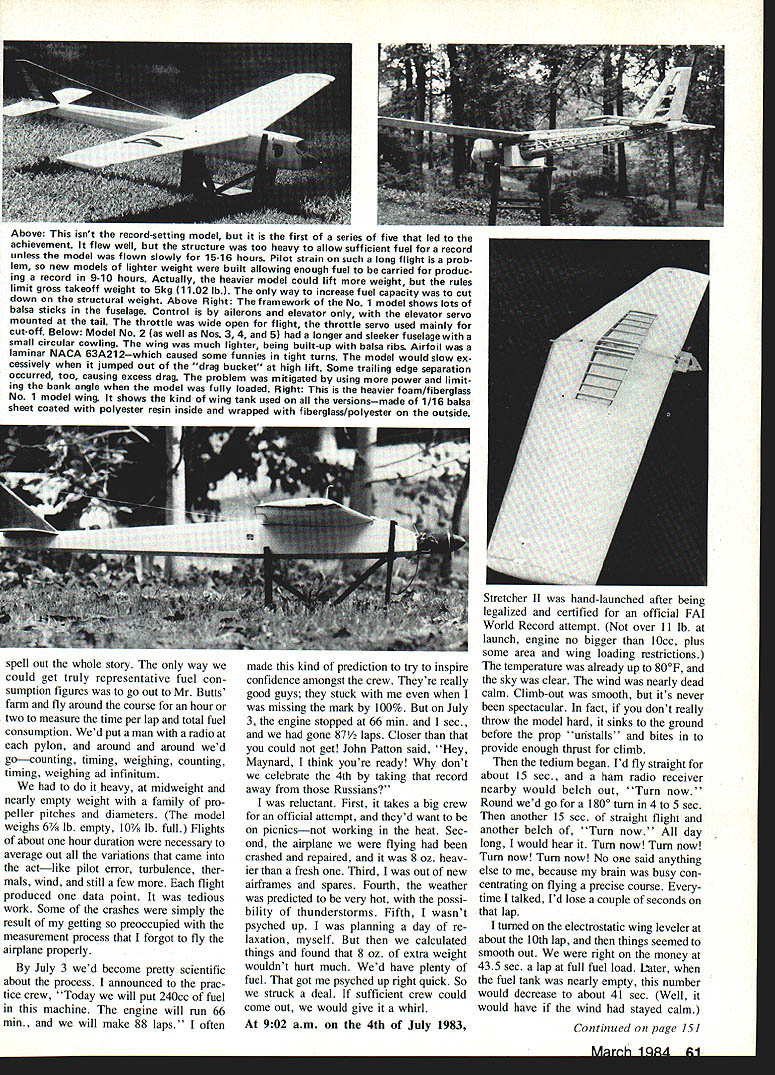
To get more representative data, I strapped the engine onto a ski rack on top of my Toyota Celica. A 240 cc baby bottle full of fuel was tied to the right rearview mirror, and a fuel pump in the back seat put pressure on the bottle to feed fuel up into the float chamber. I'd start the engine, jump behind the wheel, and drive out onto some interstate, where I'd run for 30 minutes at constant speed. A tachometer was mounted against the inside of the windshield. At first my wife drove for me, but eventually I could do it alone. Since all the gasoline was outdoors, I could even smoke a cigarette or two during the run. During a quick stop at an interchange, I'd read how much fuel was used, fill the bottle, and take off again at a new speed.
Only once was I stopped by a state policeman during a 75-mph run. He agreed it was decent of me to pick a time and highway with little traffic, but that didn't cut any mustard on the fine. He was sympathetic and suggested that if I really had to do this, perhaps it would be possible to arrange permission and an escort. Instead, I abandoned the chase-aircraft idea and dropped down closer to legal speeds for the tests.
I burned an awful lot of gas in my Celica over several months. Four-cycle engines are so quiet that other drivers did not hear the engine above road noise; the propeller was essentially invisible. Only a few people looked at me oddly. It was summertime, and I think they were wondering what kind of funny set of skis I had strapped up there.
The auto tests helped quantify how propellers of various pitch and diameter would unload to produce increases in horsepower, rpm, and fuel consumption in the air. But many hours of tests still didn't spell out the whole story. The only way to get truly representative fuel consumption figures was to fly around the course for an hour or two, measuring time per lap and total fuel consumption. We'd put a man with a radio at each pylon, and around and around we'd go—counting, timing, weighing—ad infinitum.
Flight testing at Mr. Butts' farm
We had to fly heavy, at midweight, and nearly empty weight with a family of propeller pitches and diameters. Flights of about one hour were necessary to average out variations such as pilot error, turbulence, thermals, and wind. Each flight produced one data point. It was tedious work, and some crashes were simply the result of my getting so preoccupied with the measurement process that I forgot to fly the airplane properly.
By July 3 we'd become pretty scientific about the process. I announced to the practice crew, "Today we will put 240 cc of fuel in this machine. The engine will run 66 min., and we will make 88 laps." I often made this kind of prediction to try to inspire confidence among the crew. They're really good guys; they stuck with me even when I was missing the mark by 100%. But on July 3, the engine stopped at 66 min. and 1 sec., and we had gone 87½ laps. Closer than that you could not get! John Patton said, "Hey, Maynard, I think you're ready! Why don't we celebrate the 4th by taking that record away from those Russians?"
I was reluctant. First, an official attempt takes a big crew, and they'd want to be on the course—not working in the heat. Second, the airplane we were flying had been crashed and repaired and was 8 oz. heavier than a fresh one. Third, I was out of new airframes and spares. Fourth, the weather was predicted to be very hot with possible thunderstorms. Fifth, I wasn't psyched up; I was planning a day of relaxation. But then we calculated things and found that 8 oz. of extra weight wouldn't hurt much. We'd have plenty of fuel. That got me psyched up right quick. So we struck a deal: if sufficient crew could come out, we would give it a whirl.
The record attempt — July 4, 1983
At 9:02 a.m. on July 4, 1983, we began.
The flight routine was tedious. I'd fly straight for about 15 seconds, and a ham radio receiver nearby would be clicking out, "Turn now." Round we'd go for a 180° turn in 4 to 5 seconds. Then another 15 seconds of straight flight and another, "Turn now." In fact, if you don't really throw the model hard, it sinks to the ground before the prop "unstalls" and bites in to provide enough thrust for climb.
All day I heard it: "Turn now! Turn now! Turn now!" No one said anything to me, because my brain was busy concentrating on flying a precise course. Every time I talked, I'd lose a couple of seconds on that lap.
I turned on the electrostatic wing leveler at about the 10th lap, and then things seemed to smooth out. We were right on the money at 43.5 seconds a lap at full fuel load. Later, when the fuel tank was nearly empty, this number would decrease to about 41 seconds (well, it would have if the wind had stayed calm).
We passed the 100-lap mark at 10:17 a.m.—still right on the money. By then I was comfortably ensconced on a chaise lounge in the shade of an umbrella with umbilicals to an automobile battery and a 5-watt linear amplifier plugged into the transmitter. I like strong signals so the servos don't twitch and use extra current out there on the ends of the course. Five hundred meters is an eye-straining distance; in some previous work I've concluded that if you're straining your eyes, the servos are usually twitching due to low signal strength. There are no symptoms and you're not in danger of crashing, because the servos are still getting lots of information; they just wiggle and drain extra juice.
We were pushing towards 350 laps around 1:00 p.m. when I realized my turn radius was getting pretty big even though I was holding hard-over aileron. The airplane wouldn't bank more than about 10 degrees. Uh-oh. This is something I'd felt before with electrostatic autopilots when thunderstorms start to build within about two miles of the flying site. Usually that observation serves as a warning to pack up and go home. Sure enough, I looked behind me to the southeast, and there was a big, black, ugly cloud. The sky was clear above the site, but it would not be for long.
Electrostatic effects and thunderstorms
The explanation for the flat turns is that as a thunderstorm approaches, the atmospheric electric field, which is usually about 150 V/m and positive upwards, often rises to 1,000–2,000 V/m with the same polarity. The signals coming in from the servos increase by a factor of 10 to 20, and a hard-over command from the transmitter is balanced out by the feedback loop when the airplane banks only a couple of degrees. At those times, the airplane becomes so stable you can hardly turn it. What also entered my mind was: if that big, black boomer comes much closer, the electric field will reverse polarity and build up to 10–40 kV/m, and this little old airplane is going to want to fly upside down.
So I shut down the electrostatic stabilizer and prayed for no rain. I decided to take care of a necessary physical process before the impending doom arrived and also ate a sandwich left-handed. We lost 5 to 10 seconds per lap for about 10 laps; I guess that's because I've never learned how to pat my head and rub my belly at the same time.
The storm coasted by about one mile to the southeast. A little rain fell between 2:00 and 2:20 p.m.—enough to put the transmitter in a plastic bag. A wind of about 15 mph blew parallel to the course for about an hour. Lap time rose to about 47–48 seconds, and the upwind legs seemed interminable. But at about 3:15 the wind went dead calm again. The sky was still overcast with audible thunder several miles away. I couldn't resist the urge to find out something scientific, so I switched on the electrostatic stabilizer.
Zaroom—the airplane went hard over into a 90° bank before I could flip off the stabilizer. The electric field had reversed, as I suspected. Somebody in the crew shouted, "Don't do that again!"
We passed the 700-lap mark at about 5:30 p.m. Hooray—only 64 more to go! (The FAI office said the record was 740 laps; the Soviets said it was 749. We didn't know which to believe, but to be safe our goal was 764 laps, 2% past 749 circuits.)
The final storm and finish
We'd been having a pretty peaceful time for nearly two hours. I had a mild headache, but otherwise felt pretty good. Then about 5:45 p.m. I peeked over my left shoulder to the southwest. Good grief—there was another big, black, ominous cloud, worse than the last one, with thunder. Charlie Calvert, the contest director, said, "Don't worry, Maynard, I just did my rain dance, and it won't come here." I climbed from the normal 100 ft. up to about 300 ft. to buy a little safety margin. Then I kept flying and peeking. It was coming directly toward us. It was going to hit us in about five minutes. Rats! Rats! Rats! We had 15 laps still to go.
At 756 laps the cloud let loose with its fury. It produced one of those classic outflow winds that come before the full whomp of a thunderstorm. Oddly, there wasn't much rain, but there was sure a great big wind. In order to fly straight up and down the course I had to crab into the wind at an angle of 45° to the flight path. Since the model flies at 58 mph, that implies the wind was about 41 mph straight across the course. The first three or four laps really scared me—full of bumps and mild upsets, and each lap was taking well over a minute.
Then I realized this wasn't much different from what we sometimes do with slope-soaring sailplanes in blasting winter winds near Cumberland, Md. No big deal. "Just steer and we'll make it," my mind whispered. Somebody yelled, "Hey—you might get hit by lightning." I responded, "I couldn't think of a better way to go!" Sound brave? Crazy? Neither is the case. I've studied thunderstorms enough to judge this one to have its lightning more than two miles away. The threat was minimal, and I wasn't about to stop three laps short.
We got to 764, the required number. The gale was still blowing. I remembered the crew at an earlier duration record flight had expressed a little regret when I quit at 20 hours instead of going for a full 24. Jokingly I asked Charlie Calvert, "Should we keep going for 1,000 laps?" His response was unprintable. In essence he ordered me to land. I said, "Let's tack one lap for good measure." "Turn now!" came an emphatic command from John Patton on the far radio. 765 laps! That was enough.
I dove from 300 ft. to the ground in about 10 seconds, poured on the steam into the wind, and chopped the engine to 10 ft. off the ground. We landed with no damage, not even a broken prop, which is something that happens often. The landing spot was 60 meters from the launch point.
Celebration
We did it! I threw the Kraft transmitter in the air like a midshipman's hat at graduation. It's a good piece of equipment, so I caught it on the way down. The crew and I jumped all over each other like Redskins after a winning touchdown. The wind stopped for our celebration. A little rain fell, and the champagne flowed!
Mr. Butts joined us. He is a healthy septuagenarian who rides horses every day, owns and flies an Aeronca Chief, and is as fine a Maryland gentleman as you'll ever know. He'd seen all our failures during the past year, so he came to cheer. We had used American flags to mark the pylons in honor of the 4th. We were waving these happily when a truly wonderful event descended on us. A tractor-drawn hay wagon with 50 suburban children on it pulled up in front of us. Mr. Butts' son and daughter run a children's camp within earshot of the flying site.
The children saw what we had been doing all day, and they asked if they could come over to sing "America the Beautiful" to help us celebrate. They were beautiful. Their rendition was magnificent. I didn't look, but I'm sure I'm not the only one in the crew who was choked to tears. This was the best darn 4th of July picnic I've ever been to!
On the Soviet record
As I worked on the airplanes and engines for this record, I kept mumbling to myself, "This is tough! I'm using every bit of experience I've gotten out of 14 previous records and still can't seem to hack it. I don't think there's a Soviet smart enough to do what they say they did." Then it dawned on me: the rules say the engine has to run 98% of the time. They don't say the engine has to lift the airplane, but obviously in a powered RC class that is the intention. I'll bet they did it with slope lift and a fuel-slurping engine that was idling. Sure enough, I had it verified that they used a two-cycle engine on glow fuel.
This record is impossible with that combination, period. Further, it was verified that the site was "la pente sud du Mont Klementyev" with "le vent du sud de 5 à 12 m/sec," which translates: the site was on the south slope of Mount Klementyev with a wind of 5 to 12 m/s from the south. Twelve meters per second is about 27 mph. A brick with a piece of plywood could glide in that kind of slope lift.
The engine had nothing to do with the performance other than idling to meet the specific words of a rule book. Never mind that a powered airplane is one that uses an engine to pull it through the air. What alarms me is that this flagrant violation of the intent of a rule is not an isolated case.
We did it the hard way, and we're all proud to have put together a "real good" 4th of July picnic. The food was terrible: one dried-out ham and cheese sandwich. The aerial fireworks were spectacular. Approximately one million, eight hundred and sixty-six thousand consecutive explosions produced a truly revolutionary celebration.
Transcribed from original scans by AI. Minor OCR errors may remain.

