

Fourth Junior World Championships
Bill Fee
Arrival and hosts
They came from all over America for the Junior World Champs—well, almost. East, West, and South were represented, but there were no representatives from the prairie heartland or the Pacific Northwest.
The Western contingent consisted of Wakefield fliers Daniel and Dorothy Fee, accompanied by brother David (F1B at the '92 Junior WC) and the author. We left Los Angeles several days early with Bob Waterman (National Free Flight Society president), George Batiuk, Mike Achterberg, and Sal Fruciano (Starline Products). We were joined en route by Pennsylvania's Bob Gutai.
After a long but uneventful trip we were greeted at Kiev's Borispol Airport by Alexander and Vladislav Andriukov, Eugene Verbitsky, Victor Stamov, and Mikhail Zakharov, Chief of the Ukrainian Aeromodelling Club.
David Fee and Mike Achterberg were missing suitcases. We frantically checked each wagonload of baggage as it was trundled off the tarmac. No luck; they were wearing borrowed duds and items hand-washed and hung up to dry overnight for seven days, at which time the missing gear was recovered in the basement long-term storage at Borispol.
Our hosts had expected to put up four for the night, but "no problem!" Victor and Luda Stamov treated us to a feast in their spacious seventh-floor apartment. When the party broke up, Daniel, Dorothy, Vlad, and Alex drove to the Andriukovs' apartment. A neighbor housed the Fee kids.
After breakfast at the Stamovs' we were transported in private vehicles to Irpen, our home for the rest of our stay. The facilities were more than adequate (although hot water was hard to come by) and the food was palatable and nourishing—probably first-rate by Eastern European standards.
Irpen was remote and virtually inaccessible: no rental cars or vans, no cabs or public transit vehicles, and no telephone or wire service available to facilitate communication with the outside world.
The weather was consistent: overcast early, a light morning drizzle several day, clearing by the time we got to the field, with light winds and spotty, very tricky thermals.
Transit to and from the practice field (or Borispol Airport) was a patchwork, catch-as-catch-can experience for the duration of our stay; even our part-time interpreter was dependent on a friend to transport her. Yet we had the best of what our gracious Ukrainian friends could muster, in an economy where there was no official currency and no coins for slots or telephones. They did have paper "coupons" and officially it was illegal to buy anything with foreign money. That constituted a black-market transaction.
Team USA assembly
Back in America, the rest of FAI Junior Team USA was getting underway. Team members included:
- Mark Troutman (Texas) with his son Jim, Eric Schmoekel, and Jeff Fedor — they went to Florida and were joined by Jody Miller.
- Rod Joerger and his father Tom (joined later in New York).
- Team Manager Bob Sifleet and his wife accompanied the assembly to Frankfurt, Germany, and on to Kiev.
Finally, the team was together. By this time the place was fairly jumping with contestants for the Antonov Cup (although several junior teams passed up this event).
Every evening back at Irpen Mike Achterberg was busy making virtually invisible "better than new" repairs to crashed models. He graciously applied his "invisible mending" techniques to Wakefield tail booms for the Fees. Down the hall, Mark Troutman was busy trying to keep a fleet of F1Cs airworthy—not an easy task.
All of the kids had reasonable exposure to building, trimming, and picking air. But repairs with a contest the next day kept everyone busy.
Practice, processing, and opening
Processing of models at Chaika was a daylong event on Wednesday. Daniel Fee had two backup models that were slightly underweight—a shortcoming he compensated for by gluing pennies to the pylon. Later it was discovered the forgotten winding hook had been included in the weigh-in.
Good lunch was served at the field; a water wagon provided H2O in a canteen-cup. Almost-cold Coca-Cola, beer, and snacks were available. American chocolate bars were sold by vendors at opposite ends of the field. Bathroom facilities were rather crude—like out in a corn field.
The opening ceremony took place at 1800 hours, followed by the team managers' meeting to issue rules changes. Juniors debated length. Some delegations insisted they had not received adequate notification to prepare contestants to perform. The junior mechanics' support committee apparently wavered on the rule change; in the morning contest team manager Bob Sifleet told the team the committee had decided to require compliance. The changed directive was later observed disregarded by teams—no visible enforcement.
Competition
F1B and F1C — Thursday through the rounds
The Fourth Junior Free Flight World Championships got underway Thursday morning. F1B and F1C shared flight lines and airspace. The "power squadron" had great expectations, and for good reason, but wind, trees, and changing conditions finally took their toll.
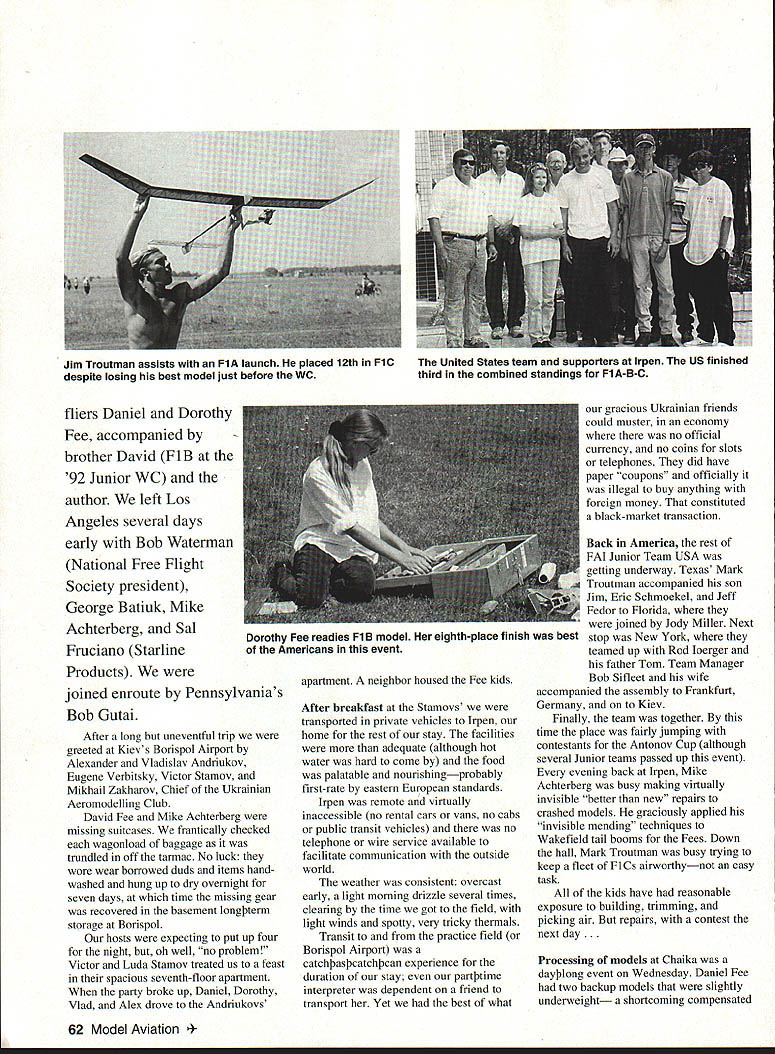
Jim Troutman had lost his number-one model the day before. In the fourth round of the Junior Champs Jim's number-two airplane crossed the tree line and went out of the timers' sight. He missed his max by 60 seconds, and the model was never found. Jeff Fedor had a wingtip fold on his new number-one in the first round, and in the third his number-two took off for Chernobyl with no fuse.
Eric Schmoekel was sick (or so he said) but he flew as best he could and chased for all seven rounds.
During the sixth round Jeff's fuse lighter ignited a whole box of fuses and emitted a large ball of smoke. The Texans laughed hysterically; sometimes things just happen, and Jeff knew that this was a case of having completely lost control. The other teams must have thought that they were going to set fire to the whole flight line as a final act of defiance.
Down the line, the Wakefield team fared a little better. Dorothy Fee maxed in the opening (210-second) round, but the chasers brought her model back with a jagged snap in the right wing panel just beyond the dihedral joint. Brother David and a stranger advised and assisted in repairs. After a short test flight, Dorothy and her twin-finned model went on to drop just 12 seconds. Seven F1B fliers maxed out, so she had to settle for eighth place.
Rod Joerger was taking his third shot at the Junior Wakefield Championship. He got off to a rough start, but finished with five straight maxes.
Daniel Fee had an up-and-down day with four maxes, two near-misses, and a round where the high wind caused a wing to separate at the joiner on launch. The climb was fine, but it stalled in the glide. That misfortune cost the Wakefield team third place in the standings.
In the seventh round Daniel's model was lost beyond the tree line in a field of alfalfa. The next day we found that it had been recovered by a local resident. Bob Waterman offered $10 for the plane. The lady appeared to be upset, so he offered her $15. She was so happy, she kissed him!
F1A — final day
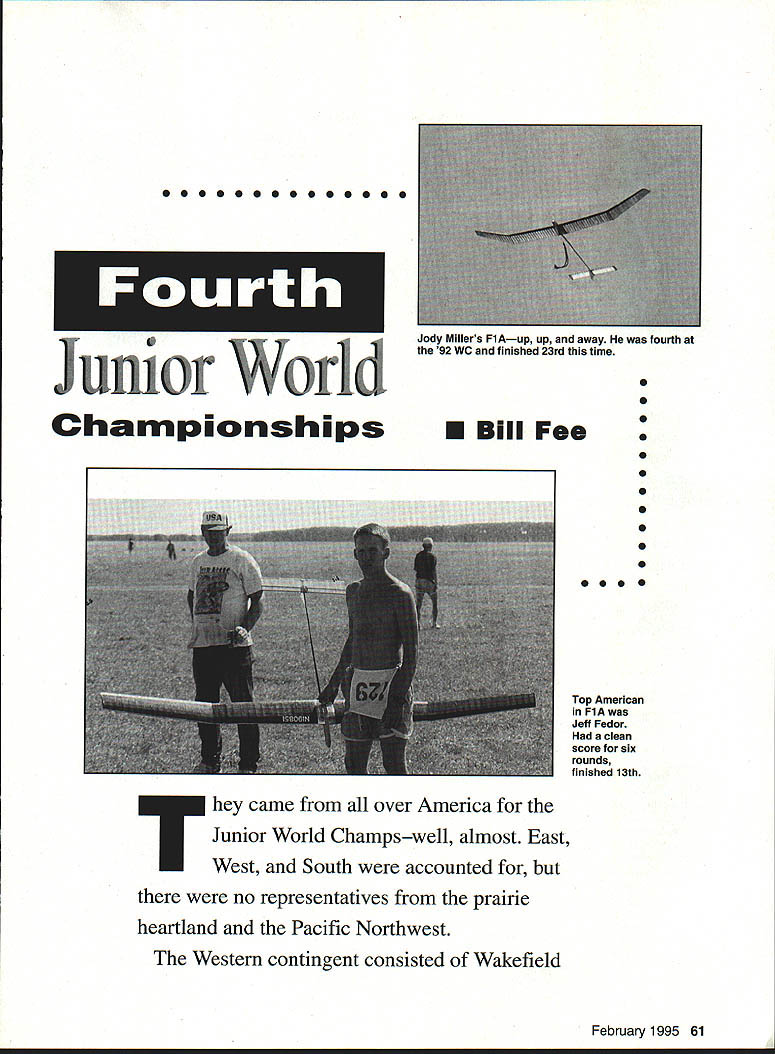
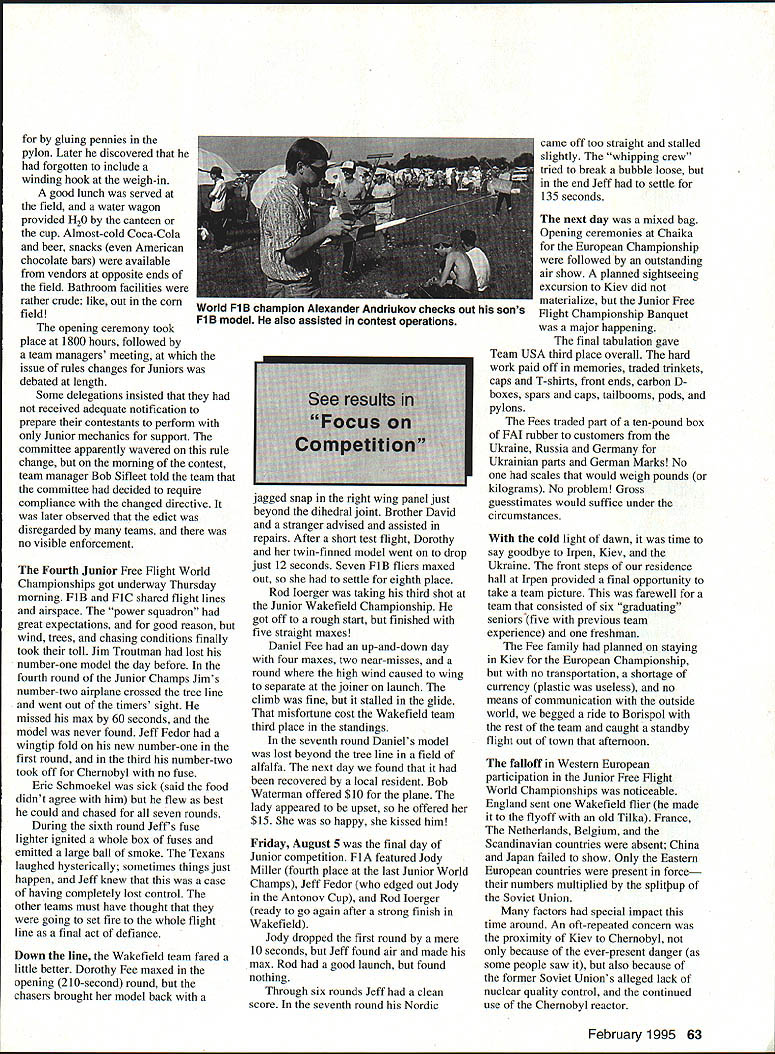
Friday, August 5 was the final day of junior competition. F1A featured Jody Miller (fourth place at the last Junior World Champs), Jeff Fedor (who edged out Jody in the Antonov Cup), and Rod Joerger ready to go again after a strong finish in Wakefield.
Jody dropped the first round by a mere 10 seconds, but Jeff found air and made his max. Rod had a good launch, but found nothing.
Through six rounds Jeff had a clean score. In the seventh round his Nordic came off too straight and stalled slightly. The "whipping crew" tried to break a bubble loose, but in the end Jeff had to settle for 135 seconds.
Aftermath and observations
The next day was a mixed bag. Opening ceremonies at Chaika for the European Championship were followed by an outstanding air show. A planned sightseeing excursion to Kiev did not materialize, but the Junior Free Flight Championship Banquet was a major happening.
The final tabulation gave Team USA third place overall. The hard work paid off in memories, traded trinkets, caps and T-shirts, front ends, carbon D-boxes, spars and caps, tailbooms, pods, and pylons.
The Fees traded part of a ten-pound box of FAI rubber to customers from Ukraine, Russia, and Germany for Ukrainian parts and German marks! No one had scales that would weigh pounds (or kilograms). No problem—gross guesstimates would suffice under the circumstances.
With the cold light of dawn, it was time to say goodbye to Irpen, Kiev, and the Ukraine. The front steps of our residence hall at Irpen provided a final opportunity to take a team picture. This was farewell for a team that consisted of six "graduating" seniors (five with previous team experience) and one freshman.
The Fee family had planned on staying in Kiev for the European Championship, but with no transportation, a shortage of currency (plastic was useless), and no means of communication with the outside world, we begged a ride to Borispol with the rest of the team and caught a stand-by flight out that afternoon.
The falloff in Western European participation in the Junior Free Flight World Championships was noticeable. England sent one Wakefield flier (he made it to the flyoff with an old Tilka). France, the Netherlands, Belgium, and the Scandinavian countries were absent; China and Japan failed to show. Only the Eastern European countries were present in force—their numbers multiplied by the spillup of the Soviet Union.
Many factors had special impact this time around. An oft-repeated concern was the proximity of Kiev to Chernobyl—not only because of the ever-present danger (as some people saw it), but also because of the former Soviet Union's alleged lack of nuclear quality control, and the continued use of the Chernobyl reactor.
Some groups who had planned to travel by car were dissuaded by admonitions about highway security. There was also concern about travel distances, local transportation, communications, food, and the remote location of lodging. And the confirmation of Kiev as the contest site came so late into the summer tourist reservation season that travel costs were prohibitive.
The contest was well run by model aviation enthusiasts who have "been there" and "done that"—former and present world champions. Bus transportation to the actual event was timely and commodious. The scoreboard system introduced at last year's World Championship was used, with pasteboard colored disks representing maxes. Scores were posted on a continuing basis. By the end of each round, almost all of the results were already in view.
The flyoffs proceeded in orderly fashion. Winning models were carefully processed for area and weight in full view of contestants and onlookers. Victor Stamov, Eugene Verbitsky, and Alex Andriukov were everywhere, on the job, answering questions, and solving problems.
Vendors formed a second "flight line" to hawk their wares. Many of the participants were also selling between rounds. Tom Joerger bought the model that won the Antonov Cup.
Kiev '94 was an unforgettable experience for all who made the trip. But in the end, how great it is to be able to call America home!
Transcribed from original scans by AI. Minor OCR errors may remain.

