
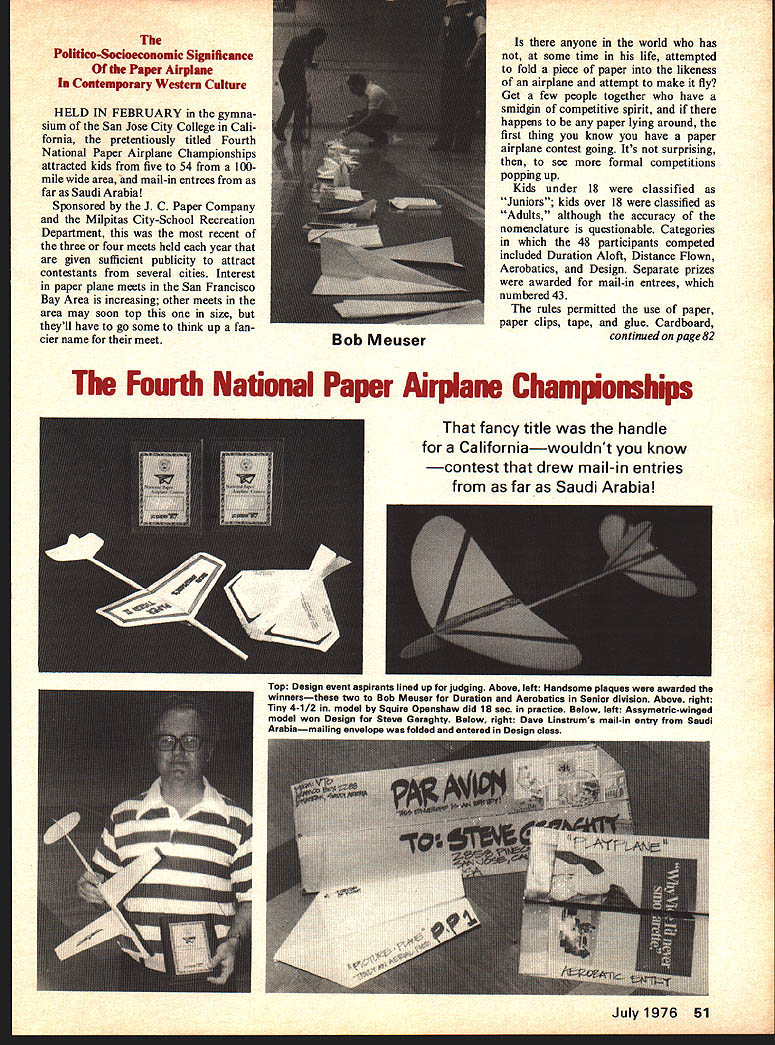
The Fourth National Paper Airplane Championships
The Politico-Socioeconomic Significance Of the Paper Airplane In Contemporary Western Culture
HELD IN FEBRUARY in the gymnasium of the San Jose City College in California, the pretentiously titled Fourth National Paper Airplane Championships attracted kids from five to 54 from a 100-mile wide area, and mail-in entrees from as far as Saudi Arabia.
Sponsored by the J. C. Paper Company and the Milpitas City-School Recreation Department, this was the most recent of the three or four meets held each year that are given sufficient publicity to attract contestants from several cities. Interest in paper plane meets in the San Francisco Bay Area is increasing; other meets in the area may soon top this one in size, but they'll have to go some to think up a fancier name for their meet.
Is there anyone in the world who has not, at some time in his life, attempted to fold a piece of paper into the likeness of an airplane and attempt to make it fly? Get a few people together who have a smidgin of competitive spirit, and if there happens to be any paper lying around, the first thing you know you have a paper airplane contest going. It's not surprising, then, to see more formal competitions popping up.
Kids under 18 were classified as "Juniors"; kids over 18 were classified as "Adults," although the accuracy of the nomenclature is questionable. Categories in which the 48 participants competed included Duration Aloft, Distance Flown, Aerobatics, and Design. Separate prizes were awarded for mail-in entrees, which numbered 43. The rules permitted the use of paper, paper clips, tape, and glue.
That fancy title was the handle for a California—wouldn't you know—contest that drew mail-in entries from as far as Saudi Arabia! Wood, and rubberbands were prohibited. A file folder was considered cardboard. A different model could be flown in each event, except that entrants flown in the Design event had to be flown in one of the other events also.
Most of the planes entered in the Junior events were simple fold-up affairs, and some did remarkably well. Bob O'Connor's best Duration flight stayed up 9.6 seconds. If that doesn't sound like much, try it! Randy Wallingford captured the Distance event; his flight went the entire 112-ft. length of the gym and hit the end wall 6 ft. above the floor. Several others did nearly as well.
Models entered in the Adult division tended to be more sophisticated. Sizes ranged from Squire Openshaw's tiny 4-1/2-in. copy of a successful balsa hand-launch glider to an elaborate 15-in. machine built by Bill Vanderbeek. The most successful Distance models were simple darts that followed an arched ballistic trajectory.
While some practice flights of over 15 seconds were made, no one managed to do well consistently in the competition. Each contestant was allowed only two flights, and consistency is not something paper planes are noted for. The best flight—over 13 seconds—was posted by Bob Meuser, who repeated his win of the previous year. Meuser, at 54 the oldest in the contest, also captured the Aerobatics event with a plane that flew as well inverted as upright, and terminated its aerobatic display with a half-dozen loops followed by a tail-first soft landing.
By an unanimous decision of the five judges, the first-place award for Design went to Steve Geraghty, who entered an asymmetric-wing model which he also flew in the Duration event. Distance winner Brian Shea, a frequent winner in all classes and inventor of the Wing-Bat flying toy, flew his model into the wall 20 ft. above the floor at the end of the 112-ft.-long gym.
A paper airplane contest can be a rewarding experience for the participants, and a mixed bag of a lot of both fun and hard work for the organizers. It can also be complete chaos if it is not well planned. The rules for the competition and the construction of the models must be spelled out clearly and completely. Organizers must decide whether to encourage sophisticated designs that require several evenings of work to build, or whether to limit the competition to simple fold-up designs employing no tape or glue. Because of the inconsistent nature of paper planes, at least two flights should be permitted, and preferably three or four if time permits.
Processing mail-in entries properly is a lot of work. The models should be flown by persons who are adept at the art of flying and adjusting them, and a few practice flights should be permitted in order to make the adjustments that are invariably required. Without that, it becomes a mere game of chance.
Publicity should be geared to the participation desired. A small notice in the school paper will pull a handful of contestants. A clever ad in the New York Times and Time magazine might get 10,000 mail-ins, as it did for the Great International Paper Airplane Contest sponsored by Scientific American magazine. End-to-end, that's two miles of paper airplanes! I mean, in hats.
Transcribed from original scans by AI. Minor OCR errors may remain.

