
FOX RACING
Les Byrd
In this age of programmable whatsits, automatic machine tools, microprocessor-based coffeemakers, and high-tech aerospace materials, there is a cadre of people who still like things simple. If you are one of these people, Fox Racing may be for you.
Fox Racing is not new; there have been several regional versions over the years (FoxBerg, FoxyHazel, Fox Sport Race, Fox Buzz, Fox Goodyear, etc.). The events were similar in concept but allowed only the use of a stock Fox Stunt .35 and a suction-fuel system, with variations in accessories and airplane configuration (landing gear, wing area and thickness, props, shutoffs, fuel, etc.). With the formation of the National Control Line Racing Association (NCLRA), an effort was made to standardize Fox Racing rules. The event was supplemental at the 1996 National Aeromodeling Championships (Nats) and drew strong entries.
Some call Fox Racing a "beginner's event" — it is a good place to start if you are new to racing — but many experienced competitors love it for its simplicity and competitiveness. The fundamentals are familiar: a solid, slightly nose-heavy (stable) airplane with bulletproof landing gear, a loose engine (but good hot-restart compression), and lots of practice with and without traffic.
Engine
- Engine: stock Fox Stunt .35. No metal may be removed or added. Screws may be replaced and the needle/spraybar may be substituted, but no other aftermarket parts (stuffer backplates, button heads, etc.) are permitted. Filing off the front muffler screw lug to avoid burns during a choke restart is commonly tolerated.
- Mounting: Some competitors prefer to enlarge the mount screw holes and use 6-32 screws instead of #4s for added security; not required, but harmless.
- Variations: There have been many versions of the Fox Stunt .35. Some start and restart better than others. Mid-1970s shiny-case, tumbler-finished units with external muffler screw lugs and two tapped holes near the exhaust are prized for one-flip restarts, but you can succeed with many other examples if you learn a good restart routine.
- Priming: Some pit crews carry a small squeeze bottle of straight castor oil or Marvel Mystery Oil to prime the engine for hot restarts — it enhances piston/liner seal for better compression and quicker restarts.
- Glow plugs: Fox glow plugs work well; K&B iL plugs have also been used successfully for long service life.
Propeller
- Rules: commercially available wood or plastic 9x6 or 9x7 props.
- Recommendation: black Grish (Tornado) 9x7 — substantial blade area, heavy for good flywheel effect, durable, and holds pitch well on a vibrating Fox. It helps starting and survives scuffs in the pits.
- Alternative: APC 9x7 can allow higher rpm and more speed but requires a light, clean airplane to be effective.
Fuel
- Typical contest fuel: 10% nitro, minimum 20% castor oil lubricant.
- Note: 22–25% castor oil won't hurt and will probably help restarts.
Tank
- Type: square-wedge uniflow tank, typically 1½ to 2½ ounces capacity.
- Because there is no shutoff in Fox Racing, monitor fuel carefully to meet the prescribed number of pit stops.
- Filling guideline: use a Sig five-ounce syringe and put in about 35 cc (≈1.25 oz) per pit stop — roughly one lap per cc and about 35 laps per full 35 cc tank.
- Pit-stop strategy: experiment with short/long tanking but beware too-short tanks (may not pick up for restart) and too-long first tanks (may force awkward short-tanking later).
Plumbing and airframe
- Tank plumbing: use a good suction uniflow tank for consistent feed and crisp end-of-run shutoff. The overflow vent must be uncapped for filling and recapped before starting.
- Quick fill/venting solutions:
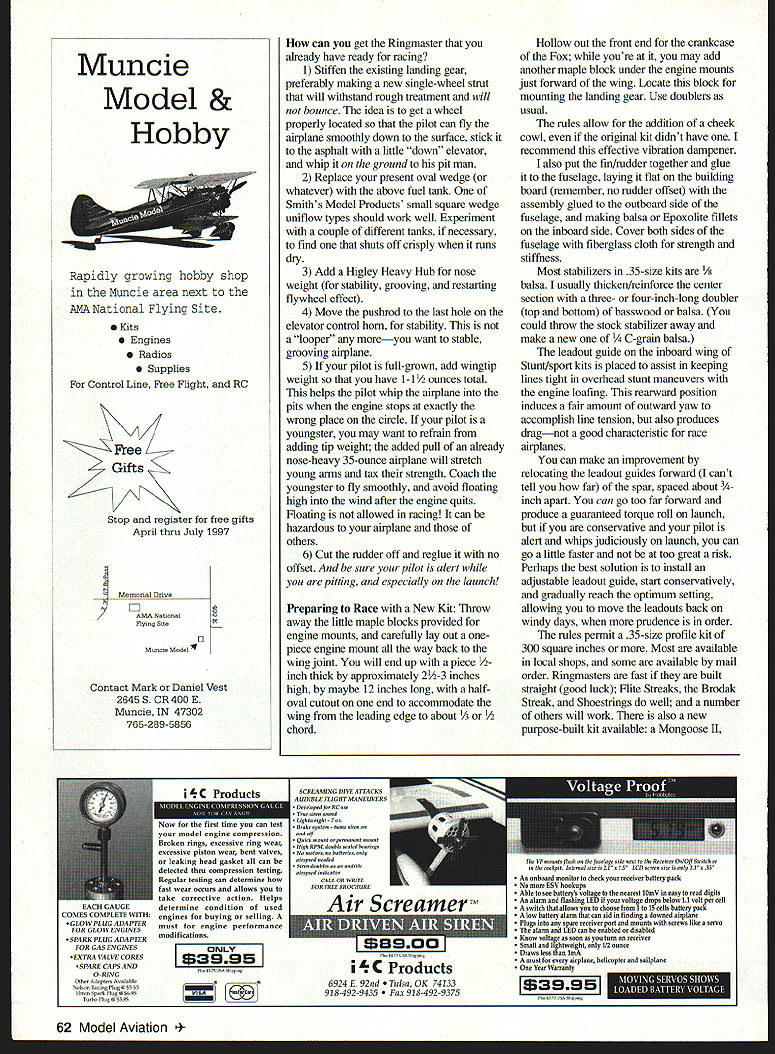
- Early method: solder an alligator clip to the tank with tubing to the vent; clip opens the vent while filling and seals it when released.
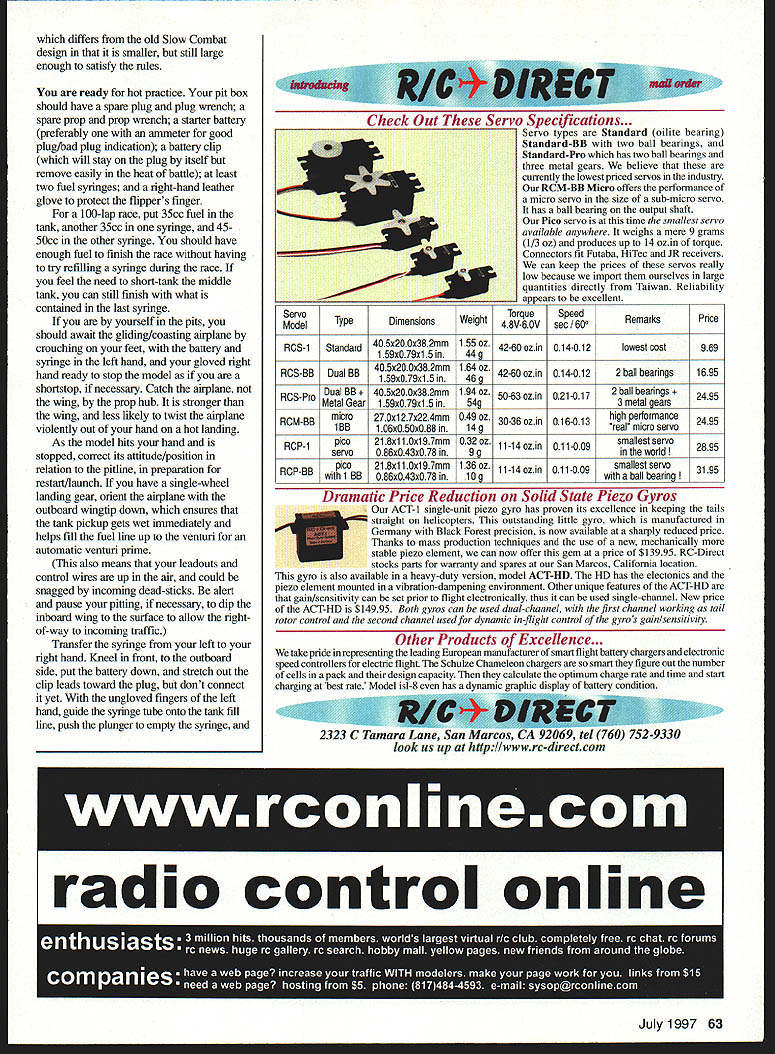
- Preferred method: Kustom Kraftsmanship #515 one-way inline ball-check valve in the overflow line — vents air while filling but prevents outside air entry, and creates slight positive pressure to force fuel up to the venturi for priming.
- Use a fuel filter between tank and needle; wire-on all tubing connections.
- Structure: hollow out the front end for the Fox crankcase; add a maple block under the engine mounts forward of the wing and locate it for landing-gear mounting. Use doublers as needed.
- Cheek cowl: permitted and recommended as a vibration dampener.
- Tail assembly: glue fin/rudder together and to the fuselage, lay flat on the building board (no rudder offset), and make fillets on the inboard side. Cover both sides of the fuselage with fiberglass cloth for strength and stiffness.
- Stabilizer: most stock .35 stabilizers are 5/16" balsa; reinforce the center with a 3–4" doubler top and bottom of basswood or balsa, or replace with a 1/4" C-grain balsa stab.
Leadouts and kit choices
- Leadouts: the stock inboard leadout guide on stunt/sport kits is rearward (for stunt line tension) and produces drag. Move the leadout guides forward (trial-and-error; start conservatively) and space them about 3/4" apart. Too far forward risks a torque roll on launch. An adjustable leadout guide is ideal: start conservative and fine-tune for conditions.
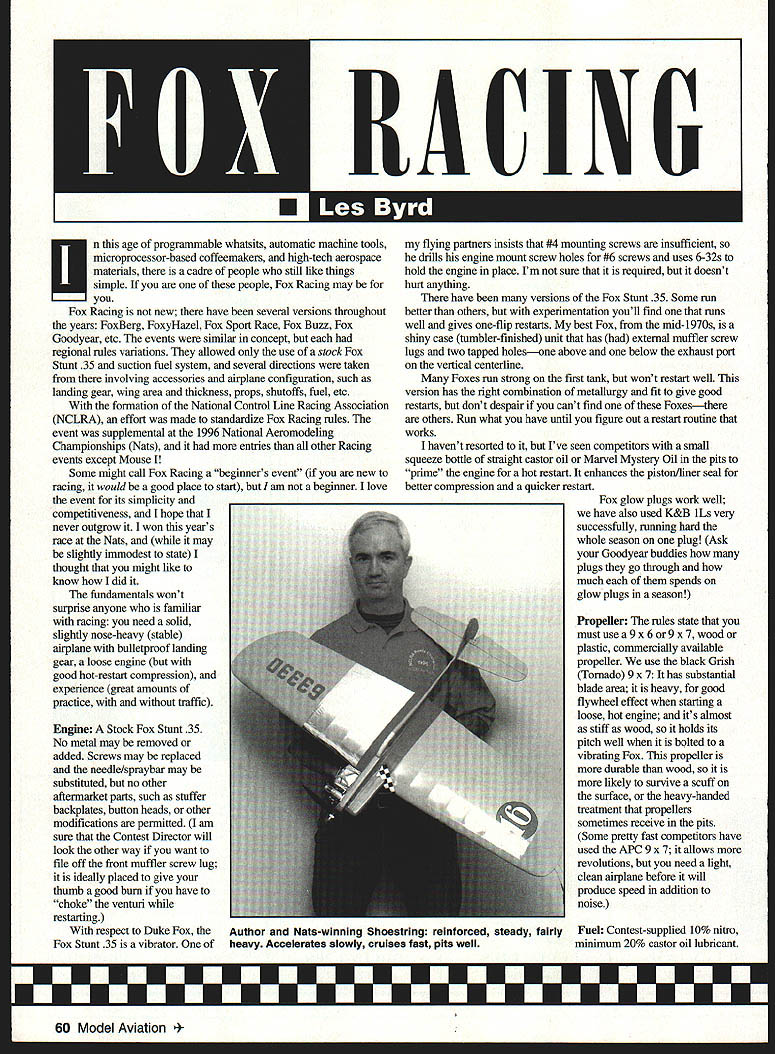
- Kits: .35-size profile kits of 300 in² or more are permitted. Ringmasters (if built straight), Flite Streaks, Brodak Streak, Shoestrings, and purpose-built Mongoose II are all good choices.
Pit procedures and equipment
- Pit box essentials:
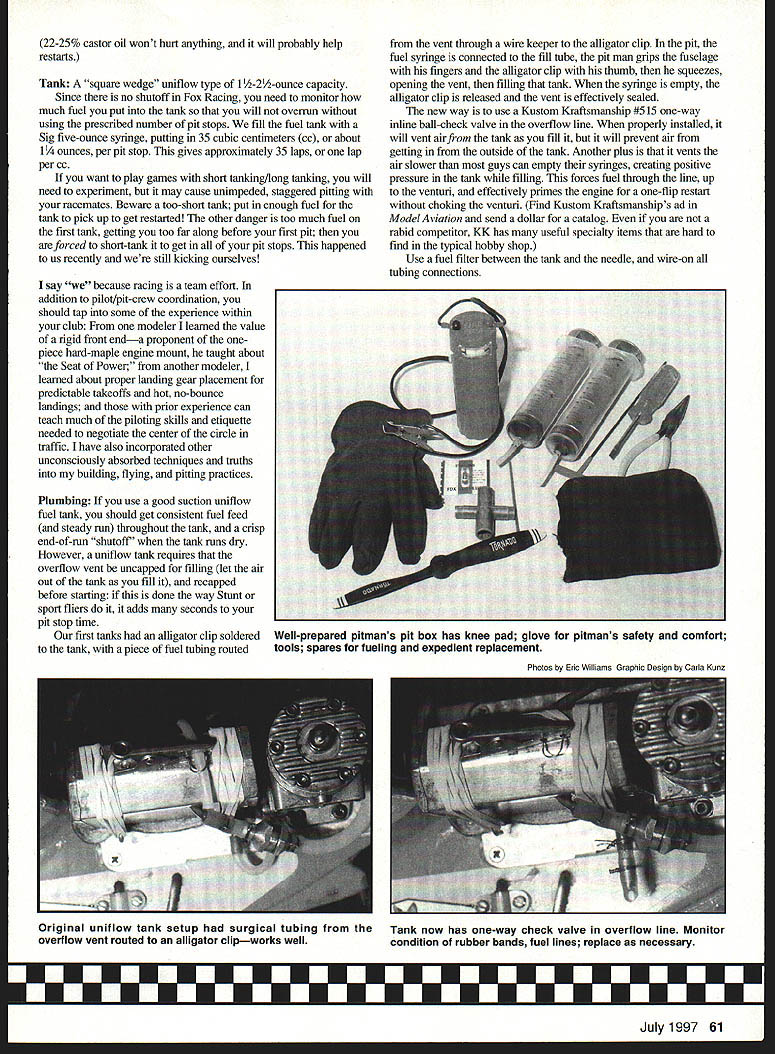
- Spare plug and plug wrench
- Spare prop and prop wrench
- Starter battery (preferably with an ammeter)
- Battery clip (secure but easy to remove)
- At least two fuel syringes (Sig five-ounce recommended)
- Right-hand leather glove for the flipper's finger
- Fuel planning example for a 100-lap race:
- Put 35 cc in the tank for the first pit stop
- Carry one syringe with 35 cc and another with 45–50 cc (so you can finish without refilling a syringe during the race)
- Solo-pit technique:
- Await the gliding airplane by crouching on your feet with the battery and syringe in your left hand and gloved right hand ready to stop the model. Catch the airplane by the prop hub (stronger than the wing).
- Correct attitude/position relative to the pit line preparing for restart/launch.
- For single-wheel gears, orient the airplane with the outboard wingtip down so the tank pickup wets immediately, helping to prime the fuel line.
- Transfer the syringe to the right hand if needed; kneel on the outboard side, set the battery down and stretch the clip leads toward the plug (do not connect yet).
- With ungloved left fingers, attach the syringe tube to the tank fill line and push the plunger until empty; toss the syringe aside safely.
- Attach the battery clip to the plug with your left hand, retreat to hold the fuselage for flipping, and use your right hand to flip the prop on compression for a one- or few-flip restart.
- If the first flips fail (engine dry), choke the venturi once or twice and try again — practice to learn your engine's preference.
- Once restarted, use your right hand to carefully remove the battery clip, and use your left hand to release the model pointing straight ahead or slightly outward.
- Collect battery and remaining syringe and check laps.
- With a helper/holder: the holder manages battery, launch orientation, clip application/removal, and release; the starter still catches, flips, and handles plugs/props if needed.
- Pit demeanor: practice smooth, deliberate, economical motions. Rapid, jerky handling often leads to errors and breakage.
Restart tips
- One-flip restarts are possible with the right engine and priming routine.
- Ball-check overflow valves and slight positive pressure while filling can help prime to the venturi and allow one-flip restarts without choking.
- If lean from running and the tank just ran dry, choke the venturi briefly before flipping to speed restarting.
Piloting fundamentals
- Takeoff position: crouch on the pilots' outer circle, slightly ahead of the line from the circle center to your pitman. Keep the inboard wing "ahead" to reduce slack lines on launch.
- Launch: do not pull the airplane out of the pitman's hands until he/she is clear; immediately enter the pilots' circle on an angle (not backing straight up) to avoid stepping on or impeding others.
- Flying: fly level and smooth with the handle chest- or neck-high and close to your body. Be aware of others pitting or flaming out.
- Passing hazards: watch for lines catching on hat buttons; other pilots should crouch and keep heads low when active aircraft pass.
- On flameout:
- Immediately leave the inner circle in a semi-crouch; do not climb the airplane (unpowered models high in wind are hazardous).
- Bring the airplane down in a smooth, steady descent toward your pitman.
- Stay ahead of the airplane until you reach a spot on the outer circle in line with your pitman and the center.
- Set the airplane down about 1/4 lap before your pit and whip it on the ground into the waiting arms of your pit crew.
- After the pit crew has the airplane, take a couple of steps ahead on the outer circle to regain the lead position for the next launch.
Organization and resources
- For full NCLRA Fox Racing rules and more racing information, join the NCLRA. They are well organized, have local presence with AMA in Muncie, and publish an informative newsletter.
- Send $10 to:
- Jerry Meyer
- 8 S. Grace St.
- North Aurora, IL 60542
Les Byrd 4561 Ozias Rd. Eaton, OH 45320
Sources:
- Fox Manufacturing Co.
- 5305 Towson Ave.
- Fort Smith, AR 72901
- Kustom Kraftsmanship
- Box 3010
- Fallbrook, CA 92088
- Smith’s Model Products
- 521 Jansen Ave.
- San Dimas, CA 91773-1617
- Pat Matson (Mongoose II kit)
- 9609 S. Olive St.
- Muncie, IN 47302
Transcribed from original scans by AI. Minor OCR errors may remain.

