
Frank Fuller's Seversky SEV-S2
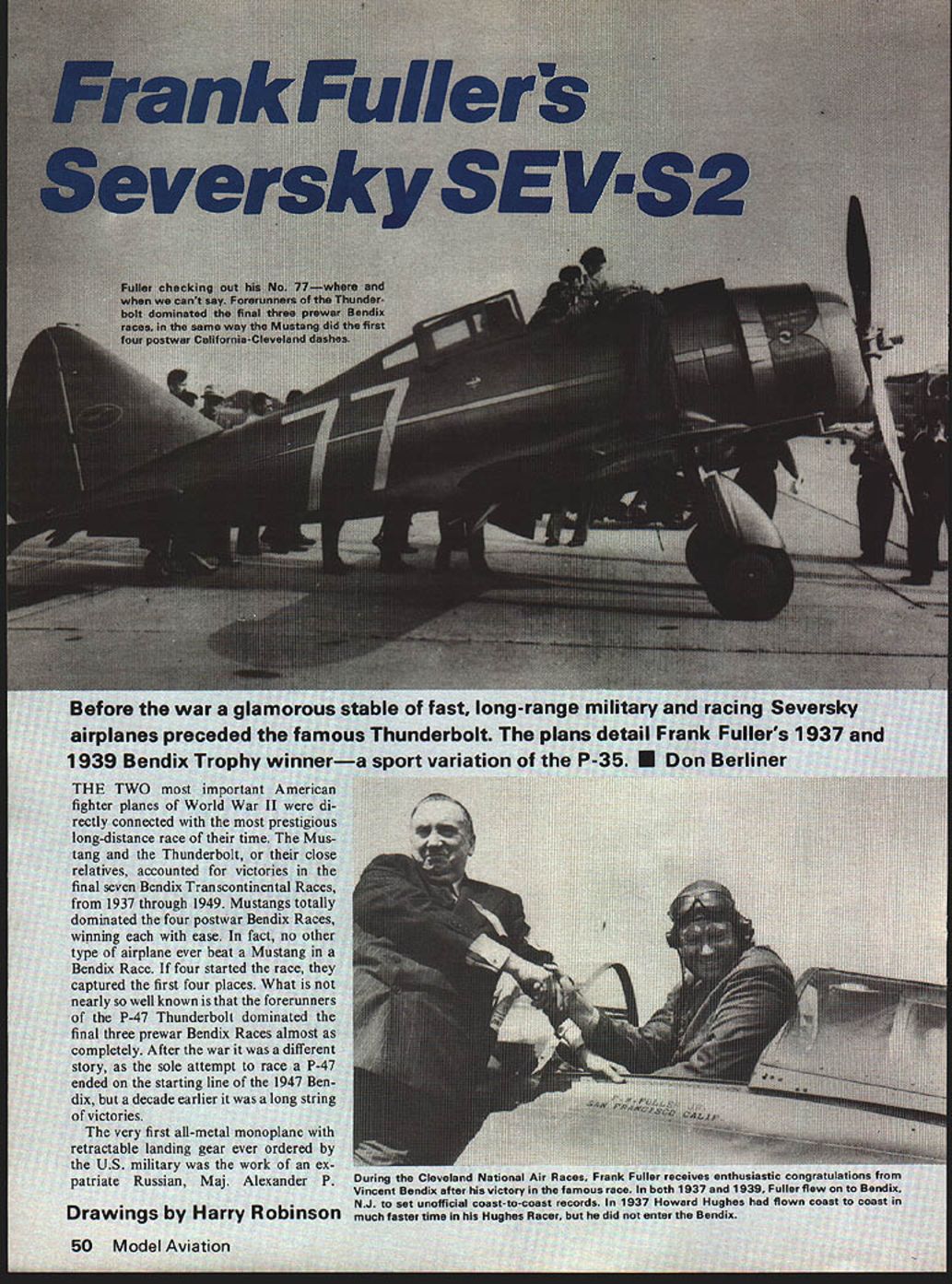
Before the war, a glamorous stable of fast, long-range Seversky military and racing airplanes preceded the famous Thunderbolt. This article details Frank Fuller's Seversky SEV-S2 — a sport variation of the P-35 and winner of the Bendix Trophy — and the factory lineage that led to the Republic P-47.
The Bendix connection and early significance
The two most important American fighter planes of World War II were directly connected with the most prestigious long-distance race of their time. The Mustang and the Thunderbolt, or their close relatives, accounted for victories in the final seven Bendix Transcontinental Races from 1937 through 1949. Postwar, Mustangs dominated the Bendix: no other type ever beat a Mustang in that event.
Less well known is that the forerunners of the P-47 Thunderbolt dominated the final three prewar Bendix Races almost as completely. The Seversky company’s fast, long-range designs served both as racing machines and as developmental steps toward the Thunderbolt.
Alexander P. de Seversky and the company lineage
The very first all-metal monoplane with retractable landing gear ever ordered by the U.S. military was the work of an expatriate Russian, Maj. Alexander P. de Seversky. De Seversky’s company developed a line of low-wing, radial-engined airplanes that culminated in the Seversky P-35 and the later P-43 Lancer. While the P-35 and P-43 never became legendary fighters in combat, they were important stepping stones to the Republic P-47 Thunderbolt.
The first American-built Seversky was a twin-float amphibian, the Model SEV-3 (registration X-2106). In that type, "Sasha" Seversky set world amphibian speed records: 180 mph with a 350-hp engine in 1933, and 230 mph with a 710-hp engine in 1935.
Another early machine went through several conversions and served both as a prototype for the production P-35 and as a racer. Registered X-18Y, it began life as a three-place military amphibian (SEV-3M), was modified into a two-place pursuit (SEV-2XP), then to the single-seat P-35 prototype (SEV-1XP), and finally became known as the SEV-7. In its final form it was powered by an 850-hp Pratt & Whitney R-1830 Twin Wasp.
Racing highlights and notable pilots
Seversky aircraft made strong showings at the Cleveland Air Races and in the Bendix Transcontinental. Some highlights:
- 1937: Company pilot Frank Sinclair flew a Seversky to fourth place in the 1937 Bendix Transcontinental Derby at 184.92 mph and then placed fourth in the Thompson Trophy at 252.36 mph. (This airplane was later scrapped circa 1938–39.)
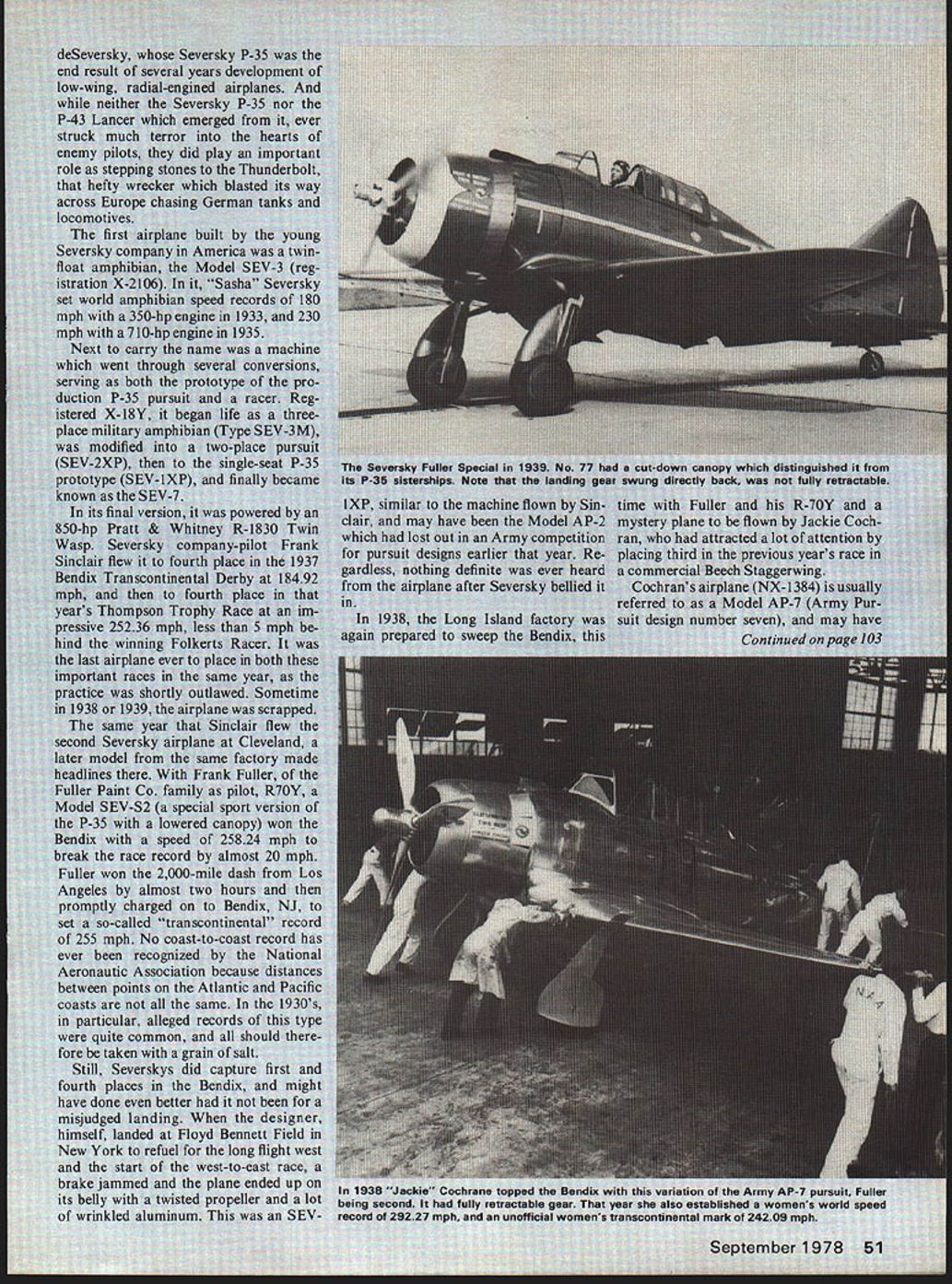
- 1937: Frank Fuller, of the Fuller Paint Co. family, flew R-70Y, a Model SEV-S2 (a special sport version of the P-35 with a lowered canopy), to win the Bendix at 258.24 mph, breaking the race record by almost 20 mph. Fuller also set a so-called "transcontinental" record of 255 mph from Los Angeles to New York (such coast-to-coast claims were often unofficial and not recognized by the National Aeronautic Association).
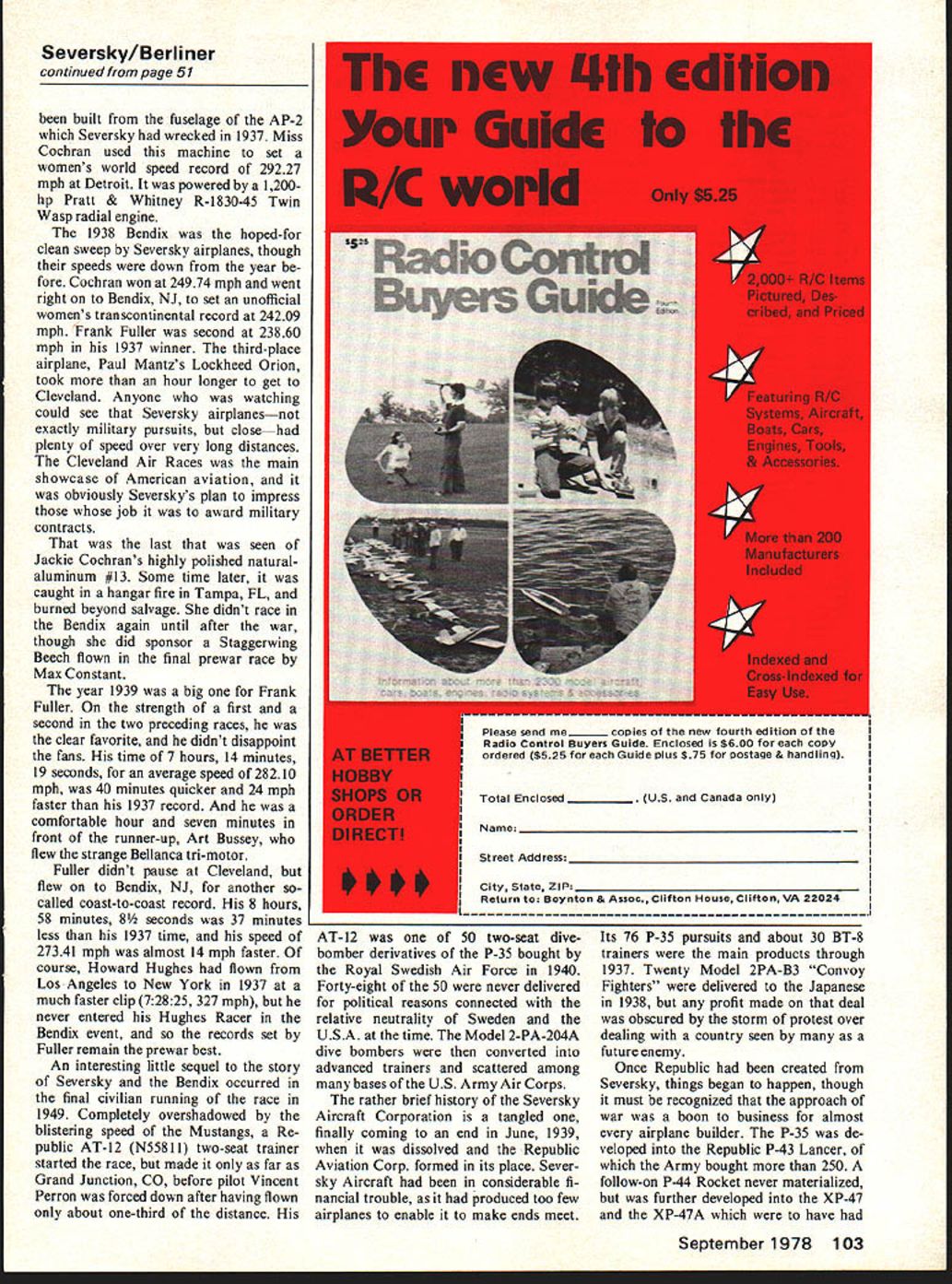
- 1938: Jackie Cochran flew an AP-7 (NX-1384), possibly built from the fuselage of the earlier AP-2, powered by a 1,200-hp Pratt & Whitney R-1830-45. She set a women's world speed record of 292.27 mph at Detroit and won the 1938 Bendix at 249.74 mph, then set an unofficial women's transcontinental mark of 242.09 mph. Frank Fuller finished second in 1938 at 238.60 mph.
- 1939: Frank Fuller won again, clocking 7:14:19 (average 282.10 mph) for the Bendix, 40 minutes faster and 24 mph quicker than his 1937 time. He arrived in Cleveland about an hour and seven minutes ahead of runner-up Art Bussey, who flew a Bellanca tri-motor. Fuller continued to Bendix, N.J., recording an 8:58:08.5 coast-to-coast time at 273.41 mph — nearly 14 mph faster than his 1937 coast-to-coast figure.
Jackie Cochran’s polished natural-aluminum #13 (her AP-7) later was destroyed in a hangar fire in Tampa, Florida, and she did not race in the Bendix again until after the war.
The 1949 coda
An interesting postscript occurred in the final civilian running of the Bendix in 1949. A Republic AT-12 (N55811), a two-seat trainer derived from the P-35 line, started the race but was forced down at Grand Junction, Colorado, after covering roughly one-third of the distance. That AT-12 belonged to a batch of dive-bomber derivatives originally built for Sweden in 1940; political complications prevented delivery and many of those airframes were converted into trainers for the U.S. Army Air Corps.
Company troubles and the birth of Republic
The Seversky Aircraft Corporation had a tangled financial history and was dissolved in June 1939. From its remains the Republic Aviation Corporation was formed. Seversky had produced too few aircraft to remain solvent: about 76 P-35s and roughly 30 BT-8 trainers through 1937, plus twenty Model 2PA-B3 "Convoy Fighters" delivered to Japan in 1938 (a deal that provoked controversy).
Under Republic, development accelerated. The P-35 evolved into the P-43 Lancer (over 250 built for the Army). A planned P-44 Rocket never materialized directly, but its development led to the XP-47 and XP-47A prototypes. Those prototypes were initially conceived with Allison V-12 engines that were never used in production. Needing far more horsepower, Republic enlarged the basic airframe and installed a 2,000-hp Pratt & Whitney radial; the result was the rugged and powerful P-47 Thunderbolt. Production of the Thunderbolt ran continuously until more than 15,000 had been built — more than any other American fighter type.
Legacy
What began as a line of sleek pursuit and racing planes from an expatriate designer culminated in one of the great American fighters of World War II. The Seversky racers proved speed and long-range capability in the public spotlight of the Cleveland Air Races and the Bendix Transcontinental — achievements that helped carry the company's designs forward into the Republic P-47 Thunderbolt era.
Notable race results (summary)
- 1937: Frank Fuller, SEV-S2 (R-70Y) — Bendix winner, 258.24 mph; transcontinental claim ~255 mph.
- 1937: Frank Sinclair — fourth in Bendix (184.92 mph) and fourth in Thompson Trophy (252.36 mph).
- 1938: Jackie Cochran, AP-7 (NX-1384) — Bendix winner, 249.74 mph; women's speed record 292.27 mph; unofficial transcontinental 242.09 mph.
- 1938: Frank Fuller — second, 238.60 mph.
- 1939: Frank Fuller — Bendix winner, 7:14:19 (avg. 282.10 mph); coast-to-coast 8:58:08.5 (273.41 mph).
- 1949: Republic AT-12 (N55811) — started final civilian Bendix but forced down at Grand Junction, CO.
Transcribed from original scans by AI. Minor OCR errors may remain.

