
FF Indoor
Clarence Mather
Venue and conditions
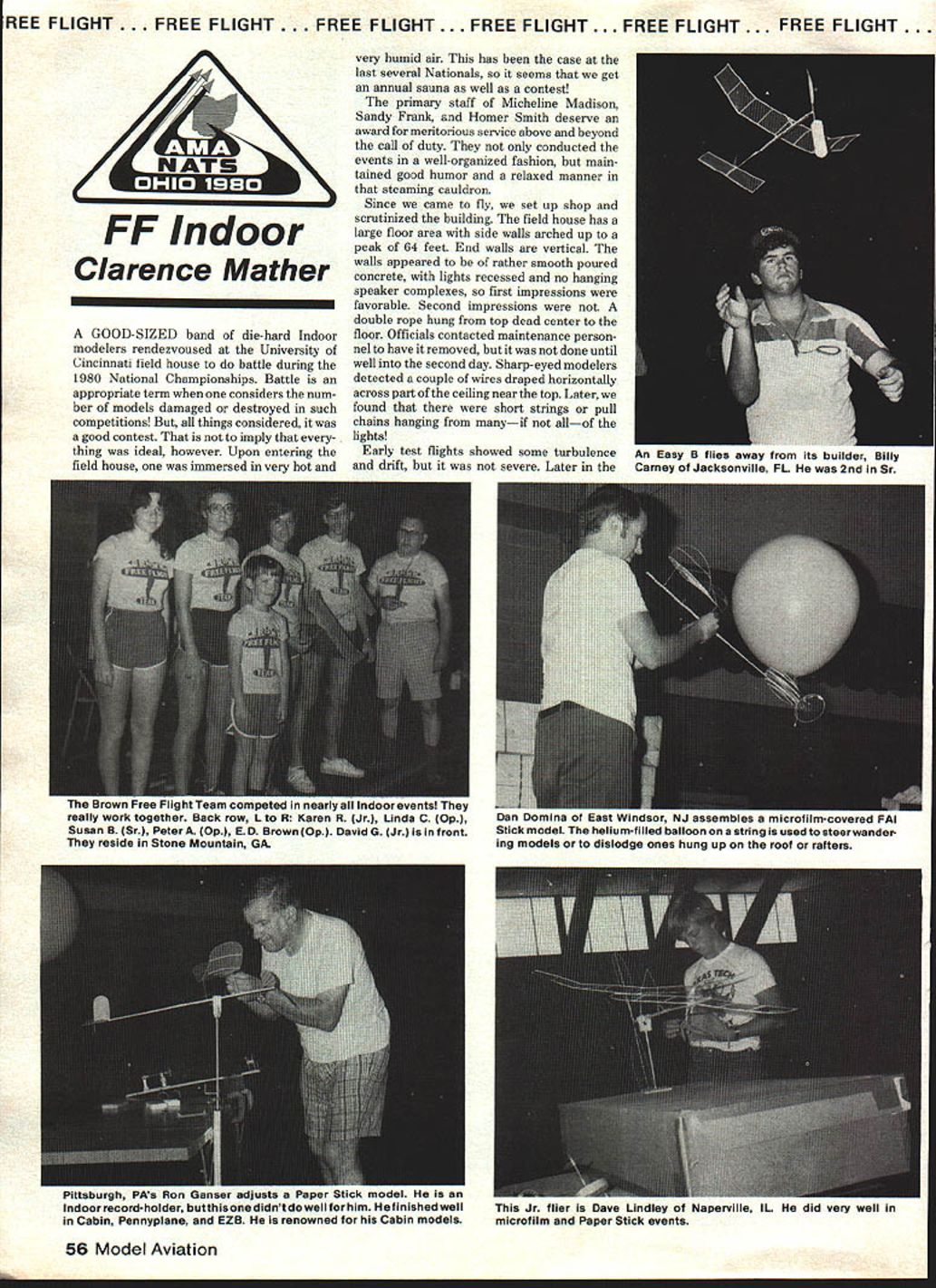
A good-sized band of die-hard indoor modelers rendezvoused at the University of Cincinnati field house to do battle during the 1980 National Championships. "Battle" is an appropriate term when one considers the number of models damaged or destroyed in such competitions! All things considered, however, it was a good contest — not that everything was ideal. Upon entering the field house, one was immersed in very hot and very humid air. This has been the case at the last several Nationals, so it seems we get an annual sauna as well as a contest.
The primary staff of Micheline Madison, Sandy Frank, and Homer Smith deserve an award for meritorious service above and beyond the call of duty. They not only conducted the events in a well-organized fashion, but maintained good humor and a relaxed manner in that steaming cauldron.
Since we came to fly, we set up shop and scrutinized the building. The field house has a large floor area with side walls arched up to a peak of 64 feet; end walls are vertical. The walls appeared to be of rather smooth poured concrete, with lights recessed and no hanging speaker complexes, so first impressions were favorable. Second impressions were not. A double rope hung from top dead center to the floor. Officials contacted maintenance personnel to have it removed, but it was not done until well into the second day. Sharp-eyed modelers detected a couple of wires draped horizontally across part of the ceiling near the top. Later, we found short strings or pull chains hanging from many — if not all — of the lights!
Early test flights showed some turbulence and drift, but it was not severe. Later in the day the air became stable.
Early flights and FAI / AMA Stick activity
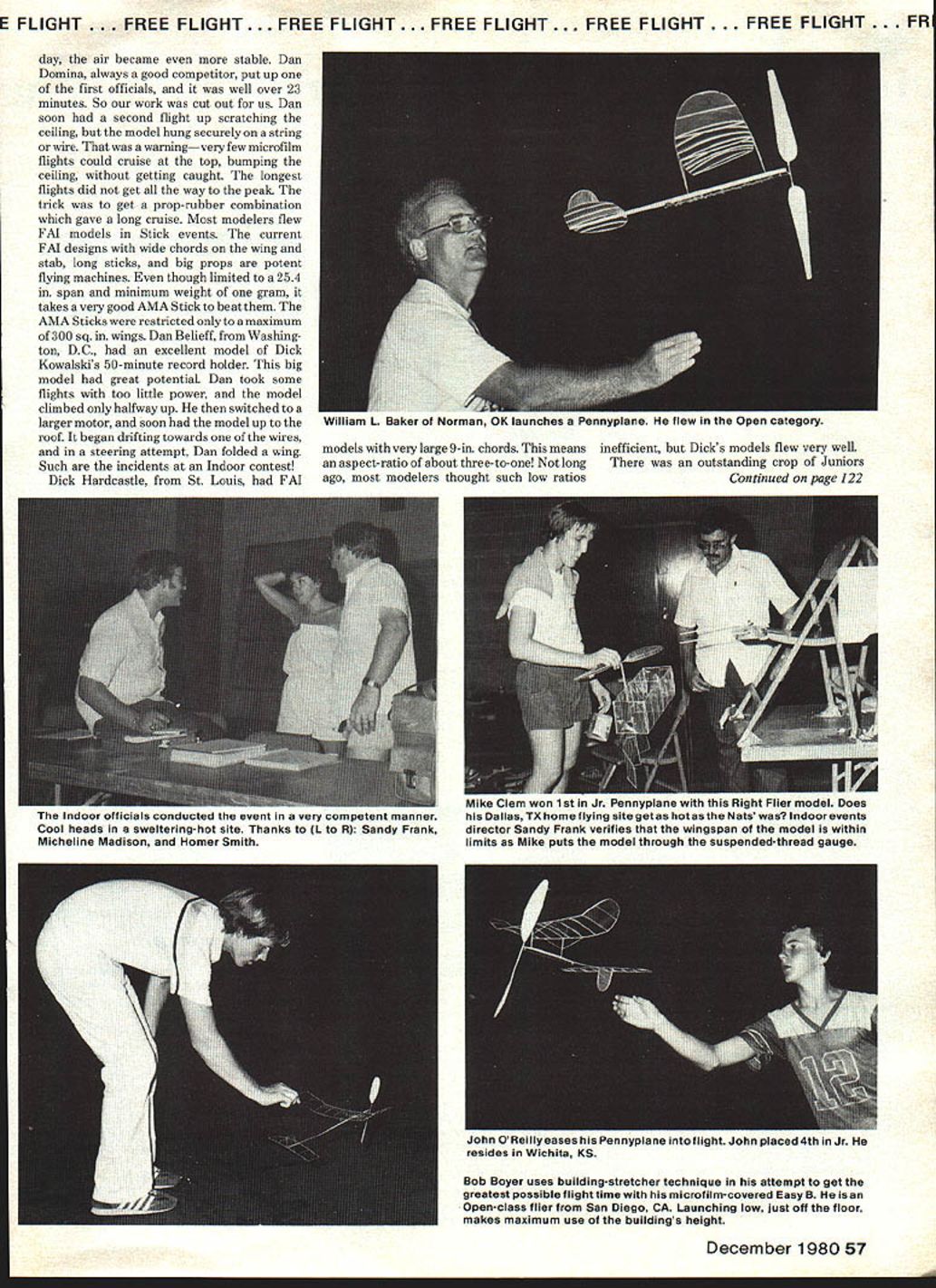
Dan Domina, always a good competitor, put up the first official flight well over 23 minutes. So work was cut out for the rest of us. On Dan’s second flight, while scratching the ceiling, the model hung securely on a string or wire — a warning that very few microfilm flights could cruise at the top without bumping the ceiling and getting caught. The longest flights did get away; the peak trick was to find a prop-rubber combination that gave a long cruise.
Most modelers flew FAI models. Current FAI Stick designs feature wide-chord wings, long stabs, long sticks, and big props — potent flying machines, though limited by a 254 mm span minimum. The AMA Sticks were restricted only to a maximum of 300 sq. in. wings.
Dan Belieff, from Washington, D.C., had an excellent model of Dick Kowalski's 50-minute record holder. This big model had great potential. Dan took some flights with too little power and the model climbed only halfway up. He then switched to a larger motor and soon had the model up to the roof. It began drifting towards one of the wires and, in a steering attempt, Dan folded a wing. Such are the incidents at an indoor contest!
Dick Hardcastle, from St. Louis, had FAI models with very large 9-in. chords. This means an aspect ratio of about three-to-one! Not long ago, most modelers thought such low ratios inefficient, but Dick's models flew very well.
Notable models and builders
Due to the humidity and heat, or whatever, the planes were not up to their usual form. Walt Egger, flying a very nice DH 60, and Warren Weisenbach, with a lovely Ramsey Bathtub, had no power problems; in fact, they might even have gotten away with a bit less. It's nice to have a bit more engine than you normally fly with "just in case."
Dave Rees' Bellanca Skyrocket, from a Flyline kit, was neatly built and even featured curtains in the windows. Dave used the old O.K. CO-2 powerplant in conjunction with a large Peck tank. The Skyrocket had some very nice flights between 20 and 30 seconds. As power is judged on realism of flight, with a 20-second minimum this is plenty.
The Lee-Richards annular monoplane that the writer brought was the only electric-powered plane there, and despite the rough takeoff surface, we managed to get in a few good ROGs. With four wheels on the ground the plane tracks straight for a long run and gives a gentle lift-off with the Astro .02 motor and four 1/4"-length NiCad packs. Mainly because of its configuration and good flight characteristics, the model was awarded the NASA FF Outdoor Scale Achievement award. The model weighed about 13 oz., with 265 square inches.
Some of the really outstanding and striking models at this year's outdoor event included:
- Dave Rees' rubber Caudron Simoun
- Jack McGillivray's red-and-white Missel Thrush combo
- Bob Clemens' lovely Farman Jabiru CO-2 and Peanut-class Pacific Standard "C" racer
- Rolf Gregory's Lindberg-kit Stinson Reliant rubber ship
- Joseph Scuro's nifty red Stinson Voyager rubber ship
- John Blair's Stinson SM-2
- Curt Sandford's J-3 Cub
Junior events
There was an outstanding crop of juniors in this most difficult of indoor events. A hard-fought contest developed. First, Ron Ganser, from Pittsburgh and a record holder in Indoor Cabin, put up a fine 17:29 flight which held the lead for a while. Next, young Bill Shailor, from Detroit, with a beautifully built model, did a great 18:54. Finally, near the end of the day, Larry Loucka, from the Cleveland area, assembled his very light, superb model and did a terrific 19:04! Bill Shailor had put his model away but got it out again for a last try. The model did well but lacked a few seconds to catch Larry.
Day two — Hand-Launched Glider
Day two began with Hand-Launched Glider. There were quite a few entries, but the air did not seem as congested as is usual for this event. A number were flying well, but many others were scattering parts of their carcasses about the walls and floor — as is also usual for this event!
Among the contestants was Wally Simmers. I suppose none of the younger fliers realized they were seeing a real past master in action. In 1936 Wally did over 58 seconds officially in a Category U site, which was nearly 10 seconds ahead of all the competition! The more mature Wally was not up to his form of 44 years ago, but he still finished in the upper half of the pack. Yes, that is the same Wally Simmers of Gollywock and Jabberwock fame.
Another name well remembered in hand-launched gliders is Joe Hervat. Joe did not fly in this contest, but he was there, did lots of timing, and assisted a number of young modelers. Joe is a real live wire and very interested in models. He lamented that he is remembered only for gliders and intimated that other events — such as microfilm — were his main activity! That may be, but people who built Joe's glider invariably pronounce it an exceptionally fine design.
As in the other indoor events, there were a number of juniors doing good times in glider. Bryan Fulmer, from Mishawaka, IN, repeated his win of last year. In second was another fine junior modeler from Dallas, Mike Clem. Mike also took second in last year's event. There were not many senior-age contestants in any of the indoor events. Susan Brown, of Stone Mountain, GA, and William Carney, of Jacksonville, FL, won or placed high in several senior events. The Brown family (Brown Free Flight Team) competed in most indoor events. With five competitors, plus a team manager (dad), they make a fair-size contest all by themselves! It is a pleasure to watch those young folks work together harmoniously.
The curvature of the peaked roof and the hanging wires kept the gliders from utilizing the full height, so times were not quite as high as one might expect. The Stoys were present with their wing-folders, developed by Stan, and he won by a large margin. To conceive, engineer, build, and fly such a machine to the high degree of perfection that Stan does is a remarkable achievement. Yet, as Stan realizes, few modelers want hand-launched glider to develop into that complex an event, so some sort of structure specification is needed.
The fixed-wing group of hand-launch fliers included many skilled modelers, and times were close all down the line. Bernard Boehm, from South Bend, IN, always an excellent flier, was tops for that group, making him second in the hand-launched glider event. The Stoys can fly conventional gliders very well also, as evidenced by their one-two placing at last year's Nats.
Pennyplanes and Easy Bs
At two o'clock, glider flying ended and Pennyplanes and Easy Bs (appropriately called "Botched B" by some) took the floor. Both events have been about equally popular over the years, and considerably more popular than the other rubber-powered duration events. Originally, the Pennyplanes were to be easy-to-build and rugged because of the penny-weight minimum. However, the originators did not foresee the type of beast that Pennyplaners would evolve into. The best fliers are the biplanes, which are really three wings with one acting as a stabilizer. The props have about the same diameter as the wing span.
I personally feel that the current Novice Pennyplane model is about what the event is intended to be, and it should replace the old Pennyplane event. Dick Hardcastle repeated his win of last year with a biplane model. Manny Radoff, from the East Coast, had a biplane that was flying very well, but the stabilizer came off in flight, ending his chances.
This year the Easy B event included models with braced wings and sticks, as well as the unbraced versions that we have always thought of as EZB. The winning model was a tissue-covered, unbraced model. That should not be considered as evidence that the current rules are satisfactory, however. The modelers simply have not had enough experience to get full capability from the lighter versions.
Earl Van Gorder is a most intense competitor and a talented one. That makes for a tough combination to beat! Earl had a fine microfilm EZB destroyed in a collision, I believe. Earl promptly got out his "old rules" model and did 16:44 to win. The model was very light for a tissue-type, but it flew perfectly. Earl had the model crawling along the ceiling for a substantial part of the flight and then it descended slowly. A check of the times will show that only the winning Paper Stick exceeded his time. That is, he could have placed second in the Paper Stick event!
A couple of other models had times nearly as good as Earl's, but they were microfilm EZBs. In Junior EZB, the times were very good, particularly for the top two places. Winner was Michael Van Gorder, with Mike Clem close behind. Mike's time was a whopping 12:31!
EZB history and rules
Historically, the EZB was to be an easy-to-build, small, microfilm event. Specifications included: no curves in the outlines, no external bracing, solid motor stick, all-wood propeller, a 3-in. maximum chord, and an 18-in. maximum span. Such a model is easy to build, easy to transport, fun to fly, and capable of surprising duration. Earl Hoffman, of California, has done over 26 minutes with one!
Somewhere along the line, modelers began requiring tissue covering rather than microfilm. That is not so bad, except that out West, where we sometimes have very low humidity, the tissue shrinks and warps the models badly. The event got written into the AMA rule book and, incredibly, the first two specifications were left off! How or why is most difficult to understand or accept. Everyone I spoke with lamented the current rules and wanted to return to the old ones. Dick Hardcastle agreed to write up a proposal to change the present rules so we can get back to the type of model we are accustomed to and like.
Manhattan Cabin
Manhattan Cabin was an unofficial event that was a close battle between Wayne Zink and Ron Ganser, with Wayne finally winning with 7:33. That was a rather good time for this class of rather heavy model that must also take off from the floor.
Conclusion
On this note, the indoor events of the 1980 Nats ended. It was good competition and lots of fun. It was great to renew old acquaintances and talk over old times, as well as to fly. We all owe thanks to the officials who kept the records and made things go. Also, a number of modelers came by just to watch and to time flights, and they were a great help in such a meet!
Transcribed from original scans by AI. Minor OCR errors may remain.

