
Free Flight Championships
Clarence Haught
The 10th Annual United States FF Champs, held over the Memorial Day weekend at Taft—where else?—was the place to be to see the rule book in action. 269 entrants flew just about everything—a 3-ring circus.
ASK any free flighter where he would like to spend the Memorial Day weekend and you'll get the same answer. Taft! Those unable to be present at this great annual extravaganza will allow their thoughts to wander for a moment, sometime during the holiday, and wonder how it's going at Taft.
Some of us fortunate enough to be present were wondering Saturday morning just how fortunate we really were. A peek from the tent fly or camper door revealed a fully overcast sky, temperatures in the 40s and wind! Almost enough to send the most dedicated back to bed. This, the tenth running of the USFFC, to the best of the memories of the faithful, set three new records: First for the solid overcast and wind, second for the temperatures in the high 60s rather than the high 90s, and the use of the Category II rules (three-minute maxes).
Even so, at precisely 8:00 a.m. Sal Taibi put up the first AMA official in "C gas" with his legendary Starduster 900 powered with a K&B 40. Others followed suit although chases were long, even at three minutes.
(FAI events were scheduled in rounds with a 7:30 a.m. start.) However, by 10:00 a.m. the wind was tolerable and lift abundant although temperatures stayed low. It seemed strange to observe modelers going about their tasks wearing coats or multiple jackets. These conditions prevailed until late afternoon.
Entry this year was 269 compared with the typical 325–350 in former years. Eleven foreign contestants registered, including two from Canada, seven from Mexico and two from England. Fifteen states were represented, the farthest being New York (two contestants). Four women registered in the competition.
Competition was abundant in some events though entry was sparse in others. Winning an event still required posting high times. Sal Taibi piled up seven maxes plus 1:48 to win the .020 Replica Playboy.
Competition isn't everything—modelers came to watch, to fly, and to enjoy the sheer love of free flight, and to visit friends, new and old acquaintances who had been sparked long ago on the competition trail. Sportsmanship was of the highest quality, allowing a relaxed meet with no taking of unfair advantages. Overruns—timers called saw—knew full well they could expect the same treatment under the time-one-fly-one system.
The P-30 rubber event, designed for beginners, drew 36 Open, five Senior and ten Junior fliers. Oddly enough, Sunday's Coupe d'Hiver event, often used as an introductory event to serious rubber competition, also drew 36 Open fliers. Bob White won both Open classes. The 30-inch smaller models powered with 10 grams of rubber did quite well in the Taft air, considering the drag and the requirement for a free-wheeling plastic propeller.
Old-Timers enjoyed 30-second Antique B, Cabin Pylon and .020 Replica C Pylon events on Saturday. Entry was low in some ignition events, but nonetheless some excellent flying was seen with max-outs and a few fly-offs. Entry in this year's contest was 269 compared to the typical 325 to 350 of former years. Eleven foreign contestants were registered, including two from Canada, seven from Mexico and two from England. Fifteen states were represented, the farthest being New York with two contestants. Four women registered for competition. By 3:00 p.m. the weather curtailed flying and rain showers encouraged attendance at the indoor events held at the Taft high school gym.
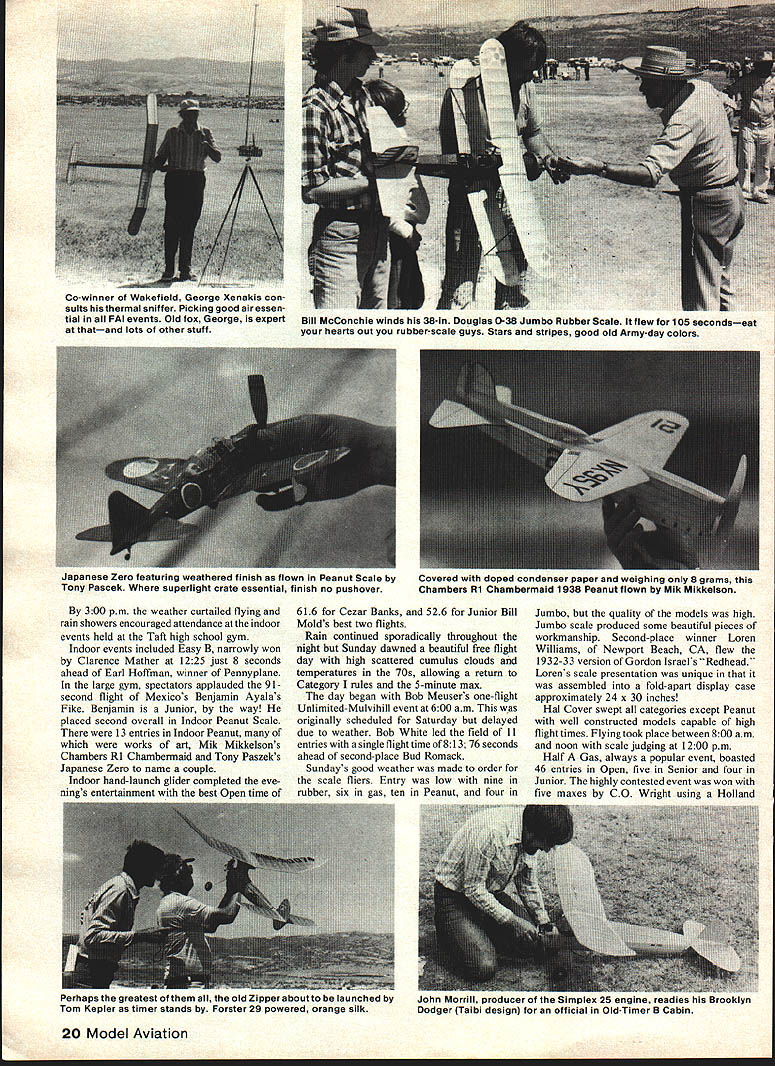
Indoor events included Easy B, narrowly won by Clarence Mather at 12:25—just 8 seconds ahead of Earl Hoffman, winner of Pennypale. In the large gym, spectators applauded the 91-second flight of Mexico's Benjamin Ayala's Fike. Benjamin is a Junior, by the way! He placed second overall in Indoor Peanut Scale. There were 13 entries in Indoor Peanut, many of which were works of art. Mike Mikkelson's Chambers R1 Chambermaid and Tony Paszek's Japanese Zero, to name a couple.
Indoor hand-launch glider completed the evening's entertainment with the best Open title going to Cezar Banks, 61.6, and 52.6 for Junior Bill Mold's best two flights. Rain continued sporadically throughout the night but Sunday dawned a beautiful free flight day with high scattered cumulus clouds and temperatures in the 70s, allowing a return to Category I rules and the 5-minute max.
The day began with Bob Meuser's one-flight Unlimited-Mulvihill event at 6:00 a.m. This was originally scheduled for Saturday but delayed due to weather. Bob White led the field of 11 entries with a single flight time of 8:13, 76 seconds ahead of second-place Bud Romack.
Sunday's good weather was made to order for the scale fliers. Entry was low with nine in rubber, six in gas, ten in Peanut, and four in Jumbo, but the quality of the models was high. Jumbo scale produced some beautiful pieces of workmanship. Second-place winner Loren Williams, of Newport Beach, CA, flew the 1932-33 version of Gordon Israel's "Redhead." Loren's scale presentation was unique in that it was assembled into a fold-apart display case approximately 24 x 30 inches!
Hal Cover swept all categories except Peanut with well-constructed models capable of high flight times. Flying took place between 8:00 a.m. and noon with scale judging at 12:00 p.m.
Half A Gas, always a popular event, boasted 46 entries in Open, five in Senior and four in Junior. The highly contested event was won with five maxes by C.O. Wright using a Holland Hornet in a Starduster! In case you don't recall, the Holland Hornet was the engine in the early post-WW II years but was overwhelmed by the Cox in later years. A nice achievement for the Hornet. A new Senior 1/2A Gas record performance, awaiting certification, was set by Paul Manana at 5:12.8. All in all a great day for the old-timers.
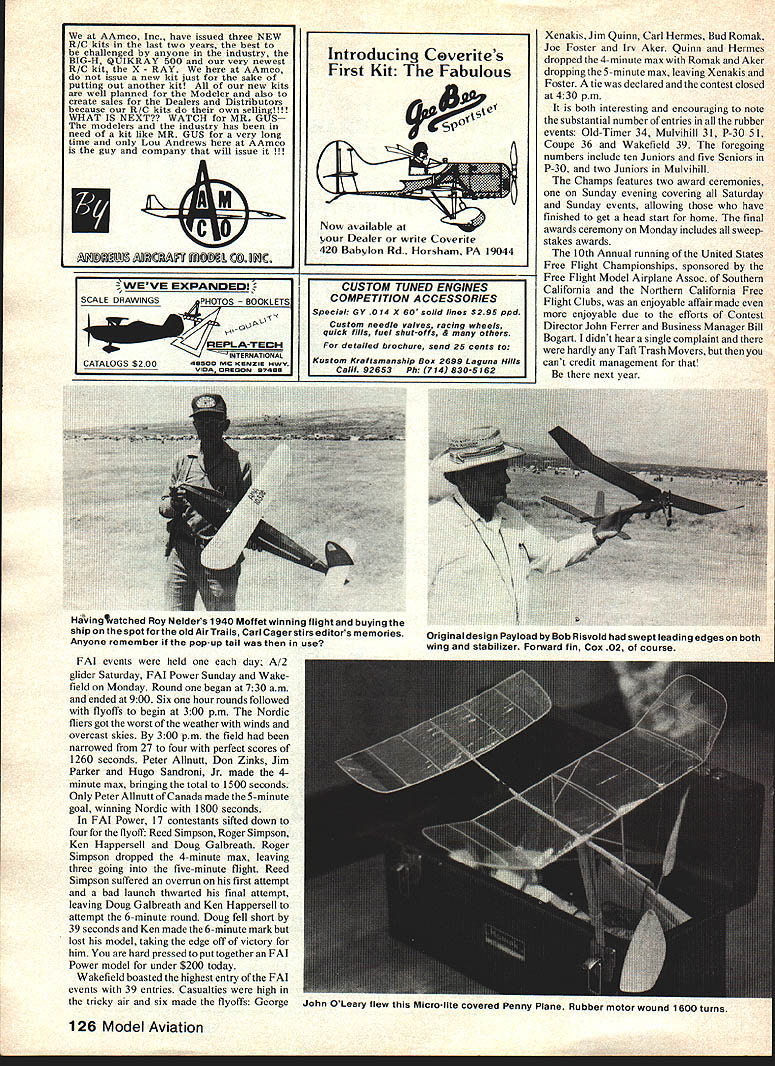
Old-time rubber enjoyed an entry of 34 contestants flying a variety of ships from a Moffett winner (1940 Air Trails) to Lanzo sticks. Three maxes won it for George Schneider, 14 seconds ahead of Charlie Worlic. Old-time power fliers also enjoyed the good
Free Flight Championships
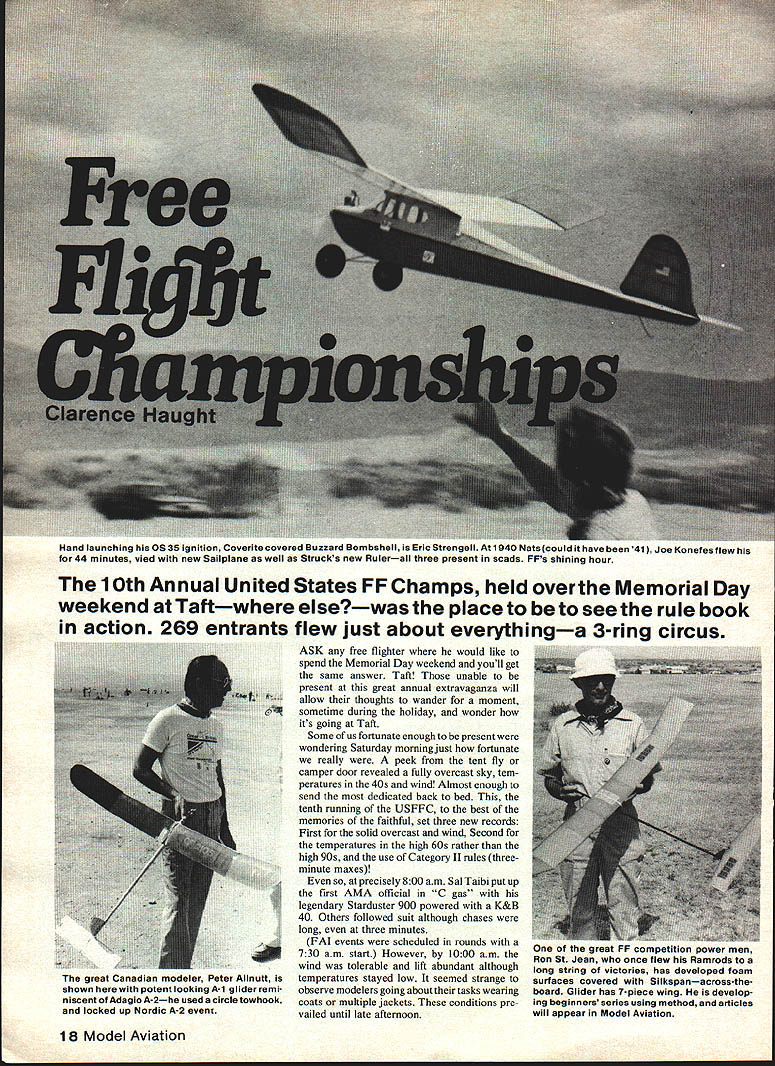
Hand launching .0535 ignition. Coverite covered Buzzard. Bombshell Eric Strengell, 1940 Nats course have been… Joe Alonzo flew 44 minutes with a new sailplane. Well-struck new Ruler all three present; scads of FFs — shining hour.
The 10th Annual United States FF Champs, held over the Memorial Day weekend at Taft (where else?), was the place to see the rule book action. Two hundred sixty-nine entrants flew just about everything — a three-ring circus. Ask any free fighter if he would like to spend Memorial Day weekend at Taft and you'll get the same answer. Taft, unable to present a greater annual extravaganza, will allow thoughts to wander for a moment sometime during the holiday to wonder: is it going to be Taft? Some of us fortunate enough to be present were wondering Saturday morning. Just fortunate, really — a peek from the tent or camper door revealed a fully overcast sky, temperatures in the 40s, wind — almost enough to send the dedicated back to bed. The tenth running USFFC' s best memories: a faithful set and three new records. First, solid overcast wind. Second, temperatures in the high 60s rather than high 90s. Using Category II rules, three-minute maxes; precisely 8:00 a.m., Sal Taibi put up the first AMA official legendary Starduster 900 powered K&B .40. Others followed suit, although chases were long; three minutes FAI events scheduled rounds; 7:30 a.m. start. However, at 10:00 a.m. wind tolerable, lift abundant, although temperatures stayed low. It seemed strange to observe modelers going about tasks wearing coats and multiple jackets. Conditions prevailed until late afternoon.
Model Aviation's great Canadian modeler Peter Allnutt is shown here with a potent-looking A-1 glider reminiscent of the Adagio A-2. He used circle tow hook locked up Nordic A-2 event great competition. Power men Ron St. Jean, once flying Ramrods during long string victories, has developed foam-surfaced, Silkspan-covered across-the-board glider with a 7-piece wing, developing a beginners' series using the method; articles will appear in Model Aviation.
Entry years at the contest numbered 269 compared with the typical 325–350 in former years. Eleven foreign contestants registered, including two from Canada, seven from Mexico, and two from England. Fifteen states were represented, the farthest being New York with two contestants. Four women registered in competition. Competition was abundant though entry sparse in some events. Winning an event still required posting high times. Sal Taibi piled up seven maxes plus 1:48 to win 020 Replica. Playboy competition isn't everything — modelers came to watch and fly for the sheer love of free flight, to visit friends new and old, acquaintances sparked long ago on the competition trail. Sportsmanship was of the highest quality, allowing a relaxed meet with no taking of unfair advantages. Overruns — timers called saws knowing full well could expect the same treatment; time-one, fly-one system.
P-30 rubber event, designed for beginners, drew 36 Open, five Senior and ten Junior fliers. Oddly enough Sunday's Coupe d'Hiver event, used as a considered introduction event to serious rubber competition, also drew 36 Open fliers. Bob White won both Open classes. Thirty-inch smaller models powered by 10 grams of rubber did quite well at Taft air considering the drag required by a free-wheeling plastic propeller.
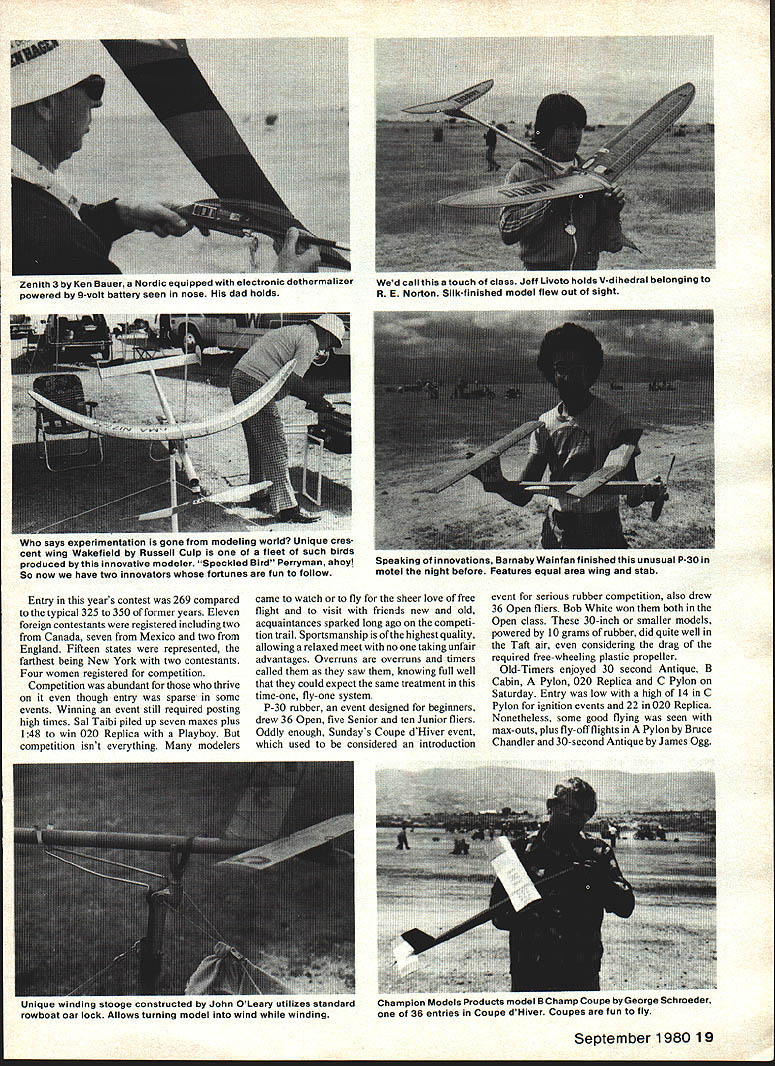
Old-timers enjoyed 30-second Antique, B Cabin Pylon, .020 Replica C Pylon Saturday. Entry low/high 14 C Pylon ignition events, 22 .020 Replica. Nonetheless, some good flying was seen — max-outs plus fly-offs. Pylon Bruce Chandler 30-second Antique; James Ogg September 1980. Zenith 5 Ken ? idoraic equipped electronic dethermalizer powered by 9-volt battery seen nose; dad holds. Wed call touch class Jeff Livoto holds V-dihedral belonging R. E. Norton. Silk-finished model flew out of sight who says experimentation has gone modeling world. Unique crescent wing Wakefield Russell Culp fleet; such birds produced an innovative modeler. Speckled Bird Perryman ahoy. So now we have two innovators; fortunes and fun follow.
Speaking of innovations, Barnaby Wainfan finished an unusual P-30 model the night before. Features: equal-area wing and stab. Unique winding stooge constructed by John O'Leary utilizes a standard rowboat oar lock. Allows turning model while winding. Champion Models Products model — U Lamp Coupe. George Schroeder: 36 entries Coupe d'Hiver. Coupes fun fly. Co-winner Wakefield: George Xenakis consults his thermal sniffer, picking good air. Essential FAI events…
[Article continues on next page] few Ardens, Atoms and Bantams, or revive one of the old home-built engine designs such as has been done with the Simplex 25.
Hand-launch gliders were everywhere all day long. Hard to believe, only 25 Senior-Open and 13 Junior entries could fill the air with sheet balsa. Bob Boyer took Senior-Open with 556 seconds and Andy Persson won Junior with 277 seconds.
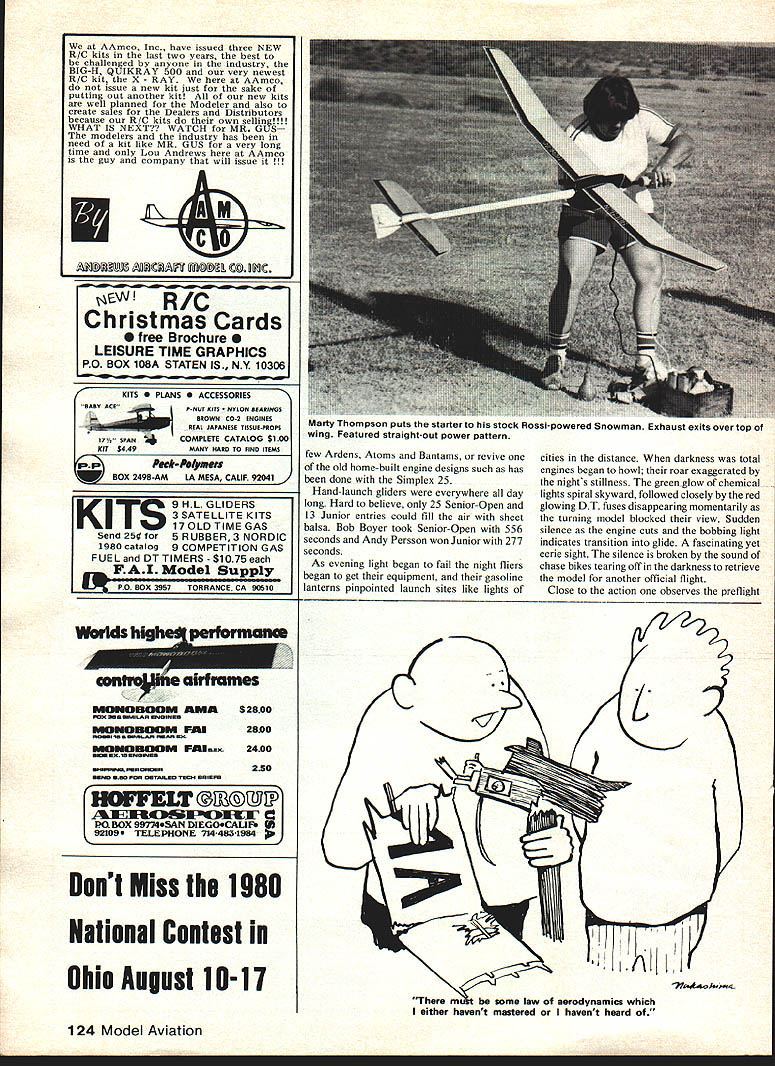
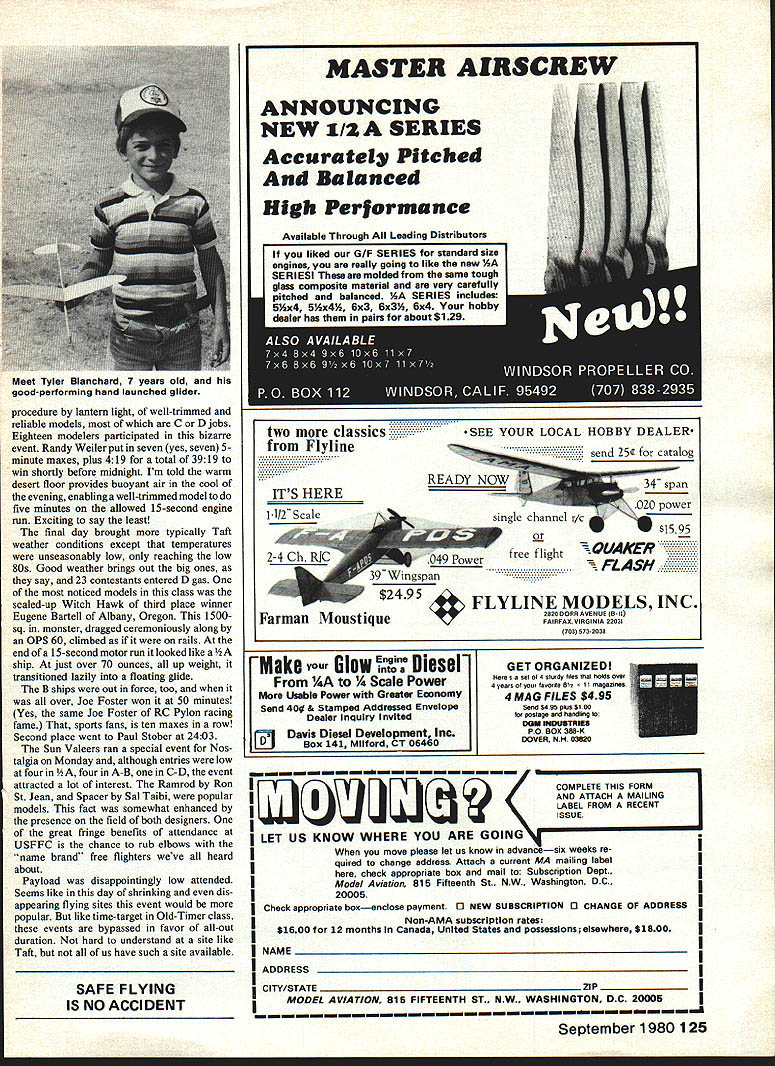
As evening light began to fail the night fliers began to get their equipment, and their gasoline lanterns pinpointed launch sites like lights of cities in the distance. When darkness was total engines began to howl; their roar exaggerated by the night's stillness. The green glow of chemical lights spiral skyward, followed closely by the red glowing D.T. fuses disappearing momentarily as the turning model blocked their view. Sudden silence as the engine cuts and the bobbing light indicates transition into glide. A fascinating yet eerie sight. The silence is broken by the sound of chase bikes tearing off in the darkness to retrieve the model for another official flight. procedure by lantern light, of well-trimmed and reliable models, most of which are C or D jobs. Eighteen modelers participated in this bizarre event. Randy Weiler put in seven (yes, seven) 5-minute maxes, plus 4:19 for a total of 39:19 to win shortly before midnight. I'm told the warm desert floor provides buoyant air in the cool of the evening, enabling a well-trimmed model to do five minutes on the allowed 15-second engine run. Exciting to say the least!
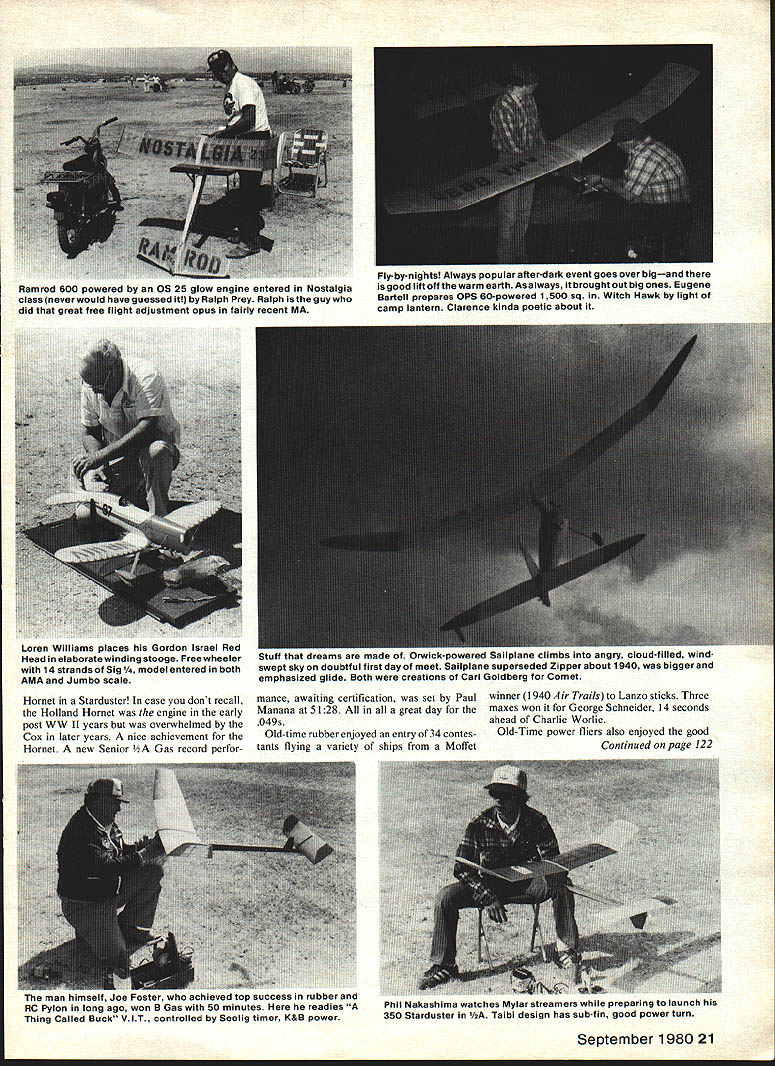
The final day brought more typically Taft weather conditions except that temperatures were unseasonably low, only reaching the low 80s. Good weather brings out the big ones, as they say, and 23 contestants entered D gas. One of the most noticed models in this class was the scaled-up Witch Hawk of third place winner Eugene Bartell of Albany, Oregon. This 1500-sq. in. monster, dragged ceremoniously along by an OPS 60, climbed as if it were on rails. At the end of a 15-second motor run it looked like a V-1A ship. At just over 70 ounces, all-up weight, it transitioned lazily into a floating glide.
The B ships were out in force, too, and when it was all over, Joe Foster won it at 50 minutes! (Yes, the same Joe Foster of RC pylon racing fame.) That, sports fans, is ten maxes in a row! Second place went to Paul Stolar at 24:03.
The Sun Valereans ran a special event for Nostalgia on Monday and, although entries were low at four in A, four in A-B, one in C-D, the event attracted a lot of interest. The Ramrod by Ron St. Jean, and Spencer by Sal Taibi, were popular models. This fact was somewhat enhanced by the presence on the field of both designers. One of the great fringe benefits of attendance at USFFC is the chance to rub elbows with the "name brand" free fliers we've all heard about.
Payload was disappointingly low attended. Seems like in this day of shrinking and even disappearing flying sites this event would be more popular. But like time-target in Old-Timer class, these events are bypassed in favor of all-out duration. Not hard to understand at a site like Taft, but not all of us have such a site available. FAI events were held one each day: A/2 glider Saturday, FAI Power Sunday and Wakefield on Monday. Round one began at 7:30 a.m. and ended at 9:00. Six one-hour rounds followed with flyoffs to begin at 3:00 p.m. The Nordic fliers got the worst of the weather with winds and overcast skies. By 3:00 p.m. the field had been narrowed from 27 to four with perfect scores of 1260 seconds. Peter Allnutt, Don Zinks, Jim Parker and Hugo Sandroni, Jr. made the 4-minute max, bringing the total to 1500 seconds. Only Peter Allnutt of Canada made the 5-minute goal, winning Nordic with 1800 seconds.
In FAI Power, 17 contestants sifted down to four for the flyoff: Reed Simpson, Roger Simpson, Ken Happersell and Doug Galbreath. Roger Simpson dropped the 4-minute max, leaving three going into the five-minute flight. Reed Simpson suffered an overrun on his first attempt and had a bad launch that thwarted his final attempt, leaving Doug Galbreath and Ken Happersell to attempt the 6-minute round. Doug fell short by 39 seconds and Ken made the 6-minute mark but lost his model, taking the edge off of victory for him. You are hard pressed to put together an FAI Power model for under $200 today.
Wakefield boasted the highest entry of the FAI events with 39 entries. Casualties were high in the tricky air and six made the flyoffs: George Xenakis, Jim Quinn, Carl Hermes, Bud Romak, Joe Foster and Irv Aker. Quinn and Hermes dropped the 4-minute max with Romak and Aker dropping the 5-minute max, leaving Xenakis and Foster. A tie was declared and the contest closed at 4:30 p.m.
It is both interesting and encouraging to note the substantial number of entries in all the rubber events: Old-Timer 34, Mulvihill 31, P-30 51, Coupe 36 and Wakefield 39. The foregoing numbers include ten Juniors and five Seniors in P-30, and two Juniors in Mulvihill.
The Champs features two award ceremonies, one on Sunday evening covering all Saturday and Sunday events, allowing those who have finished to get a head start for home. The final awards ceremony on Monday includes all sweepstakes awards.
The 10th Annual running of the United States Free Flight Championships, sponsored by the FAI Free Flight Model Airplane Assoc. of Southern California and the Northern California Free Flight Clubs, was an enjoyable affair made even more enjoyable due to the efforts of Contest Director John Ferrer and Business Manager Bill Bogart. I didn't hear a single complaint and there were hardly any Taft Trash Movers, but then you can't credit management for that! Be there next year.
Transcribed from original scans by AI. Minor OCR errors may remain.

