
Free Flight: Duration
Bob Meuser
A NEW BEGINNING, a clean slate, a time for reflection. Why are we here, where are we going, how do we get there from here? For starters, I'll do what comes naturally: a disorganized potpourri of successful or interesting models, useful hardware and construction techniques, Free‑Flight products, and news of Free‑Flight happenings. I'm not an expert at anything in particular, so I will depend almost entirely on material I receive from you. If you would like me to include more material on a particular phase of Free Flight, or less, let me know. Where we go depends largely on you. Perhaps between us we can show the ukie jockeys and beep boxers that Free Flight isn't merely CL with broken lines, or RC with dead batteries, or a mere stepping stone to either one. My address: 4200 Gregory St., Oakland, Calif. 94619.
Electric Propulsion
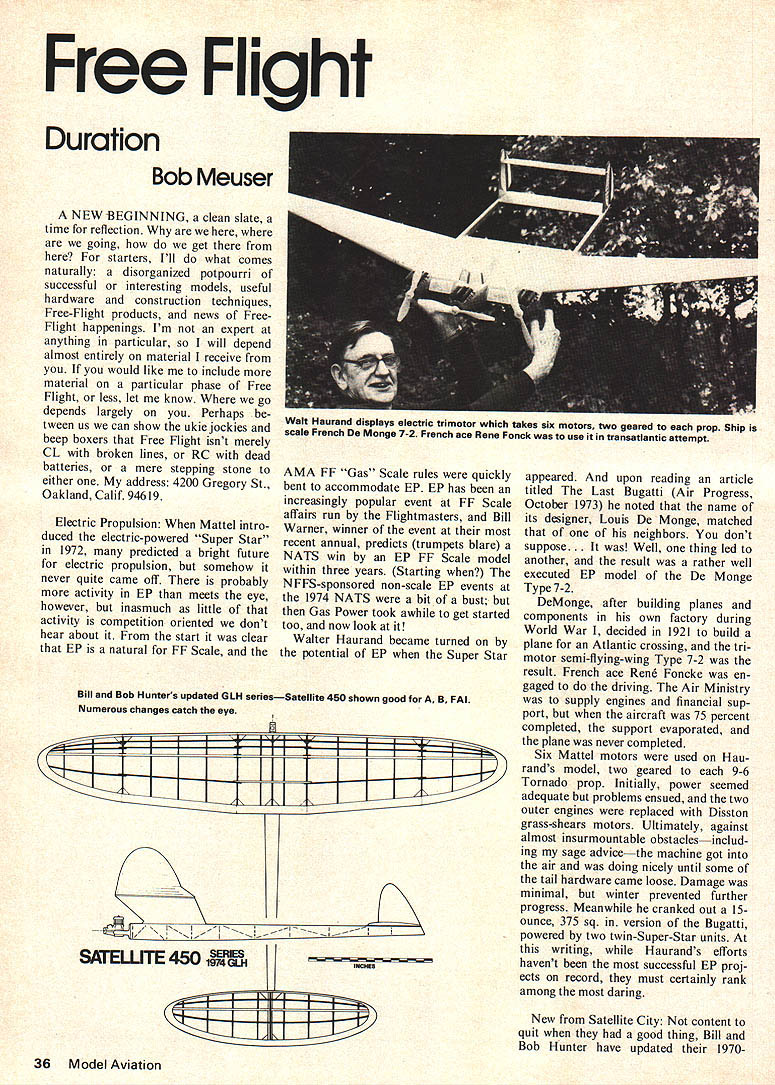
When Mattel introduced the electric‑powered "Super Star" in 1972, many predicted a bright future for electric propulsion, but somehow it never quite came off. There is probably more activity in EP than meets the eye, however, but inasmuch as little of that activity is competition oriented we don't hear about it. From the start it was clear that EP is a natural for FF Scale, and the AMA FF "Gas" Scale rules were quickly bent to accommodate EP. EP has been an increasingly popular event at FF Scale affairs run by the Flightmasters, and Bill Warner, winner of the event at their most recent annual, predicts (trumpets blare) a NATS win by an EP FF Scale model within three years. (Starting when?) The NFFS‑sponsored non‑scale EP events at the 1974 NATS were a bit of a bust; but then Gas Power took awhile to get started too, and now look at it! Walter Haurand became turned on by the potential of EP when the Super Star appeared. And upon reading an article titled The Last Bugatti (Air Progress, October 1973) he noted that the name of its designer, Louis De Monge, matched that of one of his neighbors. You don't suppose...! It was! Well, one thing led to another, and the result was a rather well executed EP model of the De Monge Type 7‑2. De Monge, after building planes and components in his own factory during World War I, decided in 1921 to build a plane for an Atlantic crossing, and the tri‑motor semi‑flying‑wing Type 7‑2 was the result. French ace Rene Foncke was engaged to do the driving. The Air Ministry was to supply engines and financial support, but when the aircraft was 75 percent completed the support evaporated, and the plane was never completed. Six Mattel motors were used on Haurand's model, two geared to each 9‑6 Tornado prop. Initially, power seemed adequate, but problems ensued, and the two outer engines were replaced with Disston grass‑shear motors. Ultimately, against almost insurmountable obstacles — including sage advice — the machine got into the air and was doing nicely until some of the tail hardware came loose. Damage was minimal, but winter prevented further progress. Meanwhile he cranked out a 15‑ounce, 375 sq. in. version of the Bugatti, powered by two twin‑Super‑Star units. At this writing, while Haurand's efforts haven't been the most successful EP projects on record, they must certainly rank among the most daring.
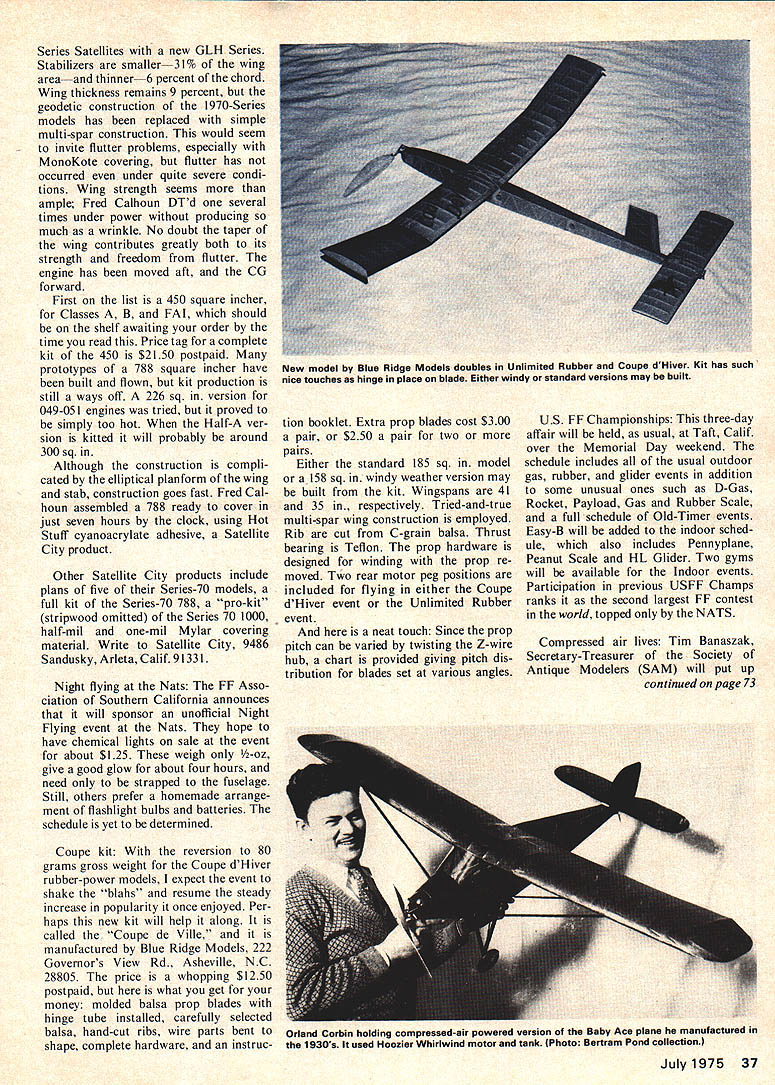
New from Satellite City: Not content to quit when they had a good thing, Bill and Bob Hunter have updated their 1970‑Series Satellites with a new GLH Series. Stabilizers are smaller—31% of the wing area—and thinner—6 percent of the chord. Wing thickness remains 9 percent, but the geodetic construction of the 1970‑Series models has been replaced with simple multi‑spar construction. This would seem to invite flutter problems, especially with MonoKote covering, but flutter has not occurred even under quite severe conditions. Wing strength seems more than ample; Fred Calhoun DT'd several times under power without producing so much as a wrinkle. No doubt the taper of the wing contributes greatly both to its strength and freedom from flutter. The e engine has been moved aft, and the CG forward.
First on the list is a 450 square incher, for Classes A, B, and FAI, which should be on the shelf awaiting your order by the time you read this. Price tag for a complete kit of the 450 is $21.50 postpaid. Many prototypes of a 788 square incher have been built and flown, but full production is still a ways off. A 226 sq. in. version for O49-051 engines was tried, but it proved to be simply too hot. When the Half-A version is kitted it will probably be around 300 sq. in.
Although the construction is complicated by the elliptical planform of the wing and stab, construction goes fast. Fred Calhoun assembled a 788 ready to cover in just seven hours by the clock, using Hot Stuff cyanoacrylate adhesive, a Satellite City product.
Other Satellite City products include plans of five of their Series-70 models, a full kit of the Series-70 788, a "pro-kit" (stripwood omitted) of the Series 70 1000, half-mil and one-mil Mylar covering material. Write to Satellite City, 9486 Sandusky, Arleta, Calif. 91331.
Night flying at the Nats: The FF Association of Southern California announces that it will sponsor an unofficial Night Flying event at the Nats. They hope to have chemical lights on sale at the event for about $1.25. These weigh only 1/2 oz., give a good glow for about four hours, and need only to be strapped to the fuselage. Still, others prefer a homemade arrangement of flashlight bulbs and batteries. The schedule is yet to be determined.
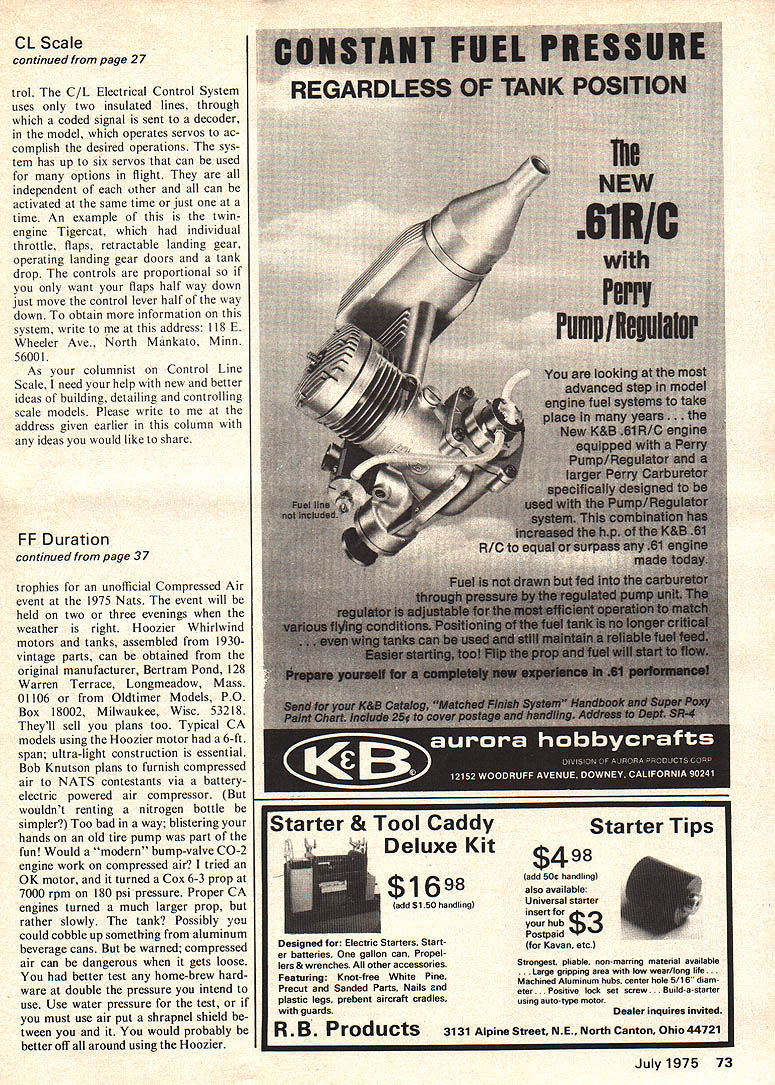
Coupe kit: With the reversion to 80 grams gross weight for the Coupe d'Hiver rubber-power models, I expect the event to shake the "blahs" and resume the steady increase in popularity it once enjoyed. Perhaps the new kit will help it along. It is called the "Coupe de Ville," and it is manufactured by Blue Ridge Models, 222 Governor's View Rd., Asheville, N.C. 28805. The price is a whopping $12.50 postpaid, but here is what you get for your money: molded balsa prop blades with hinge tube, installed, carefully selected balsa, hand-cut ribs, wire parts bent to shape, complete hardware, and an instruction booklet. Extra prop blades cost $3.00 a pair, or $2.50 a pair for two or more pairs.
Either the standard 185 sq. in. model or a 158 sq. in. windy weather version may be built from the kit. Wingspans are 41 and 35 in., respectively. Tried-and-true multi-spar wing construction is employed. Ribs are cut from C-grain balsa. Thrust bearing is Teflon. The prop hardware is designed for winding with the prop removed. Two rear motor peg positions are included for flying in either the Coupe d'Hiver event or the Unlimited Rubber event.
And here is a neat touch: Since the prop pitch can be varied by twisting the Z-wire hub, a chart is provided giving pitch distribution for blades set at various angles.
U.S. FF Championships: This three-day affair will be held, as usual, at Taft, Calif. over the Memorial Day weekend. The schedule includes all of the usual outdoor gas, rubber, and glider events in addition to some unusual ones such as D-Gas, Rocket, Payload, Gas and Rubber Scale, and a full schedule of Old-Timer events. Easy-B will be added to the indoor schedule, which also includes Pennyplane, Peanut Scale and HL Glider. Two gyms will be available for the Indoor events. Participation in previous USFF Championships ranks it as the second largest FF contest in the world, topped only by the NATS.
Compressed air lives: Tim Banaszak, Secretary-Treasurer of the Society of Antique Modelers (SAM) will put up
Free Flight: Duration
Bob Meuser
A NEW BEGINNING, a clean slate, a time for reflection. Why are we here, where are we going, how do we get there from here? For starters, I'll do what comes naturally: a disorganized potpourri of successful or interesting models, useful hardware and construction techniques, Free-Flight products, and news of Free-Flight happenings. I'm not an expert at anything in particular, so I will depend almost entirely on material I receive from you. If you would like me to include more material on a particular phase of Free Flight, or less, let me know. Where we go depends largely on you. Perhaps between us we can show the ukie jockeys and beep boxers that Free Flight isn't merely CL with broken lines, or RC with dead batteries, or a mere stepping stone to either one. My address: 4200 Gregory St., Oakland, Calif. 94619.
Electric Propulsion
When Mattel introduced the electric-powered "Super Star" in 1972, many predicted a bright future for electric propulsion, but somehow it never quite came off. There is probably more activity in EP than meets the eye, however, but inasmuch as little of that activity is competition oriented we don't hear about it. From the start it was clear that EP is a natural for FF Scale, and the AMA FF "Gas" Scale rules were quickly bent to accommodate EP. EP has been an increasingly popular event at FF Scale affairs run by the Flightmasters, and Bill Warner, winner of the event at their most recent annual, predicts (trumpets blare) a NATS win by an EP FF Scale model within three years. (Starting when?) The NFFS-sponsored non-scale EP events at the 1974 NATS were a bit of a bust; but then Gas Power took awhile to get started too, and now look at it! Walter Haurand became turned on by the potential of EP when the Super Star appeared. And upon reading an article titled The Last Bugatti (Air Progress, October 1973) he noted that the name of its designer, Louis De Monge, matched that of one of his neighbors. You don't suppose...! It was! Well, one thing led to another, and the result was a rather well executed EP model of the De Monge Type 7-2. De Monge, after building planes and components in his own factory during World War I, decided in 1921 to build a plane for an Atlantic crossing, and the tri-motor semi-flying-wing Type 7-2 was the result. French ace Rene Foncke was engaged to do the driving. The Air Ministry was to supply engines and financial support, but when the aircraft was 75 percent completed the support evaporated, and the plane was never completed. Six Mattel motors were used on Haurand's model, two geared to each 9-6 Tornado prop. Initially, power seemed adequate, but problems ensued, and the two outer engines were replaced with Disston grass-shears motors. Ultimately, against almost insurmountable obstacles — including sage advice — the machine got into the air and was doing nicely until some of the tail hardware came loose. Damage was minimal, but winter prevented further progress. Meanwhile he cranked out a 15-ounce, 375 sq. in. version of the Bugatti, powered by two twin-Super-Star units. At this writing, while Haurand's efforts haven't been the most successful EP projects on record, they must certainly rank among the most daring.
New from Satellite City:
Not content to quit when they had a good thing, Bill and Bob Hunter have updated their 1970-Series Satellites with a new GLH Series. Stabilizers are smaller—31% of the wing area—and thinner—6 percent of the chord. Wing thickness remains 9 percent, but the geodetic construction of the 1970-Series models has been replaced with simple multi-spar construction. This would seem to invite flutter problems, especially with MonoKote covering, but flutter has not occurred even under quite severe conditions. Wing strength seems more than ample; Fred Calhoun DT'd several times under power without producing so much as a wrinkle. No doubt the taper of the wing contributes greatly both to its strength and freedom from flutter. The e
Transcribed from original scans by AI. Minor OCR errors may remain.

