
Free Flight: Duration
Bob Meuser
Free Flight Spoken Here: If you dig Free Flight, and want to learn more about it, we suggest you consider joining one or more of the following organizations: The National Free-Flight Society (NFFS), The National Indoor Model Aviation Society (NIMAS), or The Society of Antique Modelers (SAM).
NIMAS, the oldest of the bunch, is spark-plugged by Bud Tenny. Its monthly publication — a minimum of four pages — gives the results of the most recent contest happenings, latest national records, a schedule of forthcoming indoor meets, lots of hints and tips, and one to four three-views of outstanding models from the U.S. and abroad. Annual dues, which include a subscription to its publication Indoor News and Views, cost $3.50. Write to Bud Tenny, Box 545, Richardson, TX 75080.
SAM, riding the crest of the nostalgia wave that seems to have inundated many phases of our lives, is the fastest growing of the bunch. Its publication, SAM Speaks, is a bi-monthly affair containing 16 small but info-packed pages of news about Old-Timer happenings, the latest Old-Timer kits, and would you believe, the latest spark-ignition engines. (I refuse to call them "ignition" engines, any more than I'd call a two-stroke engine a "two-cycle" engine.) SAM puts on its own NATS, and runs occasional postal contests. Latest innovation in the Old-Timer movement is, you should pardon the expression, radio assisted FF, or OT FF with RC, which promises to combine the best of both worlds. Dues and subscription are $3.00/year; SAM, 1947 Superior Ave., Whiting, Ind. 46394.
NFFS, the largest of the bunch, "is an AMA-affiliated non-profit organization whose purpose is to preserve, enhance, and promote the sport and hobby of Free Flight Model Aviation in all its forms." Man, you can't knock it! Its monthly publication Free Flight, affectionately called "The Digest," contains 12 jam-packed family-size pages of the latest and best news and information about all phases of Free Flight, encompassing indoor, old-timer, scale, sport, the standard AMA gas, rubber, and glider events, and the gung-ho international FAI competition events. Only my extreme modesty dissuades me from describing how truly great it really is. In addition, the NFFS presents its annual Symposium — now in its eighth running — covering the latest tech stuff in addition to its Model of the Year awards for outstanding FF models. And we cannot fail to mention its ongoing Juniors program, its sponsorship of unofficial FF NATS events which represent the growing — sometimes perhaps the dying — edge of FF, a promising but too seldom design competition for models to bridge the gap between the Delta Dart and the real stuff, critical involvement in both the Indoor and Outdoor FAI team selection programs, planning and running of FF events at the NATS, eyeball-to-eyeball confrontations with AMA headquarters in areas where we seem to disagree — or at least can't seem to understand each other — and all sorts of good stuff. Dues and subscription are $6 per annum for AMA members, $11 for two, less for Juniors and Seniors; write to NFFS, 431 Scandia Ave., Des Moines, Iowa 50315.
The Editor of a national model aviation magazine, who we won't name, recently stated that "Free Flight is where it all began, and where it will all end." I don't know about that, but meanwhile Free Flight is a helluva nice place to live, and NIMAS, SAM, and NFFS will help keep it that way.
And Then There Was One: Most stories about free flight contests at Taft, Calif. have mentioned the searing dry heat, dust, dust devils, booming thermals and vicious downdrafts. That may be an accurate description for the period between Memorial Day and Labor Day; by November it becomes a big lie — light, light lift, light drift, and downdrafts at the right. Light grass covers the field, peak temperatures are in the mid-seventies, the horned toads have migrated to Australia, or whatever they do. Last November, Taft hosted the pompously titled Tenth Annual International Challenge of the Western Free Flight Association. Traditionally, this is a two-day FAI-events-only affair. Three rounds are held on Saturday starting at 8 a.m.; and four on Sunday starting at 8 a.m.; a nice arrangement for those living five hours or more away.
I entered the FAI Power event. By the end of the seven regular rounds the usual factors had taken their toll and there were five: Ed Carroll, who has won the FAI Power event twice at recent U.S. Free Flight championships; John Warren, who was on the FAI Team Selection semi-finals; Ken Oliver, who until recently held the AMA record; George Foster, who has survived the cut and made it into the Finals the last three times; and Dave Parsons, who has also been a regular finalist.
In the flyoff flights, lots are drawn, and the three finalists' order is determined by those lots. Engines are run for prescribed durations and the models are judged on duration under the FAI rules. Many of the usual tactics and little tricks come into play — trimming for the light lift, careful timing of engine runs, and sometimes, a bit of good luck.
In what was to be the final flyoff with only 4-second engine runs, the three took off in rapid succession. Carroll and Warren had engine over-runs, and then there was Parsons' model. Parsons' model was equipped with a prop brake, built by his brother Larry, which was patterned after prototypes of one to be manufactured by Hardy Brodersen. Some of Parsons' improvements will appear in the production version, and the prop brake stopped the engine within milliseconds, allowing the model to achieve its run and win the contest. sion.) That device stops the prop within a few milliseconds after the engine is flooded off; otherwise the prop coasts for the better part of a second. Since engine-run timing continues until the prop stops, that coasting can be disastrous with a 4-sec. engine run.
Clearly, any model that goes nine straight max flights in FAI Power, particularly with the decreasing engine runs demanded by the 1974 rules (which have been changed for 1975) has to be pretty good. But since Carroll and Warren had over-runs, it would be stretching things a lot to say that Dave won because he had a superior model. However, consider this: Dave's time on that last flight was 157 sec., which was a full 30 sec. better than Carroll's or Warren's despite their over-runs. Still, one flight doesn't prove anything as there could have been many factors that affected the flight time which did not meet the eye.
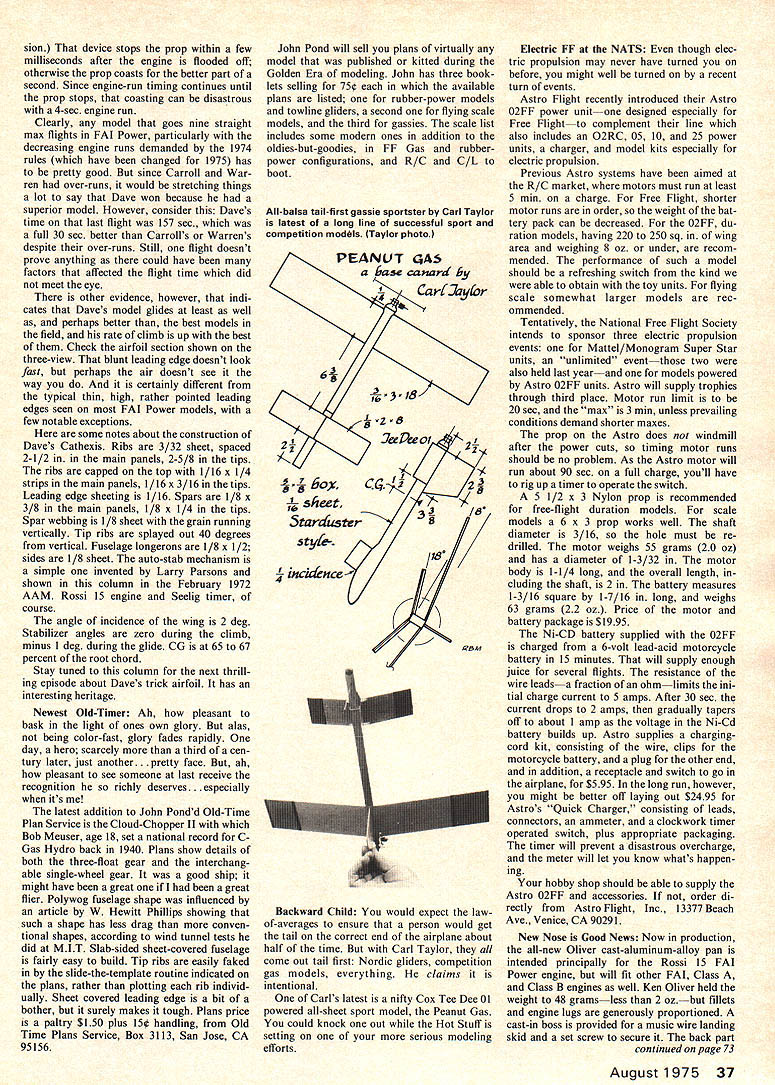
There is other evidence, however, that indicates that Dave's model glides at least as well as, and perhaps better than, the best models in the field, and his rate of climb is up with the best of them. Check the airfoil section shown on the three-view. That blunt leading edge doesn't look fast, but perhaps the air doesn't see it the way you do. And it is certainly different from the typical thin, high, rather pointed leading edges seen on most FAI Power models, with a few notable exceptions.
Here are some notes about the construction of Dave's Cathexis. Ribs are 3/32 sheet, spaced 2-1/2 in. in the main panels, 2-5/8 in. in the tips. The ribs are capped on the top with 1/16 x 1/4 strips in the main panels, 1/16 x 3/16 in. the tips. Leading edge sheeting is 1/16. Spars are 1/8 x 1/8 in. in the main panels, 1/8 x 1/4 in. the tips. Spar webbing is 1/8 sheet with the grain running vertically. Tip ribs are splayed out 40 degrees from vertical. Fuselage longerons are 1/8 x 1/2; sides are 1/8 sheet. The auto-stab mechanism is a simple one invented by Larry Parsons and shown in this column in the February 1972 AAM. Rossi 15 engine and Seelig timer, of course.
The angle of incidence of the wing is 2 deg. Stabilizer angles are zero during the climb, minus 1 deg. during the glide. CG is at 65 to 67 percent of the root chord.
Stay tuned to this column for the next thrilling episode about Dave's tricker airfoil. It has an interesting heritage.
Newest Old-Timer: Ah, how pleasant to bask in the light of one's own glory. But alas, not being color-fast, glory fades rapidly. One day, a hero; scarcely more than a third of a century later, just another... pretty face. But, oh, how pleasant to see someone at last receive the recognition he so richly deserves... especially when it's me!
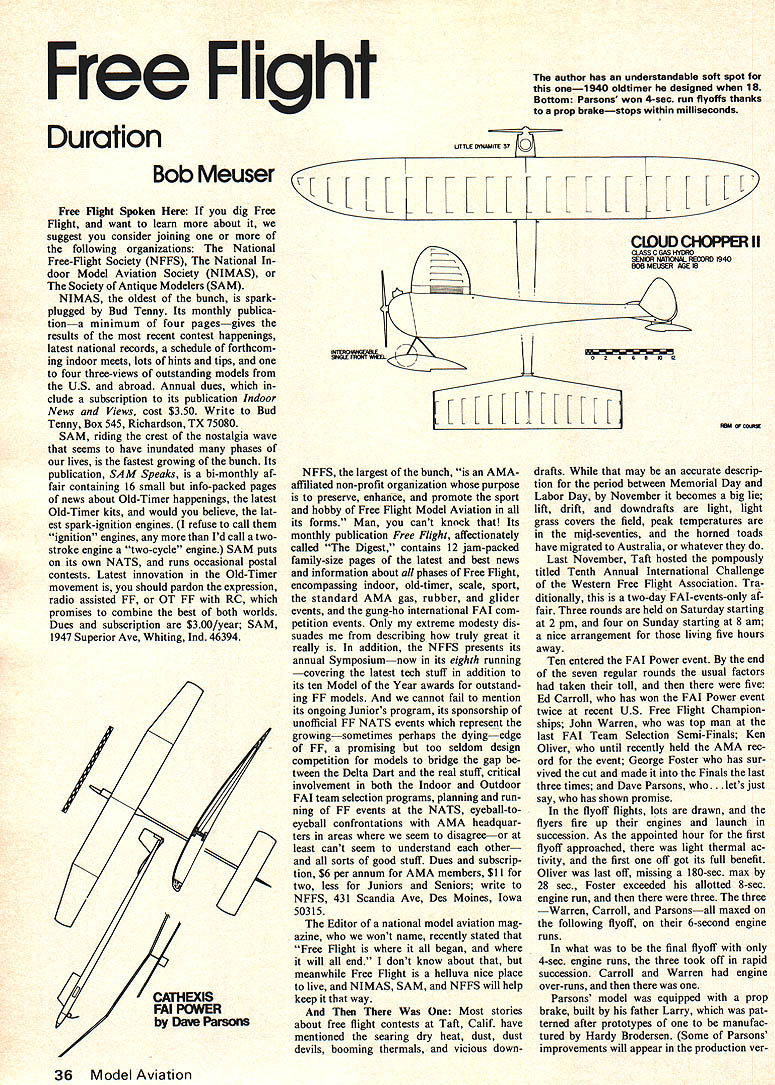
The latest addition to John Pond's Old-Timer Plan Service is the Cloud-Chopper II with which Bob Meuser, age 18, set a national record for C-Gas Hydro back in 1940. Plans show details of both the three-float gear and the interchangeable single-wheel gear. It was a good ship; it might have been a great one if I had been a great flier. Plywood fuselage shape was influenced by an article by W. Hewitt Phillips showing that such a shape has less drag than more conventional shapes, according to wind tunnel tests he did at M.I.T. Slab-sided sheet-covered fuselage is fairly easy to build. Tip ribs are easily taken in by the slide-the-template routine indicated on the plans, rather than plotting each rib individually. Sheet covered leading edge is a bit of a bother, but it surely makes it tough. Plans price is a paltry $1.50 plus 15c handling, from Old Time Plans Service, Box 3113, San Jose, CA 95156.
John Pond will sell you plans of virtually any model that was published or kitted during the Golden Era of modeling. John has three booklets selling for 75c each in which the available plans are listed; one for rubber-power models and tow-line gliders, a second one for flying scale models, and the third for gassies. The scale list includes some modern ones in addition to the oldies-but-goodies, in FF Gas and rubber-power configurations, and R/C and C/L to boot.
And Then There Was One: Most stories about free flight contests at Taft, Calif. have mentioned the searing dry heat, dust, dust devils, booming thermals and vicious downdrafts. That may be an accurate description for the period between Memorial Day and Labor Day; by November it becomes a big lie—light, light lift, light drift, and downdrafts at the right. Light grass covers the field, peak temperatures are in the mid-seventies, the horned toads have migrated to Australia, or whatever they do. Last November, Taft hosted the pompously titled Tenth Annual
Free Flight: Duration
continued from page 37
that attaches to the fuselage is round on the bottom, and it can be furnished either round or square on top. The outer contour fairs perfectly into the Brockenspar Brake; a cast-in line shows where to cut the pan off when the brake is fitted. The pan is available for immediate delivery from Doug Galbraith, 707 Second St., Davis, Calif. 95616. Price: $7 postpaid.
Oliver pan accepts Rossi 15, Supertigre FR and RR 15, and Supertigre 19 and 23 engines as well. Pan weighs only 48 grams, for all of that.
Prestigious NFFS Awards for 1975. The recipients of its free-flight model awards for '75 have just been announced by the National Free Flight Society. Almost as interesting as the winners themselves is the extent NFFS goes to insure that only the best have been chosen. It's a study in depth, really, made by three committees consisting of about 15 members and 12 consultants, with their selections reviewed by an executive committee of Bob Stalick, Hardy Brodersen, and Hewitt Phillips. The models and designs were judged according to their success in competition, long term impact on the sport, aesthetic qualities, and popularity, among other criteria. The awards, associated with the Eighth NFFS Symposium to be held at the Nats in August, in cooperation with AMA, will be covered in story form in the NFFS Symposium Report. Construction drawings for most will be available for sale by the NFFS Plan Service. The winners are noted above.
AMA Gas Events
- Half-A — Bill and Bob Hunter — Satellite 226
- A, B, C — Raymond (Red) Johnson — Tartar 800
International Classes (FAI)
- FAI Power — Bill Giesking — Development of the Flapper Concept exemplified by the Siren-Dippity
- Wakefield — John Gard — Monarch
- Coupe D'Hiver — Roger and Jean Louis Garrigou — Garricoupe
- Indoor Duration — Erv Rodemsky — Monster
- Hand Launch Glider — Steve Geraghty — Driftwood
Special Classes
- Unlimited Rubber — George Perryman — Little Daddy
- Rocket (Jetex) — Don Chancey — Canned Heat
- Hans Seelig — Seelig Multi-Function Timers
Variation on a theme. Ian Dowsett's Hawk beginner model used for promotion of the British TV program, Model World, is closely patterned after the Delta Dart designed by Frank Ehling. Of the 10 scheduled programs, two dealt with model aircraft. Thanks to Ron Moulton for the information and photo.
Transcribed from original scans by AI. Minor OCR errors may remain.

