
Free Flight: Duration
Bob Meuser
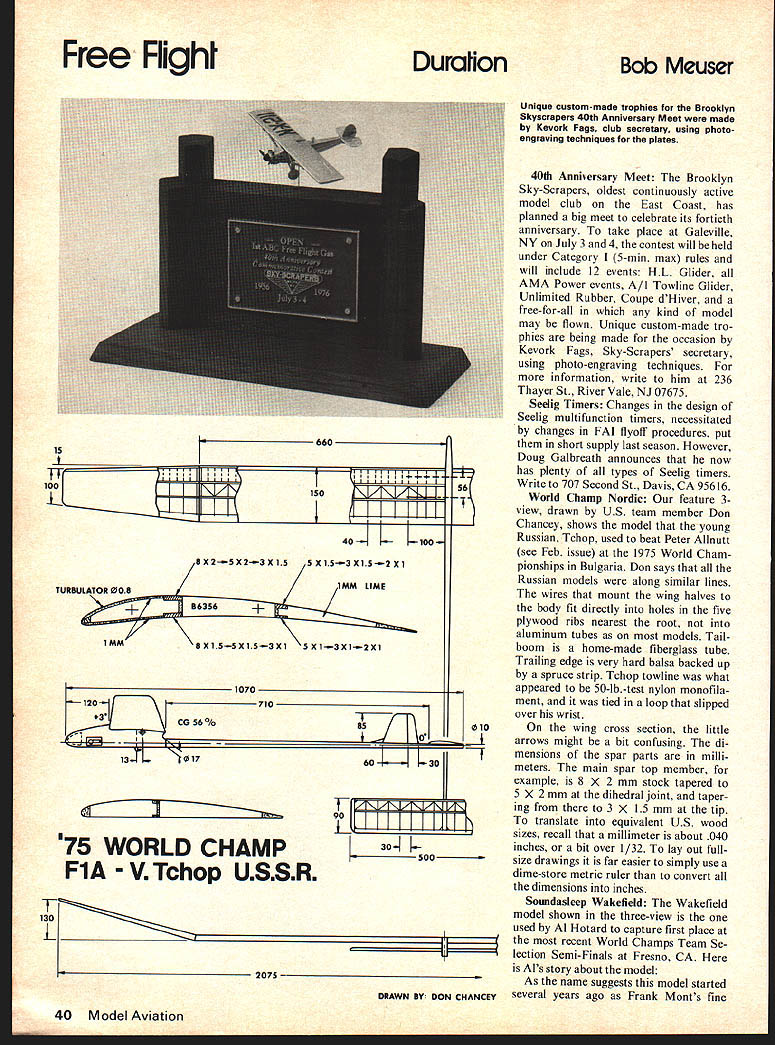
40th Anniversary Meet: The Brooklyn Sky-Scrapers, oldest, continuously active model club on the East Coast, has planned a big meet to celebrate its fortieth anniversary. To take place at Galeville, NY on July 3 and 4, the contest will be held under Category 1 (5-min. max) rules and will include 12 events: H.L. Glider, all AMA Power events, A/I Towline Glider, Unlimited Rubber, Coupe d'Hiver, and a free-for-all in which any kind of model may be flown. Unique custom-made trophies are being made for the occasion by Kevork Fags, Sky-Scrapers' secretary, using photo-engraving techniques. For more information, write to him at 236 Thayer St., River Vale, NJ 07675.
Seelig Timers: Changes in the design of Seelig multifunction timers, necessitated by changes in FAI flyoff procedures, put them in short supply last season. However, Doug Galbreath announces that he now has plenty of all types of Seelig timers. Write to 707 Second St., Davis, CA 95616.
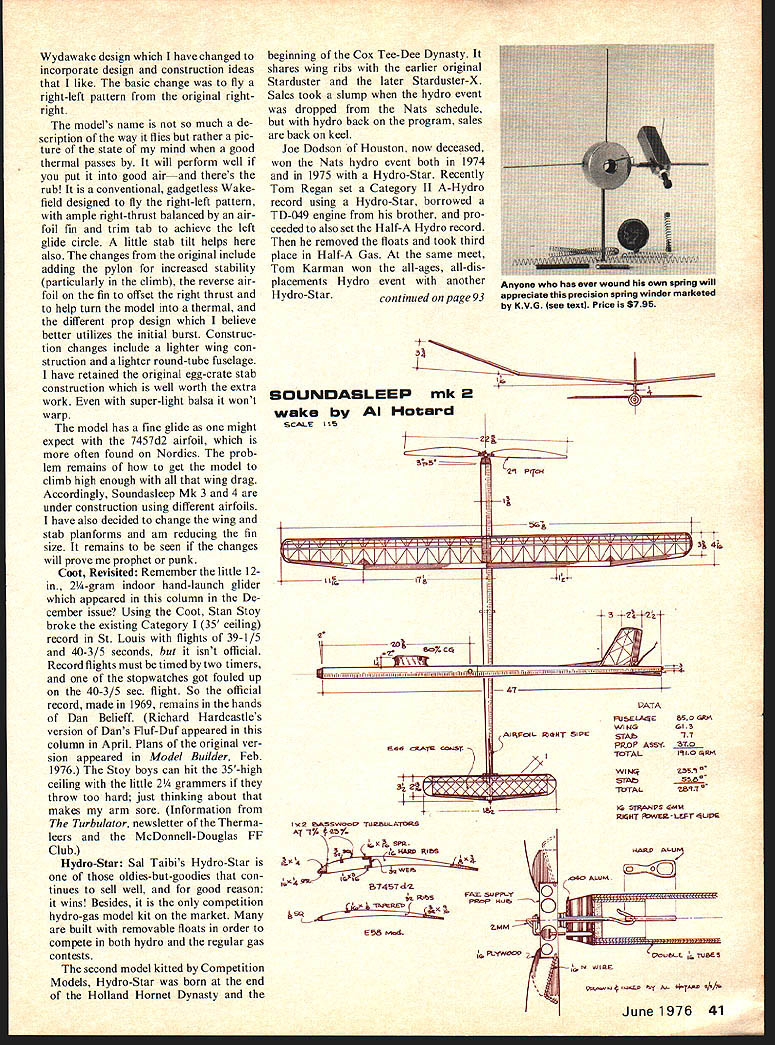
World Champ Nordic: Our feature 3-view, drawn by U.S. team member Don Chancey, shows the model that the young Russian, Tchop, used to beat Peter Allnutt (see Feb. issue) at the 1975 World Championships in Bulgaria. Don says that the Russian models were along similar lines. The wires that mount the wing halves to the body fit directly into holes in the five plywood ribs nearest the root, not into aluminum tubes as on most models. Tailboom is a home-made fiberglass tube. Trailing edge is very hard balsa backed up by a spruce strip. Tchop towline was what appeared to be 50-lb.-test nylon monofilament, and was tied in a loop that slipped over his wrist.
On the wing cross section, the little arrows might be a bit confusing. The dimensions of the spar parts are in millimeters. The main spar part, for example, is 8 x 2 mm stock tapered to 5 x 2 mm at the dihedral joint, and tapering from there to 3 x 1.5 mm at the tip. To translate into equivalent U.S. wood sizes, recall that a millimeter is about .040 inches, or a bit over 1/32. To lay out full-size drawings it is far easier to simply use a dime‑store metric ruler than to convert all the dimensions into inches.
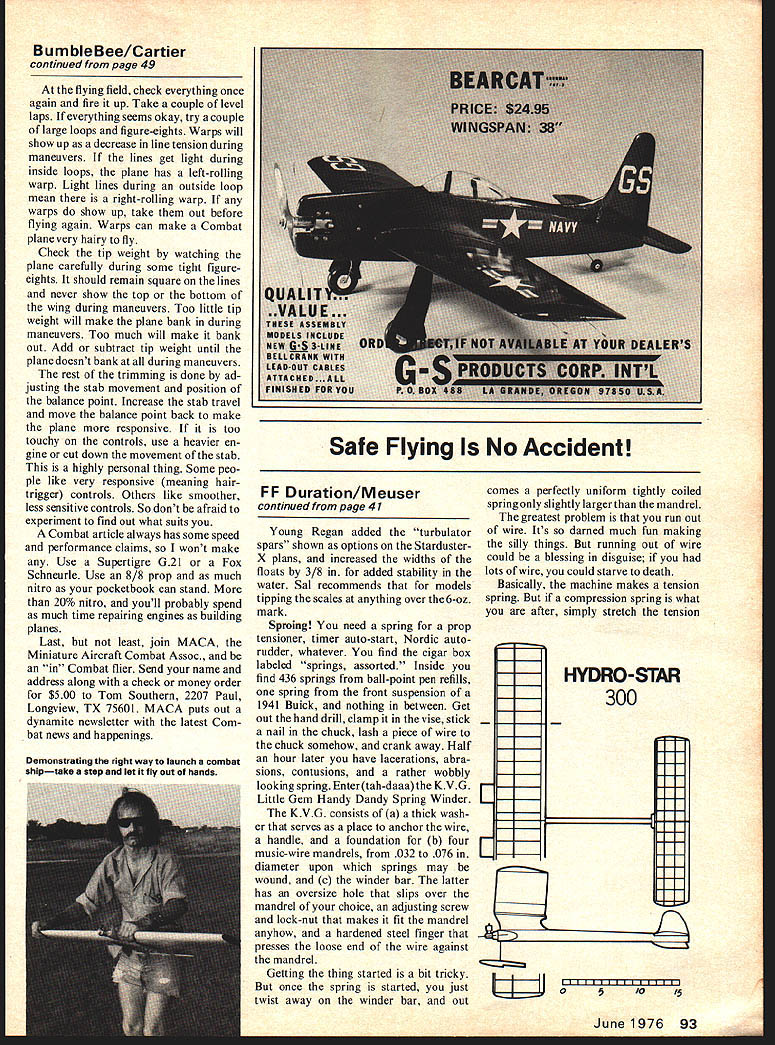
Soundasleep Wakefield: The Wakefield model shown in the three-view is the one used by Al Hotard to capture first place at the most recent World Champs Team Selection Semi-Finals at Fresno, CA. Here is Al's story about the model:
As the name suggests, this model started several years ago as Frank Mont's fine Wydawake design. I have changed and incorporated design and construction ideas, like the basic change to fly a right‑left pattern instead of the original right‑right pattern. The name says much of the way it flies; good thermal passes will perform well — put in good air and there's no rub. The conventional gadgetless Wakefield is designed to fly a right‑left pattern with ample right thrust and a balanced airfoil. A trim tab achieves left glide circle; a little stab tilt helps. Also, changes from the original include adding a pylon for increased stability, particularly in climb; a reverse airfoil on the fin; offset right thrust to help turn the model in a thermal; and a different prop design which I believe better utilizes the initial burst.
Construction changes include lighter wing construction and a lighter round‑tube fuselage. I have retained the original egg‑crate stab construction — well worth the extra work; super‑light balsa won't warp. The model has a fine glide. You might expect an airfoil often found on Nordics. The problem remains getting the model to climb high enough because of wing drag. Accordingly, Soundasleep Mk. 3 and 4 are under construction using different airfoils. I have also decided to change wing and stab planforms and am reducing fin size. Time will tell if the changes will prove prophetic.
Coot Revisited: Remember the little 12‑in., 2–4 gram indoor hand‑launch glider that appeared in this column in the December issue. Using Coot, Stan Stoy broke the existing Category 135 ceiling record in St. Louis with flights of 39‑1/5 and 40‑3/5 seconds. It's not official — record flights must be timed by two timers; stopwatches got fouled up on the 40‑3/5 sec flight. So the official record made in 1969 remains in the hands of Dan Belieff. Richard Hardcastle's version, Dan's Fluf‑Duf, appeared in the April column. Plans for the original version appeared in Model Builder, Feb. 1976. Stoy boys can hit 35‑ft‑high ceiling with little 2‑grammers; throw too hard and it just makes your arm sore.
Information: Turbulator newsletter; Thermaleers; McDonnell‑Douglas FF.
Hydro‑Star
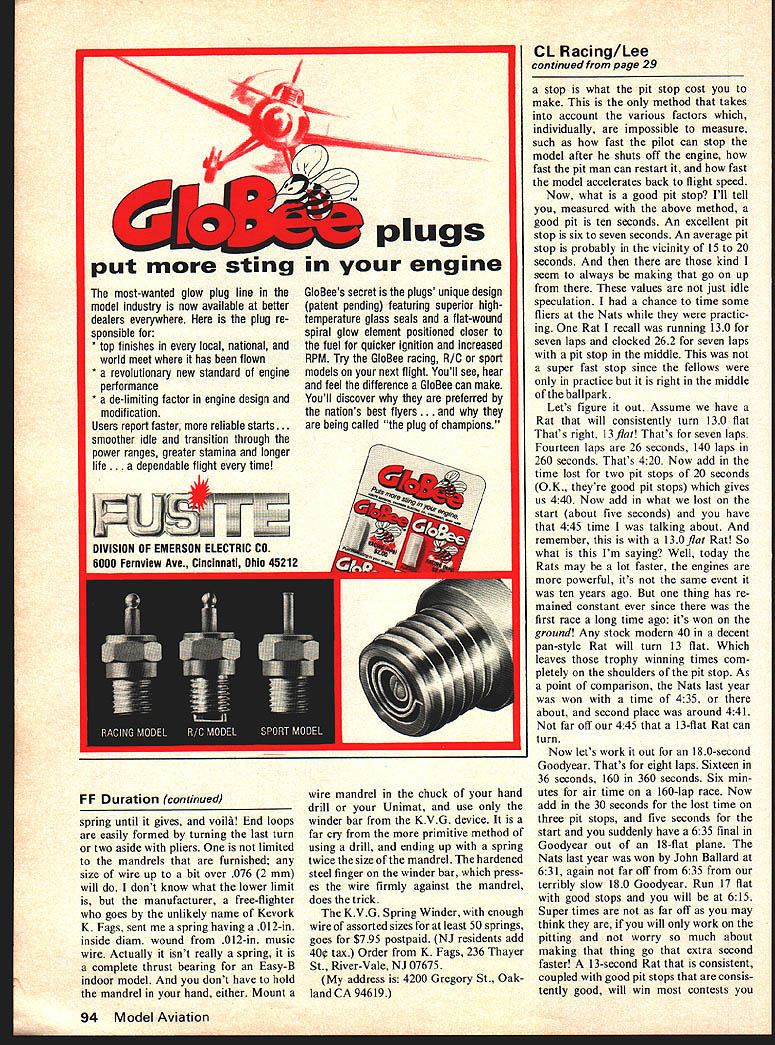
Hydro‑Star: Sal Taibi's Hydro‑Star is one of those oldies‑but‑goodies that continues to sell well, and for good reason: it wins! Besides, it is the only competition hydro‑gas model kit on the market. Many are built with removable floats in order to compete in both hydro and the regular gas contests.
The second model kitted by Competition Models, Hydro‑Star was born at the end of the Holland Hornet Dynasty and the beginning of the Cox Tee‑Dee Dynasty. It shares wing ribs with the earlier original Starduster and the later Starduster‑X. Sales took a slump when the hydro event was dropped from the Nats schedule, but with hydro back on the program, sales are back on keel.
Joe Dodson of Houston, now deceased, won the Nats hydro event both in 1974 and in 1975 with a Hydro‑Star. Recently Tom Regan set a Category II A‑Hydro record using a Hydro‑Star, borrowed a TD‑049 engine from his brother, and proceeded to also set the Half‑A Hydro record. Then he removed the floats and took third place in Half‑A Gas. At the same meet Tom Karman won the all‑ages, all‑displacements Hydro event with another Hydro‑Star.
FF Duration/Meuser
Young Regan added the "turbulator spars" shown as options on the Starduster-X plans, and increased the widths of the floats by 3/8 in. for added stability in the water. Sal recommends that for models tipping the scales at anything over the 6-oz. mark.
Spring! You need a spring for a prop tensioner, timer auto-start, Nordic autolander, whatever. You find the cigar box labeled "springs, assorted." Inside you find 436 springs from ball-point pen refills, one spring from the front suspension of a 1941 Buick, and nothing in between. Get out the hand drill, clamp it in the vise, stick a nail in the chuck, lash a piece of wire to the chuck somehow, and crank away. Half an hour later you have lacerations, abrasions, contusions, and a rather wobbly-looking spring. Enter (tah-daaa) the K.V.G. Little Gem Handy Dandy Spring Winder.
The K.V.G. consists of (a) a thick washer that serves as a place to anchor the wire, a handle, and a foundation for (b) four music-wire mandrels, from .032 to .076 in. diameter upon which springs may be wound, and (c) the winder bar. The latter has an oversize hole that slips over the mandrel of your choice, an adjusting screw and lock-nut that makes it fit the mandrel anyhow, and a hardened steel finger that presses the loose end of the wire against the mandrel.
Getting the thing started is a bit tricky. But once the spring is started, you just twist away on the winder bar, and out comes a perfectly uniform, tightly coiled spring only slightly larger than the mandrel.
The greatest problem is that you run out of wire. It's so darned much fun making the silly things. But running out of wire could be a blessing in disguise; if you had lots of wire, you could starve to death. Basically, the machine makes a tension spring. But if a compression spring is what you are after, simply stretch the tension spring until it gives, and voila! End loops are easily formed by turning the last turn or two aside with pliers. One is not limited to the mandrels that are furnished: any size of wire up to a bit over .076 in. (2 mm) will do. I don't know what the lower limit is, but the manufacturer, a free-flighter who goes by the unlikely name of Kevork K. Fags, sent me a spring having a .012-in. inside diam. wound from .012-in. music wire. Actually it isn't really a spring, it is a complete thrust bearing for an Easy-B indoor model. And you don't have to hold the mandrel in your hand, either. Mount a wire mandrel in the chuck of your hand drill or your Unimat, and use only the winder bar from the K.V.G. device. It is a far cry from the more primitive method of using a drill, and ending up with a spring twice the size of the mandrel. The hardened steel finger on the winder bar, which presses the wire firmly against the mandrel, does the trick.
The K.V.G. Spring Winder, with enough wire of assorted sizes for at least 50 springs, goes for $7.95 postpaid. (N.J. residents add 4% tax.) Order from K. Fags, 236 Thayer St., River Vale, NJ 07675. (My address is: 4200 Gregory St., Oakland, CA 94619.)
Transcribed from original scans by AI. Minor OCR errors may remain.

