
Free Flight: Duration
Harry Murphy
Like as not, the answer to "What's new in Outdoor Free Flight?" these days can often produce some vintage item that has just popped to the surface after lying around, submerged and relatively unnoticed for many years. Whereas some contemporary readers may not consider the rediscovery of modeling artifacts to be news, I certainly enjoy the stories usually associated with such instances. I am a prime supporter of recording these things on paper while verification is still possible, and by no means feel that retaining a soft spot for a little modeling history should cause alarm that I am unfurling the old "Free Flight is Dead" banner again.
A cross-sectional look at the present-day Outdoor Free Flight community would surely confirm that Old-Timer and Nostalgia Gas followings are taking a goodly share of competition activity. Fair enough — we should move over occasionally and permit some space for these folks. The reasons for the increasing trend to recapture the past are many, but the prime motive usually comes down to one simple fact: it's fun.
In the interest of fun, I leaned on model historian Bob Larsh. Before I could produce pen and notepad, he coughed up a couple of items never before seen in commercial print: an early glow-engine–powered model design of his own, and an interesting homebuilt hybrid takeoff on the old Brown Jr. engine. "Bird Dog" Bob is one of those unique individuals with an amazing memory — he will persistently trace the tiniest lead in an attempt to shed additional light on any subject. His efforts in recording modeling history will become increasingly invaluable as older generations pass on. Meanwhile, Bob offers us a portion of his own nostalgic memories below.
The Modern Bombshell
Sez Robert:
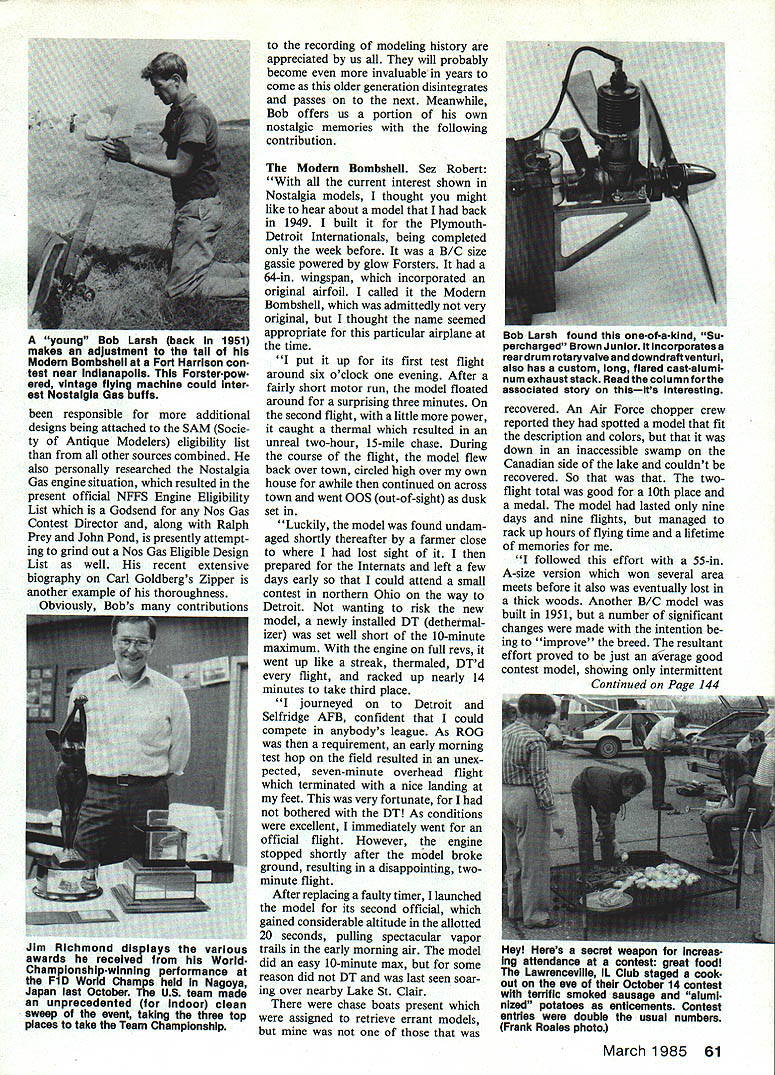
"I built a model back in 1949 for the Plymouth–Detroit Internationals, completing it only the week before the contest. It was a B/C-size 'gassie' powered by Forster glow engines. The wingspan was 64 inches and it incorporated an original airfoil. I called it the Modern Bombshell — admittedly not a very original name, but it suited the airplane.
"I put it up for its first test flight around six o'clock one evening. After a fairly short motor run, the model floated around for a surprising three minutes. On the second flight, with a little more power, it caught a thermal which resulted in an unreal two-hour, 15-mile chase. During that flight the model flew back over town, circled high over my house for a while, then continued across town and went out of sight as dusk set in. Luckily, it was found undamaged shortly thereafter by a farmer near where I had lost sight of it.
"I prepared for the Internationals and left a few days early to attend a small contest in northern Ohio on the way to Detroit. Not wanting to risk the new model, I installed a DT (dethermalizer) set well short of the 10-minute maximum. With the engine on full revs it climbed like a streak, thermaled, DT'd every flight, and racked up nearly 14 minutes to take third place.
"At Detroit and Selfridge AFB, ROG was required. An early morning test hop resulted in an unexpected seven-minute overhead flight which terminated with a nice landing at my feet — very fortunate, as I had not bothered with the DT. Conditions were excellent, so I went for an official flight, but the engine stopped shortly after takeoff, resulting in a disappointing two-minute flight.
"After replacing a faulty timer, I launched again. The model gained considerable altitude in the allotted 20 seconds, pulling spectacular vapor trails in the early morning air. The model did an easy 10-minute max, but for some reason did not DT and was last seen soaring over nearby Lake St. Clair. There were chase boats assigned to retrieve errant models, but mine was not recovered. An Air Force helicopter crew reported spotting a model that fit the description down in an inaccessible swamp on the Canadian side of the lake, so that was that. The two-total was good for 10th place and a medal. The model had lasted only nine days and nine flights, but it had given me hours of flying time and a lifetime of memories.
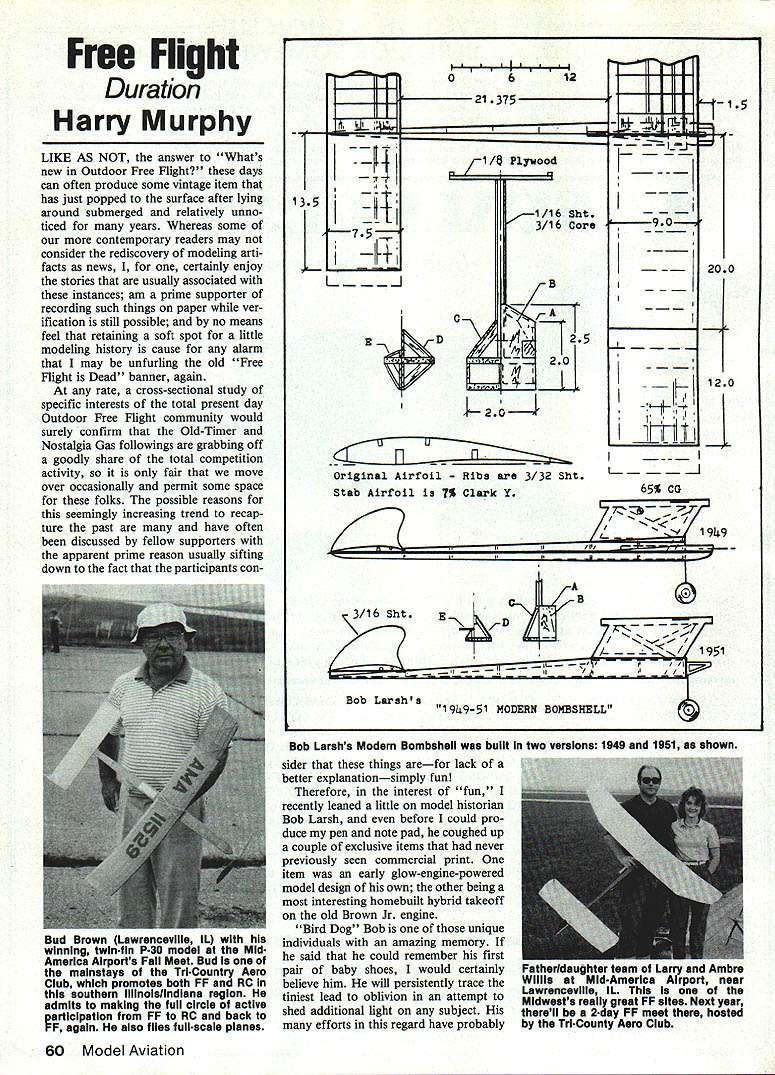
"I followed this with a 55-inch A-size version which was eventually lost in a thick wood, and another B/C model built in 1951 with a number of significant changes intended to improve the design. The 1951 version proved to be an average contest model, showing only intermittent flashes of its predecessor's performance, but it did garner a number of significant wins before being damaged and retired. I've never built the same design twice (other than in different sizes), so I never constructed an exact replica of the 1949 model. No pictures of the '49 job were taken, but I am enclosing a three-view construction sketch of it and photos of the similar 1951 version."
Construction details
If anyone wishes to draw up full-size plans from Bob's three-view, the following additional information is helpful.
- Wing
- Top spars: 1/8 x 1/4 in.
- Main bottom spar: 1/8 x 1/4 in.
- Rear spar: 3/16 x 1/4 in.
- Leading-edge (LE) blank: 1/4 in. square.
- Tapered trailing edge (TE): 1/4 x 1/8 in.
- Wing ribs: 3/32-in. sheet, with a double rib at each tip.
- Dihedral (measured at the trailing edge): 2 in. at the panel joint.
- Polyhedral: 4 in. at each wing tip, measured from the flat plane of the inner panel.
- Note: the dihedral break moves out one rib station on the 1951 model.
- Stabilizer (stab)
- LE: 1/16 x 1/4 in.
- TE: 1/16 x 1/4 in.
- Bottom spar: 1/16 x 3/16 in.
- Top spar: 1/8 x 1/4 in.
- Stab ribs: 1/16 in.
- Fuselage
- The two fuselage constructions are unconventional but clearly defined in the drawing.
- 1949 version: incorporates an X-shaped core with center and bottom horizontal components of 1/8-in. sheet and vertical backbones of 3/32-in. sheet. Motor bearers were 3/32 x 3/8 hardwood.
- 1951 version: the 1/8-in. sheet horizontal plan-view outline is moved downward to become the flat bottom of the fuselage.
- Top backbone and pylon core (both versions): 1/8 x 1/8 in.
- Both pylon and center fuselages are planked with 1/16-in. sheet.
- Motor mounts and landing gear
- 1949 model used 3/32 x 3/8 hardwood motor bearers.
- Later design used K&B steel mounts.
- Landing gear: the '49 model had a single-wheel arrangement; the '51 version used both single- and two-wheel arrangements at various times.
Bob says the foregoing should suffice for any proper duplication efforts.
Supercharged Brown Jr.?
Oddball engines that surface via the persistence of model engine collectors are often accompanied by an interesting tale of discovery. I photographed Bob Larsh's find at a recent CIA Club meeting. Bob recounted that, over the years, he'd heard rumors of two brothers named Scott who were active in Control Line in the Indianapolis area during the early Forties. Following a lead one summer, Bob knocked on a door that was answered by a young man in a U.S. Navy uniform. The young man told him that he had indeed located one of the brothers, but that the gentleman had recently passed away.
(Story continues in original column.)
See ya downwind! Harry Murphy 3824 Oakwood Blvd. Anderson, IN 46011
Transcribed from original scans by AI. Minor OCR errors may remain.

