
Free Flight: Duration
By Bob Meuser
CO-2 power interest on the rise. Material for this column seems to come in bunches; nothing on a subject for years, then suddenly a bunch of material on the same topic. Anyhow, an increasing number of modelers seem to be recognizing the virtues of CO-2 power: small, quickly built models; no starting problems or messing with fuels, glow heads, or electric starters, or even rubber winders; more than ample power giving excellent performance (if you build light).
The first item is a letter from Al Lidberg, whose CO-2–powered Civy Boy appeared in the August 1984 issue, written in response to the item on CO-2 power that appeared in this column when Larry Kruse subbed for me.
The second item is about an innovative way of getting construction plans for CO-2 models. We'd also like to call your attention to rules-change proposal FF-86-6.
Letter from Al Lidberg
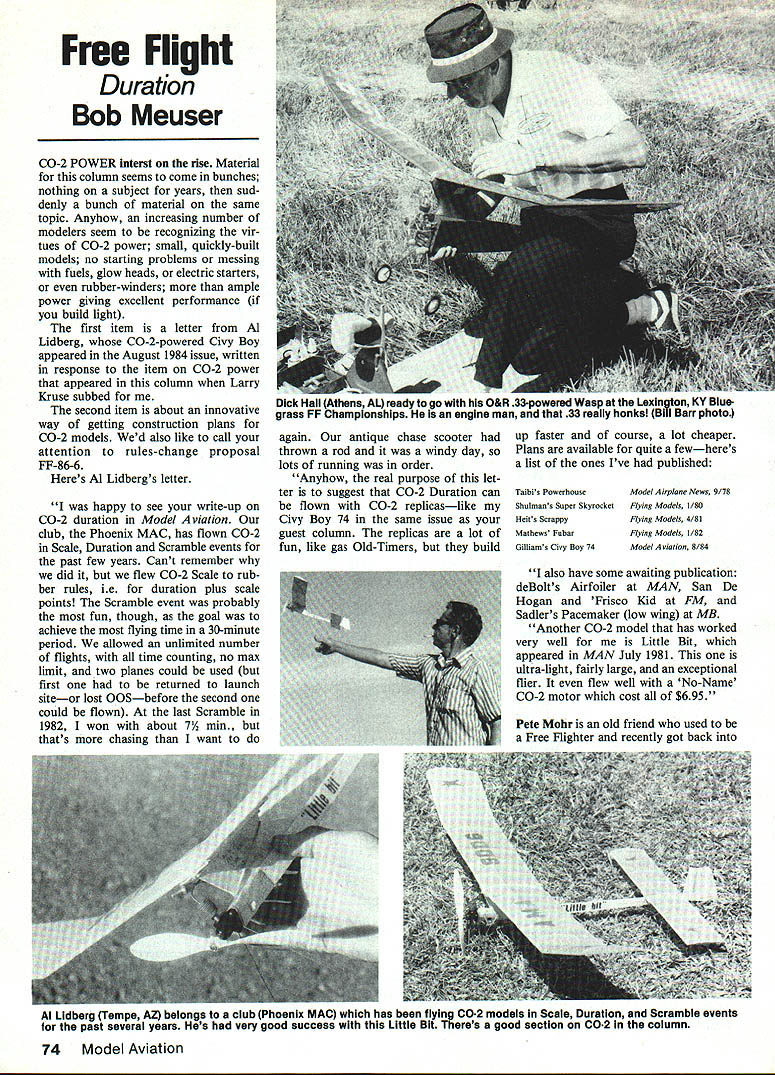
"I was happy to see your write-up on CO-2 duration in Model Aviation. Our club, the Phoenix MAC, has flown CO-2 in Scale, Duration and Scramble events for the past few years. Can't remember why we did it, but we flew CO-2 Scale to rubber rules, i.e., for duration plus scale points! The Scramble event was probably the most fun, though, as the goal was to achieve the most flying time in a 30-minute period. We allowed an unlimited number of flights, with all time counting, no max limit, and two planes could be used (but the first one had to be returned to the launch site—or lost OOS—before the second one could be flown). At the last Scramble in 1982, I won with about 7½ minutes, but that's more chasing than I want to do again. Our antique chase scooter had a thrown rod and it was a windy day, so lots of running was in order.
"Anyhow, the real purpose of this letter is to suggest that CO-2 Duration can be flown with CO-2 replicas—like my Civy Boy 74 in the same issue as your guest column. The replicas are a lot of fun, like gas Old-Timers, but they build up faster and, of course, a lot cheaper. Plans are available for quite a few—here's a list of the ones I've had published:"
- Taibi's Powerhouse — Model Airplane News, 9/78
- Shulman's Super Skyrocket — Flying Models, 1/80
- Heit's Scrappy — Flying Models, 4/81
- Mathews' Fubar — Flying Models, 1/82
- Gilliam's Civy Boy 74 — Model Aviation, 8/84
"I also have some awaiting publication: deBolt's Airfoiler at MAN, San De Hogan and 'Frisco Kid at FM, and Sadler's Pacemaker (low wing) at MB.
"Another CO-2 model that has worked very well for me is Little Bit, which appeared in MAN July 1981. This one is ultra-light, fairly large, and an exceptional flier. It even flew well with a 'No-Name' CO-2 motor which cost all of $6.95."
Pete Mohr is an old friend who used to be a Free Flighter and recently got back into it.
Model weight vs. size
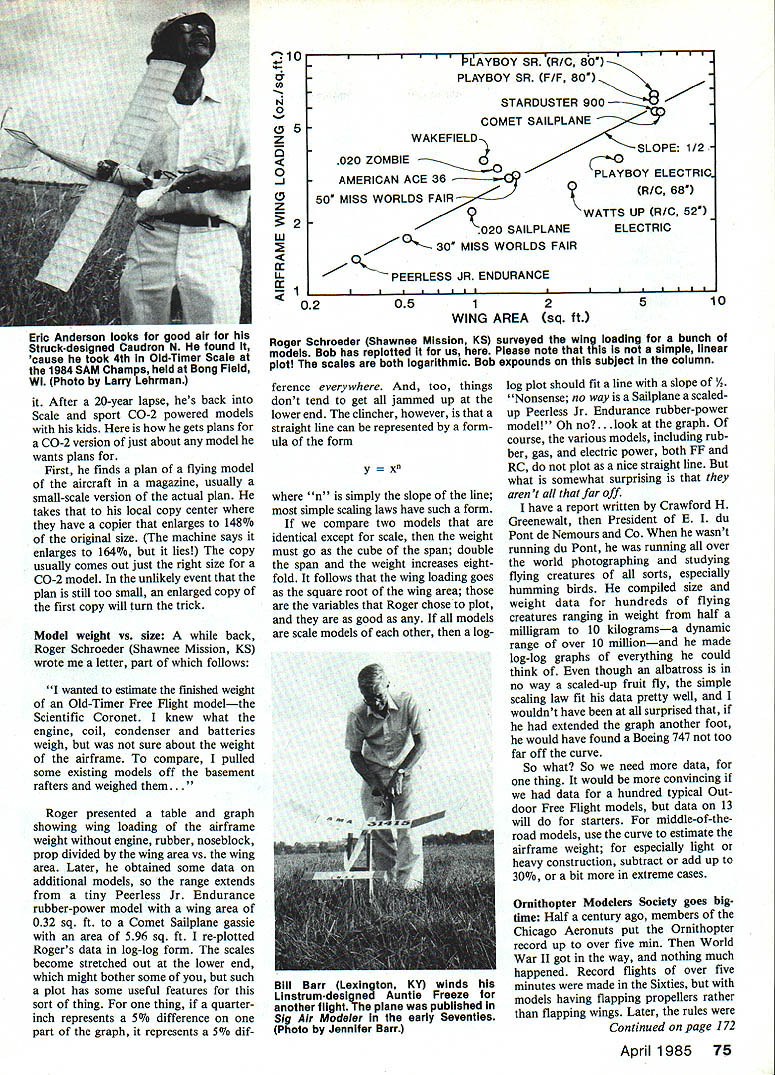
"I wanted to estimate the finished weight of an Old-Timer Free Flight model—the Scientific Coronet. I knew what the engine, coil, condenser and batteries weigh, but was not sure about the weight of the airframe. To compare, I pulled some existing models off the basement rafters and weighed them..."
Roger presented a table and graph showing wing loading of the airframe weight (without engine, rubber, noseblock, prop) divided by the wing area versus the wing area. Later, he obtained some data on additional models, so the range extends from a tiny Peerless Jr. Endurance rubber-power model with a wing area of 0.32 sq. ft. to a Comet Sailplane gassie with an area of 5.96 sq. ft. I re-plotted Roger's data in log-log form. The scales become stretched out at the lower end, which might bother some of you, but such a plot has some useful features for this sort of thing. For one thing, if a quarter-inch represents a 5% difference on one part of the graph, it represents a 5% difference everywhere. And, too, things don't tend to get all jammed up at the lower end. The clincher, however, is that a straight line can be represented by a formula of the form y = x^n, where "n" is simply the slope of the line; most simple scaling laws have such a form.
If we compare two models that are identical except for scale, then the weight must go as the cube of the span; double the span and the weight increases eightfold. It follows that the wing loading goes as the square root of the wing area; those are the variables that Roger chose to plot, and they are as good as any. If all models are scale models of each other, then a log-log plot should fit a line with a slope of 1/2.
"Nonsense; no way is a Sailplane a scaled-up Peerless Jr. Endurance rubber-power model!" "Oh no? ... look at the graph. Of course, the various models, including rubber, gas, and electric power, both FF and RC, do not plot as a nice straight line. But what is somewhat surprising is that they aren't all that far off."
I have a report written by Crawford H. Greenewalt, then president of E. I. du Pont de Nemours and Co. When he wasn't running Du Pont, he was running all over the world photographing and studying flying creatures of all sorts, and especially hummingbirds. He compiled size and weight data for hundreds of flying creatures ranging in weight from a milligram or so to kilograms—a dynamic range of over 10 million—and he made log-log graphs of everything he could think of. Even though an albatross is in no way a scaled-up fruit fly, the simple scaling law fit his data pretty well, and I wouldn't have been at all surprised that, if he had extended the graph another foot, he would have found a Boeing 747 not too far off the curve.
So what? So we need more data, for one thing. It would be more convincing if we had data for a hundred typical Outdoor Free Flight models, but data on 13 will do for starters. For middle-of-the-road models, use the curve to estimate the airframe weight; for especially light or heavy construction, subtract or add up to 30%, or a bit more in extreme cases.
Ornithopter Modelers Society goes big-time
Half a century ago, members of the Chicago Aeronauts put the Ornithopter record up to five minutes. Then World War II got in the way, and nothing much happened. Record flights of over five minutes were made in the Sixties, but with models having flapping propellers rather than flapping wings. Later, the rules were...
Frank Zaic's Yearbooks and publications
These are an important source of vital information when they were written; today, they remain both inspirational and informative, and in addition serve as chronicles of bygone eras of our beloved sport.
Only a small fraction of the space between the traditional yearbook-style, heavy-paper covers is occupied by the reprint of the 1934 Year Book itself. There are many things in there besides that: the story of Jasco, Frank's company, which supplied all of our Indoor modeling materials and a lot of our Outdoor modeling supplies and materials from the early Thirties into the late Forties; the 1934 Jasco Guide and Log Book, containing plans and information about modeling of that era; Jasco catalogs from 1934 through 1940, which are not merely catalogs, but which also contain a wealth of information; some 15 plans prepared for the never-to-be 1940 Yearbook; the first two issues of Model Yearbook, published by the newborn American Academy for Model Aeronautics (later to be called you-know-what) published in mid-1936; the first issue of Model Aeronautics, published by Frank himself in 1937; the story of the writing and publishing of the Yearbooks, which spanned more than three decades; and some notes by Jim Cahill and Wally Simmers regarding the origins of the folding prop, the lifting stab, sidethrust and downthrust.
In the early days of the Yearbooks, they were financially successful and helped support some of Jasco's losses. More recently, however, they haven't been what you might call financially viable. An attempt by Frank to get grass-roots support from the Free Flight community in the late Sixties met with deafening silence, and so we robbed ourselves of a potential 1970 Yearbook.
It is amazing—perhaps even a little disgusting—to find virtually every "new" idea I've ever thought of or heard of neatly laid out in one of Frank's ancient books. Really, if you don't have a complete set of Frank's books you are missing a good source of information for present-day sport and competition modeling.
Throughout all of Frank's many writings, there pervades the philosophy of a man who dearly loves model aviation, who derived great spiritual benefit from it, and who has done his level best to make available to others, by his publication, kits, and other activities, the means by which their lives, too, might become enriched.
Most of Frank's books are available from AMA Supply and Service. All of Frank's publications are available from Frank himself, in care of Model Aeronautic Publications, P.O. Box 135, Northridge, CA 91324. The 1934 Yearbook costs $5.50, postpaid. Make checks payable to Frank Zaic.
I'll be back in two months.
Bob Meuser 4200 Gregory St., Oakland, CA 94619.
Transcribed from original scans by AI. Minor OCR errors may remain.

