
Free Flight: Duration
Harry Murphy
Carl Goldberg has passed away. The Free Flight competition world is saddened by the recent death of a man who was probably its most well-known personality. His model designs of the Thirties and Forties established design precedents that remain with us to this day. Although he was often credited with inventing the pylon (promoted by his Zipper designs), Carl continually passed the credit to his early associate Andy Anderson. Carl did write the first commercially printed article on dethermalizers for models—and this credit he acknowledged. However, this innovation was just one of a great many that appeared in the model kits he designed during his long association with the Comet Model Airplane Company.
No Old-Timer contest would be complete without representative models of his Free Flight designs from the Golden Era. Along with the famous Zipper were other popular designs that bear his name, such as the Clipper, Valkyrie, Mercury, Interceptor, Sailplane, Cumulus, Viking, and Blazer. Carl also prided himself on being the only contestant to enter and compete in every Nationals since the first one in the early Twenties. That distinction ended with his death. He has now succumbed, and his followers mourn his passing.
Mid-America FF Mecca
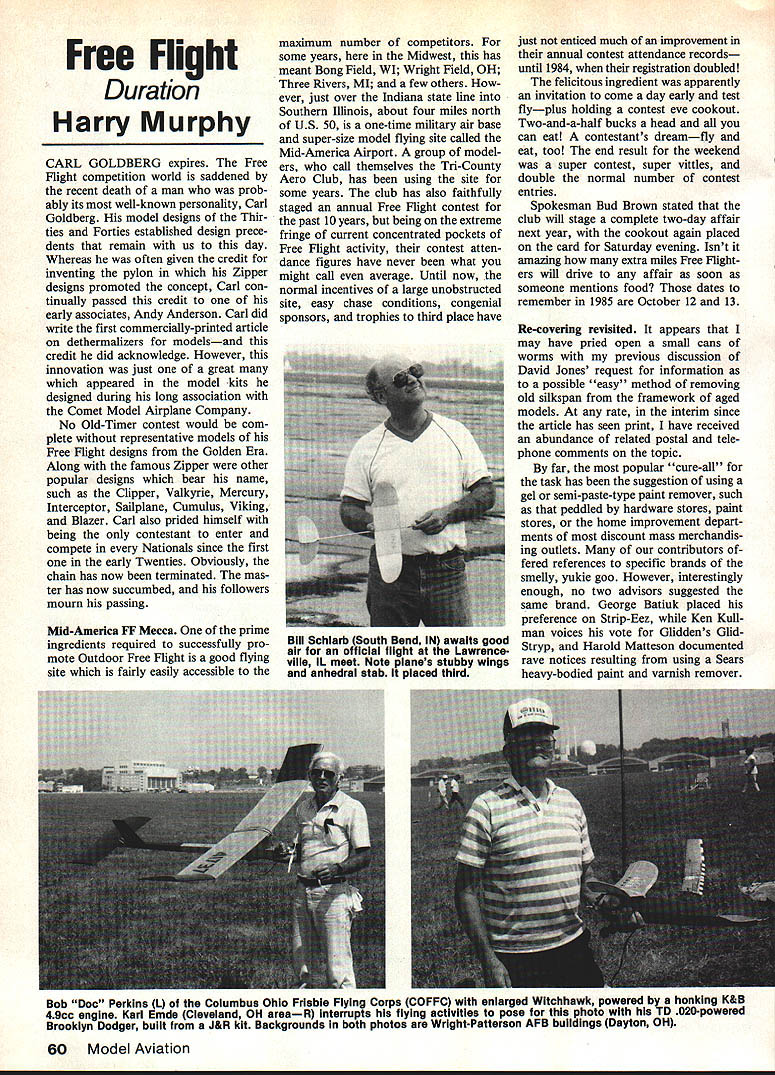
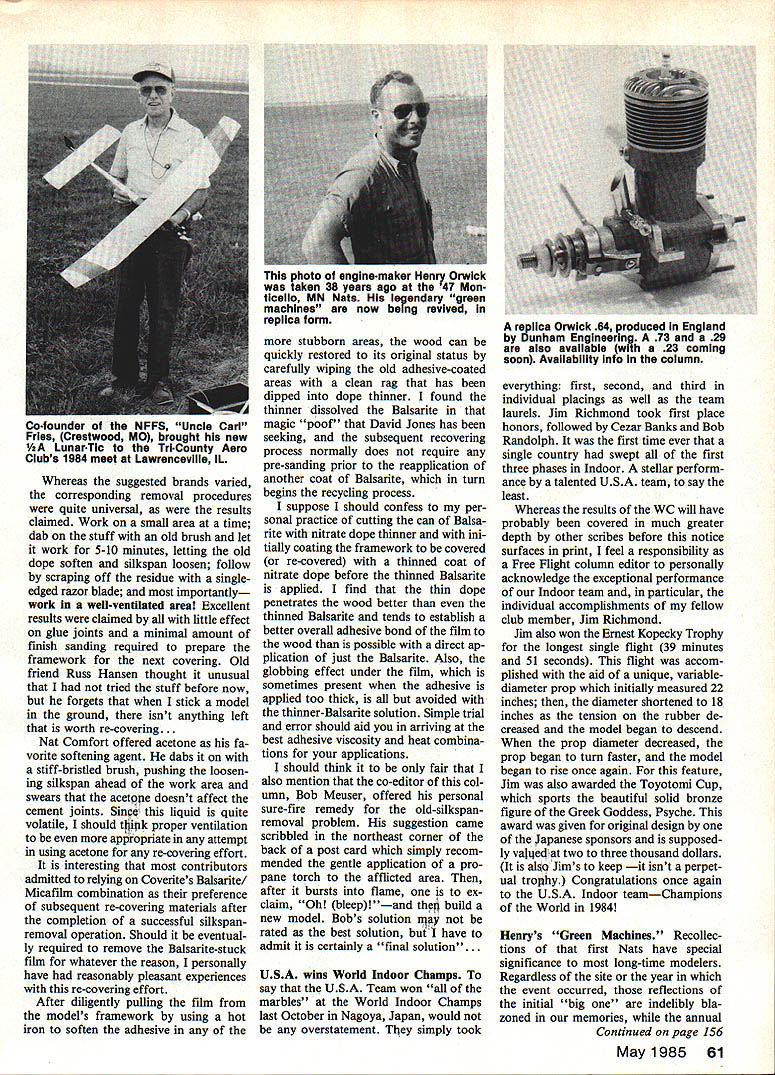
One of the prime ingredients required to successfully promote Outdoor Free Flight is a good flying site that is fairly easily accessible to the maximum number of competitors. For some years here in the Midwest this has meant Bong Field, WI; Wright Field, OH; Three Rivers, MI; and a few others. However, just over the Indiana state line into southern Illinois, about four miles north of U.S. 50, is a former military air base and super-size model flying site called Mid-America Airport.
A group of modelers who call themselves the Tri-County Aero Club has been using the site for some years. The club has also faithfully staged an annual Free Flight contest for the past 10 years, but being on the extreme fringe of current concentrated pockets of Free Flight activity, their contest attendance figures have never been what you might call even average—until now, when their registration doubled in 1984!
The felicitous ingredient was apparently an invitation to come a day early and test-fly—plus holding a contest eve cookout. Two-and-a-half bucks a head and all you can eat! A contestant's dream—fly and eat, too! The end result for the weekend was a super contest, super vittles, and about double the normal number of contest entries.
Spokesman Bud Brown stated that the club will stage a complete two-day affair next year, with the cookout again on the Saturday evening card. Isn't it amazing how many extra miles Free Flighters will drive after someone mentions food? Dates to remember in 1985 are October 12 and 13.
Re-covering revisited
It appears that I may have pried open a small can of worms with my previous discussion of David Jones's request for information about a possible "easy" method of removing old silkspan from the framework of aged models. In the interim since the article has seen print, I have received an abundance of related postal and telephone comments on the topic.
By far the most popular "cure-all" for the task has been the suggestion of using a gel or semi-paste paint remover, such as those sold by hardware stores, paint stores, or the home improvement departments of most discount mass-merchandising outlets. Many of our contributors offered references to specific brands of the smelly, yukky goo. Interestingly enough, no two advisors suggested the same brand. George Batiuk placed his preference on Strip-Eez, while Ken Kullman voices his vote for Glidden's Glid-Strip. Harold Matteson documented rave notices resulting from using a Sears heavy-bodied paint and varnish remover.
Work a small area at a time; dab the stuff on with an old brush and let it work 5 to 10 minutes, letting the old dope soften and the silkspan loosen. Follow by scraping off the residue with a single-edged razor blade. Importantly, work in the shade and do not allow the remover to dry on the wood. Rinse with clean water and sponge off the residue. In some instances it may be necessary to repeat the treatment. It sounds simple—and it is.
After diligently pulling the film from the model's framework by using a hot iron to soften the adhesive in any of the more stubborn areas, the wood can be quickly restored to its original status by carefully wiping the old adhesive-coated areas with a clean rag dipped into dope thinner. I found the thinner dissolved the Balsarite in that magic "poof" that David Jones has been seeking, and the subsequent recovering process normally does not require any pre-sanding prior to the reapplication of another coat of Balsarite, which in turn begins the recycling process.
I should confess to my personal practice of cutting the can of Balsarite with nitrate dope thinner and initially coating the framework to be recovered (or re-covered) with a thinned coat of nitrate dope before the thinned Balsarite is applied. I find that the thinner penetrates the wood better than even the thinned Balsarite and tends to establish a better overall adhesive bond of the film to the wood than is possible with a direct application of just the Balsarite. Also, the globbing effect under the film, which is sometimes present when the adhesive is applied too thick, is all but avoided with the thinner–Balsarite solution. Simple trial and error should aid you in arriving at the best adhesive viscosity and heat combinations for your applications.
I should also mention that the co-editor of this column, Bob Meuser, offered his personal sure-fire remedy for the old-silkspan-removal problem. His suggestion came scribbled in the northeast corner of the back of a postcard and simply recommended the gentle application of a propane torch to the afflicted area. Then, after it bursts into flame, one is to exclaim, "Oh! (bleep)!"—and then build a new model. Bob's solution may not be rated as the best solution, but I have to admit it is certainly a "final solution."
U.S.A. wins World Indoor Champs
To say that the U.S.A. team won "all of the marbles" at the World Indoor Championships last October in Nagoya, Japan, would not be any overstatement. They simply took everything: first, second, and third in individual placings as well as the team laurels. Jim Richmond took first place honors, followed by Cezar Banks and Bob Randolph. This was the first time ever that a single country had swept all of the first three places in Indoor. A stellar performance by a talented U.S.A. team, to say the least.
Whereas the results of the World Championships have probably been covered in much greater depth by other sources before this notice surfaces in print, I feel a responsibility as a Free Flight columnist to personally acknowledge the exceptional performance of our Indoor team and, in particular, the outstanding accomplishments of my fellow club member, Jim Richmond.
Jim also won the Ernest Kopecky Trophy for the longest single flight (39 minutes and 51 seconds). This flight was accomplished with the aid of a unique, variable-diameter prop which initially measured 22 inches; then the diameter shortened to 18 inches as the tension on the rubber decreased and the model began to descend. When the prop diameter decreased, the prop began to turn faster, and the model began to rise once again. For this feature, Jim was also awarded the Toyotomi Cup, which sports the beautiful solid bronze figure of the Greek goddess Psyche. This award was given for original design by one of the Japanese sponsors and is supposedly valued at two to three thousand dollars. (It is also Jim's to keep—it isn't a perpetual trophy.) Congratulations once again to the U.S.A. Indoor team—Champions of the World in 1984!
Henry's "Green Machines"
Recollections of that first Nats have special significance to most long-time modelers. Regardless of the site or the year in which the event occurred, those recollections of the initial "big one" are indelibly blazoned in our memories, while the annual affair continues to endure year after year.
My personal such instance occurred in 1947, which placed the Nats at Monticello, MN. This had meant a 2,200-mile (round-trip) jaunt for two recently graduated Hoosier high-school chums who were making their initial breakout from the safe confines of 17 years of constant parental surveillance. Our conveyance was a '41 Buick, which gave us innumerable problems in guzzling 37 quarts of oil during the trek; but once we reached our destination, all of the trials of the trip were forgotten—for we had arrived!
The Nationals, the world's largest model meet, which heretofore had only been a fantasy on the pages of old model magazines, was now a reality. All around us were actual built-up models of the various designs of both Free Flight and Control Line that had appeared in the model mags as pictured kits and reduced plans. Also, there were the modeling celebrities of the day appearing as real live people, where previously they had only been hallowed names in small print. What a glorious event!
Since the few models that we had taken along were anything but competitive, we had plenty of free time to absorb the various activities in detail and thereby shoot up a considerable amount of film with my dependable Brownie box camera. These now-faded photos reside in a yellowed album which only occasionally gets dusted; however, on this late evening its contents are being perused once again.
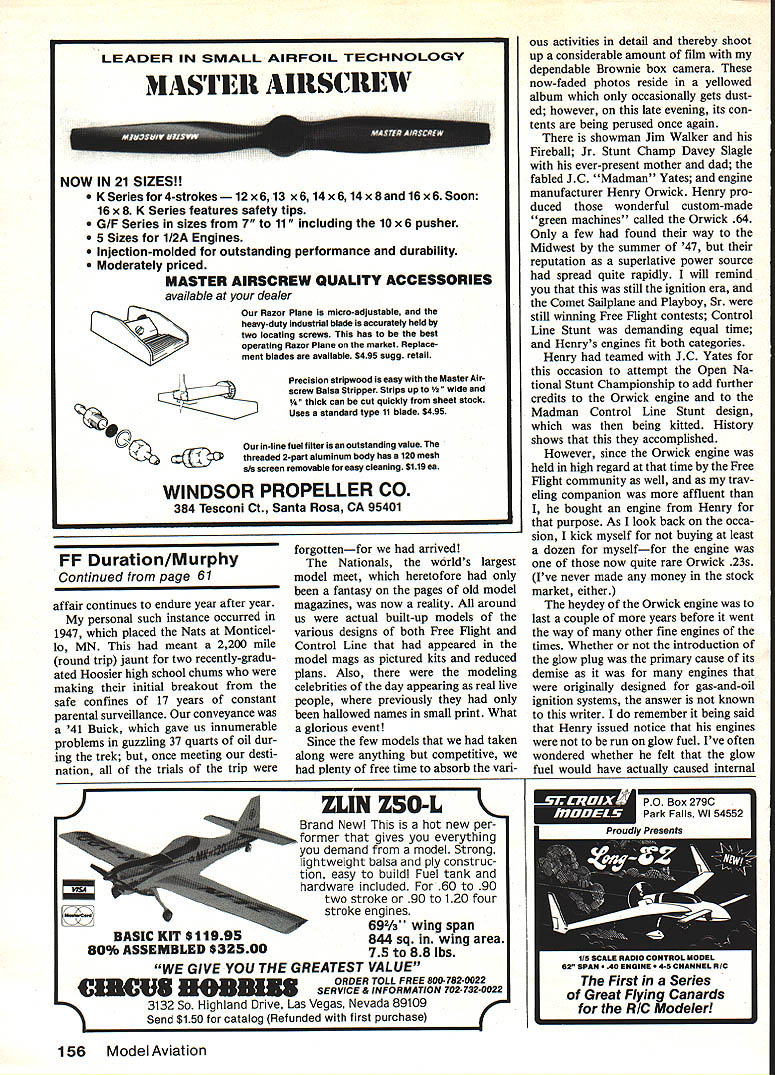
There is showman Jim Walker and his Fireball; Jr. Stunt Champ Davey Slagle with his ever-present mother and dad; the fabled J. C. "Madman" Yates; and engine manufacturer Henry Orwick. Henry produced those wonderful custom-made "green machines" called the Orwick .46. Only a few had found their way to the Midwest by the summer of '47, but their reputation as a superlative power source had spread quite rapidly. I will remind you that this was still the ignition era, and the Comet Sailplane and Playboy, Sr. were still winning Free Flight contests; Control Line Stunt was demanding equal time; and Henry's engines fit both categories.
Henry had teamed with J. C. Yates for this occasion to attempt the Open National Stunt Championship to add further credits to the Orwick engine and to the Madman Control Line Stunt design, which was then being kitted. History shows that they accomplished little here.
However, since the Orwick engine was held in high regard at this time by the Free Flight community, and as my traveling companion was more affluent than I, he bought an engine from Henry for that purpose. As I look back on the occasion, I kick myself for not buying at least a dozen for myself—for the engine was one of those rare curios that never made it into wide distribution (I never made any money in the stock market, either!).
The heyday of the Orwick engine was to last a couple more years before it went the way of many other fine engines of the times. Whether or not the introduction of the glow plug was the primary cause of its demise, as it was for many engines originally designed for gas-and-oil ignition systems, the answer is not known to this writer. I do remember it being said that Henry used castor oil in his fuel and that his engines were not to be run on glow fuel. I've often wondered whether he felt that the glow fuel would have actually caused internal harm to his sturdy powerplants, or whether it was just because raw glow fuel would make an instant mess of the green paint on the outside of the crankcases.
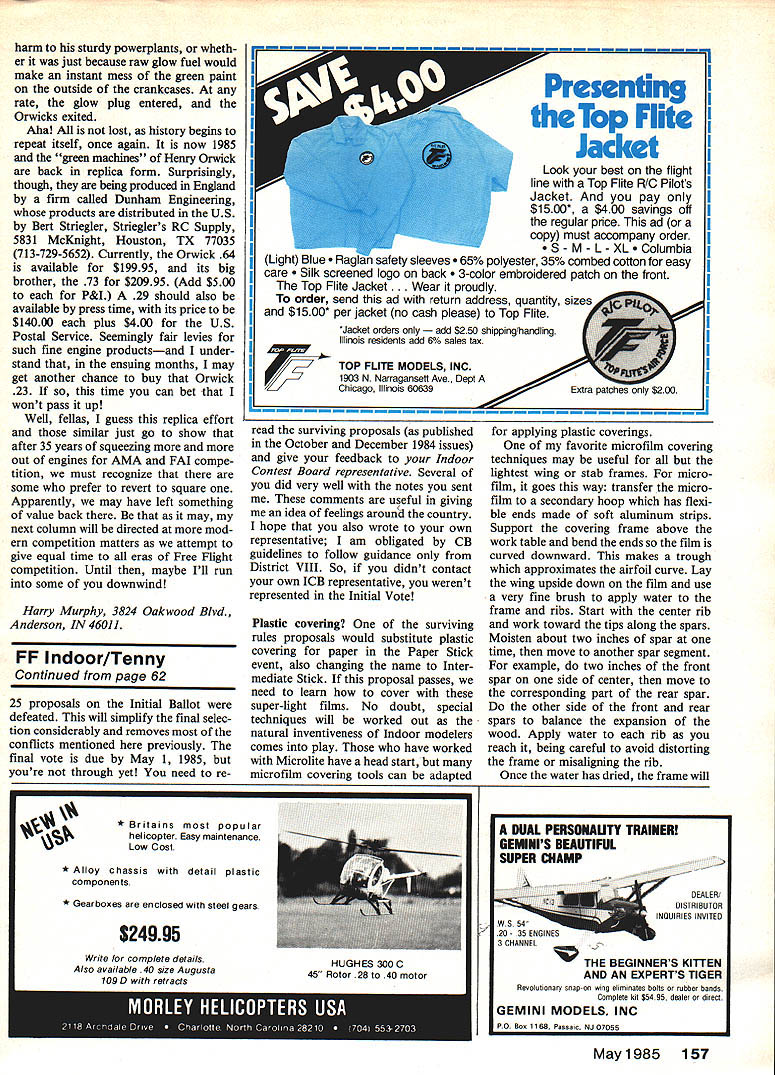
At any rate, the glow plug entered, and the Orwicks exited. Aha! All is not lost, as history begins to repeat itself once again. It is now 1985 and the "green machines" of Henry Orwick are back in replica form. Surprisingly, they are being produced in England by a firm called Dunham Engineering, whose products are distributed in the U.S. by Bert Striegler, Striegler's RC Supply, 5831 McKnight, Houston, TX 77035 (713-729-5652). Currently, the Orwick .64 is available for $199.95, and its big brother, the .73, for $209.95. (Add $5.00 to each for P&I.) A .29 should also be available by press time, with its price to be $140.00 plus $4.00 for U.S. postage. Seemingly fair levies for such fine engine products—and I understand that, in the ensuing months, I may get another chance to buy that Orwick .23. If so, this time you can bet I won't pass it up!
Well, fellas, I guess this replica effort and those similar just go to show that after 35 years of squeezing more and more out of engines for AMA and FAI competition, we must recognize that there are some who prefer to revert to square one. Apparently, we may have left something of value back there. Be that as it may, my next column will be directed at more modern competition matters as we attempt to give equal time to all eras of Free Flight competition. Until then, maybe I'll run into some of you downwind!
Harry Murphy 3824 Oakwood Blvd. Anderson, IN 46011
Transcribed from original scans by AI. Minor OCR errors may remain.

