
Free Flight: Duration
Harry Murphy
New Event Considerations
As promised at the conclusion of our last gathering, I shall, for the most part, attempt to step over some of the dust and cobwebs of the vintage competition activities of Old Timer and Nostalgia Gas in this session to enable catching up with some of the action more akin to what we might label "Modern Free Flight." With this in mind, what could be more apropos than reviewing the why and wherefore of a new-event promotion, such as the latest offering from the San Diego Orbiteers: the .020 Pee Wee 30 Event.
The promotion of new events is nothing new to this innovative group. Their resume includes:
- AMA Peanut Scale
- P-30 Rubber
- West Coast Bostonian
- The 49'er Event
In their recent club newsletter, El Torbellino, Charlie Yost and John Oldenkamp tossed a number of uncomplimentary adjectives at their own latter endeavor (the 49'er Event), stating that the event hasn't accomplished what they originally intended. In predicting its demise, Messrs. Yost and Oldenkamp summed up the event as "overly complicated, oversized, overexpensive, and somewhat overall complex." It was suggested the event should perhaps disappear, despite being another good try at putting fun back in Free Flight.
It should be noted that the original purpose of the 49'er Event was an attempt at a "laid-back" — or entry-level — event that might entice the Free Flight novice more than the more traditionally competitive 1/2A Gas event. At the time the 49'er activity was being formulated on the West Coast, a similar problem was being attacked by a small group in the Ohio–Indiana area via a revival of 1/2A Payload. Of the two events, the 49'er attracted more model press, although 1/2A Payload eventually received some "special event" backing by the NFFS at a couple of consecutive Nats.
In comparative analysis, 1/2A Payload may yet have some substance (I have a new model that has yet to be flown), but event participation has been disappointing. Since there is some similarity between the two events, perhaps both could not thrive in competition with each other. Messrs. Yost and Oldenkamp's frank analysis may have flagged a primary flaw in events of this nature: the complexity of rules and the models required to meet them. 1/2A Payload has never been able to claim tremendous success and includes some rather strict regulations.
The Orbiteers have not been discouraged by the token reception of the 49'er and are now rebounding with another event that appears to avoid some major problems of their former effort and those of 1/2A Payload. "The primary idea is to create a Threshold Gas Event that is fun, cheap, simple, and which might eventually lead the participant into more challenging projects," say the Orbiteers. Charlie Yost is credited with thinking up the .020 Pee Wee 30 Event. The event rules simply list seven items with no flowery explanations — simple and to the point:
- Engine: Cox .020 reed-valve (Pee Wee).
- Max wing span: 30 inches.
- Max flight time: Two minutes.
- Minimum: two wheels for ROG.
- Scoring: flight time divided by engine run.
- Total score: add total of three flight scores.
- Bonus points: 20% added for ROG.
"'Naw, scoring is no problem,' says supporter John Oldenkamp. 'Any school kid can tweak a battery-powered calculator, so surely we can.' Anyhow, should anyone be interested in a few more particulars, El Torbellino's mailing address is 3136 Old Heather Road, San Diego, CA 92111.
Bill's Carbon-Fiber Model
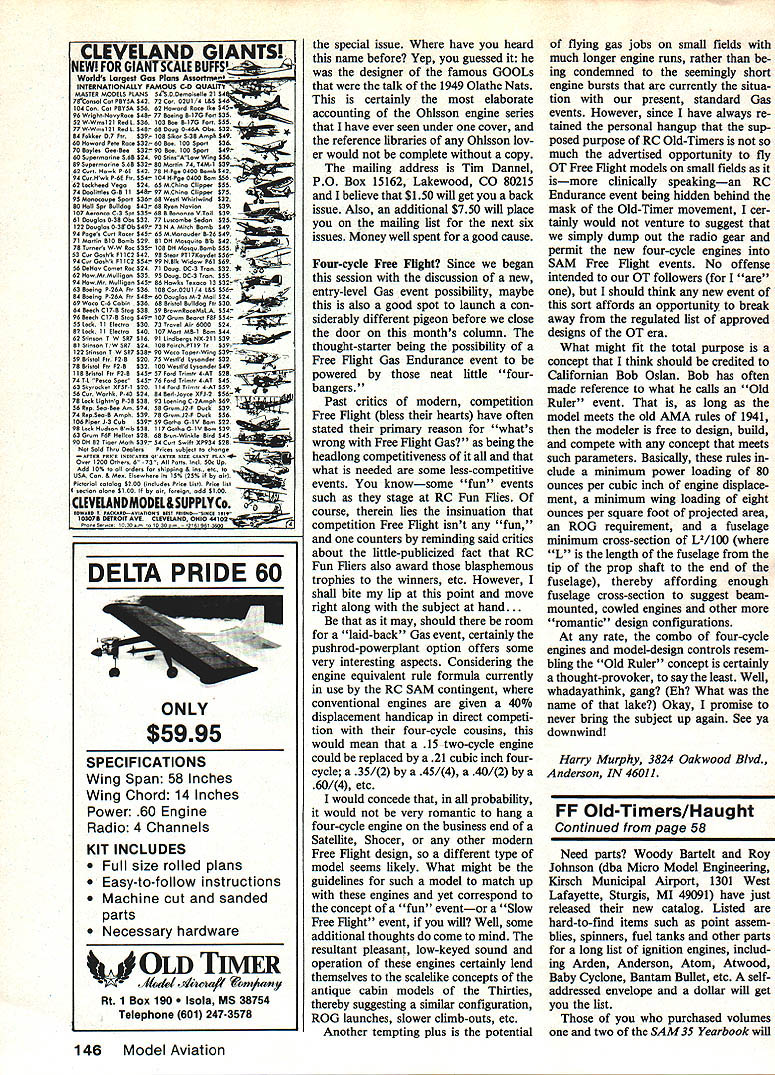
Nothing on the surface of Bill's model would appear out of the ordinary, but if we had telescopic X-ray vision, the skeleton would be of extreme interest to any inquisitive Free Flighter. Bill used an abundance of carbon-fiber rod and sheet throughout the construction.
The trailing and leading edges of both wing and stab were completely void of traditional balsa, with only a seemingly meager single length of .07‑diameter carbon-fiber rod being utilized instead. To obtain torsional rigidity, Bill incorporated long diagonal, full-depth ribs for each wing panel and for each side of the stab in addition to the conventional cross-chord parallel rib placements. The diagonal ribs began at the corners of the panel intersections and ran to the diagonally opposite corners of each panel, giving the effect of a large X in the plan view of each panel.
Each diagonal rib was, in turn, capped with a narrow strip of .007 carbon-fiber sheet. Talk about rigidity! Surely, a sheet of 1/2‑in. steel boilerplate could not have been more rigid.
Bill used the carbon-fiber sheet in other applications as well. The thickness of the sheet-base balsa pylon was reduced to 1/8‑in. by laminating approximately 1‑in.-wide strips of the .007 carbon-fiber sheet to both sides of the balsa core at the leading and trailing edges. The carbon-fiber sheet was also utilized in fabricating the firewall, permitting a skimpy 3/8‑in.-thick sheet of plywood to be used. All flying surfaces were covered with the lightweight, clear Coverite Micafilm.
So what does all this buy you? It produced a three-ounce‑lighter model than his original, conventionally constructed version. Bill admitted the carbon fiber was quite expensive — he had about $36 invested in just the rods themselves. Progress is certainly expensive, but many innovations eventually become more affordable. Good show, Bill!
Safety First
There has been a considerable increase in safety-related articles in various club newsletters this past winter. Some testimonials about the hazards of recently developed products for modeling applications are frightening. These products include carbon fibers, boron filament, and the now universally used cyanoacrylate (CYA) cements. Considerable has already been said about precautions for CYA; carbon fiber is probably the least harmful of the three, with boron wire by far the most hazardous to handle. The medical profession seems unprepared, as yet, to remedy even some minor incidents.
Safety should be foremost in the selection of these or any other products for modeling applications, and knowing your own personal ability to utilize them is very important. Personally, I now tend to avoid using CYA whenever possible, since my sinuses will not tolerate even the tiniest whiff of the fumes.
This is by no means a suggestion that the model industry should begin a "Ban-the-Boron" campaign; proper precautions should be exercised until we become more accustomed to its use. I recall my mother being concerned when I tackled my first 10¢ Comet kit with one of Dad's single-edged razor blades — and how many times have I cut my fingers since? I alone have probably kept Johnson & Johnson in business all these years.
I also did not realize how really high I could have gotten on banana-oil and nitrate-dope fumes until Uncle Sam stepped in and fixed the fumes problem so well that the products are not much good for modelers any more. Have you ever sat on a straight pin? Wow! And getting your fingers whacked by a prop when the engine backfired — boy, that smarts! It seemed years before chicken sticks and electric starters became commonplace.
What this indicates is that, heretofore, we have eventually learned to heed proper safety precautions by learning from others' experiences. Maybe we do learn by failing at times, but we can hardly blame our fellow modelers; we were a bit lacking in protective solutions.
We could simply wrap ourselves in cotton and avoid using carbon fiber, boron wire, CYA, etc., and there are substitute materials that would, with some sacrifice, perform just as well. Unfortunately, that tends to squelch progress and would not be in the spirit of continually searching for better, more innovative solutions.
Propeller Safety and High-RPM Powerplants
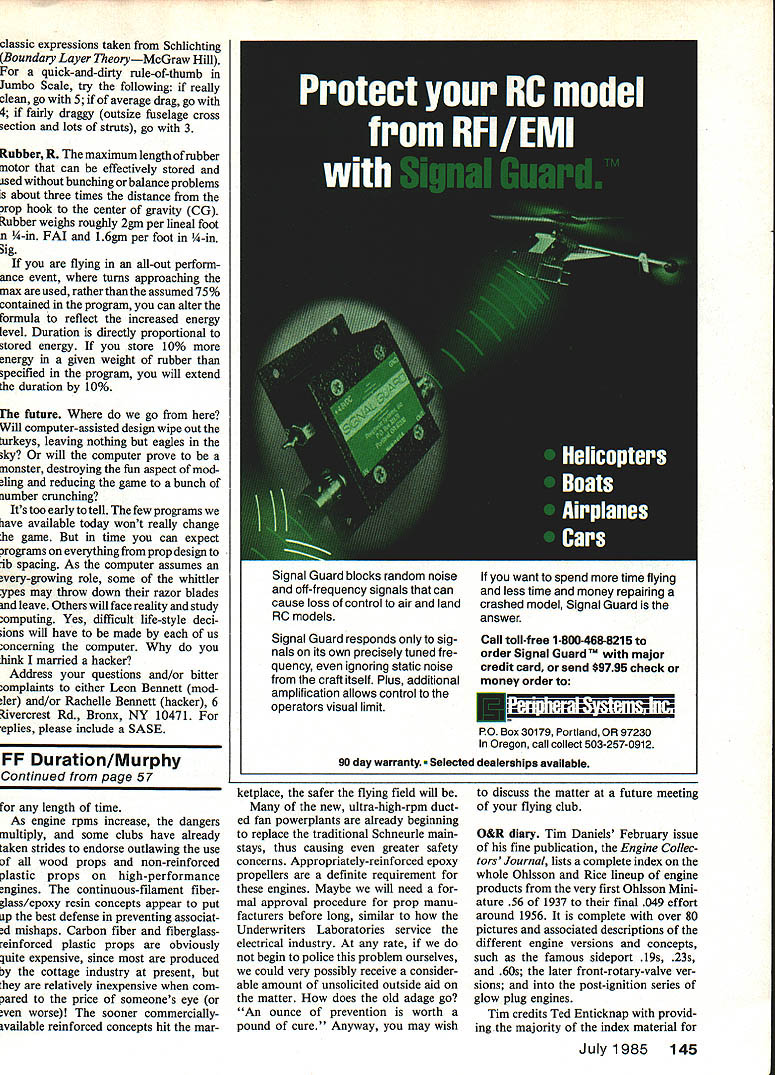
One safety-related area of growing concern among Free Flighters is flying prop blades. The aftermath of the Bill Davis accident last fall is mute testimony to the problem. Bill had dusted off an old model and taken it to the club test-flying site. A non-reinforced nylon prop that had been securely tightened on an ST G21/29 bore about 10 years parted suddenly while the engine was being started with a chicken stick. The resultant damage was obvious.
Many plastics are heat-sensitive, especially when subjected to long periods of extreme pressure, so it is a good practice to loosen the prop nut on all your engines when terminating the day's flying — and particularly if storing a model away.
As engine RPMs increase, the dangers multiply, and some clubs have already outlawed the use of all-wood props and non-reinforced plastic props on high-performance engines. Continuous-filament fiberglass/epoxy-resin concepts appear to provide the best defense in preventing associated mishaps. Carbon-fiber and fiberglass-reinforced plastic props are obviously quite expensive, since most are produced by cottage industry builders at present, but they are relatively inexpensive when compared to the price of someone's eye (or worse). The sooner commercially available reinforced concepts hit the marketplace, the safer the flying field will be.
Many of the new ultra-high-RPM ducted-fan powerplants are beginning to replace traditional Schnuerle main systems, thus causing even greater safety concerns. Appropriately reinforced epoxy propellers are a definite requirement for these engines. We may even need a formal approval procedure for prop manufacturers — similar to how Underwriters Laboratories services the electrical industry. If we do not begin to police this problem ourselves, we could receive unsolicited outside intervention. As the old adage goes, "An ounce of prevention is worth a pound of cure." You may wish to discuss the matter at a future club meeting.
O & R Diary
Tim Daniels' February issue of his fine publication, the Engine Collectors' Journal, has compiled an index on the entire Ohlsson & Rice lineup of engine products from the very first Ohlsson Miniature .56 of 1937 to their final .049 effort around 1956. It is complete with over 80 pictures and associated descriptions of different engine versions and concepts, such as the famous sideport .19s, .23s, and .60s; the later front-rotary-valve versions; and the later post-ignition series of glow-plug engines. Tim credits Ted Enticknap with providing the majority of the index material.
Four-Cycle Free Flight?
Since we began with a discussion of a new, entry-level gas event, this seems a good spot to launch a different idea: a Free Flight Gas Endurance event powered by small four-cycle engines.
Past critics of modern competition Free Flight have often said the problem is excessive competitiveness and that we need less-competitive, "fun" events — similar to RC Fun Flies. Whether competition Free Flight is fun or not is arguable, but the pushrod-powerplant option (four-cycle engines) offers some interesting aspects.
Considering the engine-equivalent rule formula used by the RC SAM contingent, where conventional two-cycle engines are given a 40% displacement handicap when compared with four-cycle engines, a .15 two-cycle could be replaced by a .21 cubic inch four-cycle; a .35/.2 by a .45/.4; a .40/.2 by a .60/.4; etc.
It might not be very romantic to hang a four-cycle engine on the business end of a Satellite, Shocor, or other modern Free Flight design, so a different type of model seems likely. The pleasant, low-key sound and operation of these engines would lend themselves to scale-like concepts of antique cabin models of the 1930s — suggesting similar configurations, ROG launches, slower climb-outs, and so on.
Another tempting advantage is the potential of flying gas jobs on small fields with much longer engine runs, rather than being limited to the short bursts typical of present standard gas events. However, any new event should afford the opportunity to break away from strictly regulated lists of approved Old-Timer designs.
A concept to consider, credited to Californian Bob Oslin, is the "Old Ruler" event: as long as the model meets the old AMA rules of 1941, the modeler is free to design, build, and compete within those parameters. Basically, these rules include:
- A minimum power loading of 80 ounces per cubic inch of engine displacement.
- A minimum wing loading of 8 ounces per square foot of projected area.
- An ROG requirement.
- A fuselage minimum cross-section of L/100 (where "L" is the length of the fuselage from the tip of the prop shaft to the end of the fuselage), affording enough fuselage cross-section to suggest beam-mounted, cowled engines and other more "romantic" configurations.
The combination of four-cycle engines and model-design controls resembling the "Old Ruler" concept is certainly a thought-provoker. Well — whadaya think, gang? See ya downwind!
Harry Murphy 3824 Oakwood Blvd. Anderson, IN 46011.
Transcribed from original scans by AI. Minor OCR errors may remain.

