
Free Flight: Duration
Bob Meuser
GIPAC II — the Second Great International Paper Airplane Contest — has come and gone. Entries had to be mailed by May 1; my last batch would have taken a bit of superhuman effort on the part of the Postal Service, and judging and the winners' announcement were scheduled for May 28. The first GIPAC was in 1967 — that's 18 years ago, although it seems like about half‑past yesterday. Eighteen‑year intervals seem about right for such things. I don't think I'll care much when the Third rolls around.
The First GIPAC got something like 12,000 entries. I doubt the Second will have gotten a third of that. Publicity wasn't great. Our local Lawrence Hall of Science — a sort of science museum and public‑awareness institution — ran a local meet as a precursor to the big one and asked me to be a judge. Three days before the judging they told me it wouldn't be necessary; the number of entries was disappointingly small. Too bad.
During about 1975–1980 there were dozens of paper‑plane contests in the San Francisco Bay Area, run by various school systems and recreation departments. It was a lot of fun. Usually the mornings were devoted to the school kids and the so‑called adults got their whack in the afternoon. Quite a number of local Free Flighters rode the circuit along with about an equal number of people interested mainly in modeling (principally Free Flight) but who didn't fly in AMA competition. The competition got pretty tough and model construction rather sophisticated — then, suddenly, the whole thing collapsed.
Now consider the odds for a mail‑in meet. First, the models must survive mailing, unpacking, and sitting around for a couple of weeks under goodness‑knows‑what humidity changes. Then they will be flown by persons not necessarily tuned in on either flying or adjusting such models — perhaps with no opportunity for test flights and adjustments. You might almost as well flip a coin. Still, the First yielded some striking developments in the art despite the odds.
Jerry Brinkman's simple fold‑up is the best I've seen in the simple fold‑up idiom, although my attempts to duplicate it recently have failed. Frederick Hooven's tiny flying plank design flew marvelously at the contest and in a demo on the long‑gone I've Got a Secret TV show. My attempts to improve on his design by using pre‑war tissue and condenser paper didn't amount to much. Captain Barnaby's little Aerobatic model was a delight, doing everything he "told" it to do, although it is difficult to see how it could have won on just one flight.
I had a lot of terrific ideas for the Second meet. Half weren't tried, and half of what was left didn't work. Still, what remained might come out OK.
- Duration: my best potential for winning the Duration event was an 18‑inch model built to typical HLG parameters but entirely of two‑ply Bristol board — double‑surface wing with internal ribs and lots of Hot Stuff. By the time I got the CG far enough forward to ensure moderate freedom from minor warps the thing weighed 40 grams, and the nose probably had 20 layers of Bristol on each side.
- Aerobatics: a copy of a model that had won five local contests. The thing is bi‑stable; it flies almost equally well normal or inverted. If it stalls and then gets its nose down it could go either way, so it tends to do figure‑eights in a vertical plane and maybe a series of loops. Replicas of the model never seemed to work quite as well as the original.
- Distance: a copy of my 1967 winner, for old times' sake, and a sort‑of Minuteman missile just in case rotating models weren't disqualified as they were in 1967.
- Aesthetic Design: I hoped my Intercontinental Rocket Express would look snazzy to the judges, but I suspected the Pterodactyl model entered by my grandson, Clinton Meuser, might fare better.
High‑tech components
Remember Mario Rocca? His winning the ultimate high‑tech Free Flight event, FAI Power, at the 1979 World Champs was impressive — as was the craftsmanship in his model. Mario now manufactures folding props, both one‑ and two‑blade, diameters from 6 to 10 inches and pitches varying in steps as small as 1/2 inch, suitable for AMA classes from 1/2A to D — and for FAI Power, too. He also sells tapered carbon‑fiber wing joiners. His address is 66020 Rovereto Ferrarese, Italy. If you send me an SASE, I'll send you his price list — might save you some time.
If you are interested in the mono‑folding variety, check out those made by Anderson Aero Units Co. Doc Anderson, who passed away a year ago, was perhaps best known as an engine man, but he was into props, too. Rol (his son) and two brothers run the rubber‑power circles and are selling props made from masters Doc made. Typical prices: $7.50 for a 10‑in. dia. × 2.75‑in. pitch; props for AMA classes (8‑in. to 10½‑in. diameter) run about $8.50–$11.00 (plus postage). Props are molded in fiberglass and reinforced with aramid fibers, finished and balanced. Check Anderson Aero Units Co., 4804 Jamestown Rd., Sylvania, OH 43560, or phone (419) 474‑8003 during non‑work hours.
NFFS department
First off, here are the NFFS 1985 Model of the Year awards.
Hints and tips
The following goodies are from Mac McJunkin, writing in Scale News and Views (the Flightmasters' newsletter). Mac likes to use paraffin wax both to stick things together and to keep things from sticking together, and he keeps a saucepan of it ready to melt at an instant's notice.
- Use paraffin‑soaked templates and jigs: they can be stuck together easily with a bit of heat from a soldering gun or heat gun, and a bit of heat (or some tweezing) will separate them again. Since even modern glues won't stick to a coating of paraffin, it's useful when you need temporary bonds. Melting wax over an open flame is hazardous; use a home‑brew double boiler (even two different‑size cans separated by a handful of gravel) on an electric hot plate.
- Jim Richmond's binoculars: for indoor contests, a pair of binoculars around the neck is not silly. A string or fragments of a popped toy balloon dangling from the ceiling can snare an indoor model; the binoculars help you see trouble before it traps your plane.
- Multi‑stringer fuselage form: Mac has a method of building multi‑stringer oval fuselages over a form made of wax‑soaked cardboard formers and then extracting the form. It seems nifty but a bit complex to present here — send a SASE to me for a copy of his description.
- Quadrille paper pads: pads ruled into quarter‑inch squares are great for scale sketches (full‑size, enlarged, or reduced). Some pads' ruling isn't accurate — check before buying. A strip makes a handy ruler for measuring around curved surfaces.
- Rubber motor jig trick: instead of using pliers as a jig, Mac uses a stick with a 1/4‑inch dowel sticking out the side near one end and a series of 1/4‑inch holes drilled into the side at one‑inch intervals. A dowel is poked into the appropriate hole and a one‑inch length of soda straw is slipped over each dowel. The rubber strand is looped between the dowels, the ends tied together, and a rubber band tied around each end close to the dowel. Slip the motor off the dowels and the pieces of straw stay with the motor, making it easier to install into a model.
Fuel pressure fitting
Pressure fuel systems that use a balloon, pacifier, or bladder are popular. Hooking a balloon neck to a skinny nozzle of tubing often requires Yankee ingenuity — and Yankee cussing. A solution appeared in the Jim Crocket Replicas catalog: a small, lightweight fitting, investment‑cast from aluminum alloy (polished appearance, made by a lost‑wax process) that is the correct size for the purpose. It weighs essentially nothing and sells for under three dollars. Jim manufactures a hundred or so small investment‑cast products designed to solve Free Flight problems.
Indoor holding stand
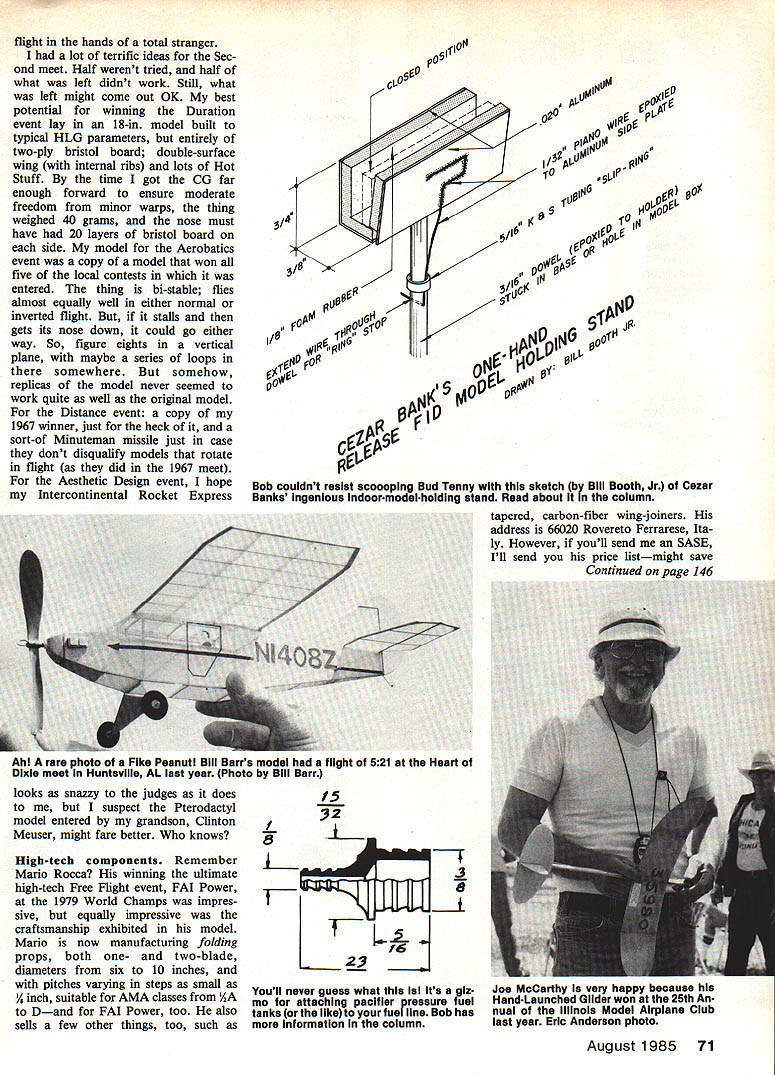
Bill Booth Jr. and Cezar Banks developed an ingenious indoor‑model‑holding stand. The trouble with some stands is that if the jaws are too tight the model can be damaged; if too loose the model might blow out or fall. With Cezar's stand, a sliding ring clamps the model in place when slid upward. If you need to remove the model (often your left hand is occupied), lower the sliding ring and grab the model — in the one or two seconds the model is free it isn't going to move very far.
There'll be more FF Duration stuff next month (if the creek don't rise) — but it'll be by Harry Murphy. Yours truly will return in the October issue. Please don't send Harry all of your good ideas and photos — save some for me!
Bob Meuser 4200 Gregory St. Oakland, CA 94619
Transcribed from original scans by AI. Minor OCR errors may remain.

