
Free Flight: Duration
Harry Murphy
Those "red-hot" Bantams
Those "red-hot" Bantams — we have all owned model engines at one time or another that caused nothing but utter frustration, regardless of what others claimed to have accomplished with the same engine. My personal candidate for this category was that diminutive little powerplant, the Bantam .19. Most would start and four‑cycle quite easily, but the cussed things would quit running when I went to lean out the fuel mixture. Boy, were they contrary!
Lightweight, attractive, and well constructed, the once‑popular Bantam was used on the machinery end of many Class A ignition designs of the early Forties era. Some kitted designs specifically drawn around the Bantam — such as the Shulman Banshee, Zomby, or the Spearhead Jr. — would have to be altered considerably to accept an Arden or an Ohlsson as alternative power. I personally avoided those designs, since constructing one would dictate a Bantam and probably invite eventual additional difficulties.
Over the years I owned at least a dozen different Bantams, ranging from the original magnesium‑case strapless version, to the mag‑case version with the strap, and finally the aluminum‑case OK Herkimer derivatives. They all performed similarly on ignition using a 3:1 gasoline:oil fuel mixture — they started quickly but would quit running when attempts were made to lean out the needle valve. I tried more oil, less oil, raised compression, universal needle valves — you name it — but to no avail. I even sent one off to engine man George Aldrich, and he eventually threw up his hands and returned it.
Any offhanded comment by fellow Old‑Timer fliers about once having a "red‑hot Bantam" provoked an immediate "Put up, or shut up!" from me. The Bantam seemed now popular only on swap tables and was rare in present‑day Class A Old‑Timer competition. Were those recollections of the "red‑hot Bantams" only wives' tales?
Then, late one evening, after pondering the problem yet again, I compared the ignition rear‑rotor timing of the Bantam with similarly constructed larger engines — the Forster and the McCoy Red Head .29s. A hurried check recorded rotor opening durations of 175° for the Forster, 160° for the McCoy, and only 140° for the Bantam. Hm‑m‑m — could the Bantam be "starving to death" from not enough air‑fuel mixture getting through the kidney‑shaped slot in its rotor?
I daintily opened the Bantam rotor with a hand‑held Dremel — about .015 in. at each end of the slot so that the rotor opened earlier and closed later. Not too scientific, I admit, but "Eureka! There really is such a thing as a 'red‑hot Bantam'!" I have doctored both a mag‑case and an aluminum‑case engine with this modification, with great results. Old‑Timer enthusiast Jim Robinson has revised one of his similarly and attained similar results. I won't guarantee this minor operation will work for every Bantam, but at the moment the score is three to zip!
Fly Max revisited
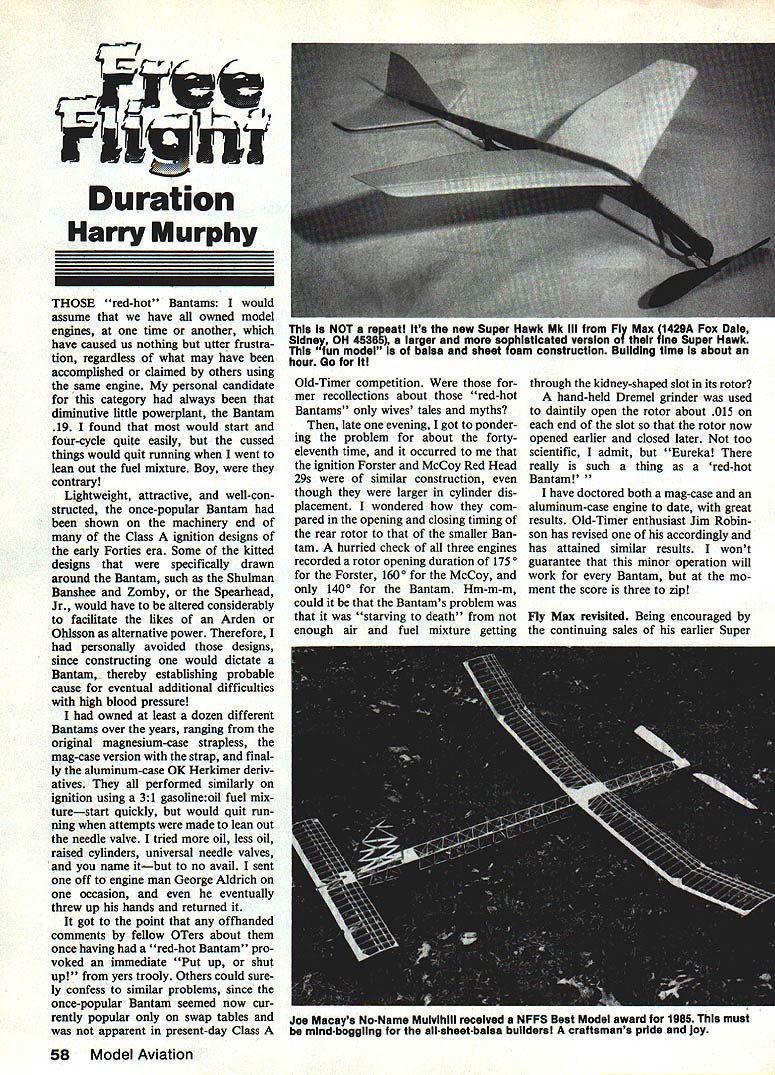
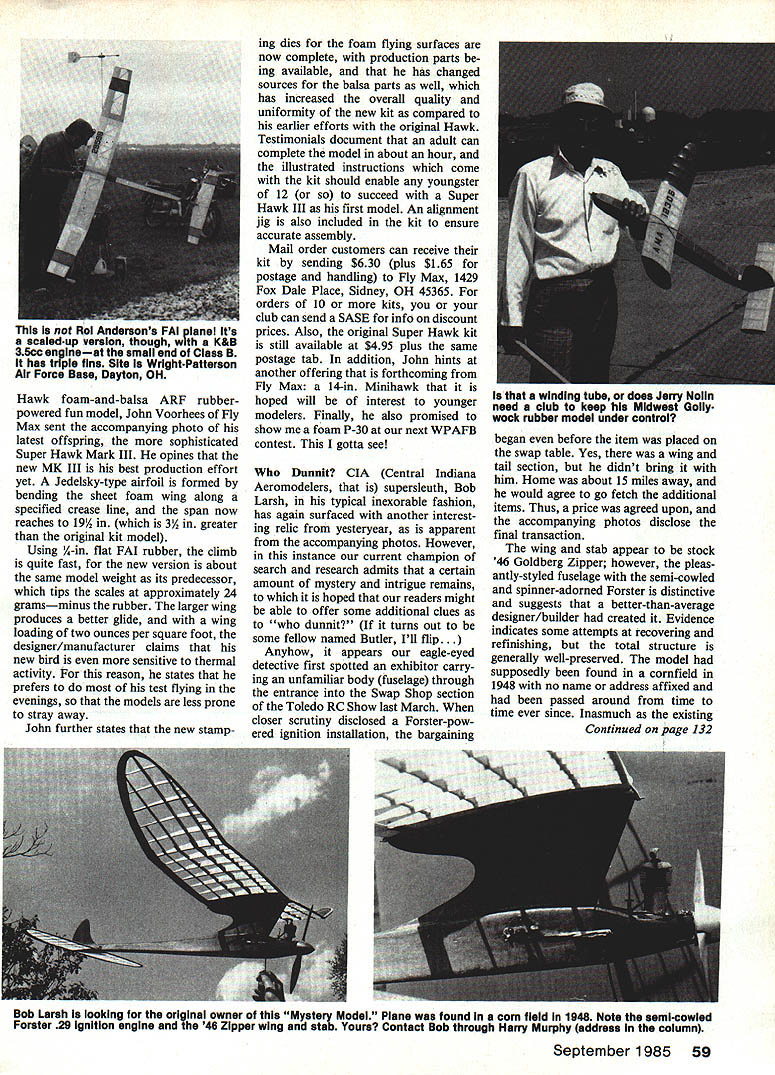
Encouraged by continuing sales of his earlier Super Hawk, Fly Max has produced a larger and more sophisticated version — the new Super Hawk Mark III. John Voorhees of Fly Max sent photos and reports that the Mark III is the best production effort yet.
Details:
- A Jedelsky‑type airfoil is formed by bending the sheet‑foam wing along a specified crease line; span is 19.3 in., greater than the original kit model.
- Uses 1/8‑in. flat FAI rubber and climbs quite fast.
- Model weight is about 24 grams (minus rubber).
- The larger wing produces better glide; wing loading is about two ounces per square foot.
- The designer claims the new bird is sensitive to thermal activity and prefers test flying in the evening.
Production improvements: new stamping dies for foam flying surfaces, changed sources for balsa parts, and increased overall quality and uniformity. Testimonials say an adult can complete the model in about an hour; illustrated instructions should enable a youngster (12) to succeed. An alignment jig is included.
Mail‑order information:
- Super Hawk Mark III: $6.30 plus $1.65 postage and handling. Send orders to Fly Max, 1429 Fox Dale Place, Sidney, OH 45365.
- For orders of 10 or more kits, send a SASE for info on discount prices.
- The original Super Hawk kit remains available at $4.95 plus the same postage.
John also hints at another forthcoming offering: a 14‑in. Minihawk aimed at younger modelers. He also promised to show me a foam P‑30 at our next WPFAB contest — this I gotta see!
Who Dunnit?
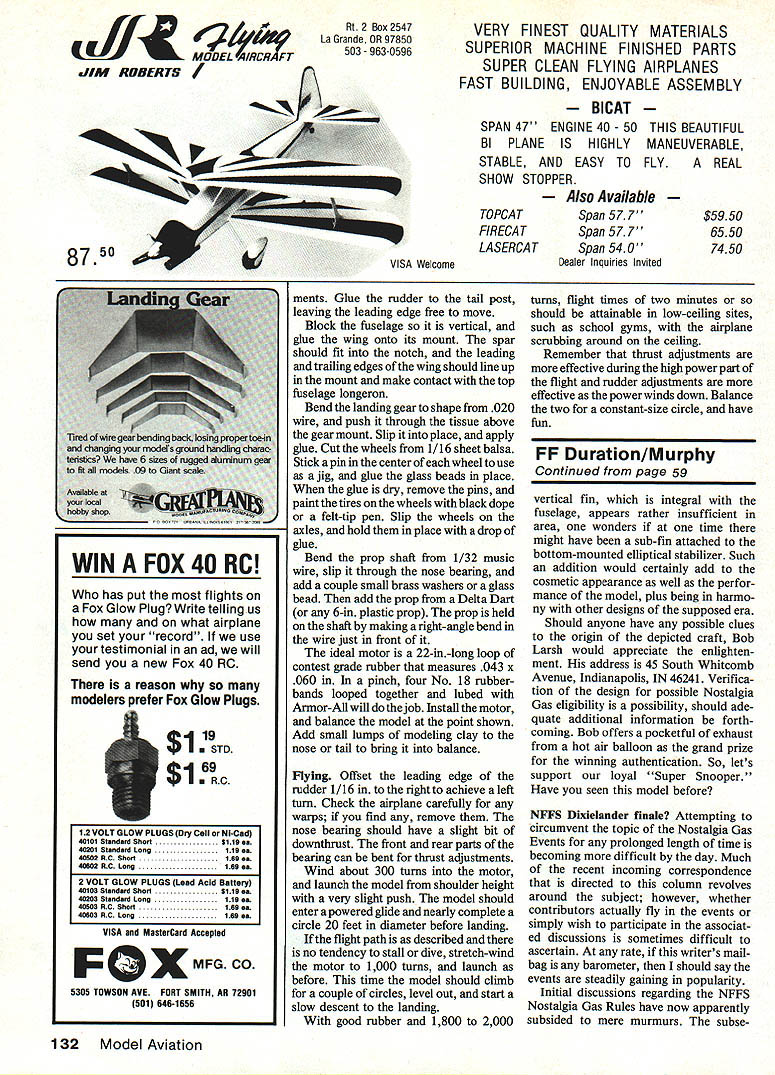
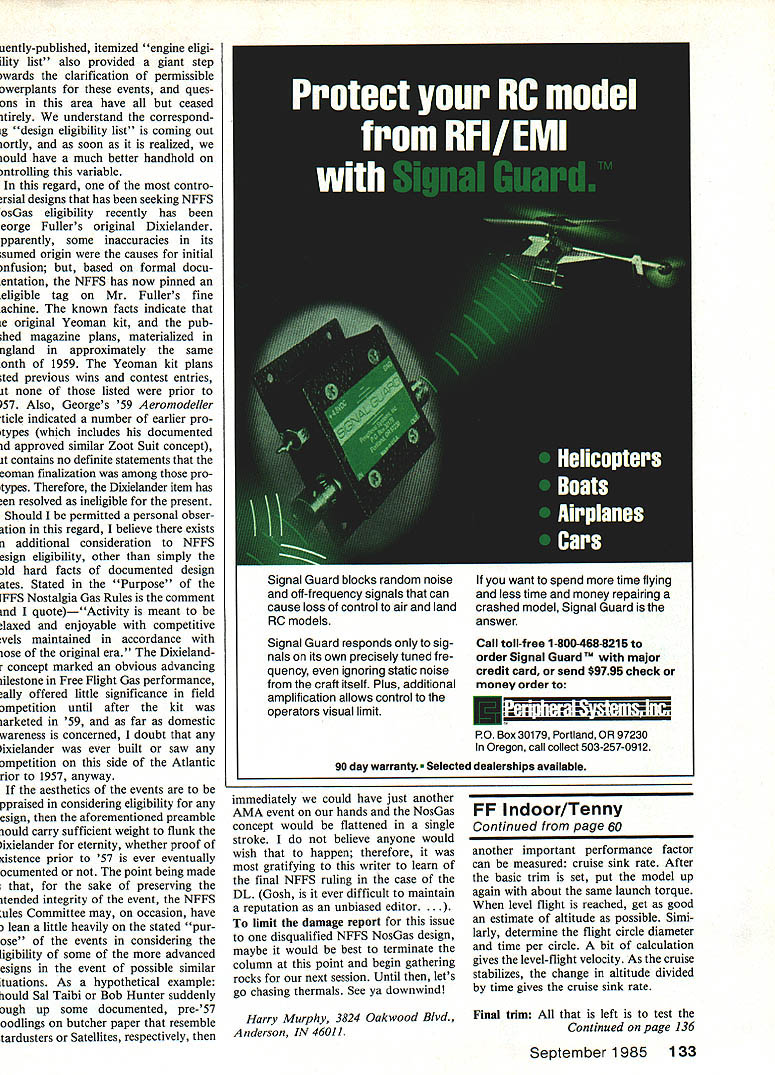
Bob Larsh, CIA (Central Indiana Aeromodellers) supersleuth, again surfaced with an interesting relic from yesteryear. He first spotted an exhibitor carrying an unfamiliar fuselage into the Swap Shop section of the Toledo RC Show last March. On closer inspection the installation was Forster‑powered, and bargaining began even before the item was placed on the swap table. There was a wing and tail, but the exhibitor didn't have them with him; he agreed to go fetch the additional items from home about 15 miles away. A price was agreed upon and the final transaction completed.
The wing and stabilizer appear to be stock '46 Goldberg Zipper; however, the pleasantly styled fuselage with its semi‑cowled spinnered Forster is distinctive and suggests a better‑than‑average designer/builder. Evidence indicates some attempts at recovery and refinishing, but the structure is generally well preserved. The model had supposedly been found in a cornfield in 1948 with no name or address affixed and had been passed around from time to time ever since. Bob hopes readers might supply additional clues as to "who dunnit?"
NFFS design eligibility and the Dixielander
The recently published engine eligibility list provided a major step toward clarifying permissible powerplants for NosGas events, and questions in that area have all but ceased. The corresponding design eligibility list is expected soon, and once released should help control that variable as well.
One controversial design seeking NFFS NosGas eligibility was George Fuller's original Dixielander. Initial confusion arose from inaccuracies in assumed origin, but based on formal documentation the NFFS has now resolved the matter. The known facts indicate that the original Yeoman kit and the published magazine plans appeared in England around the same month of 1959. The Yeoman kit plans listed previous wins and contest entries, but none prior to 1957. George's 1959 Aeromodeller article mentioned several earlier prototypes (including a documented Zoot Suit concept), but contained no definite statements that the Yeoman finalization was among those prototypes. Therefore, the Dixielander has been resolved as ineligible for the present.
A personal observation: besides documented design dates, NFFS design eligibility might reasonably consider the stated "Purpose" of the NFFS Nostalgia Gas Rules: "Activity is meant to be relaxed and enjoyable with competitive levels maintained in accordance with those of the original era." The Dixielander represented an obvious advance in Free Flight Gas construction but offered little significance in field competition prior to marketing in 1959. As far as domestic awareness is concerned, it's doubtful any Dixielander was built or competed on this side of the Atlantic prior to 1957.
If the aesthetics and spirit of the events are part of eligibility consideration, then the purpose clause could carry enough weight to exclude the Dixielander regardless of any later documentation of pre‑1957 existence. The point is that, to preserve the intended integrity of the events, the NFFS Rules Committee may sometimes need to lean on the stated purpose when deciding on the eligibility of advanced designs. As a hypothetical: if someone produced documented pre‑'57 prototypes resembling later advanced designs, we could unintentionally recreate a modern AMA event and flatten the NosGas concept. I do not believe anyone would wish that.
It was therefore most gratifying to learn of the final NFFS ruling in the Dixielander case.
Until next time, let's go chasing thermals. See ya downwind!
Harry Murphy 3824 Oakwood Blvd. Anderson, IN 46011
Transcribed from original scans by AI. Minor OCR errors may remain.

