
Free Flight: Duration
Bob Meuser
In my August column I told something about the models I had entered in the Second Great International Paper Airplane Contest. Results of the contest were to be announced about the time that issue was published. I was winner of the Distance event, Nonprofessional category, repeating my performance of 18 years ago, and again flying farther than the winner of the Professional category by a substantial margin. Will success spoil me? Will I let my hair cover my ears, insist on being addressed as Robert, wear tailor-made suits (and maybe even a necktie) and drive a fancy convertible? I replied, "Good gracious, I certainly hope so!"
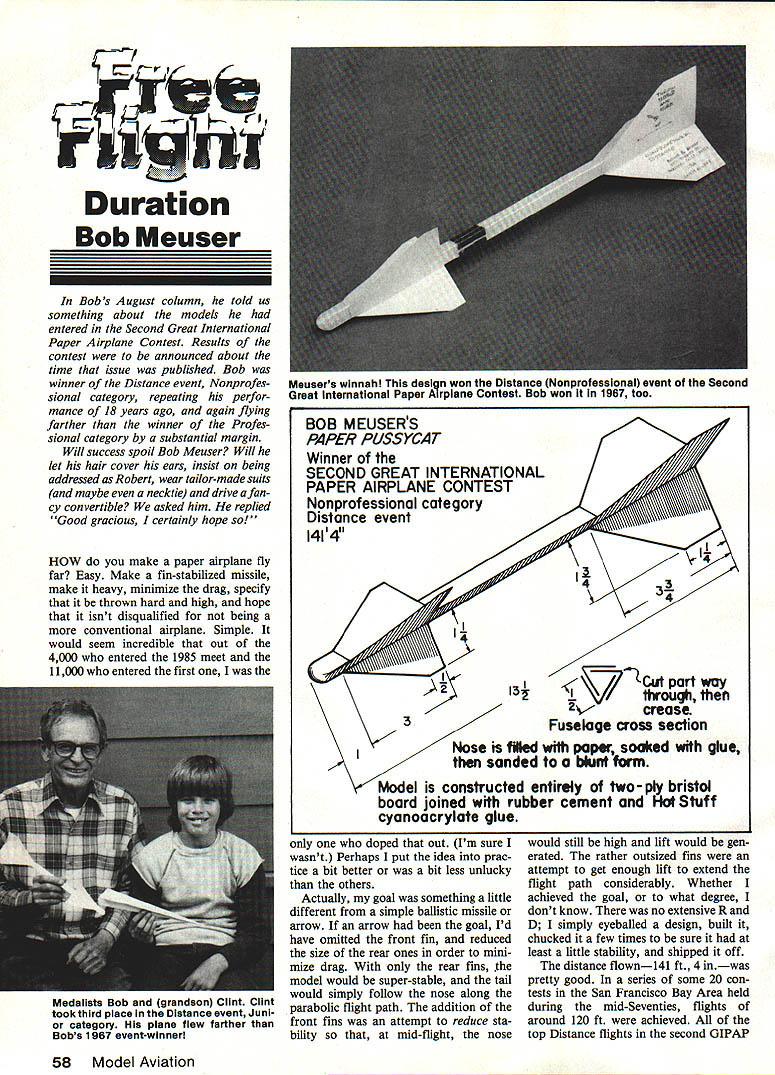
How do you make a paper airplane fly far? Easy. Make a fin-stabilized missile, make it heavy, minimize the drag, specify that it be thrown hard and high, and hope that it isn't disqualified for not being a more conventional airplane. Simple.
It would seem incredible that out of the 4,000 who entered the 1985 meet and the 11,000 who entered the first one, I was the only one who doped that out. (I'm sure I wasn't.) Perhaps I put the idea into practice a bit better or was a bit less unlucky than the others.
Actually, my goal was something a little different from a simple ballistic missile or arrow. If an arrow had been the goal, I'd have omitted the front fin and reduced the size of the rear ones in order to minimize drag. With only the rear fins, the model would be super-stable, and the tail would simply follow the nose along the parabolic flight path. The addition of the front fins was an attempt to reduce stability so that, at mid-flight, the nose would still be high and lift would be generated. The rather outsized fins were an attempt to get enough lift to extend the flight path considerably. Whether I achieved the goal, or to what degree, I don't know. There was no extensive R & D; I simply eyeballed a design, built it, chucked it a few times to be sure it had at least a little stability, and shipped it off.
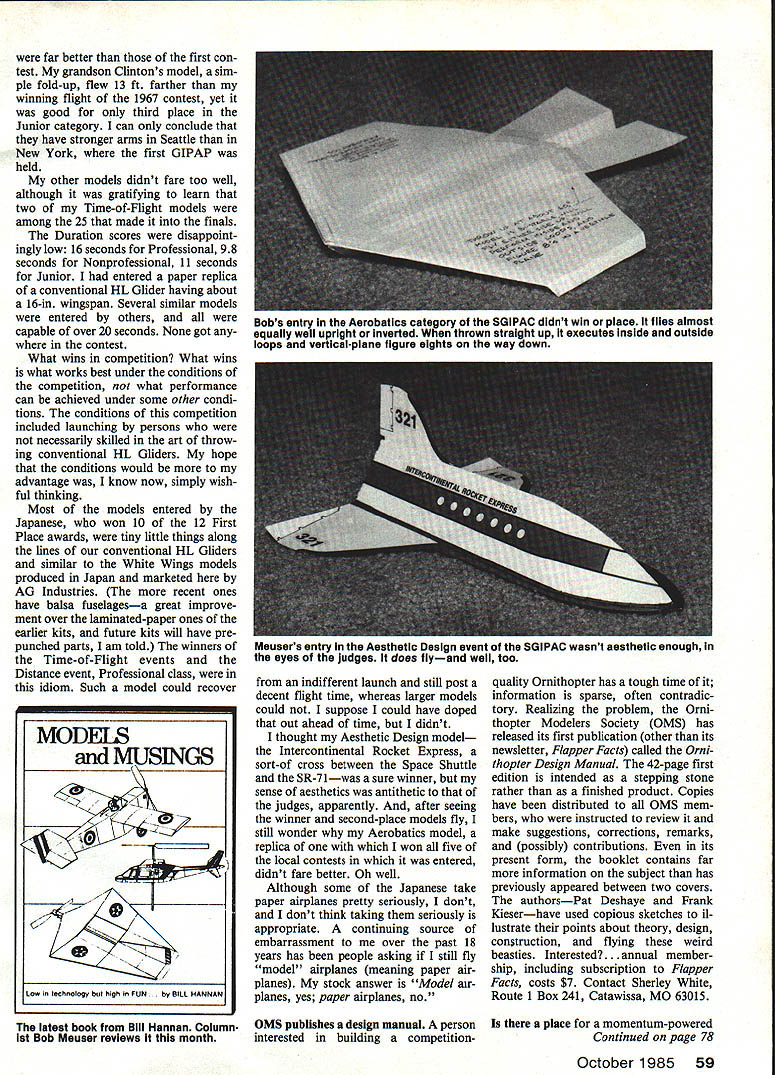
The distance flown—141 ft., 4 in.—was pretty good. In a series of some 20 contests in the San Francisco Bay Area held during the mid-Seventies, flights around 120 ft. were achieved. All of the top Distance flights in the second GIPAP were far better than those of the first contest. My grandson Clinton's model, a simple fold-up, flew 13 ft. farther than my winning flight of the 1967 contest, yet it was good for only third place in the Junior category. I can only conclude that they have stronger arms in Seattle than in New York, where the first GIPAP was held.
My other models didn't fare too well, although it was gratifying to learn that two of my Time-of-Flight models were among the 25 that made it into the finals.
The Duration scores were disappointingly low: 16 seconds for Professional, 9.8 seconds for Nonprofessional, 11 seconds for Junior. I had entered a paper replica of a conventional hand-launched glider (HLG) having about a 16-in. wingspan. Several similar models were entered by others, and all were capable of over 20 seconds. None got anywhere in the contest.
What wins in competition? What wins is what works best under the conditions of the competition, not what performance can be achieved under some other conditions. The conditions of this competition included launching by persons who were not necessarily skilled in the art of throwing conventional HLGs. My hope that the conditions would be more to my advantage was, I know now, simply wishful thinking.
Most of the models entered by the Japanese, who won 10 of the 12 First Place awards, were tiny little things along the lines of our conventional HLGs and similar to the White Wings models produced in Japan and marketed here by AG Industries. (The more recent ones have balsa fuselages—a great improvement over the laminated-paper ones of the earlier kits, and future kits will have prepunched parts, I am told.) The winners of the Time-of-Flight events and the Distance event, Professional class, were in this idiom. Such a model could recover from an indifferent launch and still post a decent flight time, whereas larger models could not. I suppose I could have doped that out ahead of time, but I didn't.
I thought my Aesthetic Design model—the Intercontinental Rocket Express, a sort-of cross between the Space Shuttle and the SR-71—was a sure winner, but my sense of aesthetics was antithetic to that of the judges, apparently. And, after seeing the winner and second-place models fly, I still wonder why my Aerobatics model, a replica of one with which I won all five of the local contests in which it was entered, didn't fare better. Oh well.
Although some of the Japanese take paper airplanes pretty seriously, I don't, and I don't think taking them seriously is appropriate. A continuing source of embarrassment to me over the past 18 years has been people asking if I still fly "model" airplanes (meaning paper airplanes). My stock answer is: "Model airplanes, yes; paper airplanes, no."
While conventional boomerangs fly for only about 12 seconds, many who have tried to get them to fly longer, I am told, have made flights exceeding a minute, and one has flown for about three minutes, although that might have involved assistance from a thermal. Such long flights, it seems to me, imply that the flight mechanism is not that of a helicopter, but rather of an autogiro, at least later in the flight as the initial rotational momentum wanes. Maple seeds know all about that.
"Amusing (yawn)," you say, "but what has that got to do with winning Free Flight contests?" Perhaps nothing. But there is nothing in our Hand-Launched Glider rules that would prevent a boomerang from competing! If those one-to-three-minute flights were made under indoor flying conditions, then boomerangs could be a threat to the life-style of indoor HLG enthusiasts. And, even if they were made with thermal assistance, with a bit of development by Free Flighters the boomerang might be competitive with conventional HLG aircraft, unlikely as it seems.
I have nothing against boomerangs; I fly them a bit myself, and hope to have the time to take a whack at developing ones for maximum time of flight. However, I don't think they have a place in Free Flight competition as we know and cherish it. And so, in the next rules-change cycle, I'll propose that boomerangs be prohibited from HLG competition.
Comments?
Flapping is good for the circulation. According to a clip I saw in a newsletter, a fellow by the name of Professor Maxworthy (yes, Free Flighters, that's his real name!) at the University of Southern California has been studying the heck out of how insects hover so effectively. Using large mechanical models "flying" in a sea of glycerine (presumably to get the Reynolds number right), he finds that by using a "clap and fling" technique, wasps and such can develop five or six times the lift of conventional aircraft wings.
I'm not quite sure what that means. I could have told the professor right off that conventional fixed wings won't lift much in hovering flight. This clap-and-fling business amounts to the wings coming into contact, or nearly so, at the top and bottom of the stroke. It's good for the circulation of the air—something like that—and circulation spells lift.
Well, it seems to work on model planes, too—ornithopter models, that is; not the conventional monoplane type, but rather biplanes. If you haven't heard, Al Rohrbaugh has been getting over 10 minutes with his ornithopter, just double what we would have considered virtually impossible only two or three years ago. This is the only quantum leap I can recall in Free Flight since the invention of the glow plug.
On ornithopters, the wings flap out of phase, and so the tips come together every second stroke. That could be part of the explanation of Al's success. But another part might lie in the fact that the flapping isn't completely out of phase—180°, that is—but it is more like 90° out. With a conventional 'thopter, about a fourth of a turn of the crank is occupied by simply changing the direction of flap from up to down, and that happens twice per crank revolution. Nothing much useful in the form of lifting or propelling the aircraft is accomplished during the reversal, yet those quarter-turns use up as much energy from the rubber motor as the ones that do the work. The useless part of the energy goes into making waves—sound waves, that is. (When is the last time you saw a silent ornithopter?)
With a machine having two wings hooked to a common crankshaft, while one wing is making its flapping reversal the other is in mid-stroke, absorbing energy usefully. It would work with tandem-wing models as well, of course, where the clap-and-fling effect would be absent.
A biplane flapper, by Reg Parham of England, appeared in one of Frank Zaic's old Yearbooks. Recently, following discussions with Parham, Pat Deshayes in the U.S. had quite some success with the configuration and found 90° phasing to work far better than 180°. One of Curt Stevens' kids (can't remember which) set an outdoor record with a biplane 'thopter of a rather different sort; the top wing on one side was continuous with the bottom wing on the other side, so that the wings teeter-tottered.
Another thing about 'thopters: with a conventional monoplane 'thopter, we tend to think of the wing as moving up on the upstroke and down on the downstroke, but it isn't as simple as that. In order for all the vertical forces to be in balance (including the effective force represented by the mass and vertical acceleration of all the parts), when the wing tips go down, the fuselage—and the center part of the wing along with it—must go up. Nature wouldn't have it any other way. Hewitt Phillips will tell you all about that in his paper to be published in the 1985 NFFS Symposium Report, which will be published about Nats time.
I wonder how long it will be before some nut proposes to ban biplane 'thopters from AMA competition? (Probably me!)
Bob Meuser's Paper Pussycat
Winner of the Second Great International Paper Airplane Contest Nonprofessional category — Distance event — 141 ft., 4 in.
- Model notes:
- Cut part way through, then crease.
- Fuselage cross section: nose is filled with paper, soaked with glue, then sanded to a blunt form.
- Model is constructed entirely of two-ply Bristol board joined with rubber cement and Hot Stuff cyanoacrylate glue.
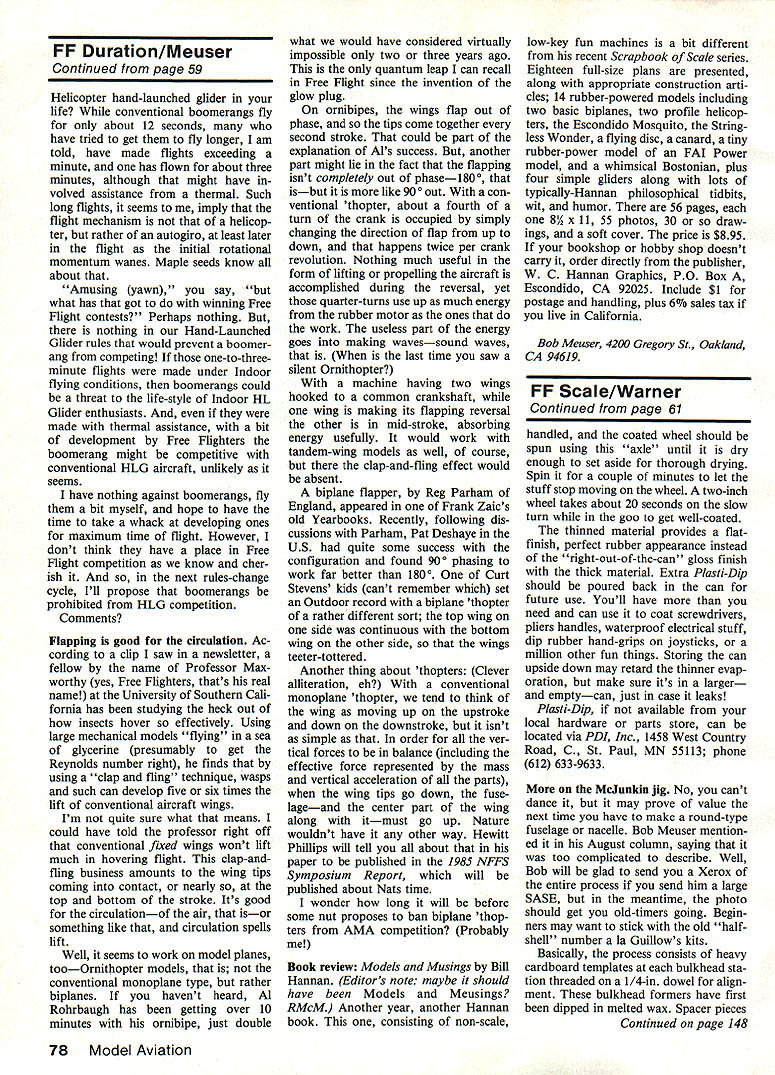
Book review: Models and Musings by Bill Hannan
(Editor's note: maybe it should have been Models and Meusings? — RMcM.)
Another year, another Hannan book. This one, consisting of non-scale, low-key fun machines, is a bit different from his recent Scrapbook of Scale series. Eighteen full-size plans are presented, along with appropriate construction articles: 14 rubber-powered models including two basic biplanes, the Escondido Mosquito, the Stringless Wonder, a flying disc, a canard, a tiny rubber-powered model of an FAI Power model, and a whimsical Bostonian, plus four simple gliders, along with lots of typically-Hannan philosophical tidbits, wit, and humor. There are 56 pages, each one 8½ x 11, 55 photos, about 30 drawings, and a soft cover. The price is $8.95.
If your bookshop or hobby shop doesn't carry it, order directly from the publisher:
- W. C. Hannan Graphics, P.O. Box A, Escondido, CA 92025.
- Include $1 for postage and handling, plus 6% sales tax if you live in California.
Bob Meuser 4200 Gregory St., Oakland, CA 94619.
Transcribed from original scans by AI. Minor OCR errors may remain.

