
Free Flight: Duration
Harry Murphy
THE LOST IS FOUND
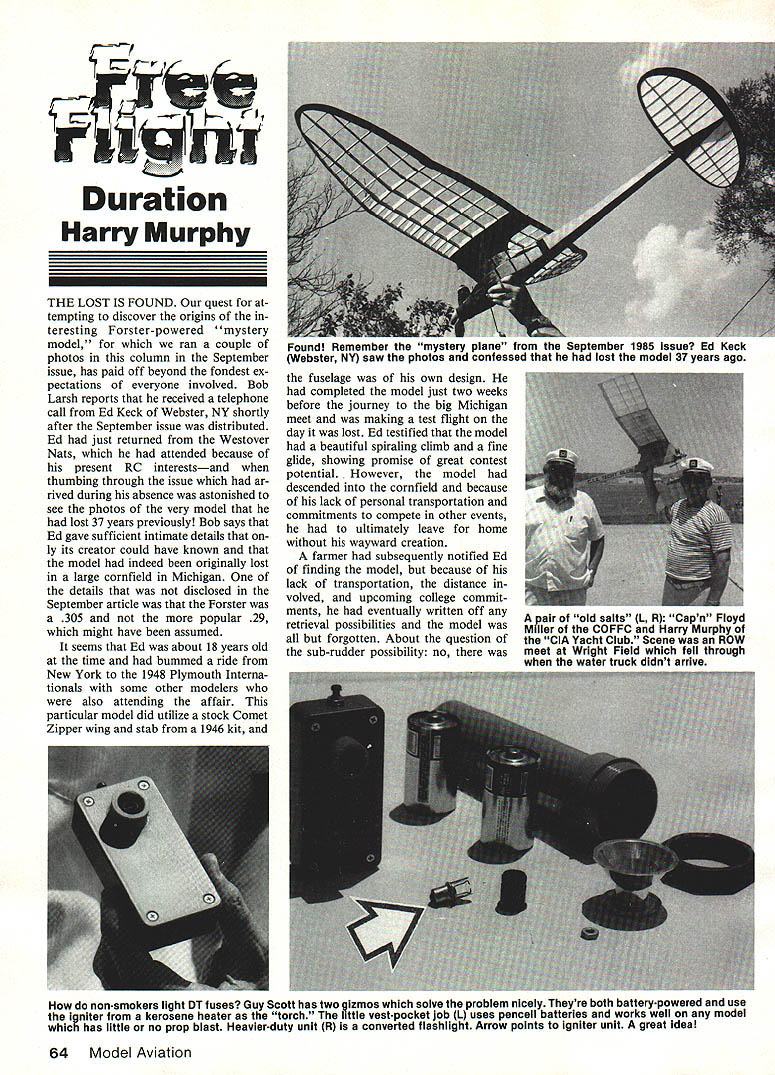
The quest to discover the origins of an interesting Forster‑powered mystery model — photos of which ran in this column in the September issue — has paid off beyond expectations. Bob Larsh reports that shortly after the September issue was distributed he received a telephone call from Ed Keck of Webster, N.Y. Ed had just returned from the Westover Nats (attending because of present RC interests) and, thumbing through the issue that arrived during his absence, was astonished to see photos of the very model he had lost 37 years earlier.
Ed provided intimate details that only the builder could have known, confirming the model had originally been lost in a large Michigan cornfield. Contrary to an earlier assumption, the engine was a Forster .305, not the more common .29. Ed was about 18 years old at the time and had bummed a ride to the 1948 Plymouth Internationals. The model used a stock Comet Zipper wing and stab from a 1946 kit with a fuselage of his own design, completed just two weeks before the trip.
On the day it was lost, Ed said the model made a beautiful spiraling climb and a fine glide, showing contest promise. It descended into a cornfield, and because Ed lacked transportation and had commitments in other events, he had to leave for home without it. A farmer later notified Ed that he had found the model, but distance, transportation, and impending college commitments made retrieval impractical, and the model was eventually forgotten.
There was no sub‑rudder on the original model, although Ed had contemplated adding one to increase fin area. Ed now builds and flies RC models but says the Society of Antique Modelers (SAM) is beckoning and he would like to return to Free Flight to build and fly some old favorites. If he has finally secured transportation, he has a head start — the model is currently parked in Bob Larsh’s basement.
An ironic coda: when Bob was negotiating for the model across a swap table at the Toledo RC Show last March, Ed Keck happened to be set up 35–40 feet away selling his own wares. Small world.
Flameless fuse lighters
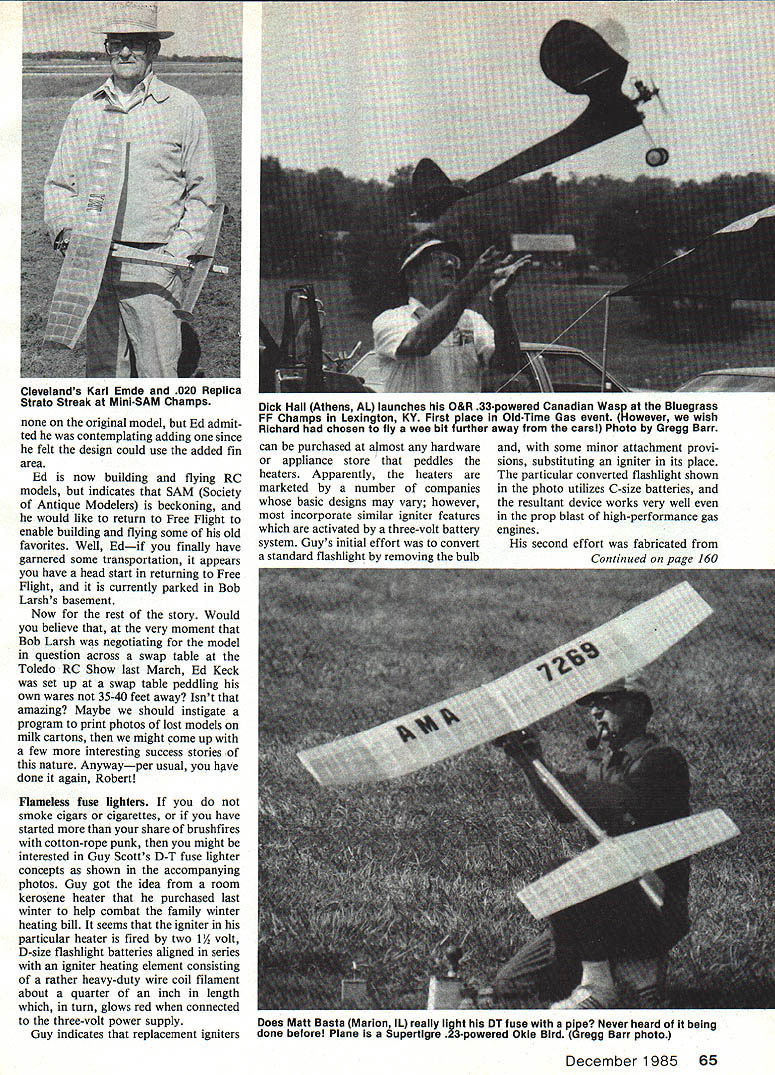
For those who light D‑T fuses, cigars, cigarettes, or who start brushfires with cotton‑rope punk, Guy Scott’s battery‑powered D‑T fuse lighters are worth considering. Guy adapted the igniter assembly from a kerosene room heater he’d bought. Key points:
- The heater igniter is driven by two 1.5‑volt batteries in series (three volts total). The igniter element is a short, heavy‑duty wire coil (about 1/4 inch) that glows red on 3 V.
- Replacement igniters are commonly available from hardware or appliance stores; many heaters use similar igniter designs.
- Guy’s first design converted a standard flashlight by removing the bulb and fitting the heater igniter. The pictured converted flashlight uses C‑size batteries and handles prop blast well — suitable even for high‑performance gas engines.
- His pocket‑size unit uses pen‑cell batteries to create a shirt‑pocket lighter for non‑gas models (hand‑launched gliders, rubber, towline), where prop‑blast cooling isn’t a concern.
I’ve seen Guy’s devices in operation — they work well. Another clever Free Flighter solution.
New 1986 Category III Gas rule
Beginning January 1, 1986, the AMA Free Flight Gas competition rules for Category III will be revised as follows:
- On the sixth official flight (the flight in which the engine run is reduced to a four‑second maximum under the existing max‑engine‑run sequence of 7, 7, 7, 5, 5 seconds for the first five flights), the flight time limit will increase from 2:00 to 2:30.
Rationale and benefits:
- The proposal argued that model drift over 2½ minutes on a four‑second motor run would not be worse than the initial three flights limited to two minutes on seven‑second runs.
- Adding 30 seconds to the sixth flight was judged preferable to reducing the engine run further (e.g., to three seconds), which many felt would be impractical.
- The Contest Board vote was 7–4 in favor initially, and the final vote was 8–3 in favor, so the change will be enacted.
Side benefits anticipated:
- Fewer marathon flyoffs, allowing contest winners to be declared with fewer flights.
- Contestants gain more time to enter other events.
- Sponsors can better manage trophies and costs with steadier event flow.
- Meet directors need fewer extra timers for excessive flyoffs.
- New challenges for model design and engine tuning to meet extended sixth‑flight demands.
- Several Category III records may be set anew, reopening the race for perfection.
One thought remains: Categories I and II also have some out‑of‑sight records, so a similar approach might be considered for them in a future rule‑change cycle. There will be time to observe the effects of this Category III change before that decision.
Bantam comments
Our recent note about revising the rotor of a Bantam to improve performance drew helpful feedback. Bob Larsh reminded me that the original factory operating instructions included with early Bantam engines specify that the holes in the needle‑valve body should be aligned fore‑and‑aft in the short bore — not across the opening, as is commonly done.
Joe Wagner sent a lengthy explanation suggesting probable eccentricity problems caused by an off‑center needle taper as the needle turns within the seat. A slight eccentricity of this type could cause mixture variations and odd running, especially at near‑idle speeds.
Harry Murphy 3824 Oakwood Blvd. Anderson, IN 46011
Transcribed from original scans by AI. Minor OCR errors may remain.

